
What Drones Need To Be Registered in the US
When it comes to figuring out if you need to register your drone, there's one factor that trumps all others: weight.
If your drone weighs 250 grams (that’s 0.55 pounds) or more at takeoff, it must be registered with the FAA. It’s that simple. This isn't just a guideline; it's a hard and fast rule that applies whether you're flying for fun in your backyard or for a paying client. Weight is the clear dividing line.
Understanding the FAA Drone Registration Rules
The Federal Aviation Administration (FAA) isn't just making up rules for the sake of it. Their guidelines are all about keeping the national airspace safe for everyone, and drone registration is a huge part of that. Think of it just like registering a car—it creates a clear line of accountability and helps authorities know who a drone belongs to if something goes wrong.
This process is mandatory for almost any drone that isn't a lightweight toy.
So, why 250 grams? That number wasn't just pulled out of thin air. It’s based on risk assessments that concluded drones heavier than this could cause more significant injury or damage if they were to crash. That’s why most of the popular consumer and professional drones you see on the market today fall squarely into the "must-register" category.
Weight and Use Case: The Two Pillars of Registration
After you've checked the weight, the next question is why you're flying. The FAA has two main categories for pilots, and your path to registration will depend on which one you fall into:
- Recreational Flyers: These are the hobbyists, the people flying purely for personal enjoyment.
- Commercial Pilots (Part 107): These are the pros flying for any kind of business purpose, whether it's snapping photos for a real estate listing or inspecting a cell tower.
This handy infographic breaks it down nicely, showing how that initial weight check is the first, most important step.

As you can see, that 250-gram mark is the first hurdle. If your drone is over that weight, registration is a definite.
To get a quick overview of the requirements based on weight and your pilot type, check out this summary table.
Drone Registration Requirements At a Glance
| Drone Weight | Recreational Flyers | Commercial Pilots (Part 107) |
|---|---|---|
| Under 250 grams (0.55 lbs) | No registration required (unless used for Part 107 operations). | Must be registered under Part 107 rules, regardless of weight. |
| 250 grams (0.55 lbs) to 55 lbs | Must be registered under the Exception for Recreational Flyers. | Must be registered under Part 107 rules. |
| Over 55 lbs | Not permitted for recreational flight. | Requires specific exemptions and a more complex registration process. |
This table makes it clear: while recreational pilots get a pass for sub-250g drones, commercial operators have to register everything they fly for work.
When you're ready to get started, the official FAA website is the only place you should go. It's your direct link to the FAADroneZone, the online portal where you'll complete the registration.
For an even deeper dive into the specifics, you can also explore our detailed guide on whether you need to register your drone. We’ll get into the nitty-gritty of recreational versus commercial registration in just a bit.
Why 250 Grams Is the Magic Number for Drones
You've probably seen that 250-gram (or 0.55-pound) number thrown around a lot in the drone world. It's not just some random figure pulled out of a hat. It’s a very deliberate line in the sand drawn by aviation authorities like the FAA, and it all boils down to safety and risk.
Think of it as the boundary where a drone stops being seen as a simple toy and starts being treated as a regulated aircraft.
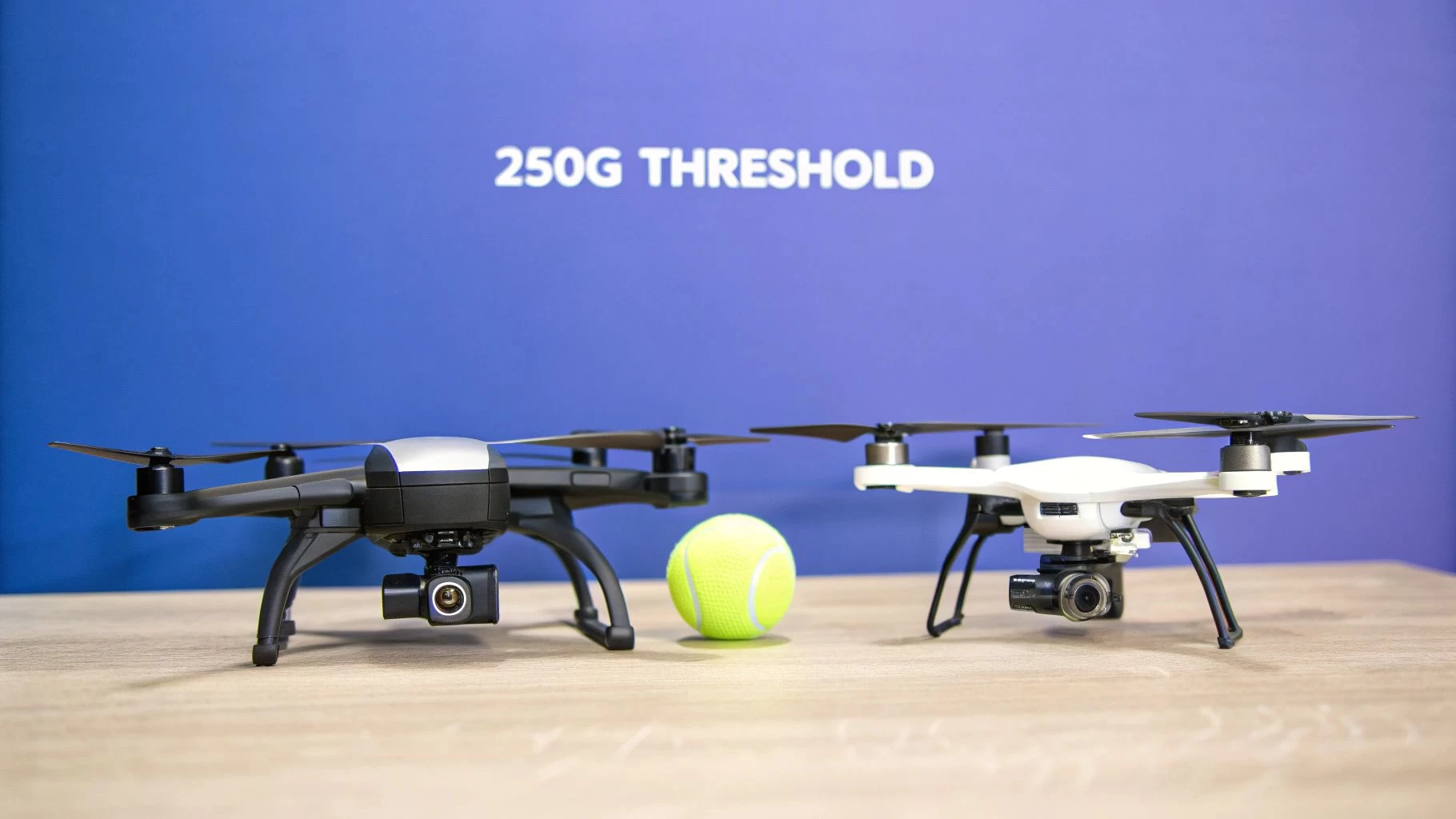
This specific weight was chosen based on studies of kinetic energy—basically, how much punch an object packs when it's moving. The research showed that a drone weighing less than 250 grams is far less likely to cause serious injury or significant property damage if it happens to fall out of the sky.
It’s the difference between being hit by a falling tennis ball and a falling brick. One might give you a bit of a shock, but the other could cause real harm. This simple distinction is why a drone's takeoff weight is the first thing regulators look at.
Real-World Drone Examples
You can see the impact of this rule right on the store shelves. Drone manufacturers have gotten incredibly good at engineering models to sneak just under this weight limit, giving pilots a hassle-free, registration-free option for recreational flying.
- Sub-250 Gram Drones: Models like the DJI Mini series are wildly popular for a reason—they often come in at exactly 249 grams. This means hobbyists can get in the air without jumping through the FAA's registration hoops.
- Over-250 Gram Drones: On the other hand, more powerful drones like the DJI Air or Mavic series cruise right past that limit. Their bigger batteries, heavier frames, and advanced payloads put them squarely in the "must-register" camp for every single pilot, whether you're flying for fun or for work.
The 250-gram rule cuts through the noise. It gives pilots a clear, simple benchmark, shifting the focus away from complex tech specs and onto one easy number: the drone's takeoff weight.
Getting your head around this concept is step one for navigating the rest of the drone regulations. If your drone is under the limit and you're just flying for fun, you're usually good to go. But the second you hit 250 grams or more, registration is no longer optional. It's the starting line that determines all your next steps as a responsible pilot.
Navigating Recreational vs Commercial Registration
The FAA sees the drone world through two different lenses: flying for fun and flying for work. It’s a simple distinction, but it completely changes the registration game. What you need to do depends entirely on why you're putting a drone in the air, and the rules for a hobbyist are worlds apart from those for a pro.
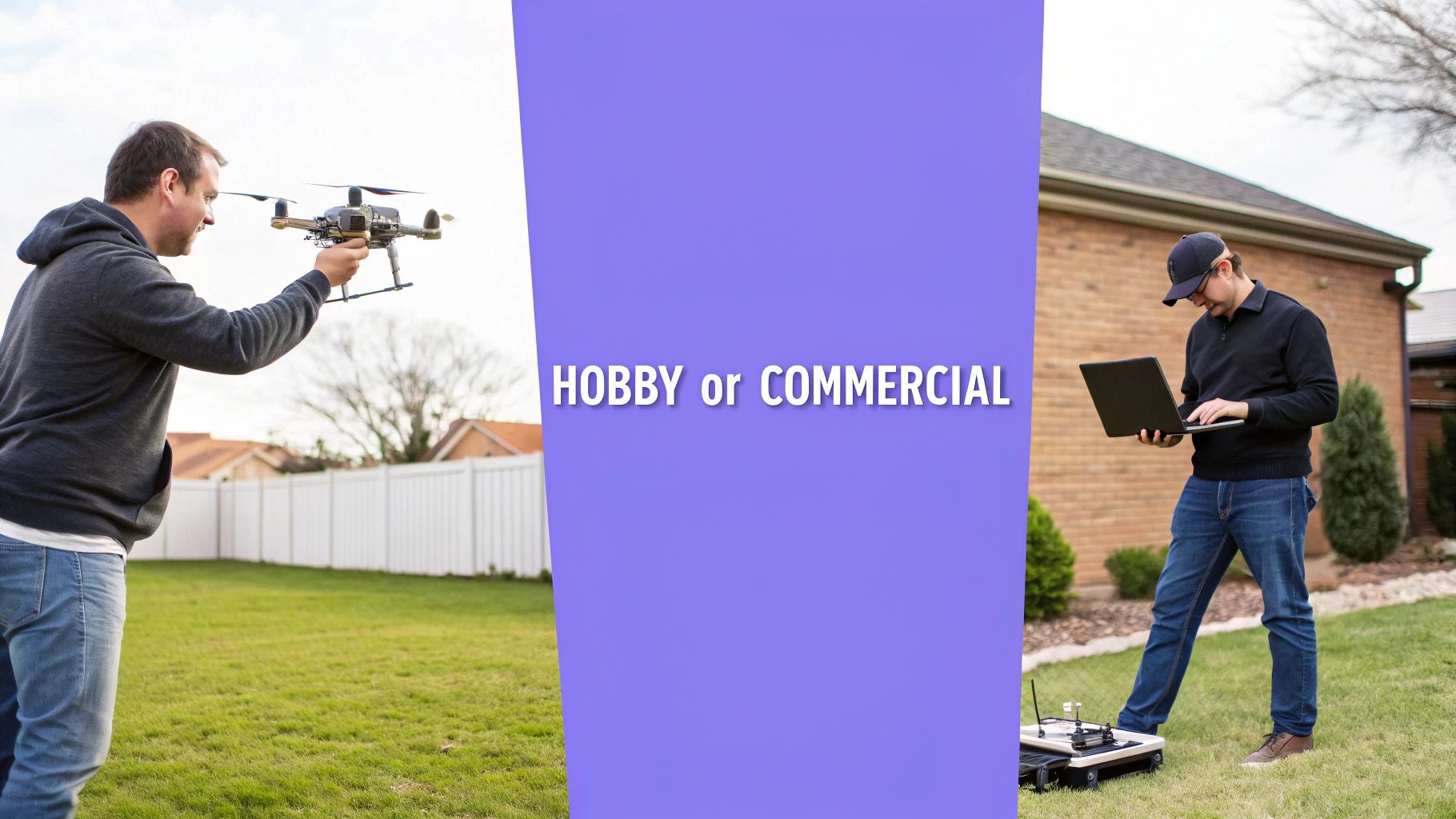
If you're just flying for the sheer joy of it, life is pretty simple. You register once under the "Exception for Recreational Flyers," pay a small fee, and you're issued a single registration number. That one number is good for your entire fleet of drones for three years.
Think of it like getting a fishing license—it covers you no matter which fishing rod you decide to use that day. This keeps things straightforward for hobbyists, so you can stay compliant without drowning in paperwork.
The Commercial Pilot Path
Things get a bit more serious for commercial pilots operating under the FAA's Part 107 rules. If you're earning money or using your drone for any business purpose, every single aircraft has to be registered individually. Each drone gets its own unique registration number, much like a commercial trucking company has to register every truck in its fleet.
This one-drone, one-registration rule is all about accountability. So, who's considered a commercial pilot in the FAA's eyes?
- Real Estate Agents taking aerial shots of a property for a listing.
- Professional Videographers filming content for a paying client.
- Inspectors checking out rooftops or power lines for a fee.
- Content Creators who post monetized drone footage online.
The second your flight is meant to help a business in any way, shape, or form, the FAA classifies you as a commercial operator. This shift triggers much stricter requirements for both you and your drone.
The registration numbers paint a clear picture of this split. As of October 2023, the FAA had 855,860 drones registered in total. Recreational drones made up the lion's share with 536,183 units (63%), while 316,075 commercial drones accounted for the other 37%.
This clear separation ensures that pilots flying for profit are held to higher safety and accountability standards—something that’s absolutely critical for things like insurance and legal compliance. If you need a more detailed walkthrough, our guide on registering a drone breaks down every step.
Why Commercial Drone Registration Is Non-Negotiable
When you're flying a drone for business, registration isn't just another box to check—it’s the bedrock of your professional credibility. It goes way beyond simply following a rule. It creates a clear line of accountability that clients, insurance companies, and regulators all expect to see.
Think of your FAA registration number like a license plate for your car. It proves you're a legitimate, traceable, and responsible pilot.
This official status is your ticket to getting liability insurance, landing bigger client contracts, and flying legally in controlled airspace. For anyone looking into professional drone work, understanding things like wedding drone photography costs also means recognizing that any operator worth their salt has their aircraft properly registered.
Building Trust in a Growing Industry
The commercial drone scene is absolutely booming, which makes professional standards more critical than ever. In 2025, the market is projected to hit USD 12.6 billion in revenue, and it's expected to rocket to USD 54.6 billion by 2030. This kind of explosive growth tells you just how much different industries are coming to rely on drones. You can find out more about the sustained momentum in commercial drone adoption.
A registered drone builds instant trust. Simple as that. When a potential client sees you’ve met the federal requirements, they feel much more confident that you can do the job safely and by the book. It’s a small step that draws a big line between serious professionals and weekend hobbyists.
If you're serious about turning your flying skills into a business, registration isn't optional. It's the first critical move that supports your long-term success, your safety record, and your professional reputation in a field that's getting more competitive every day.
At the end of the day, registration protects you and your clients. It makes sure you're part of a regulated system designed to keep the skies safe for everyone, cementing your place as a pilot people can trust in a high-stakes industry.
Keeping Up with Evolving Drone Regulations
If there's one constant in the world of drones, it's change. The laws and regulations governing our industry are a moving target, constantly being updated to keep pace with technology.
What's perfectly compliant today might be outdated tomorrow, which is why staying educated isn't just a good idea—it's a pilot's best friend.
A perfect example is the rollout of Remote ID. You can think of it as a digital license plate for your drone. While in the air, it broadcasts key identification and location data, which helps authorities maintain accountability in the sky. By 2025, any drone that needs to be registered must have this feature.
Staying Ahead of Regulatory Hurdles
For pilots, this means figuring out "what drones need to be registered" is really just the starting point. If you want to fly safely and professionally, you have to make staying informed a continuous part of your routine.
Keeping up with evolving rules isn't just about avoiding fines; it’s about maintaining your credibility as a pilot in an increasingly crowded and regulated airspace.
These regulatory hurdles are a big deal for the entire industry. In fact, global insights show that challenges like certification and registration have been the top issue facing the drone sector for three years running. You can get more details on these global drone industry challenges if you're curious.
This constant evolution is exactly why pilots have to stay sharp. A few key areas to keep an eye on include:
- Changes to Airspace Rules: New no-fly zones or restrictions can pop up around sensitive areas with little warning.
- Updated Technology Mandates: Requirements like Remote ID are just the beginning; expect more tech-driven rules in the future.
- State and Local Ordinances: Don't forget that city or state rules can be very different from—and often stricter than—the federal guidelines.
Getting a handle on new requirements is absolutely crucial for every operator. To get a head start on the next big change, check out our deep dive on Remote ID for drones and make sure you're prepared.
Common Questions About Drone Registration
Once you get the basics down, the little "what if" questions start popping up. It's totally normal. When you're trying to fly by the book, you want to be sure you've covered all your bases.
We've gone through the main rules, so let's tackle some of those specific questions that pilots ask all the time. Think of this as your go-to guide for clearing up any lingering confusion.
Do Sub 250g Drones Ever Need Registration?
This is a big one, and it trips up a lot of new pilots. It’s true that a drone weighing less than 250 grams is exempt from registration if you're just flying for fun. But that's the key—only for fun.
The second you use that tiny drone for any kind of work, the exemption disappears. Whether you're taking photos for a client, making videos for a monetized YouTube channel, or inspecting a roof for a business, it immediately falls under Part 107 rules. And that means registration is mandatory, no matter how light it is. The drone's purpose is just as important as its weight.
What Are the Penalties for Flying Unregistered?
Let's be clear: the FAA does not mess around with registration. Flying an unregistered drone that requires a number isn't a slap on the wrist; it's a serious federal offense, and the penalties are designed to be a real deterrent.
Here’s what you could be looking at:
- Civil Penalties: Fines can soar up to $27,500.
- Criminal Penalties: For more serious violations, you could face fines up to $250,000 and even jail time of up to three years.
These aren't just empty threats. The registration system is a cornerstone of national airspace security. The risk of flying unregistered is massive, and frankly, it's just not worth it.
How to Mark Your Drone Correctly
Got your registration number? Great. Now you have to put it on your drone, and sticking it in the battery compartment won't cut it. The FAA is very specific: the number must be clearly visible on an exterior surface of the aircraft.
The rule of thumb is simple: an official should be able to find your registration number with a quick visual inspection. Most pilots use a durable label maker or a permanent marker to ensure the number is legible and securely affixed to the drone’s body.
This isn't just red tape. It ensures that if your drone is ever lost or involved in an incident, it can be quickly identified and traced back to you. It's a small step that proves you're an accountable and responsible pilot.
How Often Do I Need to Renew?
Your FAA registration isn't a one-and-done deal. It's valid for three years, and when that time is up, you'll need to head back to the FAADroneZone portal to renew it.
The FAA usually sends out an email reminder when your expiration date is getting close, but ultimately, keeping it current is on you. Pro tip: set a calendar reminder for yourself. It’s a simple way to make sure your registration never accidentally lapses.
Managing jobs, staying compliant, and keeping track of your entire drone operation can be a real headache. Dronedesk simplifies it all into one powerful platform, helping you plan flights, manage your fleet, and handle administrative tasks effortlessly. Stop juggling spreadsheets and start flying smarter. Explore how Dronedesk can transform your workflow at https://dronedesk.io.
 Drone Risk Assessment Controls That Work in the Field →
 FAA Drone License Costs Beyond the Knowledge Test →
 Drone Part 107 Operations: When a Waiver May Be Needed →
 Drone Operating Rules for Managing Contractors and Employees →
 BVLOS Drone Requirements for Building a Safety Case →
 Drone Pilot Test Mistakes That Cost Candidates Marks →
 FAA 107 License vs Part 107 Certificate: What’s the Difference? →
 Drone Airport Rules: A Field Checklist for Site Assessments →
 FAA Part 107 Record-Keeping Rules for Commercial Teams →
 How to Review a DJI Flight Log After an Unexpected Event →