
Your Guide to the Ultra Light Aircraft Licence in 2026
You already know how to think like an air operator. You plan around weather, airspace, battery limits, client deadlines, and regulatory boundaries. If you're a professional drone pilot, the jump toward manned flying often starts the same way. A job wraps, the kit goes back in the case, and you realize the part you enjoy most isn't just capturing data. It's aviation itself.
That's where the phrase ultra light aircraft licence gets confusing fast. In one country, it means a formal permit. In another, it's a misleading phrase because the aircraft category exists without a pilot licence in the usual sense. Add in microlights, sport pilot routes, experimental training aircraft, and local club culture, and a lot of otherwise sharp operators end up reading bad advice.
For drone professionals, this matters for more than personal curiosity. Manned flight can deepen your judgement, sharpen your safety culture, and create new business options around aerial work, instruction pathways, ferrying, airport operations, or credibility with aviation clients who already live in the crewed world.
From Drone Pilot to Aviator
A lot of drone operators reach the same point. You've become the person clients trust for difficult jobs. You can brief a mission near controlled airspace, spot a weather problem before launch, and explain risk to a site manager without sounding dramatic. But your aircraft still leaves the ground without you.
That gap starts to matter.
A survey pilot flying corridors for infrastructure inspections might feel it first. A media operator filming coastal properties might feel it when a helicopter passes and the radio calls suddenly make the whole airspace picture feel more real. A mapping specialist might feel it after years of working with flight planning software and realizing they understand aviation systems well enough to sit in the aircraft, not just manage it from the ground.
For many readers, the first step into aviation wasn't a flying lesson. It was paperwork, exams, procedures, and operating discipline. That's why moving from drones into crewed aircraft is often less of a leap than it looks. If you've already worked through the process of getting a drone licence, you've built habits that transfer surprisingly well.
What already transfers
Some drone skills carry over almost directly:
- Airspace awareness: You're already used to reading where you can and can't operate, and why.
- Weather judgement: Small aircraft care about wind, visibility, and local conditions in ways drone pilots already respect.
- Risk management: Go or no-go decision making is a shared discipline.
- Operational professionalism: Checklists, logs, maintenance awareness, and briefings aren't new to you.
What changes
The biggest change isn't technical knowledge. It's consequence and feel.
In a manned aircraft, your body becomes part of the system. You sense turbulence, momentum, yaw, pitch changes, runway slope, and energy state in a way no remote cockpit can fully teach. Drone pilots often understand air law and planning earlier than hobby fliers do. What they haven't built yet is physical aircraft handling and the instinctive judgement that comes from being inside the machine.
Practical insight: Drone pilots usually aren't starting from zero. They're starting from airmanship without seat-of-the-pants flying experience.
That's why ultralight flying appeals to so many technically minded operators. It offers a simpler, lower-barrier entry into real stick-and-rudder flight, while still rewarding the disciplined mindset you already use on unmanned jobs.
Understanding the Ultralight Philosophy
The best way to understand an ultralight is to stop thinking about licences for a moment and think about design intent.
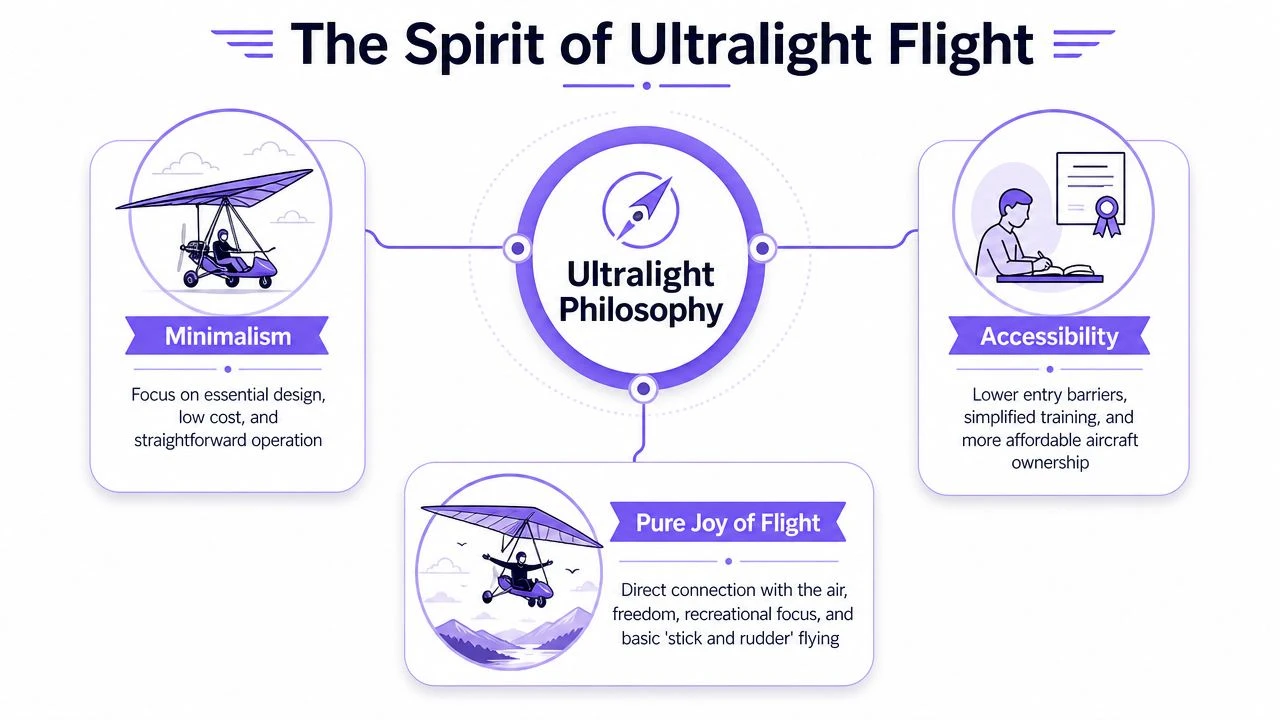
An ultralight is aviation stripped back to essentials. It isn't built to carry a family, haul baggage, or cross a continent in comfort. It's built to fly with the least possible complexity. That philosophy drives the rules, the handling, and the culture around these aircraft.
Less aircraft, more flying
A useful comparison is this:
- A true ultralight is like a dirt bike. Light, direct, exposed, and focused on the basics.
- A light sport or microlight type aircraft is closer to an adventure motorcycle. Still simple, but more capable and often more practical.
- A typical general aviation trainer is more like a family car. Stable, broader-purpose, and designed around a wider operating envelope.
That helps explain why the phrase ultra light aircraft licence often gets muddled. People use one term to describe aircraft that sit in very different regulatory buckets.
In the United States, the FAA treats a true ultralight under Part 103 as a very narrow category. The aircraft must fit historical limits that the FAA codified in 1982, including a maximum empty weight of 254 lb, a top speed of 55 knots, a power-off stall speed not exceeding 24 knots, and fuel capacity of no more than 5 U.S. gallons. It's also single-seat only, for daylight use, and limited away from congested airspace. Under that framework, no pilot certificate is required, but the operating restrictions still apply, as the FAA explains in its ultralight FAQ.
Why the rules are so tight
Those limits aren't arbitrary. They're the whole deal.
A regulator can allow a lower barrier to entry only if the aircraft itself stays small, light, slow, and operationally limited. Once an aircraft gets heavier, faster, carries more fuel, or adds another seat, the risk picture changes. Then certification, pilot qualification, maintenance rules, and airspace access usually get more formal.
The restrictions are not a punishment. They are the trade that makes the category accessible.
For a drone pilot, this should sound familiar. Operational freedom always sits on top of technical limits. With drones, lower mass and lower-risk environments often mean simpler permissions. With ultralights, the same logic appears in crewed aviation.
The confusion point
Many readers ask, “So does an ultra light aircraft licence exist or not?”
The honest answer is: sometimes yes, sometimes no, depending on what aircraft and what country you mean.
In everyday conversation, people use “ultralight” to describe everything from a true single-seat minimalist aircraft to a two-seat training machine that only looks ultralight-ish. That's why understanding the philosophy matters first. If you know the category was built around minimalism and constrained performance, the legal differences start making more sense.
The Training and Syllabus for Ultralight Pilots
Training for ultralight-type flying is less linear than many new pilots expect. That's not a bad thing. It means there may be more than one workable route into the cockpit, especially if your local area has active clubs, light aircraft instructors, or experimental-aircraft operators.
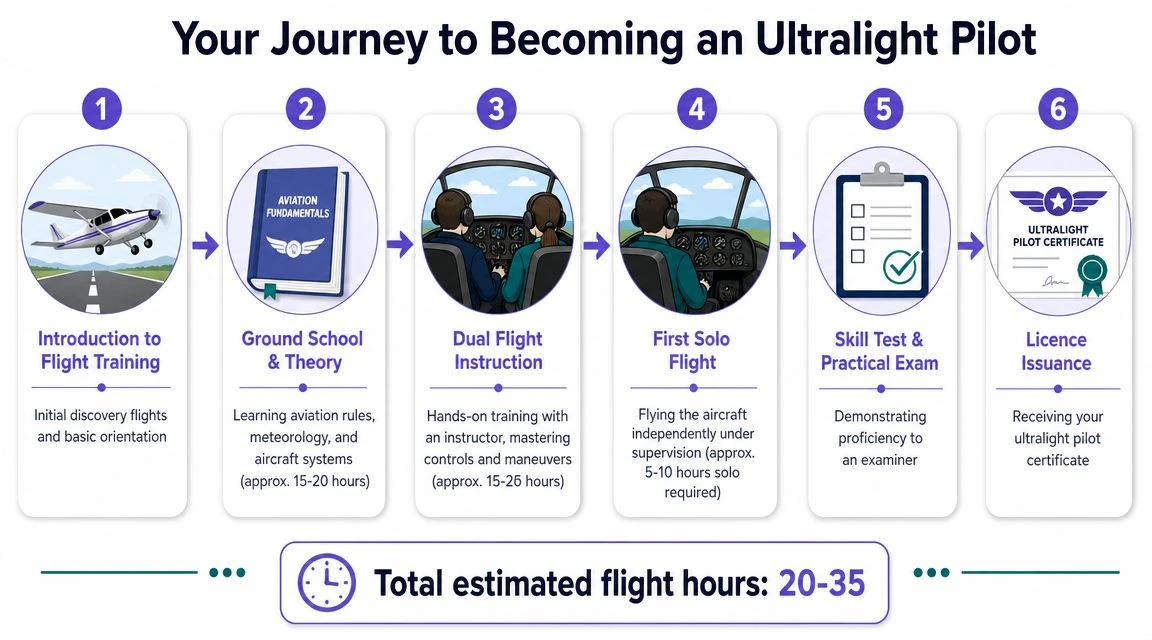
The exact syllabus depends on your country and on whether you're aiming at a true ultralight category, a sport pilot route, or a national microlight permit. But the core learning pattern stays familiar: ground knowledge first, aircraft handling second, judgement throughout.
What you actually learn
A technically minded drone operator usually expects flying lessons to be mostly about controls. In reality, the syllabus is a blend of physical skill and decision-making.
Typical topics include:
- Aircraft handling: Taxiing where applicable, takeoffs, climbs, turns, descents, approaches, and landings.
- Emergency thinking: Engine issues, forced landing judgement, aborted takeoffs, and basic abnormal procedures.
- Meteorology: Wind, visibility, thermals, local effects, and weather-related no-go calls.
- Air law and procedures: Airspace structure, right-of-way, radio use where required, and operating limitations.
- Navigation and planning: Even simple local flights require route thinking, alternates, fuel awareness, and terrain respect.
If you've done structured drone flight training, the learning rhythm will feel familiar. You study the rules, build muscle memory, then prove you can make sound decisions when conditions aren't ideal.
Why the training market is changing
One of the biggest recent developments isn't about pilot skill. It's about what aircraft can legally be used for instruction.
The training ecosystem for ultralight-like aircraft is evolving. Under a newer LODA rule, Experimental Light Sport Aircraft can be used for compensated flight training, and experimental aircraft under 650 lb empty weight and 87 knots maximum speed can be used to train sport pilots from start to finish, according to EAA's explanation of the current regulatory state of ultralight training.
That matters because access is often the primary bottleneck. A student may be fully ready to train, but if no compliant aircraft or instructor is available nearby, progress stalls. Broader aircraft eligibility can make local training more practical.
Why this matters: For many aspiring pilots, the real question isn't “Is there an ultralight licence?” It's “What legal training path exists near me?”
How to judge a good training route
Don't choose only by aircraft type. Choose by training quality.
Look for these signs:
- Clear preflight discipline: Instructors should explain not just what to check, but why it matters aerodynamically and operationally.
- Structured decision-making: Good schools teach weather and airspace judgement early, not as an afterthought.
- A progression plan: You should know whether your path ends at local recreational flying or feeds into broader licences later.
- Safety culture: A strong provider will talk openly about limitations, not just freedoms.
For a useful companion resource, spend some time reading about general aviation safety. It's especially relevant if you're coming from drones, where many hazards are familiar in principle but very different once you're physically onboard.
Budgeting for Your Flight Journey
Many articles fall short here. They either pretend ultralight flying is cheap in every case, or they throw out tidy cost ranges without explaining what drives the difference. If you're approaching this like a working drone operator, a better method is to budget by decision points, not by fantasy totals.
Think in tiers, not one number
Your spending usually falls into three layers:
| Investment tier | What it includes | What changes the total |
|---|---|---|
| Starter phase | Intro flights, study materials, club visits, initial equipment | Local availability, whether you buy gear early |
| Training phase | Instruction, aircraft time, exams or permit admin where applicable | Aircraft type, weather delays, school structure |
| Post-qualification phase | Rental, memberships, recurrent training, ownership planning | How often you fly and whether you buy into an aircraft |
That structure matters because the cheapest route on paper may become expensive if access is poor and training gets stretched out. A slightly pricier school with reliable instructors and aircraft can be the better value.
Costs drone pilots often underestimate
The obvious line item is flight instruction. The hidden ones are usually operational.
Watch for:
- Travel friction: If your nearest viable school is far away, transport and lost work time add up.
- Weather inefficiency: Light aircraft training is sensitive to conditions. Gaps between lessons can slow progress.
- Equipment creep: Headsets, maps, books, kneeboards, and logbooks aren't individually dramatic, but they accumulate.
- Currency flying afterward: Getting qualified is only the start. Staying sharp requires ongoing flying.
Treat your budget as a training system, not a shopping list. Access and consistency usually matter more than chasing the lowest hourly rate.
Ownership versus access
A lot of drone professionals are tempted by ownership because they're used to owning their operational kit. That instinct makes sense, but aircraft ownership is a different kind of responsibility. Administration, maintenance coordination, storage, and downtime all become part of the job.
Early on, many pilots are better served by one of these models:
- Club access: Good if you want community, local knowledge, and a cheaper route into regular flying.
- School rental: Best when you're still learning what type of aircraft and flying style suits you.
- Shared ownership: Attractive once you know your flying habits and have trusted partners.
If you've already worked through the economics of a drone licence cost, use the same mindset here. Separate mandatory training spend from optional gear, and separate qualification costs from the ongoing cost of staying current.
The practical business lens
For a professional drone pilot, this investment can also be career development. You may not monetize manned flying immediately, but the operational judgement, aviation language, and comfort around airfields can improve how you work with survey firms, infrastructure clients, emergency planners, and conventional aviation stakeholders.
That doesn't mean you should force a business case where there isn't one. It means your return may show up in skill depth, credibility, and access to adjacent opportunities, not just direct revenue.
How Ultralight Rules Differ Globally
This is the section where the term ultra light aircraft licence usually falls apart.
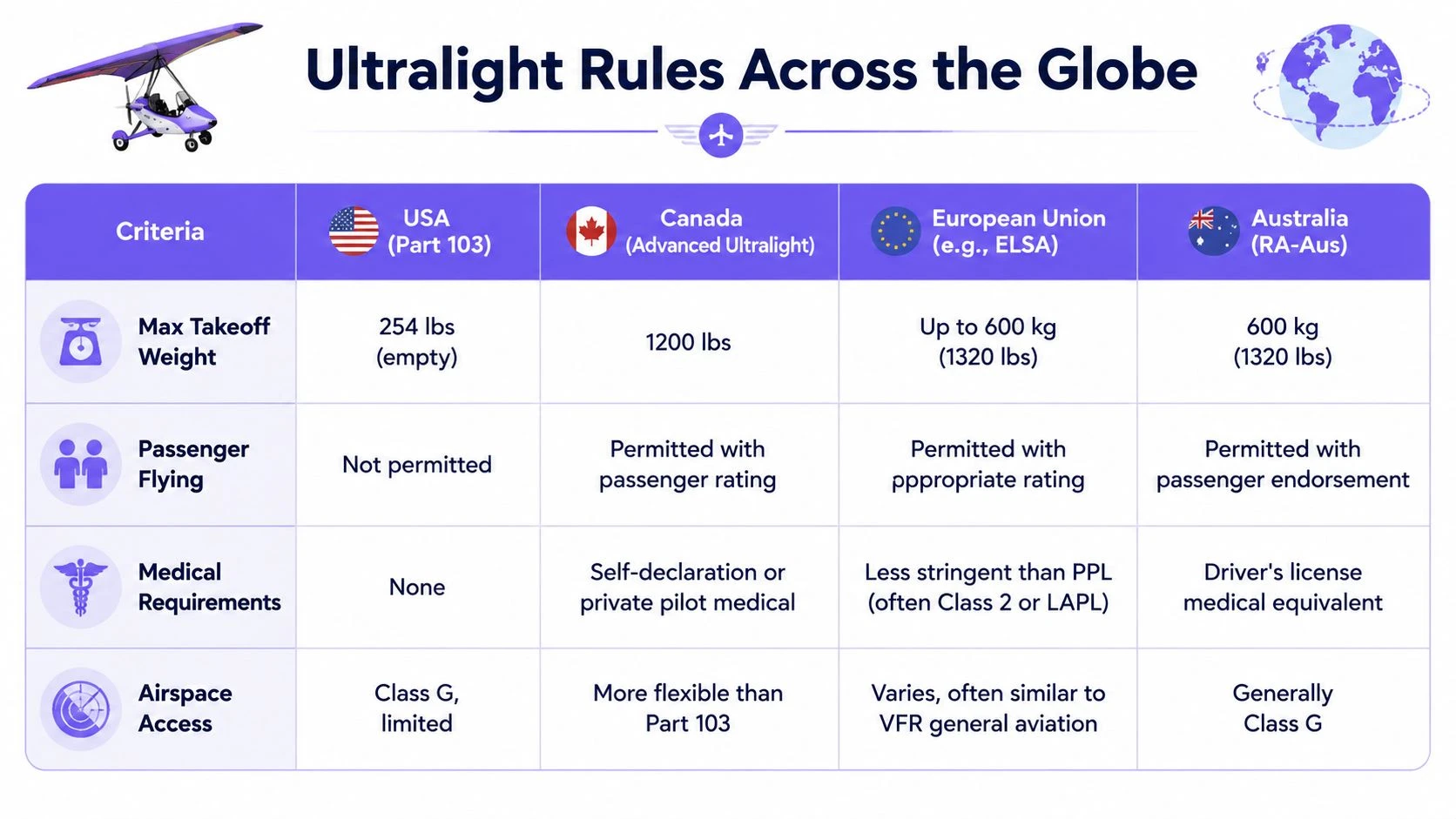
The United States is the exception that makes everyone else harder to understand. In the U.S., a true ultralight can sit in a category where no pilot licence is required, provided the aircraft and operation stay inside a narrow box. In many other countries, “ultralight” or “microlight” still means a light aircraft category, but pilot qualification is mandatory.
Ultralight regulations at a glance 2026
| Country | Governing Rule | Licence/Permit Required | Max Take-off Weight | Passenger Allowed? |
|---|---|---|---|---|
| United States | FAA Part 103 | No pilot licence for true Part 103 ultralights | Not expressed as take-off weight in the FAA FAQ. Part 103 defines 254 lb maximum empty weight for powered ultralights | No. Part 103 is single-seat only |
| Canada | Ultralight aeroplane rules | Yes. Ultralight Aeroplane Pilot Permit or another aeroplane permit/licence | 1,200 lb for basic ultralights, 1,232 lb for advanced ultralights | Yes, depending on category and qualification |
| European jurisdictions | Varies by national or regional microlight/light aircraft rules | Usually yes | Varies by jurisdiction | Often yes with the appropriate qualification |
| Australia | Recreational aviation framework | Usually yes | Varies by category | Often yes with the appropriate endorsement |
Why the U.S. system is unusual
The FAA's Part 103 approach is built around aircraft limitations rather than pilot licensing. As noted earlier in the article, the aircraft itself must stay extremely light and limited. That's why the phrase “ultralight licence” can mislead U.S. readers. They may be searching for a licence that doesn't exist for the narrow category they intend.
The trade is obvious once you look at the operating environment. No passenger. Daylight use. Uncongested airspace. Very limited aircraft capability. Simpler access comes from tighter limits.
Canada as a useful contrast
Canada shows how different the same broad idea can look in practice. Transport Canada describes ultralights as aircraft that generally require registration and insurance, and it distinguishes between basic and advanced ultralight aeroplanes. The guidance notes 1 to 2 seats, daylight VFR operation, and the need for an ultralight aeroplane pilot permit or another aeroplane permit/licence. It also sets 1,200 lb maximum take-off weight for basic ultralights and 1,232 lb for advanced ultralights, as outlined in Transport Canada's ultralight transition guidance.
That's a very different regulatory philosophy from Part 103. Same family of lightweight aviation. Different assumptions about training, oversight, and aircraft capability.
If you hear two pilots argue about whether an ultralight needs a licence, they may both be right in their own country.
What about Europe and Australia
The key point for readers outside the U.S. and Canada is this: don't import American terminology into your local system without checking the legal category first.
Across Europe and Australia, lightweight recreational aircraft are usually folded into more formal permit, medical, and operational structures than U.S. Part 103. The local labels vary. The operating privileges vary. Passenger rules vary. Airspace access varies. But the broad pattern is consistent. Once an aircraft can carry more capability, regulators usually require more pilot qualification too.
For a drone operator, the practical lesson is simple. Start with your national regulator and your local training ecosystem, not with generic internet advice. “Ultralight” is a family resemblance term, not a universal legal answer.
Your Privileges Limits and Upgrade Paths
Most pilots focus on the word “limits” as if it means compromise. In light aviation, limits are often what make the category achievable in the first place.
If an entry-level flying route is restricted to simpler aircraft, daytime conditions, local operations, or certain airspace, that usually isn't because the system wants to frustrate you. It's because lower complexity makes the path more accessible, more teachable, and easier to supervise safely.
What your privileges usually look like
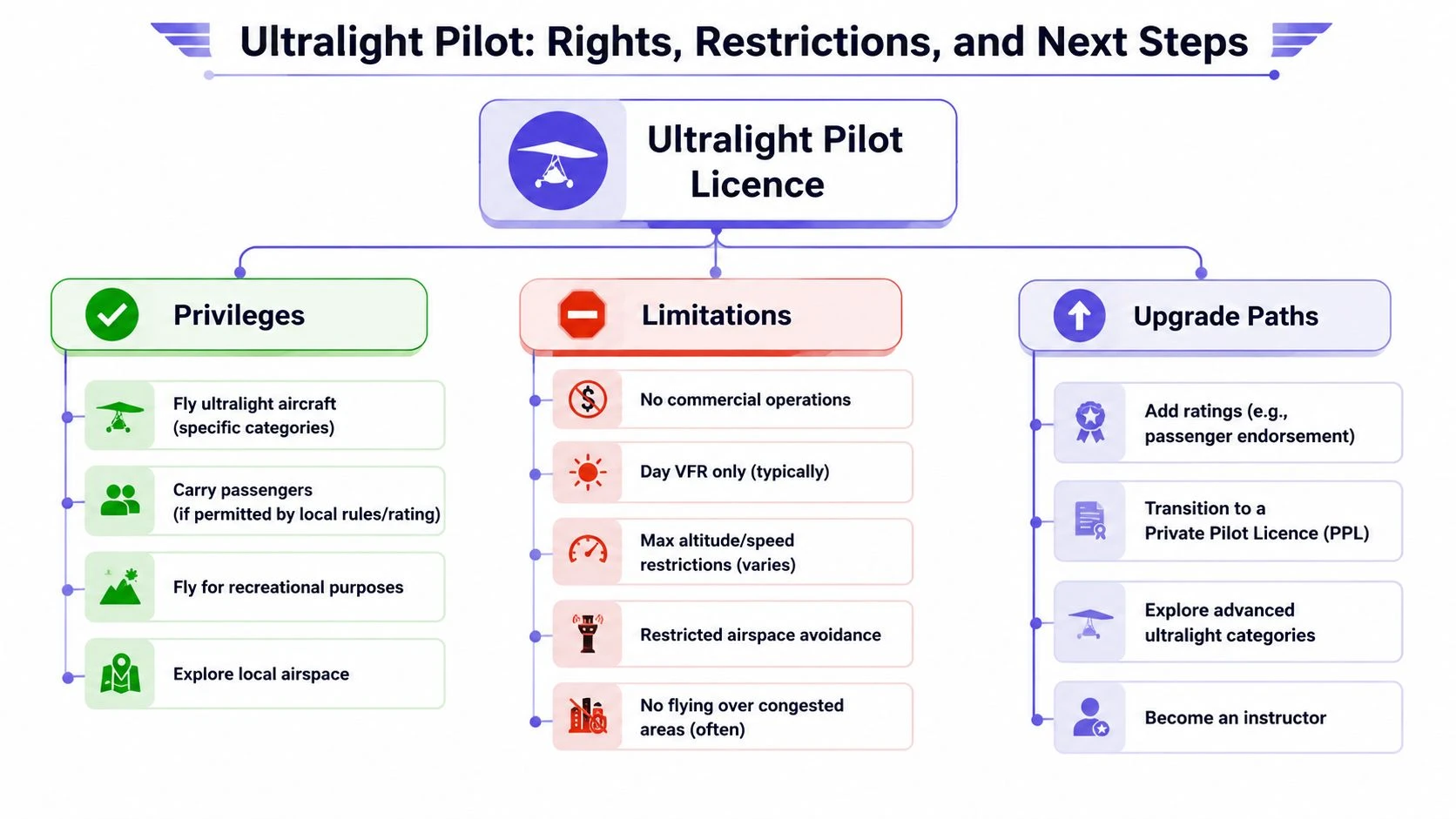
Your exact privileges depend on country and category, but the practical pattern often includes:
- Local recreational flying: Short flights, local areas, and visual conditions.
- Simple aircraft operation: Light, lower-performance machines with fewer systems to manage.
- Progressive privileges: Some systems let you add passenger or aircraft-specific privileges later.
- A strong foundation: The handling, planning, and judgement you learn carry upward into broader licences.
The limits are part of the value
A drone pilot will recognize this immediately. A lower-complexity framework lets you learn the essential operational skill before complexity piles on.
Common limitations often include:
- Day VFR emphasis: You fly when visibility and weather support visual reference.
- Airspace restrictions: Controlled or congested environments may need more qualification or be off-limits.
- Passenger limits: Some categories prohibit carrying passengers altogether. Others require extra ratings or a different aircraft class.
- No broad commercial privilege: Entry-level crewed licences rarely open the door to unrestricted commercial operations.
The category stays affordable because it avoids the cost and regulatory burden that come with heavier, faster, more capable aircraft.
Upgrade paths that make sense
Ultralight or ultralight-like training offers increased interest for professionals.
You might start with simple recreational flying, then move toward:
- A passenger privilege or local endorsement, where your system allows it.
- A sport or recreational certificate, if your country separates no-licence ultralight activity from certificated light aircraft flying.
- A private pilot route, if you want broader aircraft access, more airspace flexibility, and stronger long-term progression.
- Instruction or mentoring roles later on, once experience and qualification support that move.
The smart approach is to choose an entry path that teaches transferable habits, not just a quick sign-off. If your local ultralight scene feeds naturally into sport pilot or private pilot training, that can save frustration later.
For drone operators, this ladder matters because many aren't looking only for a weekend hobby. They want a structured way to grow into broader aviation without committing immediately to the full cost and complexity of general aviation training.
Why Manned Flight Makes You a Better Drone Pro
The biggest benefit of manned flying isn't prestige. It's judgement.
Once you've sat in a light aircraft and worked through wind drift, runway selection, circuit traffic, terrain cues, and changing visibility from the cockpit, your understanding of aviation becomes less abstract. Airspace stops being a set of shapes on a screen. Weather stops being an app overlay. Risk stops being something that happens to “the aircraft” while you stand safely below.
That changes how you operate drones too.
Skills that carry back into drone work
Manned flight tends to improve three things that matter in professional UAS operations:
- Weather interpretation: You become more conservative in a useful way. You start reading conditions as an aviator, not just as an operator checking a forecast.
- Airspace literacy: Radio traffic, circuit patterns, and airport behavior become easier to visualize.
- Crewed-aircraft empathy: You understand what the pilot overhead is managing, which improves deconfliction and communication.
Where it can help commercially
For a drone business, that added depth can help when you work with:
- infrastructure clients near aerodromes
- survey and inspection teams that already use crewed aviation
- emergency planning environments
- mixed-operation sites where helicopters, fixed-wing aircraft, and drones all share nearby airspace
It also changes how clients perceive you. Not because a manned qualification automatically makes your drone work better, but because it signals broader aviation literacy and a serious safety mindset.
If you're serious about this path, take three practical steps. Book an introductory lesson with a reputable local school. Visit a light aviation club and ask what aircraft are active there, not just what's advertised online. Then ask one very specific question: “If I start here, what can I progress to next?”
That answer will tell you far more than any generic article about the ultra light aircraft licence.
If you already run professional drone operations, Dronedesk helps you bring the same discipline to planning, compliance, logging, fleets, teams, and client work. It's a practical way to reduce admin load while building the kind of safety-focused operation that translates well into every part of aviation.
 Drone Operating Rules for Managing Contractors and Employees →
 BVLOS Drone Requirements for Building a Safety Case →
 Drone Pilot Test Mistakes That Cost Candidates Marks →
 FAA 107 License vs Part 107 Certificate: What’s the Difference? →
 Drone Airport Rules: A Field Checklist for Site Assessments →
 FAA Part 107 Record-Keeping Rules for Commercial Teams →
 How to Review a DJI Flight Log After an Unexpected Event →
 Drone Laws Around the World: A Pre-Flight Research Framework →
 How to Compare Drone Survey Services for Complex Sites →
 How to Start a Drone Mapping Business With a Clear Workflow →