
Remote ID for Drones Explained Simply
Think of Remote ID for drones as a digital license plate. It's a simple, elegant solution that broadcasts key info like the drone's location and serial number while it's in the air. This isn't just another piece of tech; it's a critical FAA requirement that boosts airspace safety and accountability for every pilot out there, from hobbyists to commercial pros.
What Is Remote ID and Why Does It Matter

Picture the sky as a busy highway. Just like cars need license plates to keep things orderly and safe, drones need a way to be identified in real time. That's the whole idea behind Remote ID for drones. It’s a federally required system that lets authorities and even the public see basic identifying information from drones flying nearby.
This isn't about Big Brother watching your every move. It's about creating a transparent, organized airspace where everyone can operate safely. The FAA's main goal here is to give law enforcement a tool to check out suspicious drone activity, making sure the skies are secure for all of us.
The Core Principle: Accountability in the Air
At its heart, Remote ID is all about accountability. Before this system, figuring out who was flying a drone from the ground was next to impossible. This created some pretty serious safety and security headaches, especially near sensitive spots like airports, government buildings, or big public events.
By broadcasting a signal with a few key data points, Remote ID links a drone in the sky to its registered pilot on the ground. This straightforward connection is a game-changer for encouraging responsible flying and discouraging anyone from using a drone carelessly or maliciously.
The system provides real-time information for law enforcement officers who are investigating suspicious UAS flight activity, fundamentally changing how airspace is monitored and managed for safety.
To really get your head around Remote ID, it helps to think about broader identity management principles. These are the concepts that underpin systems like this, ensuring everyone is accountable and building a foundation of trust.
More Than Just a Rule
If you just see Remote ID as another box to tick on a compliance checklist, you're missing the bigger picture. This technology is the bedrock for the future of advanced drone operations. Think about it—without a reliable way to identify drones, the cool stuff like automated deliveries would be way too risky to get off the ground.
Here’s why Remote ID is actually a gateway to innovation:
- Enabling BVLOS Flights: It gives regulators the confidence they need to approve Beyond Visual Line of Sight (BVLOS) flights. This is huge for long-range pipeline inspections, large-scale mapping, and, yes, drone delivery.
- Building Public Trust: When people know drones are identifiable and accountable, they're much more likely to accept them in their communities. This public trust is essential for the widespread adoption of services like automated package delivery.
- Integrating Drones Safely: It’s a key piece of the puzzle for safely fitting drones into the national airspace alongside airplanes and helicopters, a concept the industry calls Unmanned Aircraft System Traffic Management (UTM).
Bottom line? Getting to grips with the remote id for drones requirement isn't just about staying legal. It’s about being part of a safer, more efficient future in the sky and unlocking incredible new opportunities for your operations.
Making Sense of the FAA's Remote ID Rule
Getting to grips with the Federal Aviation Administration's (FAA) rules is your first step toward flying with confidence. The regulations around Remote ID for drones might look a bit daunting at first, but they really just boil down to a few key ideas meant to make the skies safer for everyone. Think of it as learning the rules of the road before you get behind the wheel.
The biggest takeaway is the weight limit. If your drone weighs 0.55 pounds (250 grams) or more, you're on the hook for Remote ID. That number wasn't just plucked out of thin air; it’s the FAA’s way of balancing the need to track more capable drones while letting the smaller, less risky ones off the hook.
This rule applies to pretty much every flight. It doesn't matter if you're a hobbyist getting some weekend landscape shots or a commercial pilot on a paid gig. The FAA wants a consistent way to see who is flying what, right across the national airspace.
What Your Drone Is Actually Broadcasting
When your drone is Remote ID compliant, it’s constantly sending out a low-power signal—kind of like a Wi-Fi or Bluetooth broadcast. This signal acts as a "digital license plate," sharing specific info to keep things transparent without giving away your personal details to just anyone.
Here’s what that broadcast message includes:
- Drone's Unique ID: This will be either the drone’s serial number or a special session ID for that flight.
- Drone's Location and Altitude: Real-time data on its latitude, longitude, and height.
- Drone's Velocity: Its current speed and direction.
- Control Station's Location: The position of the person flying the drone.
- Time Mark: A timestamp to keep all the broadcast data in sync.
It’s important to know that while the public can only see flight data, law enforcement and the FAA can use that unique ID to look up the registered owner if an issue arises. For a deeper dive into the specifics, you can check out our detailed guide on the FAA Remote ID rule.
The Global Push for Drone Safety
This whole idea of drone identification isn't just happening in the US. Remote ID rules are popping up worldwide, becoming a standard safety measure in just about every major drone market. Here in the States, with over one million drones registered with the FAA, the ecosystem for commercial, recreational, and public safety flights is booming. The FAA’s Remote ID rule, requiring drones weighing 250 grams or more to broadcast key data, is critical for preventing unauthorized flights and keeping the public safe. You can discover more insights about how Remote ID is essential to the future of airspace management on Airsight.com.
The FAA's stated intent for this system is to provide real-time information for law enforcement officers who are investigating suspicious UAS flight activity. This elevates safety and security for everyone.
Getting this right is crucial. The deadlines for compliance are behind us, which means any pilot flying a drone over 250 grams outside of a designated safe area must have a compliant system. Don't risk it—non-compliance can bring hefty penalties from the FAA. Taking the time to understand and follow the rules is a non-negotiable part of being a modern drone pilot. When you adhere to these regulations, you're not just covering yourself; you're helping build a safer, more trusted airspace for the entire drone community.
Choosing Your Path to Remote ID Compliance
Alright, you've got the basics of the rules down. Now it's time to figure out how you're going to comply. The good news is the FAA didn't create a one-size-fits-all mandate for remote ID for drones. You've got three different pathways, so you can pick the one that makes the most sense for your gear, budget, and how you fly.
Each option strikes a different balance between convenience, cost, and operational freedom. Let's walk through these three choices so you can make a smart decision and get back in the air legally and safely.
This handy decision tree boils it all down to the first question every pilot needs to ask.
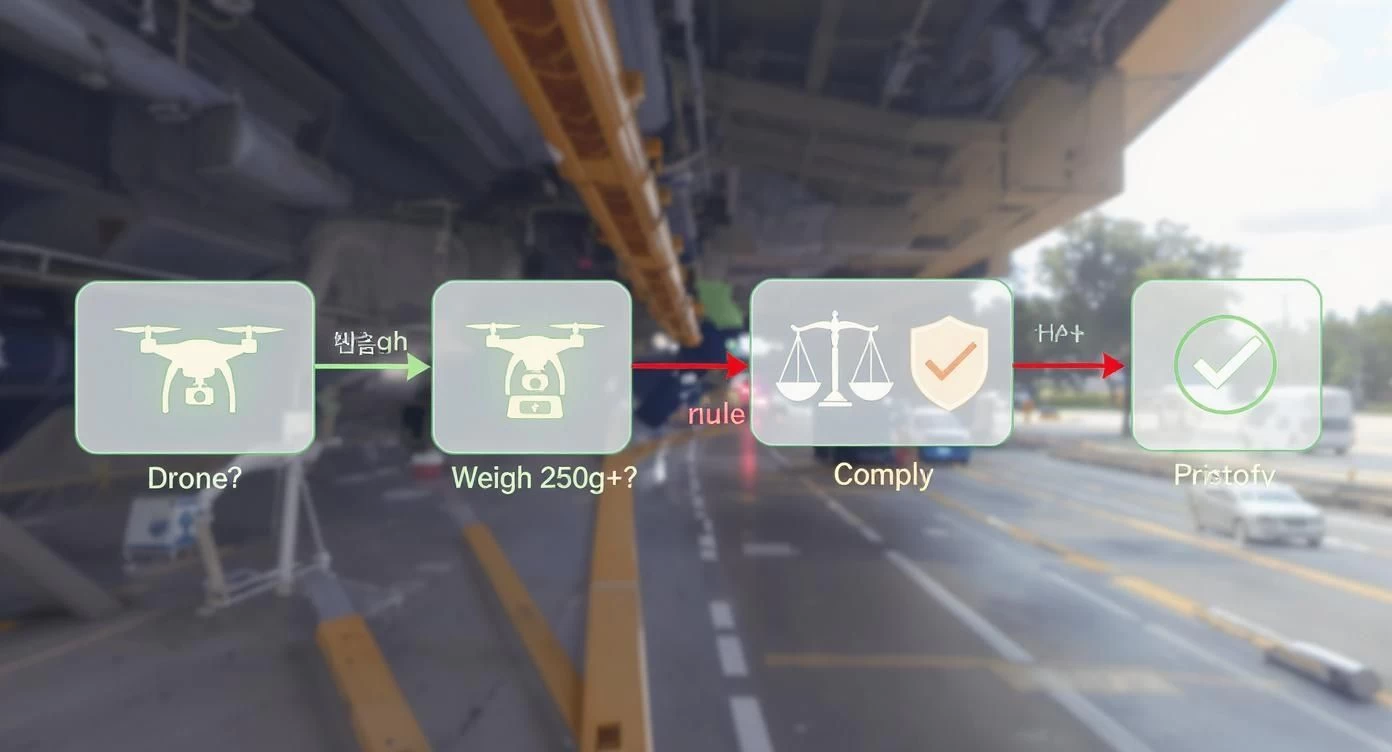
As the graphic shows, the big trigger for most pilots is weight. If your drone is 250 grams (0.55 lbs) or more, you're on the hook for Remote ID. Simple as that.
To help you decide which route is best for you, we've broken down the three compliance methods.
Comparing Remote ID Compliance Methods
This table lays out the three ways to meet the FAA's Remote ID requirements, comparing how they work, who they're for, and their main upsides and downsides.
| Compliance Method | How It Works | Best For | Pros | Cons |
|---|---|---|---|---|
| Standard Remote ID | The drone has Remote ID technology built-in from the factory. The broadcast starts automatically when the drone is powered on. | Pilots buying new drones or commercial operators wanting a seamless, integrated solution. | Completely automatic, no extra gear to buy, carry, or charge. It just works. | Only available on newer drone models. You can't retrofit it into an older aircraft. |
| Broadcast Module | An external, self-powered device is attached to the drone. This module contains its own GPS and broadcasts the required Remote ID signal. | Owners of older drones, custom-built aircraft, or pilots with a mixed fleet of compliant and non-compliant drones. | A cost-effective way to make older drones compliant. One module can be swapped between multiple aircraft. | Requires an external device that needs to be mounted, charged, and managed separately. |
| Fly in a FRIA | Fly a drone without any Remote ID equipment, but only within the specific geographic boundaries of an FAA-Recognized Identification Area. | Recreational hobbyists who exclusively fly at a local, approved club field that has FRIA status. | The most budget-friendly option, as no new hardware is required. | Extremely restrictive. You are legally forbidden from flying that drone anywhere outside the FRIA's boundaries. |
Ultimately, the right choice depends entirely on your specific situation—the drones you fly, where you fly them, and your budget.
Path 1: Fly a Drone with Standard Remote ID
The easiest, most straightforward way to comply is to fly a drone with Standard Remote ID baked right into its hardware. Most new drones coming off the line from major players like DJI and Autel are already equipped with this feature.
This integrated system is a true "set it and forget it" solution. The moment you power on the drone, it starts broadcasting its Remote ID signal automatically. You don't have to think about it or do a thing.
- Who It's For: Anyone buying a new drone, and commercial operators who can’t afford any hassle or extra steps in their workflow.
- Pros: Zero extra hardware to purchase, carry around, or keep charged. Compliance is built-in and automatic.
- Cons: This is a feature of newer models. If your drone is a few years old, you can't just add this functionality internally.
Path 2: Use an External Broadcast Module
So, what if you've got an older drone that you absolutely love, or maybe a custom FPV rig you built yourself? That’s where the Broadcast Module saves the day. It’s a small, self-contained gadget that you strap onto your drone to send out the required Remote ID signal.
Think of it like adding an external GPS unit to a car that didn't come with one. You just mount the module, turn it on, and it does the broadcasting job for you. These little units have their own battery and GPS, making them compatible with almost any drone that can handle their minimal weight.
One of the best things about a Broadcast Module is that you can move it between different drones in your hangar. You don’t need to buy one for every single aircraft you own, which makes it a really smart, cost-effective fix for pilots with multiple older models.
When you get a module, you’ll need to register its serial number with the FAA and link it to your pilot registration. This is what connects the module's broadcast signal back to you.
Path 3: Fly Exclusively in FRIAs
The last option lets you fly without any Remote ID gear whatsoever, but it comes with a major catch. You can only fly within the strict boundaries of an FAA-Recognized Identification Area (FRIA).
FRIAs are specific locations—think model aircraft club fields—where the FAA has agreed that the risk to other air traffic is low enough to waive the broadcast rule.
- Who It's For: Strictly recreational hobbyists who do all their flying at a local, AMA-sanctioned club field that has successfully applied for and received FRIA status.
- Pros: It’s the cheapest route because you don't have to buy any new equipment.
- Cons: You are absolutely limited to flying inside the FRIA's defined geographic area. Take your non-compliant drone even a few feet outside that invisible fence, and you're breaking FAA rules.
The FAA maintains an official map of approved FRIA locations, but you should always double-check a site's current status before you fly. This path offers the least flexibility, but for a dedicated model aircraft enthusiast who never leaves their home field, it can be a perfect solution.
Unlocking the Future with Remote ID
 Thinking of remote ID for drones as just another piece of red tape is like looking at a highway and only seeing the speed limit. You’re completely missing the destination. This technology is so much more than a box-ticking exercise; it's the master key that unlocks the next generation of advanced commercial drone work.
By creating a system of trust and accountability in our skies, Remote ID gives regulators and the public the confidence they need to greenlight more complex drone operations. It takes the airspace from a wild, unmonitored frontier to a managed, transparent environment—exactly what’s needed for real innovation to take off.
Moving Beyond Visual Line of Sight
For years, the holy grail for commercial drone pilots has been flying Beyond Visual Line of Sight (BVLOS). The ability to operate a drone well past your own eyesight is a game-changer for big jobs like inspecting miles of pipeline, mapping massive farms, or managing sprawling infrastructure projects.
Remote ID is what makes BVLOS possible. It hands air traffic controllers and other authorities the real-time location data they need to keep the airspace safe and organized. Without a dependable way to identify and track drones from afar, widespread BVLOS approvals would just stay a pipe dream.
Remote ID creates a digital ecosystem of trust. When every aircraft is identifiable, the perceived risk of complex operations drops dramatically, opening doors for businesses to take on projects that were previously impossible.
Powering the Drone Delivery Revolution
Automated drone delivery is one of the most exciting new frontiers in logistics, promising to bring everything from life-saving medical supplies to your Friday night takeaway right to your doorstep. This entire industry depends on the universal adoption of Remote ID.
The growth here has been explosive. Between 2021 and 2022, the number of drone-delivered packages worldwide shot up by over 80%. Projections showed the world hitting one million commercial drone deliveries by the end of 2023. But taking these operations from quiet rural test sites to busy urban centers is a non-starter without a solid system for real-time identification.
Turning Compliance into a Competitive Edge
At the end of the day, getting on board with Remote ID isn’t about dodging fines—it’s about setting your business up for the future. The operators who are fully compliant are the ones who can confidently bid on advanced jobs and win the trust of high-value clients.
Being compliant shows you’re serious about safety and professionalism, which is a massive advantage in a crowded market. It allows you to:
- Access Advanced Operations: Get the waivers and authorizations you need for complex flights like BVLOS or operations over people.
- Build Client Trust: Prove to potential clients that you operate at the highest standard of safety and regulatory know-how.
- Future-Proof Your Business: Make sure your fleet and skills are ready for the next wave of drone integration into the national airspace.
When you understand how compliance can boost your business, you can turn a regulatory requirement into a genuine asset for growth. It's your ticket to playing in the most valuable and innovative parts of the drone economy.
A Global View on Drone Identification
The push for a digital license plate on every drone isn't just an FAA initiative; it's a global movement. As drone operations pop up all over the world, countries are scrambling to build their own frameworks to manage their skies. The end goal is the same everywhere: safety, security, and accountability. This worldwide perspective really shows just how vital remote ID for drones has become.
While everyone agrees on the core principle—know what’s flying overhead—the way it's being rolled out varies wildly. You'll see different weight thresholds, technology choices, and timelines from one country to the next, highlighting just how fast this area of regulation is evolving. Looking at how other nations are tackling drone identification gives us a much clearer picture of where the industry is heading.
Pioneering Approaches Around the World
Different countries have effectively become testbeds for specific types of Remote ID. This is great for the industry, as it provides a ton of real-world data on what works best in different environments. Some nations have jumped in with strict mandates, while others are taking a more gradual, phased approach.
This global patchwork of rules really drives home why it's so critical for pilots to stay informed, especially if you work internationally or with global partners. What gets you a green light in one country might not cut it in another.
The global adoption of Remote ID signals a universal agreement: for the drone industry to reach its full potential, the skies must be transparent and accountable. It's the foundational layer for all future innovation.
A few nations have taken the lead in this regulatory push. Japan was an early adopter, making Remote ID mandatory for drones over 100 grams way back in June 2022. Hot on their heels, Israel became the first country to require Network-based Remote ID in November 2023 for drones heavier than 200 grams. You can dive deeper into how these systems are essential for airspace management on Airsight.com.
Regulations on the Horizon
Other major aviation authorities are busy cooking up their own frameworks, with many taking cues from the systems already live in the US, Japan, and Israel. This includes some of the biggest markets in Europe and Oceania.
- The United Kingdom: The UK is deep in the process of defining its own drone identification rules, and we expect to see a full framework locked in by 2026.
- Australia: Similarly, Australia is looking at various Remote ID solutions to manage its huge and diverse airspace, also aiming for a 2026 rollout.
- The European Union: EASA has already put a comprehensive set of rules in place that include identification requirements, which are currently being rolled out across all member states.
If you operate in any of these regions, getting your head around the details of these upcoming changes is non-negotiable. You can learn more about what the new drone regulations mean for UK and EU operators in our detailed guide. This global trend makes one thing crystal clear: Remote ID isn't just some temporary rule—it's a permanent feature of modern aviation.
Got Questions About Remote ID? We've Got Answers.
Even when the rules are spelled out, you always run into real-world questions once you're out in the field. The whole remote ID for drones thing can feel a bit tangled, but most of the common worries have pretty simple answers. Let's run through the top questions pilots are asking to clear the air and get you flying with confidence.
Think of this as the practical, no-nonsense guide for the situations you're actually going to face.
Can Just Anyone See My Exact Location When I'm Flying?
This is the big one, and the short answer is: sort of, but not in the way you might think. Anyone with a scanner app can see the drone's location and where it took off from (which, let's be honest, is usually right where you are). But—and this is the important part—they cannot see your name or personal details.
All that's broadcasted is the serial number of your drone or the Remote ID module. Only the FAA and law enforcement can take that number and look it up in the secure registration database to see who the pilot is.
The whole point is accountability in the airspace, not public surveillance. It's a balance between keeping the skies transparent and protecting your privacy.
What Happens if My Remote ID Cuts Out Mid-Flight?
The FAA's official stance here is refreshingly practical. If your Remote ID broadcast stops working while you're in the air, you need to land the drone as soon as practicable. This doesn't mean you have to panic and execute a risky emergency landing that could damage property or hurt someone.
It just means you need to safely and quickly bring the drone home and land it. And you can't take off again until you've fixed whatever was causing the problem. Simple as that.
Do I Really Need Remote ID for My Tiny Drone?
The rules are all about weight. If you're flying purely for fun and your drone weighs less than 250 grams (0.55 lbs), you're off the hook for Remote ID.
But there's a huge catch. That exemption only works if the drone is not registered. If you’ve registered that little sub-250g drone for any reason—maybe for Part 107 commercial work—then it absolutely must have Remote ID, no matter how small it is. Registration is the trigger.
How Can I Be Sure My Drone Is Actually Compliant?
The quickest way is to just look at your drone. There should be a label on it that says it has an FAA-approved Remote ID system built-in. For a more official check, head over to the FAA's public Declaration of Compliance (DOC) list.
This is a database where you can search for your drone's make and model to confirm it's been approved for Standard Remote ID.
- Standard RID Drones: Find your model on the FAA's DOC list.
- Broadcast Modules: If you're buying a module, make sure it's on the FAA's approved list before you spend any money.
Stick to these checks, and you'll know you're flying by the book.
Trying to keep track of compliance, flight logs, and mission plans can feel like a full-time job. Dronedesk pulls it all together into one clean platform, taking care of the paperwork so you can get back to what you love—flying. Plan, fly, and log your missions with total confidence. Check out how we can help your operations at https://dronedesk.io.
 FAA Drone License Costs Beyond the Knowledge Test →
 Drone Part 107 Operations: When a Waiver May Be Needed →
 Drone Operating Rules for Managing Contractors and Employees →
 BVLOS Drone Requirements for Building a Safety Case →
 Drone Pilot Test Mistakes That Cost Candidates Marks →
 FAA 107 License vs Part 107 Certificate: What’s the Difference? →
 Drone Airport Rules: A Field Checklist for Site Assessments →
 FAA Part 107 Record-Keeping Rules for Commercial Teams →
 How to Review a DJI Flight Log After an Unexpected Event →
 Drone Laws Around the World: A Pre-Flight Research Framework →