
UAV for Sale: A Professional Buyer's Guide for 2026
You are looking at a screen full of listings that all claim to be professional, long-range, high-payload, field-ready, or enterprise-grade. The trouble is that a uav for sale listing seldom tells you what the aircraft will cost you after it arrives, how hard it will be to keep compliant, or whether it will fit the way your team operates.
That is where most first major purchases go wrong. Buyers compare airframes, battery counts, and payload specs, then discover that the primary strain appears in training, documentation, spares, software compatibility, and downtime.
A better buying process starts with one question. What has to happen after the sale for this UAV to earn its keep?
Beyond the Sticker Price A Strategic Guide to Buying a UAV
The professional drone market is crowded because demand is real. The global UAV market was valued at USD 15.21 billion in 2023 and is projected to reach USD 47.67 billion by 2032, with a 15.35% CAGR according to Zion Market Research's UAV market report. That growth is good news for buyers because there are more capable systems on the market, but it also means more noise, more feature inflation, and more expensive mistakes.
A listing can make a UAV look like an equipment purchase. It is not. For a professional buyer, it is a capability decision.
If you run inspections, mapping, media work, public safety support, or utility operations, the aircraft is only one part of the job chain. You still need launch suitability, sensor fit, legal readiness, pilot proficiency, maintenance support, flight logging, and a clean handoff from field data to client deliverable.
What buyers often get wrong
The first mistake is buying for headline specs.
A long endurance claim sounds useful until you realize your jobs need hover precision near structures. A heavy payload option sounds flexible until you price the batteries, transport cases, extra operators, and maintenance routine that come with it. A lower purchase price looks attractive until spare parts take too long to source or the aircraft cannot slot into your reporting workflow.
The second mistake is treating the aircraft as a standalone tool. Professional teams need an aircraft that fits the operation around it.
Tip: If a supplier cannot explain setup time, parts availability, training expectations, and ongoing compliance requirements, treat that as a buying signal too.
Think in lifecycle terms
A sound purchase decision looks at four things together:
- Mission fit: What jobs will this aircraft perform repeatedly and profitably?
- Operational load: How much staff time will the system add or remove?
- Supportability: Can you keep it flying without constant disruption?
- Scalability: Will it still work when you add pilots, sites, clients, or aircraft?
Some buyers also benefit from understanding how the aircraft itself may be produced and repaired, especially when custom parts or rapid prototyping matter. This overview of UAV 3D Printing is useful for thinking about manufacturability, replacement parts, and how airframe design choices can affect long-term support.
Understanding the Three Core UAV Platforms
The fastest way to narrow a crowded market is to stop comparing brands first and compare platform types first. Most professional purchases come down to three airframe families, and each one solves a different operational problem.
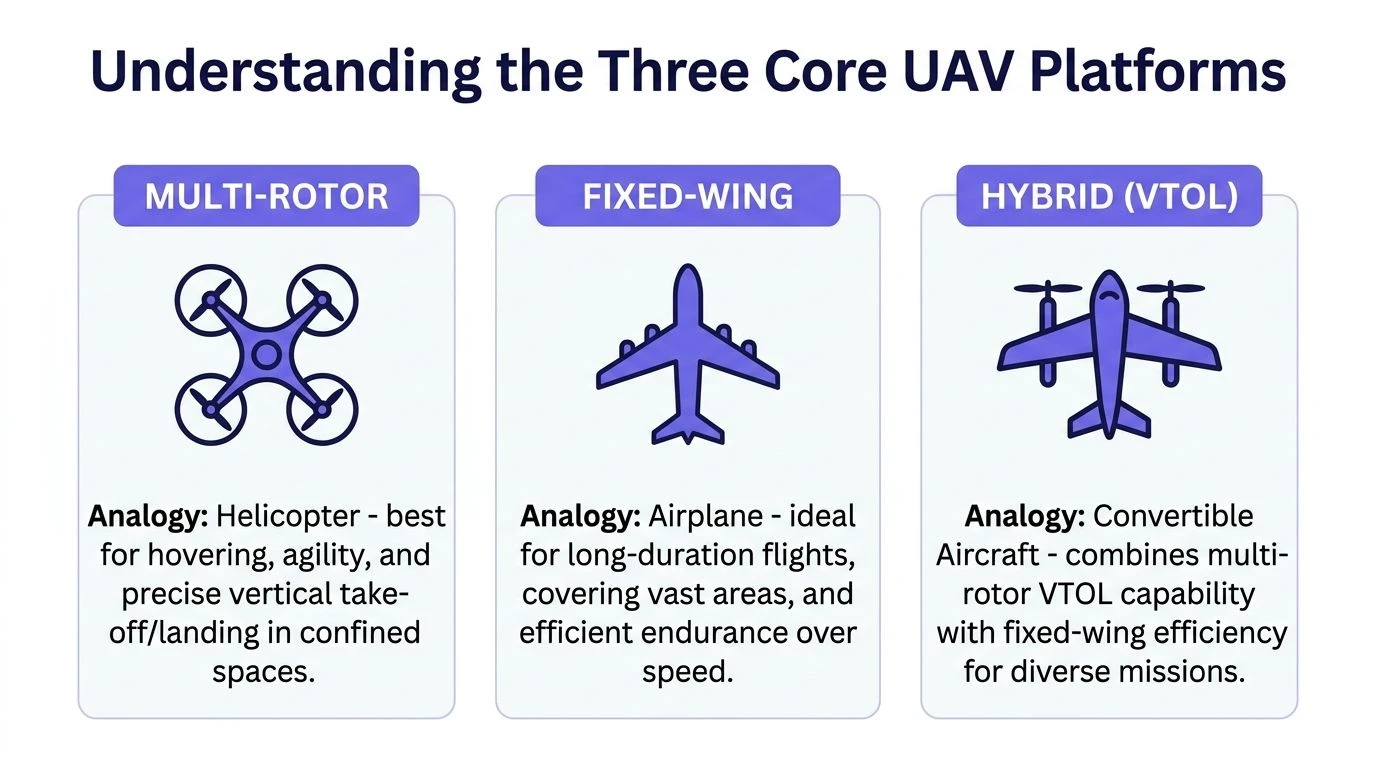
For a broader grounding in categories and terminology, this overview of professional UAVs and drones is a good companion reference.
Multi-rotor
Think of a multi-rotor as the helicopter of the drone world.
It lifts off vertically, hovers well, holds position precisely, and works in tighter spaces than the other two platform types. That makes it the practical choice for close inspections, facade work, roof surveys, tower imaging, media capture, and any task where framing accuracy matters more than covering huge distances.
Multi-rotors are easier to deploy quickly. They are also easier for newer teams to understand operationally because the mission profile is simpler. Launch, hover, reposition, land.
Where buyers get caught out is endurance. Hovering is power-hungry. If your work involves long corridors, wide-area mapping, or repeated site hops in a day, a multi-rotor can become a battery management problem rather than a productivity tool.
Best fit
- Building inspections
- Utility spot checks
- Cinematic work
- Public safety overwatch in tight zones
Common limitation
- Less efficient for large-area coverage
Fixed-wing
A fixed-wing platform is the airplane option.
It is built for efficiency. Once airborne, it covers large areas with far less energy wasted on staying aloft. If your work is corridor mapping, large agricultural fields, environmental monitoring, or long-route survey work, fixed-wing aircraft can make far more operational sense than a hovering platform.
Many first-time professional buyers overcorrect here. They see endurance and range, then ignore launch and recovery realities. Traditional fixed-wing systems are less forgiving in confined spaces and less suited to detailed, slow, close-in inspection work.
That does not make fixed-wing less capable. It makes it more specialized.
Hybrid VTOL
Hybrid VTOL sits between the two. It is the convertible aircraft choice.
It takes off and lands vertically like a multi-rotor, then transitions to fixed-wing flight for efficient cruise. For many professional buyers, this is the most compelling category because it solves the launch problem without giving up large-area efficiency.
The trade-off is complexity. VTOL hybrids ask more from the operator, from the support plan, and from your procurement process. They are not the platform to buy because the spec sheet looks impressive. They are the platform to buy when your mission set clearly demands both flexibility and coverage.
A useful market signal sits here too. The commercial platform segment comprises over 48% of the Americas UAV market, with VTOL types leading revenue, according to Grand View Research's Americas UAV market analysis. Buyers are not moving toward VTOL because it sounds advanced. They are buying it because it solves mixed operational requirements.
A practical way to choose
| Platform | What it does best | What usually breaks the deal |
|---|---|---|
| Multi-rotor | Hovering, close inspection, confined sites | Shorter endurance on large jobs |
| Fixed-wing | Efficient wide-area coverage | Harder launch and recovery constraints |
| Hybrid VTOL | Flexible deployment plus efficient cruise | Higher complexity and support demands |
Key takeaway: Buy the platform for the work you repeat most often, not the occasional job you might win someday.
Matching Specs and Payloads to Your Mission
After you pick the platform class, the next filter is less complex than many buyers realize. Ask two questions. What data must this UAV collect, and under what field conditions must it collect it reliably?
That puts specs in the right order. The payload tells you what business you can do. The airframe specs tell you whether you can do it consistently.
For buyers entering the commercial side of the market, this primer on the commercial drone environment helps frame the difference between consumer-style comparisons and operational buying criteria.
Read endurance and range like an operator
Flight time and range are not bragging points. They are planning variables.
Long endurance matters when each launch has real setup cost, when access to the site is difficult, or when you need to collect a lot of data in one sortie. Range matters when you are inspecting corridors, surveying broad sites, or operating where repeated repositioning would waste crew time.
A useful example of what high-end capability looks like is the JOUAV CW-30E, which reaches a maximum range of 200km, offers up to 480 minutes of flight time, and carries an 8kg payload capacity, according to JOUAV's long-range drone overview. Those numbers matter because they show what becomes possible when endurance, range, and payload all support the same mission profile.
That kind of aircraft makes sense for large-scale surveying, extended corridor work, and remote operations. It does not automatically make sense for building inspection, media work, or short urban flights.
Payload is the business end
The sensor package is what clients pay for. The aircraft is how you move it.
A buyer who focuses on airframe first frequently ends up forcing the wrong payload onto the wrong platform. A better approach is to start with deliverables.
RGB payloads
RGB cameras are the base layer for many commercial jobs.
They fit marketing content, real estate, progress monitoring, visual inspection, and orthomosaic capture when the camera system is suitable for mapping workflows. The key buying question is not just image quality. It is whether the payload can produce repeatable, usable data in the way your clients expect it.
Thermal payloads
Thermal is valuable when you inspect assets, identify heat anomalies, or support search and response work.
What matters in practice is not just whether the UAV can carry a thermal camera. You also need a stable platform, a useful field workflow, and a reporting process your team can repeat without improvising every time.
LiDAR and advanced mapping payloads
LiDAR, multispectral, and other specialist sensors can open higher-value work, but they raise the bar for the whole aircraft system.
Once you add a more complex sensor, you also need:
- Power margin: The UAV must carry the payload without turning endurance into a weak point.
- Mounting stability: Sensor performance depends on reliable integration, not just lift capacity.
- Data workflow readiness: Field collection is half the job. Processing and QA matter just as much.
- Crew competence: Advanced payloads punish weak planning faster than simple visual sensors do.
Specs that matter more than buyers expect
Several details on a data sheet deserve more attention than they receive.
Airframe material affects durability, field repairability, and transport practicality.
Environmental tolerance matters if you fly in coastal, cold, dusty, or high-wind conditions.
Communication reliability matters when the mission depends on stable command and data links, especially outside easy visual operating patterns.
Navigation precision matters for repeatability. Mapping, inspection, and asset monitoring all benefit when positioning performance supports accurate reflight and cleaner outputs.
A buyer test that works
Before approving any UAV for sale listing internally, run it through this short mission test:
- Name the service the aircraft will deliver.
- Name the payload required to deliver it.
- Name the field condition that usually makes the job difficult.
- Name the operational constraint that would cause a failed mission.
- Check whether the aircraft solves all four.
If the answer is vague at any step, the listing is still marketing, not procurement.
The Hidden Costs Compliance Insurance and Lifecycle
Most buyers do not overspend because the aircraft is expensive. They overspend because they budget for acquisition and ignore ownership.
That gap appears quickly. Training slips. Documentation lags. Batteries degrade. Software renews. A repair grounds the aircraft longer than expected. A pilot discovers that a legal requirement was assumed rather than verified.
The result is not just higher cost. It is lower readiness.
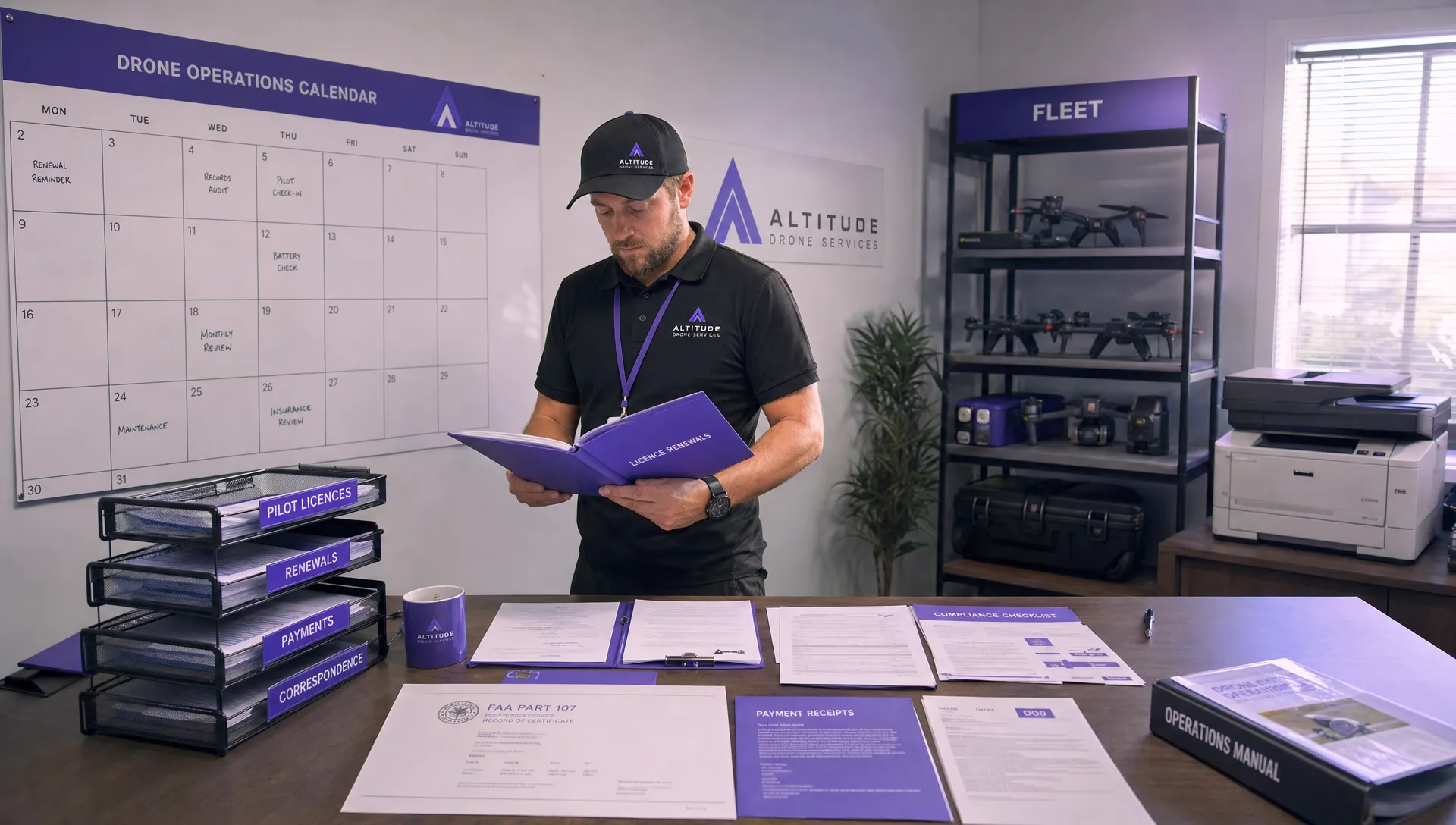
A 2025 Drone Industry Insights report notes that 68% of small operators cite compliance delays as a top barrier to scaling, and average hidden costs reach $2,500 per year per drone due to training, recertification, and audits. The same source notes FAA Part 107 recertification every 24 months costs $175, according to this UAV buyer guide discussion. Those are the kinds of costs sales listings routinely skip.
Compliance starts before first flight
The aircraft is not operational when it arrives. It is operational when your team can fly it legally and repeatedly without administrative friction.
That means checking:
- Pilot qualification requirements: In the US, that frequently means Part 107 readiness and recertification discipline.
- Remote ID status: If the aircraft requires added hardware, the total purchase cost just changed.
- Region-specific rules: EASA and other local frameworks can affect category, operational limits, and documentation.
- Mission-specific permissions: Some jobs need more than basic legal eligibility.
If you import equipment, procurement terms matter too. Teams frequently discover too late that shipping responsibilities, customs handling, and risk transfer were poorly defined in the quote. A plain-English guide to understanding Incoterms is worth reviewing before you commit to an overseas supplier.
Insurance is not an accessory
Insurance does two jobs. It protects the business when something goes wrong, and it protects decision-making before anything goes wrong.
A buyer who skips insurance planning frequently picks an aircraft that is awkward to operate in commercial conditions. You then see risk avoidance in the field. Pilots fly more conservatively than the mission requires, managers hesitate on certain contracts, and high-value work gets declined because the liability picture is unclear.
For a practical look at the types of cover professional operators usually evaluate, this guide to commercial UAV insurance is useful.
What to account for
Insurance planning usually includes these questions:
- Liability cover: What exposure comes with your sites, clients, and operating environment?
- Hull cover: Can you absorb repair or replacement cost without disrupting the business?
- Payload cover: If the sensor is the expensive part, is it protected properly?
- Client requirements: Some contracts specify cover levels or proof of insurance before work begins.
Lifecycle costs cause the most damage
The purchase price is visible. Lifecycle cost is where budgeting discipline matters.
Batteries
Batteries are consumables, not permanent assets.
A team that buys only enough batteries to get through a demo phase often creates a bottleneck immediately. Real work needs charging strategy, rotation discipline, storage care, transport planning, and replacement forecasting. Endurance-heavy aircraft can become operationally clumsy if battery management is poor.
Maintenance and repairs
Professional UAVs need a maintenance routine whether the manufacturer markets them as rugged or not.
That includes inspections, firmware control, prop and airframe checks, wear tracking, transport protection, and a clear process for grounding aircraft when something looks off. If spare parts are slow to source, your cheapest aircraft on paper may become your most expensive aircraft in service.
Software and subscriptions
Many teams price the aircraft and overlook recurring tools around it.
That may include mission planning software, payload software, processing platforms, support contracts, mapping tools, storage, and reporting systems. None of these are optional if the aircraft is tied to a client deliverable.
Tip: Ask every vendor one direct question. “What recurring costs will I still be paying in year two if I keep flying this aircraft at normal commercial volume?”
The cost model that works in practice
When evaluating any uav for sale, build a simple ownership sheet with five lines:
- Acquisition
- Compliance
- Insurance
- Consumables and maintenance
- Software and admin time
This catches weak purchases early. If the aircraft only works when you ignore two of those lines, it is not affordable. It is under-costed.
From Purchase to Operation Integration and Management
A UAV does not become valuable when it is delivered. It becomes valuable when it fits the daily rhythm of your operation without adding chaos.
That sounds obvious, but many teams still buy hardware as if fieldwork ends when the aircraft lands. It does not. You still need logs, pilot records, fleet visibility, maintenance status, client reporting, and a clean way to connect the sortie to the actual job.
The integration gap is where good aircraft underperform.
A 2025 UAV market analysis found that 55% of mid-sized drone teams report losing over 20 hours per week to administrative tasks, with poor API support preventing automated data syncing in many UAV models, according to Skyfront's market analysis summary. For growing teams, that is not a side issue. It is a productivity drain.
Hardware fit is only step one
A strong purchase has support behind it.
Before approving a platform, check how the manufacturer handles:
- Spare parts availability
- Repair turnaround
- Firmware stability
- Payload compatibility updates
- Technical support quality
- Training materials for operators and maintainers
This matters more than glossy brochures suggest. If the aircraft needs specialist knowledge to stay airworthy, you need that knowledge in-house or available quickly from the supplier.
The admin load grows incrementally
A single pilot can get by with a rough system for longer than they should. A team cannot.
Once you have multiple aircraft, multiple clients, or multiple pilots, manual administration starts leaking time everywhere:
- Flight logs live in different places.
- Maintenance status sits in a spreadsheet nobody fully trusts.
- Pilot currency checks become reactive.
- Site planning details go missing between quote and mission day.
- Reports take too long to produce because field records were incomplete.
None of this feels dramatic in isolation. Together, it turns a capable UAV into a hard-to-scale service line.
Key takeaway: The wrong management process can waste more value than the wrong aircraft.
What operationally mature teams do differently
They treat drone operations like a system, not a flying device.
That means the aircraft, payload, pilot, site plan, legal checks, flight records, maintenance status, and client job information all need to connect. If those pieces stay separate, the business pays in rework and avoidable risk.
A practical operating model
A mature workflow usually looks like this:
- Job created with client and site details
- Airspace and location reviewed
- Aircraft and payload assigned
- Pilot and team responsibilities confirmed
- Flight completed with records captured
- Logs, compliance, and reports updated without double entry
That last point is where teams either gain advantage or lose hours.
Why integration should influence procurement
When comparing a UAV for sale, ask operational questions early:
- Can this platform fit our current logging process?
- Does it export useful flight data cleanly?
- Will our team be stuck retyping basic records?
- Can we track maintenance and usage per aircraft?
- Will this become harder when we add more pilots?
These are buying questions, not post-purchase questions.
An aircraft that works well in isolation can still be the wrong commercial choice if it creates admin friction every week. By contrast, a platform that fits your workflow often outperforms a better spec sheet because the team can utilize it at full pace.
A true measure of readiness
A UAV is operationally ready when a pilot can move from scheduled job to completed documentation without inventing steps in the middle.
That means:
- the aircraft is available,
- the payload is configured,
- the crew knows the process,
- the paperwork is current,
- the records flow into the rest of the business.
When those pieces line up, the UAV stops being a technical asset and starts behaving like a business tool.
Your Procurement Checklist and Final Thoughts
A professional UAV purchase should survive one final test. If the aircraft arrived next week, could your team deploy it safely, legally, profitably, and repeatedly without scrambling to fill obvious gaps?
If the answer is not a firm yes, keep evaluating.
The market is moving toward more capable commercial systems. In the Americas, the commercial platform segment comprises over 48% of the UAV market, and VTOL types lead revenue, which shows where professional demand is concentrating, based on the Grand View Research analysis cited earlier. That trend supports one conclusion. Buyers are investing in platforms that can do more, but those platforms demand more disciplined planning too.
Procurement checklist
Mission and revenue fit
- Define the core job: Name the service this UAV will perform most often.
- Match the payload first: Confirm the aircraft supports the sensor that generates deliverables.
- Reject edge-case buying: Do not buy for rare future work if it weakens today’s main operation.
Platform and field suitability
- Choose the right airframe: Multi-rotor for hover and tight access, fixed-wing for coverage, hybrid VTOL for mixed demands.
- Check site realities: Launch area, transport constraints, crew requirements, and environmental conditions all matter.
- Look past brochure specs: Endurance only helps if the mission profile can use it.
Cost and compliance
- Build a full ownership budget: Include compliance, insurance, batteries, maintenance, repairs, and software.
- Verify legal readiness: Confirm certification, registration, and any required hardware or documentation.
- Review procurement terms: Shipping and import responsibilities should be clear before payment.
Operational readiness
- Check support quality: Parts, repairs, updates, and training should be easy to access.
- Plan the workflow: Logging, maintenance tracking, and reporting need a clear home.
- Think about scale: If you add more aircraft or pilots, the system should get better, not messier.
Final takeaway: The best uav for sale is not the one with the most dramatic spec sheet. It is the one your team can keep flying, keep compliant, and keep profitable over time.
A first major purchase sets habits that last for years. Buy for the operation you want to run, not the listing you want to believe.
If you want a cleaner way to turn new aircraft into a structured, compliant operation, Dronedesk helps professional drone teams manage planning, fleet records, flight logging, reporting, and day-to-day admin in one place. It is a practical fit for solo operators growing up, small teams tightening processes, and larger organizations that need consistent control across multiple pilots and aircraft.
 How to Evaluate a Free Drone Logbook Before Using It →
 FAA Part 107 Test: How to Master Airspace Questions →
 Drone Risk Assessment Controls That Work in the Field →
 FAA Drone License Costs Beyond the Knowledge Test →
 Drone Part 107 Operations: When a Waiver May Be Needed →
 Drone Operating Rules for Managing Contractors and Employees →
 BVLOS Drone Requirements for Building a Safety Case →
 Drone Pilot Test Mistakes That Cost Candidates Marks →
 FAA 107 License vs Part 107 Certificate: What’s the Difference? →
 Drone Airport Rules: A Field Checklist for Site Assessments →