
UAS Practice Exam: Your 2026 Part 107 Study Plan
You've probably got a browser full of tabs open right now. One tab has sample Part 107 questions. Another has a weather guide. A third has a sectional chart you keep meaning to learn properly. You may even have taken a quick uas practice exam already and felt decent about it, right up until a question on airspace or drug and alcohol effects knocked your confidence sideways.
That's normal. The problem isn't usually effort. It's strategy.
Many individuals prepare for the remote pilot knowledge test by hammering question banks until the answer choices start to look familiar. That can help, but it also creates a dangerous kind of confidence. You start recognizing patterns without fully understanding the rules, and the knowledge test itself punishes that fast. Good prep is less about memorizing isolated answers and more about learning how the test is built, what it emphasizes, and how to perform under pressure.
Beyond Memorization A Smarter UAS Exam Strategy
A serious uas practice exam has to match the benchmark set by the FAA. The reference format is 60 multiple-choice questions, two hours, and a 70% passing score, which means 42 correct answers are required, as outlined in the FAA Part 107 exam overview. If the practice test you're using doesn't reflect that structure, it's not preparing you for the job you need to do on test day.
That matters for more than timing. It changes how you study.
A weak prep approach treats the exam like trivia. A stronger one treats it like a professional screening tool. The questions aren't there to see whether you can recite a flashcard. They test whether you can apply rules, interpret weather information, recognize airspace implications, and make judgment calls that align with FAA expectations.
What usually fails
Candidates who struggle often make the same mistakes:
- They memorize answer keys: They know which option looked right in a quiz bank, but they can't explain why.
- They study evenly across all topics: That feels organized, but the exam isn't evenly weighted.
- They practice casually: Open-book quizzes at the kitchen table don't resemble a proctored testing center.
- They ignore version drift: Old prep materials can train you for an outdated format.
Practical rule: If your study method doesn't improve your judgment, it's probably only improving your recognition.
What actually works
The better framework is simple. Learn the blueprint. Practice under realistic conditions. Review misses by topic, not by emotion. Then tighten weak areas until they stop showing up.
That approach does two things at once. It helps you pass the test, and it turns exam prep into operational knowledge you'll use later when a client asks whether a flight is legal, practical, or smart.
Decoding the Exam Blueprint What Your UAS Test Covers
The fastest way to waste study time is to treat every topic as equal. They aren't. The FAA-aligned weighting for the Part 107 knowledge exam is summarized as Regulations 15 to 25%, Airspace 15 to 25%, Weather 11 to 16%, Loading and Performance 7 to 11%, and Operations 35 to 45%, according to this Part 107 knowledge test breakdown.
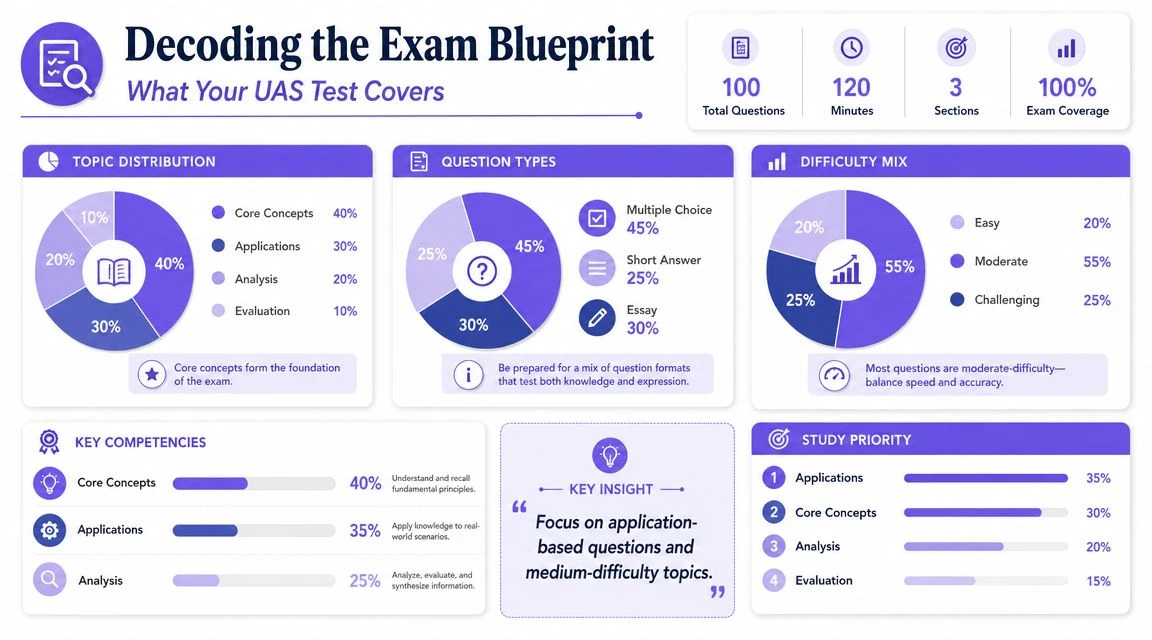
That tells you something important immediately. Operations is the biggest domain. Regulations and Airspace also carry major weight. If your study plan gives the same attention to every chapter, you're not studying in the same proportions the exam uses.
Part 107 knowledge area breakdown
| Knowledge Area | Exam Weight (%) | Key Subtopics |
|---|---|---|
| Regulations | 15–25% | Operating rules, remote pilot eligibility, night operations, visual line of sight, moving-vehicle restrictions |
| Airspace | 15–25% | Sectional chart reading, airport operations, radio communication procedures, controlled airspace interpretation |
| Weather | 11–16% | METARs, weather effects on small UAS, aeronautical decision-making tied to conditions |
| Loading and Performance | 7–11% | Aircraft performance, loading effects, maintenance awareness, preflight considerations |
| Operations | 35–45% | Emergency procedures, crew resource management, physiological effects of drugs and alcohol, maintenance and preflight inspection procedures |
Regulations means rule logic, not rule recitation
A lot of students read the regulations section like it's a legal glossary. That's the wrong approach. On the test, regulations usually matter in context. Can you identify whether a planned flight fits operational limits? Can you spot when a scenario conflicts with pilot responsibilities or operating restrictions?
That's how working pilots use the material too. A roof inspection, utility survey, or media shoot doesn't begin with abstract legal theory. It begins with a go or no-go decision.
If you want a business-side example of why this matters, see how operators use drones for winning bids. The technical questions on the exam connect directly to real client work because legal and safe planning is part of professional credibility.
Airspace is applied chart reading
Airspace questions punish shallow study. Memorizing chart symbols in isolation won't get you far. You need to look at a chart, identify what airspace you're dealing with, and understand what that means operationally.
That includes airport awareness, communication expectations, and whether a mission is feasible without changing the plan. When students miss these questions, it's usually because they studied labels instead of decisions.
The exam doesn't care whether you stared at a sectional chart for hours. It cares whether you can use one.
Weather is a decision tool
Weather prep isn't about becoming a meteorologist. It's about recognizing what weather information means for a small UAS flight. If METAR decoding is one of your weak points, this guide on how to read METAR reports is worth working through slowly.
Questions in this domain often expose a bigger issue. Some pilots can repeat acronyms but can't connect weather data to aircraft performance or risk. That's exactly what the test is looking for.
Operations is where strong candidates separate themselves
Because Operations carries the largest share of the exam, it deserves the largest share of your effort. This category often includes the details many people leave until late: emergency procedures, crew resource management, aeronautical decision-making, airport operations, maintenance, and preflight inspection habits.
Those aren't filler topics. They reflect how the FAA expects a remote pilot to think. If your uas practice exam results keep slipping because of these scenario-based questions, stop collecting more quizzes and start tightening your judgment.
How to Build Your Perfect Practice Environment
A lot of candidates sabotage themselves by practicing in comfort and testing in stress. That gap shows up on score day.
The official knowledge test is administered at an FAA-approved testing center, not at home, so your prep should mimic a closed-book, timed, single-session environment, as explained in this FAA-linked practice test guidance. If you always practice with notes open, phone nearby, and unlimited pauses, you're building habits the official knowledge test won't allow.

Build the room before you build confidence
Treat your practice session like an appointment, not a casual study block.
- Choose a quiet space: No music, no videos in the background, no interruptions.
- Use one sitting: Start the test and finish it without wandering off.
- Remove your safety nets: Close tabs, put away guides, silence the phone.
- Use basic tools only: Keep your materials limited to what helps you think clearly without turning the session into an open-book exercise.
Pressure changes performance. Consequently, pilots who know the material often still underperform when they haven't trained their pacing or concentration.
Match the feel of test day
The biggest psychological benefit of a full-length practice exam is stamina. You're not just answering questions. You're learning how your mind behaves when question after question asks for disciplined recall and judgment.
Here's a practical setup I recommend to students:
- Start at the same time of day you expect to test if possible.
- Use a visible timer so you can monitor pace without checking your phone.
- Sit at a desk or table, not on a couch.
- Finish every question in one session, even if you feel rough halfway through.
- Review only after the timer ends.
Your goal is to remove surprises. The testing center should feel familiar because you already rehearsed the conditions.
Practice tools that support the process
Digital tools can help, but they need to support disciplined prep rather than replace it. Some pilots use a notebook or spreadsheet for an error log. Others use planning software to stay organized around study sessions, flight knowledge, and operational workflows. For pilots who already want structure around their flight operations, Dronedesk's flight simulator article is a useful companion when you're pairing knowledge prep with procedural rehearsal.
What doesn't work is stacking random quiz apps and hoping volume solves the problem. Precision beats volume almost every time.
A Realistic UAS Practice Test With Annotated Answers
The point of a sample uas practice exam isn't to prove you're ready. It's to expose how you think. The ten questions below are written in the style of the actual test: short, practical, and designed to check whether you understand the rule or principle behind the answer.
Answer them first without looking at the explanations.
Sample questions
-
A remote pilot is planning a commercial flight and wants to improve their odds of passing the FAA knowledge exam. Which practice format best mirrors the standard test environment?
A. A short untimed quiz completed over several study sessions
B. A full-length timed exam completed in one sitting
C. An open-book worksheet completed with online references -
Which knowledge area generally deserves the greatest share of study time because it carries the largest exam weight?
A. Operations
B. Loading and Performance
C. Weather -
A pilot keeps missing questions on sectional charts. What is the strongest next step?
A. Keep retaking the same mixed quiz until the score rises
B. Focus review on the airspace topic and practice chart interpretation directly
C. Skip airspace and strengthen easier subjects instead -
A practice bank advertises itself using older Part 107-era expectations and doesn't clearly reflect current FAA sample material. What is the main risk?
A. The questions may build false confidence if they don't match the current structure
B. The questions will automatically be harder than the official test
C. The FAA won't allow you to take the official exam -
Why is memorizing isolated answer choices a weak method for exam prep?
A. The exam uses essay responses
B. The test rewards concept application, not just recognition
C. The FAA publishes the exact live answer key elsewhere -
A pilot takes a practice exam with notes open and pauses often to look up unfamiliar terms. What is the biggest downside?
A. It improves endurance too quickly
B. It creates a practice environment that doesn't resemble the proctored test
C. It causes sectional chart questions to disappear from the test -
Which topic pair can account for a large portion of the exam when combined?
A. Weather and Loading and Performance
B. Regulations and Airspace
C. Operations and Weather -
A student wants to improve after a disappointing practice score. Which review method is strongest?
A. Check the score, feel discouraged, and move to a new test
B. Review only the questions answered correctly to reinforce confidence
C. Map missed questions to subject areas and study by weakness pattern -
Why should a candidate care whether a uas practice exam reflects the current UAG sample set?
A. Because current FAA-aligned materials are more relevant than legacy prep banks
B. Because the FAA grades older resources more harshly
C. Because UAG removes the need to study regulations -
A pilot wants a final review method before test day. Which choice is most effective?
A. Broadly reread everything from the beginning
B. Target recurring weak areas from the error log and verify materials are current
C. Avoid all practice tests to stay fresh
Annotated answers
1. Correct answer: B A strong practice exam should mirror the actual test structure and pressure. A full-length timed session builds pacing, concentration, and recall under realistic conditions. Why the others are wrong:
- A fragments the experience and removes stamina pressure.
- C may help while learning, but it doesn't simulate test conditions.
2. Correct answer: A
Operations is the largest weighted knowledge area in FAA-aligned prep materials, so it should command the largest share of focused study.
Why the others are wrong:
- B matters, but it has a smaller weight.
- C is important, but it isn't the largest domain.
3. Correct answer: B
This is what professional review looks like. If you miss sectional chart questions, isolate the airspace domain and work directly on chart interpretation.
Why the others are wrong:
- A can inflate familiarity without fixing the root issue.
- C avoids a weakness instead of solving it.
4. Correct answer: A Outdated prep materials can train you against the wrong assumptions. The actual danger is false confidence, not automatic difficulty. Why the others are wrong:
- B isn't guaranteed. Older material may be easier, harder, or merely mismatched.
- C is false. Study resources don't determine exam eligibility.
5. Correct answer: B
The exam is built around aeronautical knowledge and operational judgment. Recognition helps a little. Understanding is what carries your score.
Why the others are wrong:
- A is plainly false because the test uses multiple-choice questions.
- C is also false. You should never expect verbatim live items from a practice bank.
Study the reason an answer is right, then study why the distractors looked tempting. That's how you get better fast.
6. Correct answer: B
Open-note pausing can be useful during learning sessions, but it's weak exam simulation. It removes the pressure and discipline of a closed-book session.
Why the others are wrong:
- A doesn't happen. It usually masks endurance problems.
- C is nonsense. Practice behavior doesn't change exam content.
7. Correct answer: B
Regulations and Airspace together can make up a major share of the exam, which is why those areas deserve structured study rather than casual review.
Why the others are wrong:
- A combines smaller domains.
- C includes the largest area plus another important one, but the commonly emphasized paired share is Regulations plus Airspace.
8. Correct answer: C
This is the strongest review method because it turns a score into a study plan. You stop guessing what to do next and start working by pattern.
Why the others are wrong:
- A wastes the data you just collected.
- B may feel good, but it doesn't address weakness.
9. Correct answer: A
Pilots need current FAA-aligned prep, especially as materials shift toward the UAG structure. Relevance matters more than volume.
Why the others are wrong:
- B has no basis.
- C is false. Regulations remain central.
10. Correct answer: B
Late-stage prep works best when it's targeted. Tighten recurring weak areas and confirm your materials are current.
Why the others are wrong:
- A sounds productive but usually spreads attention too thin.
- C removes one of the best feedback tools you have.
How to use these questions properly
Don't score this set and move on. Mark which misses came from misunderstanding the rule, rushing the wording, or falling for a distractor. Those are different problems, and they require different fixes.
Scoring Yourself and Tracking Your Progress
Most students focus too hard on the raw score from a practice test. The score matters, but the pattern matters more. A passing-looking result can still hide a real weakness in airspace or operations, and that weakness can cost you on test day if the mix shifts against you.
The better method is simple and repeatable. Take a baseline exam before studying, map missed questions to subject areas, prioritize high-frequency weak domains, and then retake a practice exam to verify improvement, as outlined in this Part 107 study method.

Build a usable error log
Keep this plain. A notebook works. A spreadsheet works too. The format matters less than the consistency.
Track each missed question with a few fields:
- Question topic: Airspace, weather, regulations, operations, or loading and performance
- Specific concept: For example, sectional chart interpretation or crew resource management
- Why you missed it: Didn't know it, misread it, guessed, or changed the right answer
- Fix required: Re-read FAA material, do chart drills, review weather decoding, or retest later
That last field is where progress happens. It forces you to assign a correction, not just record the mistake.
Review by cluster, not by emotion
A frustrating miss can feel larger than it is. The error log keeps you honest. If you miss one oddball question but keep dropping airspace items, your next study block should go to airspace.
Use your results to sort weak areas into three buckets:
-
Immediate risk areas
These are recurring misses in heavily tested domains. Fix them first. -
Secondary weaknesses
These matter, but they don't need to displace the biggest score leaks. -
One-off mistakes
Review them, but don't overreact if they aren't repeating.
Review note: A practice exam is only valuable if it changes what you study next.
When to retest
Retest after you've done focused review, not immediately after seeing a bad result. If you retake too quickly, memory can disguise whether you understood the concept.
Use the second attempt to answer one question only: did the weakness shrink?
If yes, keep going. If not, change the study method, not just the study volume.
Final Checks Closing Knowledge Gaps Before Test Day
The last stretch before the exam isn't the time for random studying. It's the time for cleanup. Pull out your error log and look for repeats. If the same kind of miss keeps showing up, that's the issue that deserves your final attention.
Targeted review is always more effective than broad review. Re-reading entire guides can feel productive, but it often protects your comfort zones instead of fixing your weak spots. If METARs still trip you up, review METARs. If you're slow on chart questions, do chart work. If you keep missing operations scenarios, tighten your rule logic and decision-making.
Verify that your materials are current
One of the biggest mistakes I see is candidates using stale prep material and assuming all Part 107 practice is interchangeable. It isn't. A major gap in test prep is failing to recognize the shift toward the Unmanned Aircraft General (UAG) structure. The current FAA sample set for the Remote Pilot Certificate consists of a 60-question set, and modern prep should align with that, as shown in the FAA UAG sample questions.
That doesn't mean every older explanation is useless. A lot of core aeronautical knowledge still transfers. But old question banks can frame the exam incorrectly, emphasize the wrong expectations, or leave you practicing against a version of the test that no longer matches current FAA materials closely enough.
What to do in the final review window
Keep your last review phase tight and deliberate.
- Check your source materials: Make sure your primary practice set reflects current FAA-aligned expectations.
- Prioritize FAA material over third-party shortcuts: Use outside quizzes as supplements, not as the final authority.
- Revisit your highest-risk misses: Focus on recurring errors, not random details.
- Avoid score chasing: Don't keep taking new quizzes just to feel busy.
- Use one reliable study reference for cleanup: This Part 107 study guide is a solid place to consolidate core topics before test day.
The final goal isn't to feel ready. It's to remove the specific reasons you might fail.
A good uas practice exam strategy doesn't end with a decent score. It ends when you know your weak areas, your materials are current, and the testing environment won't feel unfamiliar. That's the difference between hoping you pass and showing up prepared to do it.
If you're building a professional drone operation, passing the exam is only one step. Dronedesk helps pilots and teams manage planning, logging, compliance, airspace awareness, assets, and operational admin in one system, which makes it a practical next step once your certificate is in hand.
 BVLOS Drone Requirements for Building a Safety Case →
 Drone Pilot Test Mistakes That Cost Candidates Marks →
 FAA 107 License vs Part 107 Certificate: What’s the Difference? →
 Drone Airport Rules: A Field Checklist for Site Assessments →
 FAA Part 107 Record-Keeping Rules for Commercial Teams →
 How to Review a DJI Flight Log After an Unexpected Event →
 Drone Laws Around the World: A Pre-Flight Research Framework →
 How to Compare Drone Survey Services for Complex Sites →
 How to Start a Drone Mapping Business With a Clear Workflow →
 Class C Airspace Drone Rules for Commercial Flights →