
UAS Fleet Management Tips for Safer Multi-Pilot Operations
Multi-pilot drone operations rarely become unsafe because one person forgets how to fly. Problems usually appear in the gaps between people: a pilot assumes a site has already been checked, a battery issue is not passed on, a risk assessment is copied without the latest hazards, or two teams plan work using different versions of the same job information.
That is why UAS fleet management is a safety discipline, not just an admin task. As soon as you manage multiple pilots, aircraft, payloads, clients and sites, you need a repeatable system that gives every crew the same operational picture before, during and after the flight.
Below are practical tips for safer multi-pilot operations, written for commercial drone operators, survey teams, utilities and emergency services that need to scale without losing control of compliance, asset readiness or decision quality.
Why multi-pilot UAS fleet management needs a safety-first mindset
A solo operator can keep a lot in their head. A multi-pilot organisation cannot. Once several crews are working across different locations, safety depends on shared records, clear ownership and consistent procedures.
In the UK, the Civil Aviation Authority expects operators to understand their responsibilities, assess risks and operate within the rules for their category of operation. The UK CAA’s drone guidance is a useful starting point for regulatory context, but compliance in the field still comes down to day-to-day operational control.
The bigger your UAS fleet becomes, the more you need to manage:
- Which pilots are assigned, available and appropriately briefed.
- Which aircraft, batteries and payloads are suitable for the job.
- Which airspace, proximity and ground hazards affect the site.
- Which risk controls are required for that specific mission.
- Which logs, incidents and maintenance actions must be recorded afterwards.
If any of those records live in separate spreadsheets, email threads or individual notebooks, your team is relying on memory and luck. A safer approach is to make fleet management part of the operational workflow.
1. Create one source of truth for every operation
The first rule of safer multi-pilot fleet management is simple: everyone should be working from the same information.
For a survey company, that might mean ensuring the pilot, project manager and data team all see the same site address, client brief, airspace notes and required deliverables. For a utility company, it could mean linking inspection locations to the correct aircraft, payload and access constraints. For emergency services, it means crews need rapid access to mission-critical details without searching through scattered documents.
A single source of truth should cover the job, the people, the aircraft, the site, the risk controls and the post-flight record. It does not remove the need for professional judgement, but it reduces the chance that pilots make decisions from incomplete or outdated information.
| Multi-pilot risk | Typical symptom | Safer fleet management control |
|---|---|---|
| Conflicting job information | Different pilots use different site notes | Centralise the job record and planning documents |
| Unknown aircraft status | A pilot discovers an issue on site | Keep fleet records current before allocation |
| Inconsistent risk assessments | Each pilot uses a different template | Standardise risk assessment structure and review points |
| Missing post-flight evidence | Logs are delayed or incomplete | Make flight logging part of the close-out process |
| Weak operational oversight | Managers cannot see workload or trends | Review planning, fleet and flight data regularly |
This is also where a dedicated operations platform can help. Dronedesk brings client management, fleet management, team management, flight planning, flight logging, data reporting, configurable checklists and risk assessments into one web platform, helping teams keep operational records connected rather than spread across disconnected tools.
2. Define roles before the aircraft is assigned
In multi-pilot operations, safety can break down when responsibility is implied rather than explicit. Before planning begins, make it clear who owns each part of the operation.
The remote pilot may be responsible for the safe conduct of the flight, but that does not mean they should also be the only person managing client changes, airspace checks, equipment readiness, site access and post-flight reporting. Larger teams need role clarity so that no critical task is missed and no one assumes someone else has done it.
A simple role structure might include:
| Role | Primary safety responsibility | Record that should be visible |
|---|---|---|
| Operations lead | Approves the job workflow and resource allocation | Job plan, assigned crew and authorisation status |
| Remote pilot | Conducts the flight safely and follows agreed controls | Briefing, risk assessment and flight log |
| Observer or visual observer | Supports situational awareness and communication | Crew briefing and communication plan |
| Fleet or equipment owner | Confirms aircraft and payload readiness | Aircraft, battery and equipment records |
| Client or project lead | Confirms scope, access and deliverables | Client brief, site requirements and contacts |
The point is not to add bureaucracy. It is to ensure every safety-critical task has an owner and every owner has access to the information they need.
3. Standardise the pre-flight planning pack
A consistent planning pack is one of the easiest ways to improve safety across multiple pilots. It gives every crew a familiar structure, which reduces cognitive load and makes omissions easier to spot.
For most commercial UAS work, a robust planning pack should include site details, client requirements, airspace considerations, proximity hazards, weather assumptions, crew roles, aircraft and payload allocation, risk assessment, emergency procedures and communication arrangements.
The exact content will vary by operation. A roof survey in a congested area has different concerns from a rural infrastructure inspection. A police deployment will have different urgency and command requirements from a scheduled mapping job. But the structure should remain consistent enough that pilots do not have to reinvent the planning process every time.
Dronedesk includes flight planning, airspace intelligence and proximity intelligence as part of its feature set, which is useful for teams that need to bring planning inputs into a repeatable workflow. The key safety principle is that every pilot should be guided through the same planning logic, while still being required to assess the specific site in front of them.
4. Treat aircraft, batteries and payloads as go or no-go decisions
Fleet management is often treated as an asset register. For safer UAS operations, it needs to be more than a list of drones.
Before a pilot is assigned to a mission, the team should know whether the selected aircraft is appropriate, available and in a fit condition for the task. The same applies to batteries, controllers, sensors, parachute systems, lights, charging equipment and any mission-specific payloads.
This becomes especially important for survey and utility work, where payload selection affects data quality as well as safety. A thermal inspection, photogrammetry flight and close visual inspection may require different aircraft configurations, different crew experience and different contingency planning.
Good fleet discipline answers four questions before the aircraft leaves base:
- Is this aircraft suitable for the environment, payload and mission profile?
- Are there any open defects, maintenance concerns or usage limits to consider?
- Are batteries and accessories available, charged and traceable?
- Has the pilot been briefed on the exact configuration being used?
If those answers are not recorded somewhere accessible, the operation is relying on informal knowledge. That might work for two pilots in one office, but it rarely scales safely.
5. Use checklists, but do not let them become box-ticking
Checklists are essential in aviation because they reduce variation. However, a checklist only improves safety if it prompts meaningful action.
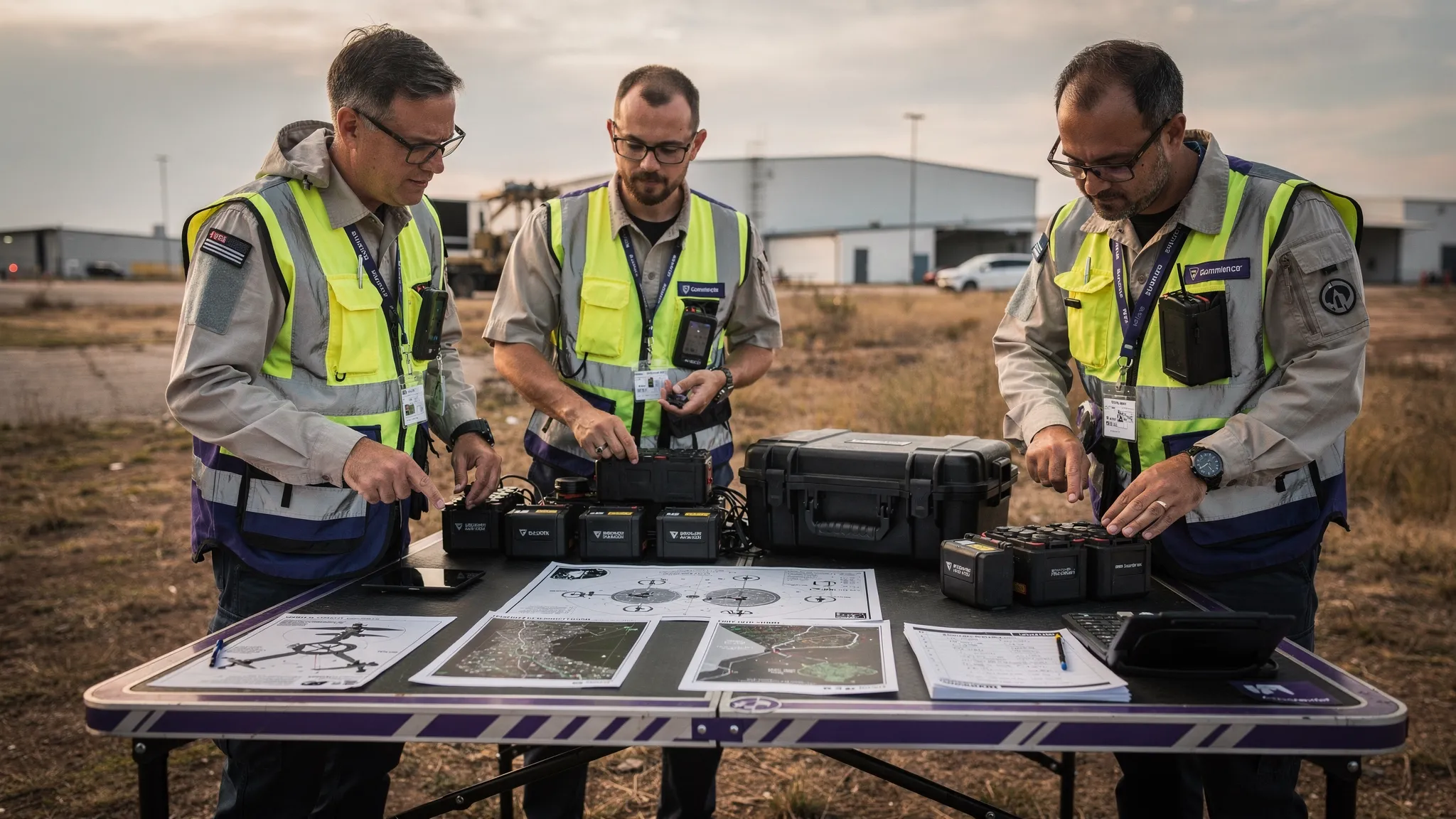
In UAS fleet management, checklists should support each phase of the operation: job acceptance, planning, site arrival, pre-flight, flight, abnormal situations and post-flight close-out. They should also be configurable enough to reflect different mission types. An emergency response deployment, quarry survey and urban roof inspection should not all be forced through an identical checklist if their hazards and controls differ.
The danger is checklist fatigue. If pilots are asked to complete long, generic lists that do not match the job, they may rush through them. Safer checklist design is specific, concise and reviewed regularly.
A useful test is to ask: “Would this checklist help a competent pilot catch a real-world mistake before it becomes a safety issue?” If the answer is no, simplify or redesign it.
Dronedesk includes configurable checklists and risk assessments, which can help operators standardise safety processes without forcing every mission into the same template.
6. Make risk assessments site-specific, not just template-specific
Templates are helpful, particularly for repeatable work such as construction progress surveys, infrastructure inspections or media shoots. But the risk assessment still needs to reflect the actual site, date, crew, aircraft and operating conditions.
Multi-pilot teams are especially vulnerable to “template drift”, where an assessment is copied from a previous job and gradually becomes less relevant. The more often a template is reused, the more important it is to challenge its assumptions.
A safer approach is to separate baseline hazards from site-specific hazards. For example, your baseline process may cover standard controls for people, property, take-off areas, lost link procedures and emergency actions. The site-specific review then asks what is different today: temporary works, livestock, public events, road closures, poor GNSS conditions, nearby cranes, emergency activity or unexpected access limitations.
Risk assessments should also be easy to review after the job. If a pilot identifies a new hazard on site, that learning should feed back into future planning rather than staying in one person’s memory.
7. Build better handovers between pilots and teams
Handovers are one of the most underestimated safety controls in multi-pilot operations. They matter when crews rotate during a long task, when a project spans several days, when a different pilot returns to the same site, or when an operations manager passes a job to a field team.
A good handover should explain what has changed, not just repeat what is already in the plan. The next pilot needs to know whether the client scope changed, whether a landowner raised concerns, whether a battery or aircraft behaved unexpectedly, whether weather assumptions still hold, and whether any risk controls need updating.
For emergency services, handovers may happen under pressure. For utilities, they may involve remote sites and specialist access requirements. For survey companies, they may affect data consistency and re-flight decisions. In every case, the handover should be written or logged clearly enough that the next person can act without guesswork.
Technology can support this by making decisions and updates visible to the whole team. The same principle appears in wider civic technology projects focused on technology-driven transparency, where shared records and clear decision trails help people understand what was decided, by whom and why. In UAS operations, that transparency supports accountability, safer decisions and better continuity between crews.
8. Log flights promptly and capture the decisions around them
A flight log should be more than a compliance afterthought. It is the operational memory of your fleet.
At a basic level, logs should show who flew, when, where, with which aircraft and for what purpose. For safety management, they should also help you understand what happened around the flight: delays, aborted missions, abnormal events, equipment concerns, weather deviations, client changes and lessons learned.
Prompt logging matters because details fade quickly. If a pilot waits until the end of the week to record five jobs, the log may be technically complete but operationally weak. Encourage close-out while the flight is still fresh, particularly where a decision could affect future missions.
Dronedesk includes flight logging and data reporting, which supports a more joined-up approach between planning, execution and review. For growing teams, this helps turn individual flight records into fleet-level insight.
9. Review fleet data as a safety management tool
Safer UAS fleet management improves over time. The best teams do not just record data, they review it.
A monthly or quarterly fleet review can reveal patterns that are hard to see at job level. You might find that one site type generates most aborted flights, one aircraft has recurring issues, one checklist is regularly skipped, or one team is carrying a disproportionate workload.
Useful review metrics include:
| Metric | What it can reveal | Possible action |
|---|---|---|
| Planned versus completed flights | Operational friction, weather sensitivity or poor scoping | Improve planning assumptions or client communication |
| Aborted or delayed flights | Site access, airspace, equipment or weather issues | Update pre-flight checks and briefing requirements |
| Open equipment issues | Maintenance pressure or poor defect reporting | Tighten aircraft status controls |
| Late flight logs | Weak close-out discipline | Make logging part of the operational workflow |
| Repeated risk controls | Common hazards by site or client type | Improve templates and pilot briefings |
| Pilot workload | Fatigue or resource imbalance | Rebalance scheduling and review team capacity |
This is where fleet management becomes strategic. Instead of reacting to individual problems, you can identify systemic risk and improve the way the whole operation works.
10. Keep the system simple enough for pilots to use
The safest process is not always the most complicated one. If your UAS fleet management system is too slow, too fragmented or too difficult to use in the field, pilots will find workarounds. Those workarounds create blind spots.
Good systems make the safe action the easy action. They reduce duplication, keep records close to the job and support pilots before they are on site. They also respect the reality of drone work: changing weather, changing clients, remote locations, time pressure and field conditions that are rarely perfect.
For teams moving beyond spreadsheets, it is worth reviewing how your tools support the full operational cycle. Dronedesk’s features cover client management, fleet management, team management, airspace and proximity intelligence, flight planning, flight logging, data reporting, configurable checklists and risk assessments. If you are comparing approaches more broadly, the Dronedesk guide to drone fleet management explores how growing operations can structure people, assets and compliance more effectively.
A 30-day reset for safer multi-pilot operations
If your team is already flying but your management process feels stretched, do not try to fix everything at once. Start with a focused 30-day reset.
| Timeframe | Action | Safety benefit |
|---|---|---|
| Week 1 | Audit where job, pilot, aircraft and risk records currently live | Identifies fragmentation and duplicated admin |
| Week 2 | Standardise the minimum planning pack for every mission type | Gives pilots a consistent briefing structure |
| Week 3 | Review fleet status, equipment records and handover process | Reduces aircraft readiness and continuity risks |
| Week 4 | Tighten flight logging and introduce a monthly safety review | Turns records into operational learning |
By the end of the month, you should have clearer ownership, fewer disconnected records and a more reliable picture of your fleet. That alone can reduce many of the everyday risks that appear when teams grow.
Frequently Asked Questions
What is UAS fleet management? UAS fleet management is the process of managing drone aircraft, pilots, payloads, planning records, risk assessments, flight logs and operational data in a structured way. For multi-pilot teams, it ensures people, assets and compliance information stay connected.
Why is fleet management important for multi-pilot drone operations? Multi-pilot operations create more handovers, more equipment movements and more opportunities for inconsistent planning. Fleet management reduces those risks by standardising records, clarifying responsibilities and making aircraft, pilot and job information visible.
What should be included in a multi-pilot drone handover? A good handover should include job status, site changes, client updates, aircraft or battery concerns, weather assumptions, access issues, completed tasks, outstanding actions and any new hazards identified during the operation.
Can small drone teams benefit from UAS fleet management software? Yes. Even a small team can quickly outgrow spreadsheets if pilots are working on different sites or sharing aircraft. Software becomes especially useful when you need consistent planning, shared records, clear risk assessments and reliable flight logs.
How does Dronedesk support safer fleet management? Dronedesk provides an all-in-one web platform for drone operations management and flight planning. Its features include client management, fleet management, team management, airspace intelligence, proximity intelligence, flight planning, flight logging, data reporting, configurable checklists and risk assessments.
Make multi-pilot operations safer and easier to manage
Scaling a drone team should not mean accepting more admin, more uncertainty or more safety risk. With the right UAS fleet management process, every pilot can work from the same operational picture, every aircraft can be managed with better visibility and every flight can leave a clearer audit trail.
If your current process relies on spreadsheets, email chains or duplicated documents, it may be time to bring your operations into one place. Explore Dronedesk and see how a connected approach to planning, fleet records, risk assessments, checklists and flight logs can support safer multi-pilot drone operations.
 Drone Operating Rules for Managing Contractors and Employees →
 BVLOS Drone Requirements for Building a Safety Case →
 Drone Pilot Test Mistakes That Cost Candidates Marks →
 FAA 107 License vs Part 107 Certificate: What’s the Difference? →
 Drone Airport Rules: A Field Checklist for Site Assessments →
 FAA Part 107 Record-Keeping Rules for Commercial Teams →
 How to Review a DJI Flight Log After an Unexpected Event →
 Drone Laws Around the World: A Pre-Flight Research Framework →
 How to Compare Drone Survey Services for Complex Sites →
 How to Start a Drone Mapping Business With a Clear Workflow →