
UAV Drone Canada Guide 2026: Rules for Flying Safely
Thinking about flying a drone for work in Canada? Great. But before you even think about powering up, you need a solid mission briefing on the rules. Whether you call it a UAV, a drone, or the official term, Remotely Piloted Aircraft System (RPAS), it all boils down to one thing: know the rules before you fly.
Let's cut through the jargon and get you a clear picture of what it takes to operate professionally and safely in Canada.
Your Guide to Canadian Drone Ops in 2026
The Canadian drone scene is booming. It's not just a hobbyist's playground anymore; this is serious business with massive potential.
This isn't just about dodging fines. It's about operating professionally to tap into a rapidly growing market. We're talking big numbers—the Canadian drone market was valued at USD 4.73 billion in 2024 and is on track to hit USD 9.20 billion by 2030. Unit sales are climbing even faster, projected to jump from 610,000 in 2024 to a staggering 1.48 million by 2030.
With that kind of growth, understanding the regulatory landscape isn't just important; it's fundamental to your success.
Basic vs Advanced: The First Big Decision
Every flight you plan in Canada will fall into one of two buckets defined by Transport Canada: Basic Operations or Advanced Operations. This is the first and most important decision you'll make for any mission, as it shapes everything that follows—the pilot certificate you need, the drones you can fly, and exactly where you can fly them.
The simplest way to think about it comes down to risk. Basic operations are for low-risk flights, far away from people and in wide-open, uncontrolled airspace. Advanced operations cover everything else—flights in more complex, controlled, or populated areas.
Getting this right is crucial. It dictates your entire workflow, from training and certification to the nitty-gritty of your pre-flight planning. A quick glance at a drone restrictions map will give you a real-world view of how these rules play out on the ground.
Drone Operations At a Glance
To make it even clearer, here’s a quick rundown of the two categories. Think of this table as your cheat sheet before we dive deeper into what each of these requirements really means for your day-to-day operations.
| Requirement | Basic Operations | Advanced Operations |
|---|---|---|
| Airspace | Uncontrolled airspace only | Controlled and uncontrolled airspace |
| Proximity to People | Never over bystanders; >30m away | Can fly closer to or over bystanders |
| Pilot Certificate | Small Basic Exam (online) | Small Advanced Exam + Flight Review |
| Drone Safety Markings | Not required | Required for controlled airspace flight |
| Site Survey | Required to confirm rules are met | Detailed, comprehensive survey required |
This division is the bedrock of Canadian drone law. Now that you have the big picture, we can start breaking down what it takes to get certified and airborne, no matter which category your work falls into.
Navigating Transport Canada's Core Regulations
If you're flying a drone in Canada, your rulebook comes directly from Transport Canada. The whole system is laid out in Part IX of the Canadian Aviation Regulations (CARs), which is the section built from the ground up for Remotely Piloted Aircraft Systems (RPAS). Think of CARs Part IX as the law of the land—or sky, in this case.
These rules aren’t meant to be a maze, but they are strict. The goal is simple: keep people on the ground and other aircraft in the sky safe. The very first thing you need to get your head around is that every single flight you plan will fall into one of two buckets: Basic Operations or Advanced Operations.
The Two Paths: Basic Versus Advanced
Picking between Basic and Advanced is the first fork in the road for any mission. Your choice determines the pilot certificate you need, the specific rules you’ll follow, and where you can actually fly. The big decider here is risk, which Transport Canada mainly boils down to how close you are to people and what kind of airspace you’re in.
It's a bit like getting a driver's license. A Basic certificate is your standard car license—great for simple drives on quiet, rural roads. An Advanced certificate is more like a commercial truck license, the one you need for complex jobs in busy downtown cores or near airports where things can get crowded.
This isn't just a friendly suggestion; it's the heart of your responsibility as a pilot. Getting this wrong can lead to some serious penalties, so it's the first thing any professional drone operator in Canada needs to nail down.
This decision tree breaks down the fundamental question that splits most Basic flights from Advanced ones.
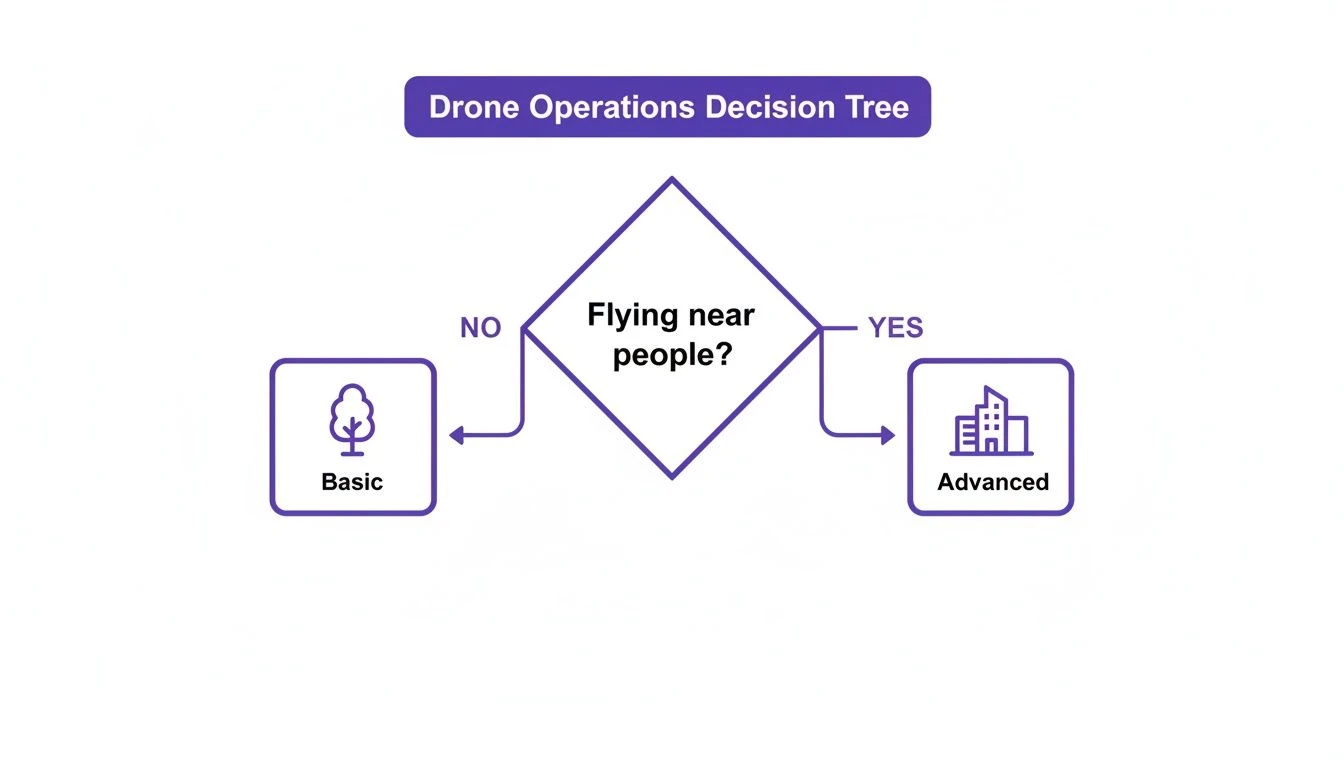
As you can see, the moment bystanders enter the picture, you're almost always pushed into the Advanced category.
Defining Basic Operations
Basic Operations are all about low-risk flying. To stay in this category, your flight has to tick all of these boxes, no exceptions. You must be flying:
- In uncontrolled airspace, where there's no active air traffic control.
- More than 30 metres (100 feet) away from any bystanders, horizontally.
- Never directly over bystanders. Not for a second.
It’s also worth noting that if your drone doesn't have a manufacturer's safety declaration on it, you’re automatically stuck in the Basic category, even if you have an Advanced Pilot Certificate. These kinds of flights are your bread and butter in rural areas—think farm surveys or inspecting a pipeline miles from anyone.
Understanding Advanced Operations
If your flight plan can't meet even one of the conditions for Basic, you've automatically leveled up to an Advanced Operation. This is where the risk is higher, and so are the requirements for you and your gear.
You're in the Advanced world if you plan to fly:
- In controlled airspace (like the area around an airport).
- Over bystanders.
- Closer than 30 metres (100 feet) to bystanders.
Flying within 5.6 kilometres (3 nautical miles) of an airport or 1.9 kilometres (1 nautical mile) of a heliport also puts you squarely in the Advanced camp. These missions demand more skill, a far more detailed site survey before you even think about taking off, and often a drone with a specific safety assurance from the manufacturer. Our in-depth guide to commercial drone compliance goes into more detail on the planning these flights require.
Getting these two categories straight is the first real step to becoming a competent, compliant pro. It ensures you get the right certificate and follow the right steps on every job, which protects your business, your clients, and the public. For anyone serious about flying a drone in Canada, this knowledge is absolutely non-negotiable.
How to Become a Certified Drone Pilot in Canada
So, you're ready to fly drones professionally in Canada? Getting certified by Transport Canada is your first official step. It’s the process that proves you know the rules of the sky and can operate safely and legally.
The journey for any pilot flying a drone between 250g and 25kg begins at one place: the Drone Management Portal. Think of this as your personal command center for everything related to your drones and your pilot certificate.
Before you can even think about an exam, you have to register your drone. You'll do this through the portal for each drone you own, pay a small fee, and get a unique registration number. Make sure that number is marked clearly on your drone before it ever leaves the ground.

Once your hardware is registered, it's time to get yourself certified. The path you take from here splits depending on whether you're aiming for Basic or Advanced operations.
Earning Your Basic Pilot Certificate
The Basic Pilot Certificate is your entry point for flying in low-risk scenarios. We're talking about uncontrolled airspace, well away from bystanders. The process is refreshingly straightforward and can be done entirely online.
- Hit the Books: Transport Canada gives you all the study material you need. You'll want to get comfortable with airspace fundamentals, how weather impacts flight, and the specific rules for Basic Operations.
- Take the Small Basic Exam: This is an online, open-book test you'll take right in the Drone Management Portal. You get 90 minutes to answer 35 multiple-choice questions. To pass, you need to score at least 65%.
- Get Your Certificate: Pass the exam, pay the fee, and your Basic Pilot Certificate is issued instantly. You’ll find it waiting for you in your portal account.
This certificate is your proof that you’ve mastered the essential rules of the Canadian sky.
Achieving the Advanced Pilot Certificate
Now for the big one. If your goal is to fly in controlled airspace, near people, or even over them, the Advanced Pilot Certificate is non-negotiable. As you'd expect, this path is more rigorous, matching the higher risks involved. It’s not just about what you know—it's about what you can do.
Think of the Advanced certification process as earning a commercial driver’s license. It’s not just about knowing the rules of the road; you have to prove you can handle a complex vehicle safely under challenging conditions. The Flight Review is your road test.
Getting your Advanced certificate breaks down into three main steps:
- Pass the Small Advanced Exam: This exam is a step up in difficulty. You have 60 minutes for 50 multiple-choice questions, and the passing grade is a much higher 80%. The questions get into the weeds of complex airspace, crew management, and in-depth flight planning.
- Complete a Flight Review: After you’ve aced the exam, you'll need to book an in-person flight test with a certified Flight Reviewer. This is where you put theory into practice, demonstrating everything from pre-flight checks to handling emergency situations like a pro.
- Receive Your Certificate: Your Flight Reviewer will submit your successful results to Transport Canada. Once that's processed, your Advanced Pilot Certificate will be issued.
While this guide zeroes in on Canadian rules, pilots with global ambitions might also want to see how to become a certified drone pilot elsewhere, like getting ready for the FAA's Part 107 exam in the US.
Staying Current and Compliant
Your pilot certificate never expires, but your knowledge can't get stale. Transport Canada requires you to complete a recency activity every 24 months to keep your certificate valid. This can be as simple as retaking an exam, attending an official safety seminar, or doing another Flight Review.
This system ensures every UAV drone pilot in Canada stays sharp and current with the latest rules. For a more detailed breakdown of the licensing journey, check out our guide on getting a drone licence.
Mastering Airspace for Safe and Compliant Flights
A great pilot knows their environment even better than their equipment. For any professional operating a drone in Canada, mastering the airspace isn't just a good idea—it's a non-negotiable part of the job. It’s about more than just looking up; it’s about understanding the invisible highways that dictate where you can and cannot fly.
Think of Canadian airspace like a road system. Some areas are like quiet country lanes with very little traffic (uncontrolled airspace). Others are like bustling multi-lane highways around major cities, complete with on-ramps and off-ramps managed by air traffic controllers (controlled airspace). As a pilot, you have to know which type of road you're on before you even power up your drone.
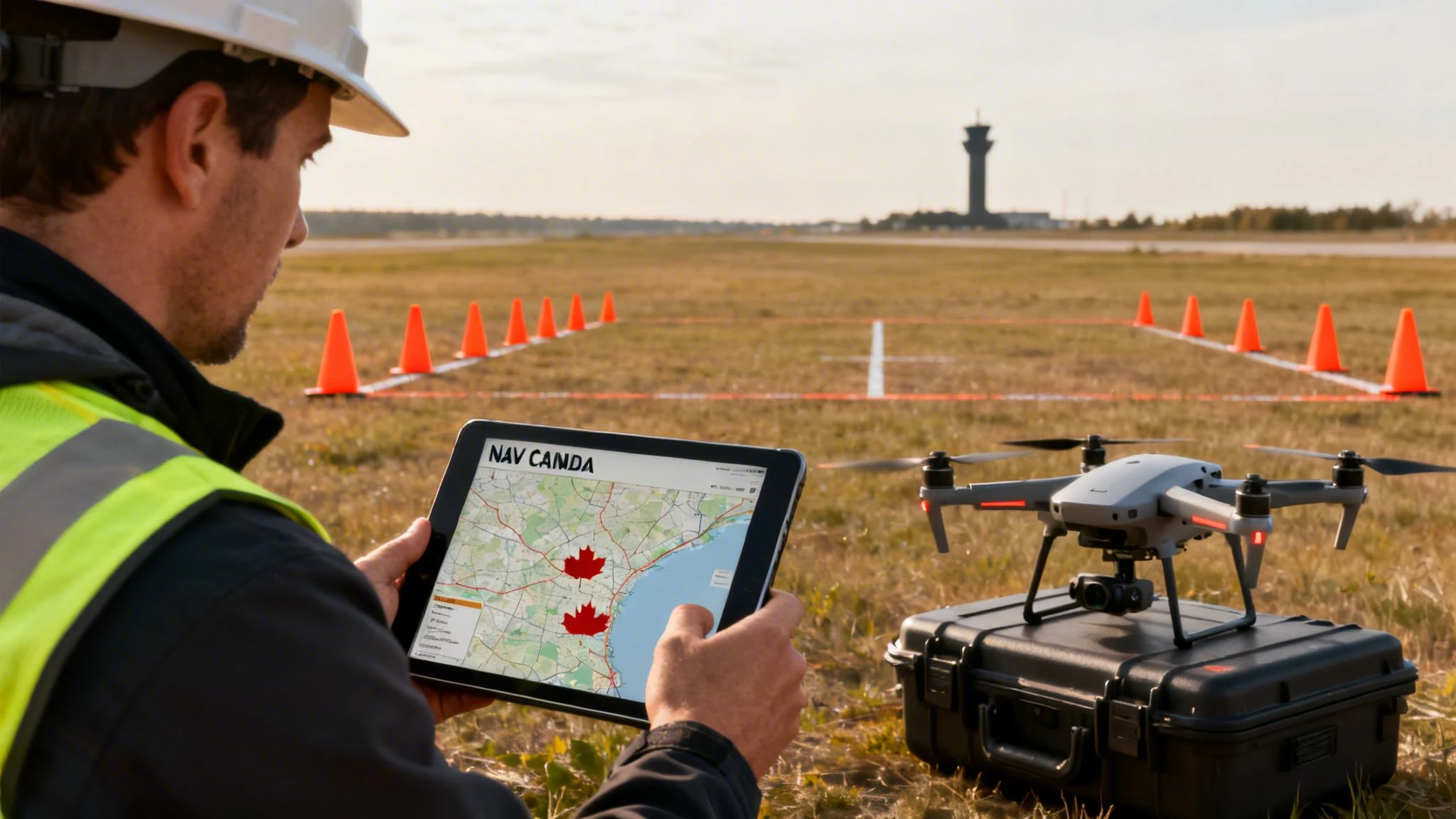
Pilots flying under Basic Operations are limited to those quiet country lanes—uncontrolled airspace. If you have an Advanced Pilot Certificate, you get the clearance to navigate the busy highways of controlled airspace, but only after getting the proper permissions.
Your Essential Pre-Flight Planning Tools
Thankfully, you don't have to guess. Transport Canada gives you the official tools to see these invisible roads and plan your flights with precision. Using them isn't just a suggestion; it's a mandatory part of your pre-flight checklist.
- NAV CANADA Drone Map: This is your most critical tool. The NAV CANADA Viewer is an interactive map that shows airspace classifications, airport locations, and other vital flight information. It's a must-use for confirming the airspace class at your job site.
- NRC Drone Site Selection Tool: This tool from the National Research Council is another fantastic resource. It helps you size up a potential flight area against Transport Canada's rules, flagging nearby airports, heliports, and other spots that demand extra caution.
These tools are your first step in any site survey. They immediately tell you if you need an Advanced certificate and whether you have to get authorization from NAV CANADA to fly in controlled airspace. This level of planning is crucial as the industry booms—drone imports to Canada saw a staggering 84.45% increase between 2023 and 2024. You can read more about the findings on Canada's expanding drone market to see just how fast operators are scaling up.
Understanding Geofencing and GeoZones
Beyond the broad airspace classes, you'll also run into very specific, geographically-defined flight restrictions. These are called GeoZones, or what your drone's software probably calls "geofencing."
A GeoZone is like a digital fence put up by Transport Canada or another authority around a sensitive location. Think of them as permanent or temporary "no-fly zones" for drones, often placed around airports, prisons, national parks, or over emergency sites like wildfires.
These zones are not suggestions. Flying into one without permission is a serious violation with real consequences. Your drone's manufacturer often builds these geofenced areas into the flight software, which might stop your drone from taking off or flying into a restricted zone. But, and this is critical, you, the pilot, are ultimately responsible. You must check official sources like the NAV CANADA map, because not all restrictions will be baked into your drone’s software.
Why a Thorough Site Survey Matters
A site survey is so much more than a quick look at a map. It's your on-the-ground risk assessment where you bridge the gap between the digital world of charts and the physical reality of your flight location.
A comprehensive site survey means identifying:
- Ground Hazards: Look for people, cars, and animals. Where do people gather? What's the general flow of foot traffic?
- Obstacles: Pinpoint any buildings, towers, power lines, and tall trees that could get in the way of your flight path.
- Privacy Concerns: Take note of private homes, schools, or any other areas where flying a camera in the sky could be seen as an invasion of privacy. Always be a good ambassador for the industry.
This process isn't just about checking a box. It’s about building a complete mental picture of the entire operation, spotting problems before they happen, and planning a mission that is not just legal, but fundamentally safe from takeoff to landing.
Earning your Advanced Pilot Certificate opens up a huge range of commercial opportunities. But sooner or later, you'll encounter a job that pushes the boundaries of even those advanced rules.
When your missions get into that highly specialized territory, you’ll need to get familiar with the Special Flight Operations Certificate (SFOC) from Transport Canada.
Think of an SFOC not as a pilot license, but as a custom-tailored permission slip for a single, unique flight or series of flights. It's granted only after you’ve proven you can safely manage an operation that carries a higher level of risk than a standard Advanced flight.
When Do You Need an SFOC?
You’ll have to stop and apply for an SFOC before you even think about conducting a flight that involves scenarios like these:
- Flying a drone weighing over 25 kg. These heavy-lift birds are no joke. A detailed operational plan is non-negotiable because the risks are so much greater if something goes wrong.
- Operating Beyond Visual Line-of-Sight (BVLOS). This is any flight where you, the pilot, can't maintain a direct, unaided visual connection with your drone.
- Flying above 400 feet in uncontrolled airspace.
- Coordinating a drone swarm, which means flying multiple drones from a single control station at the same time.
- Carrying dangerous or hazardous payloads, like specific agricultural chemicals.
- Flying at a special event, such as a festival, outdoor concert, or any large gathering of people.
Each of these situations demands a bespoke safety case. Your Advanced certificate is the foundation, but it's not enough on its own to cover these kinds of complex jobs.
Demystifying the SFOC Application
Applying for an SFOC is a meticulous, detail-oriented process. Transport Canada needs to be absolutely convinced that you've identified every conceivable risk and have a rock-solid, documented plan to handle it.
The heart of your submission is a comprehensive risk assessment. They will scrutinize every word, so being thorough is everything.
You have to become your own harshest critic. Your application must show you've thought through every possible failure—from a simple equipment malfunction to a sudden change in weather—and have a clear, actionable procedure ready for each scenario.
This is all about proving you can maintain a level of safety equivalent to traditional manned aviation. As the commercial UAV market in Canada grows, it's interesting to see the parallel growth in the defense sector. The Canadian military drone market is projected to hit USD 3,511.1 million by 2030, spurred by government investments of over CAD 900 million in research. You can discover more about Canada's strategic drone investments to get a sense of the national importance being placed on these advanced systems.
Professional Responsibilities for Advanced Flights
Operating under an SFOC, or even a standard Advanced Certificate, comes with some serious professional duties. Two of the most critical are insurance and privacy.
Liability Insurance: While only legally required for SFOC-BVLOS operations, carrying robust liability insurance is a non-negotiable for any serious commercial operator. Accidents can and do happen. Insurance protects your business, your clients, and the public from the financial fallout. Good luck landing a professional client without it; most will demand to see proof before they even consider hiring you.
Privacy Laws: The moment you put a camera in the sky, you become subject to Canadian privacy legislation, mainly the Personal Information Protection and Electronic Documents Act (PIPEDA). You have to be transparent about your operations, collect personal information (like images of identifiable people) only when it's absolutely necessary for the mission, and have clear policies for how that data is used and eventually destroyed. Respecting privacy is absolutely crucial for maintaining the public's trust in our entire industry.
Let's be honest, flying a drone in Canada isn't just about the flying. It's about navigating a maze of regulations, certifications, and airspace restrictions that can feel like a full-time job in itself. The paperwork and administrative headaches can easily pile up, burying the actual work you love—getting your drone in the air. This is where dedicated drone operations management software stops being a nice-to-have and becomes an essential part of your toolkit.
Instead of wrestling with a tangled web of spreadsheets, paper logbooks, and a dozen different websites, imagine having a single place for your entire workflow. This isn't about adding another tool; it's about replacing a clunky, manual process with a simple, auditable system for planning, flying, and reporting. It'll save you countless admin hours and, more importantly, drastically cut down the risk of a compliance slip-up.
A Single Hub for Compliance and Team Management
The right software basically acts as your digital co-pilot, keeping a constant watch on all the critical details that make a mission legal and safe. Think of it as a central dashboard that gives you a complete overview of your entire operation, from pilot certifications to aircraft maintenance schedules. It’s a complete, at-a-glance picture of your operational readiness.
Here's what a typical dashboard looks like—you can see how key operational details are laid out for a quick check.
This kind of visual command centre gives pilots and managers an instant look at job status, who's available, and what's next on the to-do list. It makes sure nothing ever falls through the cracks.
For teams, this is a total game-changer. A platform like Dronedesk can automatically track pilot certificate expiry dates, making sure everyone on your team stays current with Transport Canada's 24-month recency rule. It also logs every aircraft's flight hours and maintenance, building a complete, auditable history for every drone in your fleet.
From Site Surveys to Final Reports
Beyond just tracking your admin, this kind of software actively helps you plan your missions. Instead of manually jumping between different maps and websites, the best platforms pull all the necessary airspace data directly into your planning phase.
What that means is, while you're doing your site survey, the system can automatically check NAV CANADA airspace, spot any nearby airports or heliports, and flag active GeoZones. A process that used to take multiple steps across several tools now happens in seconds, all within your mission plan.
This seamless approach is woven through the entire lifecycle of a mission:
- Automated Planning: Build flight plans that automatically pull in weather forecasts, airspace restrictions, and risk assessments.
- Live Flight Logging: Sync flight data straight from your drone to create detailed logs on the fly, capturing key info like flight time and location without you lifting a finger.
- Painless Reporting: Churn out comprehensive reports for clients or compliance audits with just a few clicks, as the system pulls all the necessary data from the mission record.
For any professional pilot or company operating a UAV drone in Canada, getting on board with a robust management system is the smartest move you can make. It frees you up to focus less on paperwork and more on delivering great results for your clients—all while maintaining the highest standards of safety and compliance.
Your Questions About Flying Drones in Canada Answered
Even when you think you've got the rules down pat, real-world questions always pop up. Here, we’ll tackle some of the most common queries we hear from pilots flying a UAV in Canada, helping you handle those everyday situations with confidence.
Can I Fly a Drone Under 250 Grams Without a License?
The short answer is yes. In Canada, drones that weigh less than 250 grams fall into the "micro-drone" category. This means you don't need to register them or get a pilot certificate.
But don't mistake that for a free-for-all. This freedom comes with a big responsibility. You are still legally required to fly safely and never operate your drone in a reckless manner that could endanger people or other aircraft. Think of it this way: common sense and safety should always be your co-pilot, no matter the drone's size.
What Happens if I Fly Without a Pilot Certificate?
Flying a drone that’s 250g or heavier without the right Transport Canada certificate is a serious mistake, and the penalties are no joke. The fines can be a major financial hit for both individuals and businesses.
For an individual, you’re looking at fines up to $1,000 for basic offenses. For a business, that number jumps to $5,000. If you do something more serious, like flying in a way that puts safety at risk, the fines can be much higher, and you could even face legal action. Plain and simple, it's just not worth it.
Is It Okay to Fly My Drone Over a Neighbor's House?
This is one of the most common—and trickiest—questions out there. While Transport Canada regulates the airspace, flying over private property puts you in a grey area with privacy laws. Technically, it might not be illegal under aviation rules if you’re following all other regulations, but it's a really bad idea.
Flying over private property without permission is a fast track to nuisance complaints, privacy disputes, and a damaged professional reputation. The best practice is always to respect people's privacy. Avoid flying over homes unless you absolutely have to, and always get the property owner's buy-in beforehand.
For commercial operators, this is where having a good system comes in handy. Using a lightweight CRM helps you keep track of all client communications, including flight permissions, so you always have a clear record.
Do I Need to Renew My Drone Pilot Certificate?
Good news here: your Basic or Advanced Pilot Certificate doesn't have a hard expiry date. However, to keep it valid for flight operations, you need to prove your knowledge is current by completing a "recency" activity at least once every 24 months.
This is Transport Canada's way of making sure every pilot stays sharp and up-to-date with any rule changes.
Dronedesk takes the headache out of all this. Our platform is built to help you plan compliant missions, keep an eye on pilot recency, and manage your whole fleet. We turn regulatory chores into a simple, automated part of your workflow. Find out how you can fly safer and smarter at https://dronedesk.io.
 Drone Manufacturers Compared for Enterprise Operations →
 How to Prepare for the Drone Licence Test →
 How to Choose a Drone Mapping Service for Your Project →
 Drone Safety Rules That Every Commercial Team Needs →
 Airport Drone Rules: How to Plan Flights Without Surprises →
 FAA Part 107 Licence: Your Step-by-Step Application Guide →
 How to View DJI Flight Logs Online Safely →
 What Part 107 Covers Beyond the Pilot Certificate →
 How to Download and Read a DJI Flight Log →
 Drone Videography Planning Tips for Professional Crews →