
How Enterprise Drone Teams Standardise Safe Operations
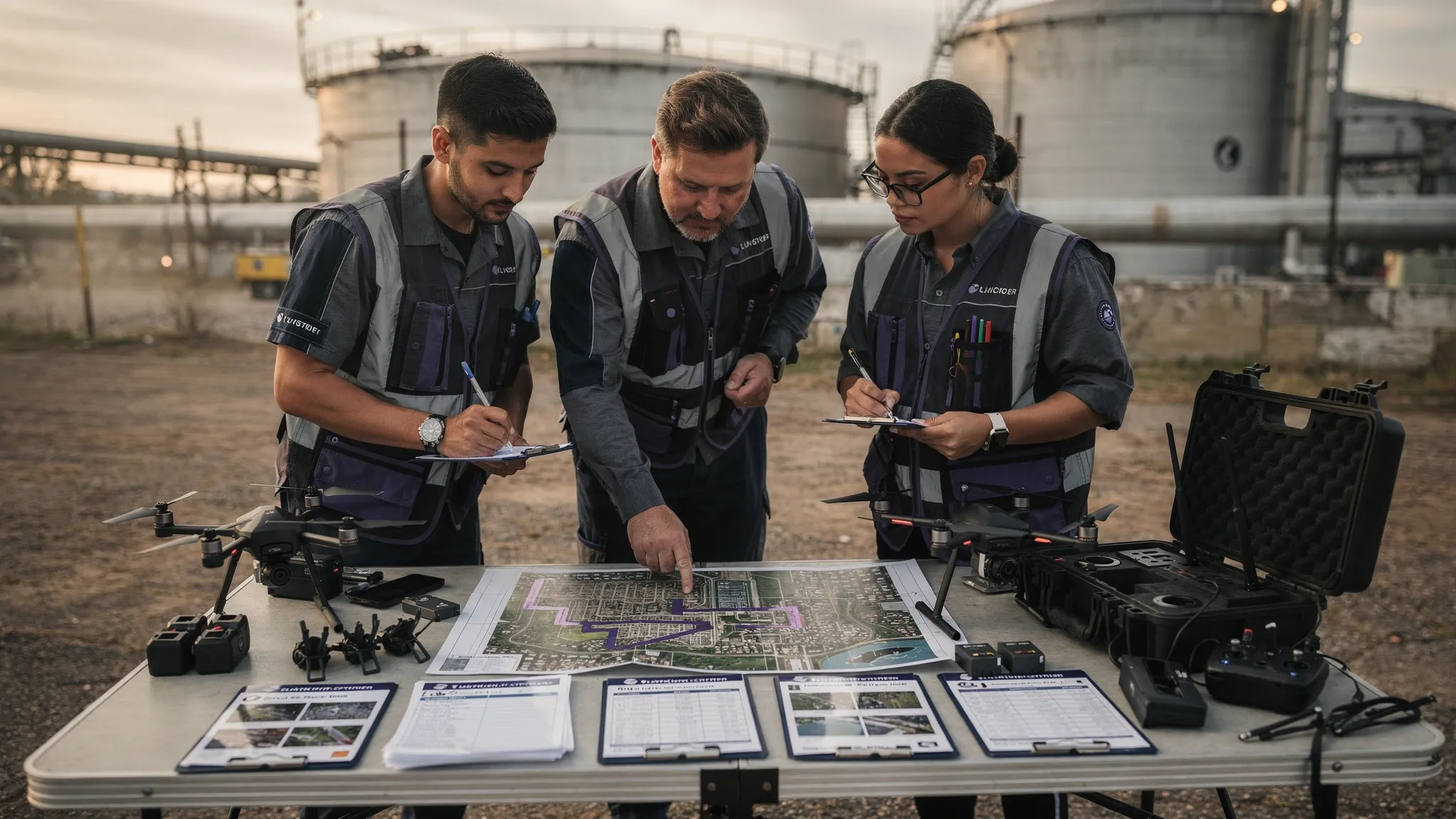
Enterprise drone programmes are no longer experimental side projects. In utilities, surveying, infrastructure, public safety and industrial inspection, drones are now part of everyday operational delivery. That creates a new challenge: how do you keep every pilot, site, aircraft, battery, checklist and flight record aligned when operations span multiple teams and locations?
The answer is standardisation. Not standardisation for its own sake, and not paperwork that slows everyone down. The goal is to create repeatable, auditable workflows that help teams make safer decisions faster, especially when pressure is high and conditions change.
For an enterprise drone team, safe operations depend on three things working together: clear procedures, reliable information and consistent record keeping. When those foundations are in place, teams can scale without relying on individual memory, disconnected spreadsheets or local workarounds.
What standardised safe operations really means
Standardising drone operations means defining how work should be requested, planned, approved, flown, logged and reviewed across the organisation. It gives pilots and managers a shared operating model, while still allowing competent people to respond to site-specific risks.
This matters because enterprise drone teams often operate in complex environments. A utility inspection may involve critical infrastructure, public access, electromagnetic hazards and multiple landowners. A survey company may need repeatable data capture across dozens of sites. Emergency services may have to deploy quickly while maintaining a defensible audit trail.
Regulators also expect operators to understand and manage operational risk. In the UK, the Civil Aviation Authority provides guidance through resources such as CAP 722, while European operators often work with methodologies such as SORA for specific category risk assessment. The details vary by jurisdiction, but the principle is consistent: the operator must be able to show that risks were identified, mitigated and managed appropriately.
Standardisation turns that requirement into a practical system.
Why enterprise drone teams outgrow informal processes
Small drone teams can often cope with manual processes for a while. One chief pilot knows the aircraft history, remembers who is qualified, keeps risk assessment templates locally and checks airspace manually before each job.
That model breaks down as soon as operations expand. More pilots, more aircraft, more locations and more stakeholders create more opportunities for inconsistency. The risk is not only that something gets missed. It is that the organisation cannot prove what happened, who approved it or which controls were applied.
Common warning signs include:
- Different pilots using different versions of checklists or risk assessments.
- Aircraft maintenance records stored separately from flight logs.
- Team qualifications tracked in spreadsheets that are not always current.
- Jobs approved verbally or through email chains with no single audit trail.
- Site hazards being rediscovered repeatedly instead of reused intelligently.
- Managers struggling to report on utilisation, incidents, compliance or fleet readiness.
These gaps can create operational friction, but they can also become safety risks. If a pilot cannot see the latest site notes, if a battery record is incomplete or if a risk assessment is copied without review, the team is relying on luck rather than process.
The building blocks of a standardised drone operating model
Enterprise standardisation works best when it follows the full lifecycle of a drone job. That lifecycle begins before a pilot is assigned and continues after the aircraft has landed.
| Operating area | Standardisation goal | Why it matters |
|---|---|---|
| Job intake | Capture consistent client, site and task information | Reduces ambiguity before planning begins |
| Team readiness | Confirm pilot competence, availability and responsibilities | Ensures the right people are assigned to the right work |
| Fleet readiness | Track aircraft, batteries, maintenance and equipment status | Prevents avoidable equipment-related issues |
| Airspace review | Use a repeatable method for checking airspace and local constraints | Supports safer go or no-go decisions |
| Risk assessment | Apply consistent risk criteria and mitigations | Makes safety decisions comparable across teams |
| Checklists | Standardise pre-flight, on-site and post-flight checks | Reduces reliance on memory |
| Flight logging | Record flights in a consistent format | Supports compliance, reporting and operational learning |
| Review and reporting | Analyse activity, issues and performance | Helps improve safety and productivity over time |
This table is simple, but it reflects an important shift. Safe operations are not created by a single document. They are created by a connected system of decisions and records.
Create one source of truth for operational data
A central principle for enterprise drone teams is to avoid duplicate, conflicting records. If fleet information lives in one spreadsheet, pilot credentials in another, risk assessments in a shared drive and flight logs in a separate app, managers spend too much time reconciling information.
A single operational record should show what was planned, what was checked, what was flown and what was learned. This does not mean every department needs to use the same tools for everything. It means the drone operation needs a reliable operational hub.
Dronedesk is designed for this kind of end-to-end drone operations management. Its features include client management, fleet management, team management, airspace intelligence, proximity intelligence, flight planning, flight logging, data reporting, configurable checklists and risk assessments. You can review the platform’s current capabilities on the Dronedesk features page.
The same principle applies in other business functions too. Enterprise teams increasingly look for platforms that connect work from idea to execution, whether that is drone operations management or an AI-powered marketing workflow platform for campaign creation and optimisation. The value comes from reducing handoffs, standardising repeatable steps and keeping the evidence of work in one place.
Standardise risk assessments without making them generic
Risk assessment is one of the hardest areas to standardise well. If the process is too loose, hazards are missed. If it is too rigid, pilots may treat it as a tick-box exercise that fails to reflect the actual site.
The best approach is to standardise the structure, not the judgement.
Every operation should follow a consistent risk assessment framework. That framework should guide pilots through airspace, ground risk, people, property, weather, communications, emergency procedures and task-specific hazards. However, the actual assessment must still reflect the site, aircraft, crew, operating category and mission objective.
For example, a roof inspection in a quiet industrial estate and an emergency deployment near a public event may both use the same risk assessment structure. But the hazards, mitigations and approval thresholds will be different.
Enterprise teams should define when escalation is required. A routine low-risk job may be approved by a remote pilot or chief pilot under established procedures. A complex operation near controlled airspace, critical infrastructure or uninvolved people may need additional review, permissions or stakeholder coordination.
Use checklists to protect against routine failure
Checklists are not just for new pilots. They are a defence against distraction, fatigue and assumptions. In enterprise environments, they also create consistency across different crews and sites.
Good drone checklists are specific enough to be useful but not so long that people bypass them. They should cover the operational moments where mistakes are most likely or most costly: pre-deployment preparation, site arrival, aircraft setup, take-off readiness, emergency actions, landing and post-flight closeout.
Configurable checklists are especially useful for enterprise teams because different missions require different controls. A survey flight, powerline inspection, police deployment and confined industrial site inspection may all require different prompts. Standardisation should allow those differences while preserving the same underlying safety culture.
Make fleet and team readiness visible before the job starts
Safe operations depend on assigning the right people and equipment before anyone arrives on site. That sounds obvious, but it becomes difficult when a team manages multiple aircraft, batteries, sensors and pilots across different regions.
Fleet readiness should include aircraft status, maintenance history, payload suitability and supporting equipment. Team readiness should include pilot competency, role allocation and any relevant authorisations or training records.
For enterprise drone teams, this information should be visible during planning, not discovered at the last moment. A job should not depend on someone remembering that a drone is awaiting maintenance or that a particular pilot is not current for a certain type of work.
The practical aim is simple: reduce surprises on the day of operation.
Build a standard flight planning workflow
Flight planning is where enterprise drone safety becomes operationally real. The planning workflow should bring together the task, site, airspace, proximity risks, crew, fleet and weather considerations into a coherent plan.
A standard planning workflow might include these stages:
- Define the task and outcome: Clarify what the flight is intended to achieve, what data or service is required and what success looks like.
- Review the operating environment: Check airspace, ground hazards, nearby infrastructure, public access, sensitive sites and local constraints.
- Select the crew and equipment: Match the pilot, aircraft, payload and support roles to the complexity of the job.
- Complete risk assessment and checklists: Identify hazards, apply mitigations and confirm operational controls.
- Approve and brief: Ensure the right people understand the plan, responsibilities, contingencies and go or no-go criteria.
- Log and review: Record the flight and capture any issues, deviations or learning points.
This type of workflow does not remove professional judgement. It gives professional judgement a consistent structure.
Adapt standardisation to each operating environment
Enterprise drone teams often serve very different use cases. A single organisation may have routine inspection flights, urgent incident response, mapping projects and training activity. Standardisation must be flexible enough to support all of them.
| Sector | Typical operational challenge | Standardisation priority |
|---|---|---|
| Utilities | Linear assets, substations, public access, critical infrastructure | Repeatable site risk controls and asset-level records |
| Survey companies | Consistent data capture, repeat visits, client reporting | Standard planning, logs and project documentation |
| Emergency services | Rapid deployment, dynamic scenes, multi-agency coordination | Fast planning workflows with strong audit trails |
| Construction and infrastructure | Changing site conditions, contractors, heavy machinery | Site-specific checklists and stakeholder communication |
| Environmental and land management | Remote locations, permissions, weather exposure | Pre-deployment planning and equipment readiness |
The point is not to force every mission into the same template. The point is to create a common operating language so teams can collaborate, report and improve.
Turn flight logs into operational intelligence
Flight logs are often treated as a compliance requirement, but they are much more valuable than that. At enterprise scale, logs become a source of operational intelligence.
Consistent flight logging helps answer important management questions. Which aircraft are most heavily used? Which sites generate the most aborted flights? Are certain teams experiencing repeated delays? Are maintenance intervals being managed effectively? Which types of job create the highest administrative burden?
Without structured logs, these questions are hard to answer. With structured logs and reporting, managers can spot patterns and make better decisions about training, fleet investment, staffing and procedures.
This is where standardisation supports productivity as well as safety. The organisation is not simply collecting records. It is creating feedback loops.
Keep procedures alive through review and learning
A standard operating model should never be static. Drone regulations, aircraft capabilities, client requirements and operational environments all change. Enterprise teams need a review rhythm that keeps procedures current.
Post-flight reviews do not have to be complicated. The key is to capture useful information consistently. Did the plan reflect the site reality? Were there unexpected hazards? Was communication clear? Did the equipment perform as expected? Were any checklists confusing or unnecessary?
Over time, those small observations reveal where procedures need improvement. They also help leaders distinguish between individual performance issues and process design problems.
If multiple pilots are making the same mistake, the answer is rarely just more reminders. It may be that the checklist is unclear, the planning data is incomplete or the approval workflow is too fragmented.
A practical rollout plan for standardising enterprise drone operations
Enterprise standardisation works best when it is introduced deliberately. Trying to change everything at once can create resistance, especially among experienced pilots who already have established ways of working.
Start with the highest-risk or highest-volume workflows. For many teams, that means flight planning, risk assessments, fleet readiness and flight logging. These areas have immediate safety and compliance value, and they create the foundation for better reporting.
A sensible rollout usually follows four phases.
| Phase | Focus | Outcome |
|---|---|---|
| 1. Baseline | Map current tools, documents, approvals and pain points | Clear view of operational inconsistency |
| 2. Standardise | Agree core templates, checklists, roles and approval rules | Shared operating model |
| 3. Centralise | Move key records into one operational platform | Better visibility and audit readiness |
| 4. Improve | Review logs, incidents, feedback and performance data | Continuous improvement cycle |
Change management matters. Pilots should understand why the new process exists, not just what buttons to click. Managers should also avoid creating unnecessary admin. The best systems make the safe way the easiest way.
How Dronedesk supports standardised drone operations
For organisations managing drone work at scale, Dronedesk provides a central platform for the operational administration that sits around every flight. Rather than spreading work across disconnected tools, teams can manage clients, fleet, team information, flight planning, risk assessments, checklists, flight logs and reporting in one place.
That matters because enterprise drone safety depends on repeatability. When the same operational workflow is followed across teams, managers gain clearer oversight and pilots gain a more consistent planning experience.
Dronedesk does not replace professional judgement, pilot competence or regulatory responsibility. It supports them by giving teams a structured environment for planning, recording and managing drone operations.
Frequently Asked Questions
What does it mean to standardise enterprise drone operations? It means creating consistent workflows for planning, risk assessment, approvals, checklists, flight logging and review across a drone team. The aim is to improve safety, compliance, visibility and operational efficiency.
Does standardisation make drone teams less flexible? Not if it is designed properly. Good standardisation creates a shared framework while still allowing pilots and managers to respond to site-specific risks, urgent tasks and changing conditions.
What records should an enterprise drone team keep? Teams should keep records of flight plans, risk assessments, checklists, pilot and crew details, aircraft and equipment status, maintenance activity, flight logs, incidents and post-flight notes. Exact requirements depend on jurisdiction and operating category.
How can emergency services standardise operations without slowing response? Emergency services can use pre-defined workflows, reusable planning structures and clear role assignments so crews can move quickly while still capturing essential safety and audit information.
How does Dronedesk help with standardisation? Dronedesk brings key operational tasks into one platform, including client management, fleet management, team management, airspace and proximity intelligence, flight planning, flight logging, reporting, configurable checklists and risk assessments.
Build safer, more consistent drone operations
Enterprise drone operations become harder to manage as teams grow, but they do not have to become less controlled. With the right procedures and systems, organisations can scale drone work while maintaining clear oversight, consistent safety practices and reliable records.
If your team is moving beyond spreadsheets, shared drives and ad hoc processes, explore Dronedesk to see how an all-in-one drone operations management platform can support safer, more standardised operations.
 Drone Manufacturers Compared for Enterprise Operations →
 How to Prepare for the Drone Licence Test →
 How to Choose a Drone Mapping Service for Your Project →
 Drone Safety Rules That Every Commercial Team Needs →
 Airport Drone Rules: How to Plan Flights Without Surprises →
 FAA Part 107 Licence: Your Step-by-Step Application Guide →
 How to View DJI Flight Logs Online Safely →
 What Part 107 Covers Beyond the Pilot Certificate →
 How to Download and Read a DJI Flight Log →
 Drone Videography Planning Tips for Professional Crews →