
The Drone Professional's Prop Pitch Calculator Guide
A prop pitch calculator is a handy tool that takes the guesswork out of drone performance. It uses the physical specs of your props—like pitch and diameter—along with your motor RPM to estimate how fast your drone could fly or how much thrust it can generate.
Think of it as a translator. It turns the numbers on a prop into real-world performance data, helping you pick the perfect propeller for any mission, whether you're chasing speed, maximizing flight time, or lifting a heavy payload.
What Is Propeller Pitch And Why It Matters
Ever driven a screw into a piece of wood? The distance that screw travels with one full 360-degree turn is its pitch. A drone propeller works exactly the same way, but instead of screwing into wood, it’s screwing itself forward through the air.
Propeller pitch is simply the theoretical distance, in inches, a prop would move forward in one complete revolution if the air were a solid. This is the second number you'll see stamped on any propeller.
Decoding The Numbers On Your Prop
When you grab a new prop, you'll see a code like '1045' or '10x4.5'. These aren't just model numbers; they're the two most important specs you need to know.
- Diameter (10 inches): The first number is the prop's length from one tip to the other. A bigger diameter moves more air, which usually means more thrust and stability. The trade-off is that it's often less responsive.
- Pitch (4.5 inches): The second number is the pitch. In this case, a '4.5' pitch means one full spin theoretically moves the prop 4.5 inches forward.
A prop labeled '1045' is the same as one marked '10x4.5'—it's just a common shorthand. Getting a handle on these two numbers is the first step to truly understanding and tweaking your drone's performance.
How Pitch Affects Your Drone's Flight
Your propeller's pitch has a massive impact on how your drone feels and flies. It’s a constant balancing act between raw speed and overall efficiency, much like the gears on a bicycle.
A higher pitch is like a high gear on a bike. It moves you a lot further with each rotation, but it takes a lot more effort to get it going. A lower pitch is like a low gear—it's easier to pedal, but you don't cover as much ground.
This analogy lines up perfectly with drone performance. A high-pitch propeller (like a 10x6.0) tries to grab a big chunk of air with every rotation. This gives you:
- Higher potential top speeds.
- A more "locked-in" and aggressive feel.
- A much bigger current draw from the battery and more strain on the motors.
On the other hand, a low-pitch propeller (like a 10x3.8) is far less aggressive. It takes a smaller "bite" of air, which results in:
- Better efficiency and longer flight times.
- Increased stability and smoother, more predictable control.
- Less stress on your motors and electronics, which often makes for a quieter drone.
Picking the wrong pitch can lead to disappointing performance, or worse, fried electronics. This is where a prop pitch calculator becomes an essential part of your toolkit, letting you predict these outcomes before you even spin up the motors.
How A Prop Pitch Calculator Actually Works
To really get a grip on your drone's performance, you need to understand what's going on inside a prop pitch calculator. Far from being some black box, it’s a tool that applies some pretty straightforward physics, taking a few key details about your setup to predict how your drone will fly. Think of it as your pre-flight forecaster for performance.
The whole process starts with the basic specs of your drone's power system and propellers. Just like you can't bake a cake without knowing the ingredients, a prop pitch calculator needs the right data to give you anything useful back.
This map breaks down the fundamental give-and-take you're dealing with when you change your prop pitch.
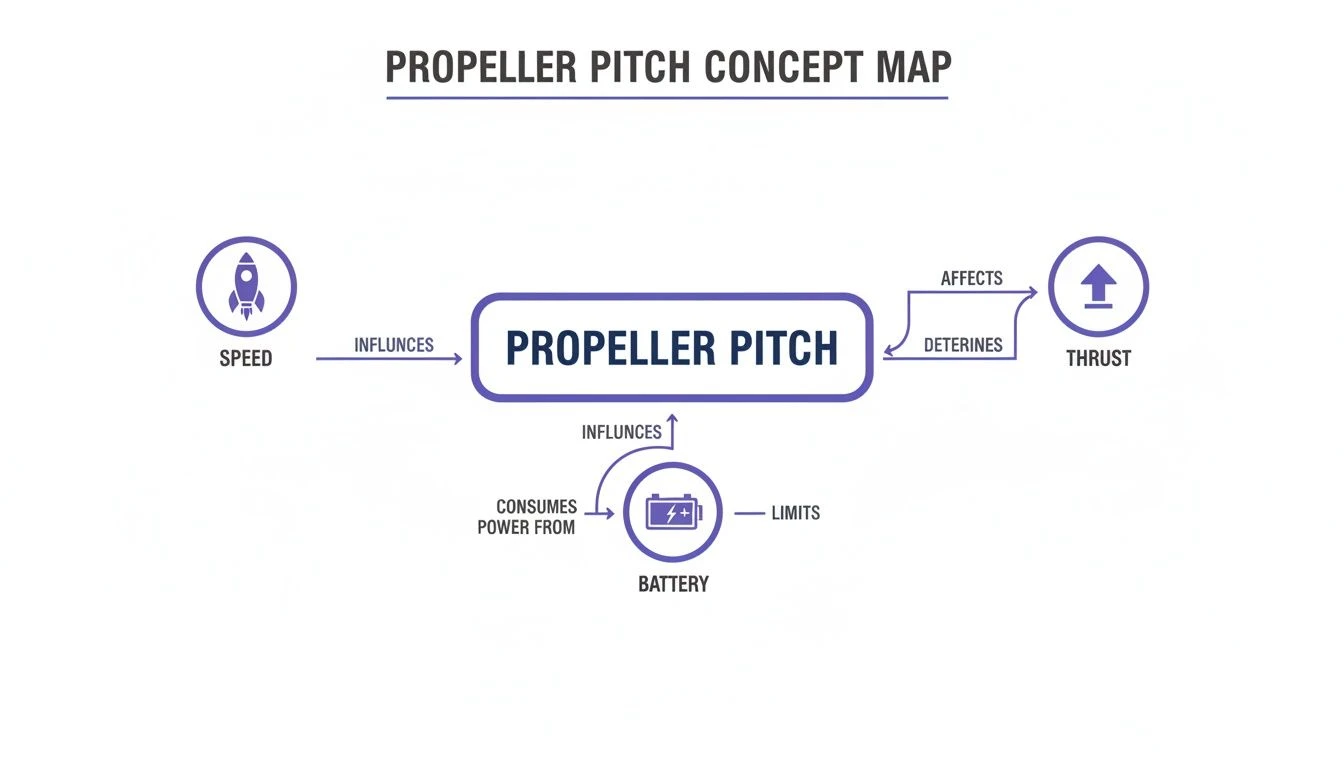
As you can see, cranking up the pitch can give you more top-end speed, but it almost always comes at the expense of battery life and can reduce your static thrust—the power you have for hovering or punching out.
The Core Calculation
At its heart, the main job of a prop pitch calculator is to figure out the theoretical pitch speed. This is the absolute maximum speed your drone could hit in a perfect world, based entirely on how fast its motors are spinning and the pitch of the props.
The formula itself isn't too scary:
Pitch Speed = (Motor RPM x Propeller Pitch x 60) / 63,360
Let's pull that apart:
- Motor RPM: How many times your motor spins in one minute.
- Propeller Pitch: The distance, in inches, that the prop would theoretically screw itself through the air in one full rotation.
- 60: A simple conversion to turn RPM (per minute) into revolutions per hour.
- 63,360: The number of inches in a mile. This is what turns our final number into the familiar miles per hour (MPH).
Getting your head around this is a bit like mastering an asphalt square footage calculator before a big paving job; both tools turn a few key variables into a solid, actionable number.
Introducing Propeller Slip
Of course, we don't fly in a perfect world. Air isn't a solid, and as propellers slice through it, they lose some of their theoretical efficiency. We call this loss propeller slip.
Imagine spinning your car's tires on an icy road. The speedometer might be climbing, but you aren't actually moving forward that fast because there's no grip. Prop slip is the exact same idea for a drone in the air.
A calculator might tell you a top speed of 80 MPH is possible, but once you account for slip, your real-world top speed might be closer to 65-70 MPH. Depending on the prop design, drone weight, and even air density, you can expect slip to be anywhere from 15% to 30% or even more.
Prop Pitch Calculator Inputs And Outputs
To get an estimate you can actually trust, you need to feed the calculator accurate data. A good tool won't just ask for the pitch; it needs to know about the entire power system.
Here’s a breakdown of the typical inputs you'll need and the valuable outputs you'll get in return.
| Parameter | Description | Unit of Measurement | Example Value |
|---|---|---|---|
| Motor KV Rating | A motor's revolutions per minute per volt with no load. | KV (RPM/Volt) | 2400KV |
| Battery Voltage | The nominal voltage of your LiPo battery (e.g., a 4S pack is 14.8V). | Volts (V) | 14.8V |
| Propeller Diameter | The full length of the propeller from one tip to the other. | Inches | 5 inches |
| Propeller Pitch | The theoretical forward distance the prop moves per revolution. | Inches | 4.3 inches |
Once you plug in these numbers, the calculator crunches them to give you a clear picture of what to expect from that specific combination. These outputs let you fine-tune your setup for a mission without endless, costly trial and error on the field.
Calculating Prop Pitch For Different Drone Missions
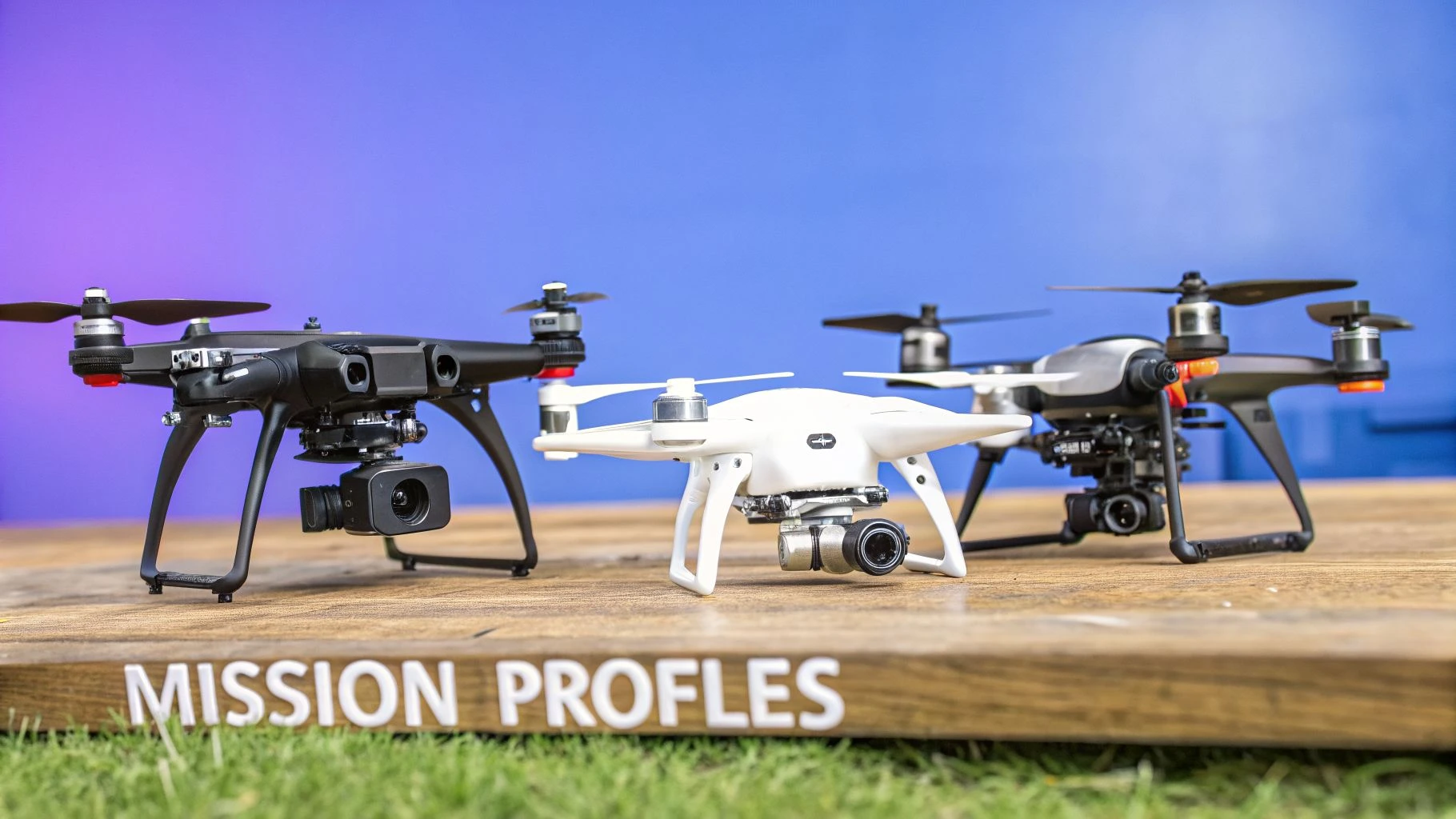
Knowing the theory is one thing, but the real magic happens when you apply it. Let's crunch the numbers for three completely different drone missions that professional pilots tackle every day. You'll see just how much the hardware choices matter and how they directly shape the outcome of a flight.
We’re going to walk through the calculations for a high-speed FPV racer, a smooth cinematic quadcopter, and a beast of a heavy-lift hexacopter.
Scenario 1: The High-Speed FPV Racer
When it comes to FPV racing, it’s all about speed and hairpin turns. Pilots need a drone that can punch out instantly and scream through the track. This mission profile throws flight time and payload capacity out the window in favour of pure, unadulterated power.
Let's say this quad is built with aggressive, high-performance parts meant for the racetrack.
- Motor KV: 2750KV (high RPM for lightning-fast response)
- Battery: 4S LiPo (14.8V nominal)
- Propeller: 5.1x5.1x3 (a 5.1-inch diameter, 5.1-inch pitch, tri-blade prop)
Plug these numbers into a prop pitch calculator, and you get a frankly ridiculous theoretical top speed. The high motor KV and equally high-pitch propeller are a match made in heaven for speed demons. This machine is built to win, but it’s a thirsty one—flight times are often just a couple of minutes, and you can bet the motors and battery will be running hot.
The big takeaway here is that the aggressive 5.1-inch pitch is the star of the show, designed to claw the drone forward as fast as humanly possible.
Scenario 2: The Cinematic Quadcopter
A cinematic drone, like one of the popular DJI models, has a totally different day job. Its mission is to deliver smooth, stable, and predictable flight to capture those jaw-dropping aerial shots. Long flight times are crucial to get the perfect take, and it needs to be quiet enough not to ruin the audio.
This kind of drone prioritises efficiency and stability over raw speed.
- Motor KV: 920KV (a much lower, more efficient rating)
- Battery: 4S LiPo (14.8V nominal)
- Propeller: 9.4x5.0 (a 9.4-inch diameter, 5.0-inch pitch, bi-blade prop)
The calculated speed for this setup is way lower than the FPV racer. But that's the point. The much larger 9.4-inch diameter props, paired with lower KV motors, generate a ton of lift very efficiently. This allows the drone to hover with rock-solid stability and stay in the air for upwards of 25-30 minutes.
The gentler 5.0-inch pitch doesn't try to "bite" as much air with each rotation, which is exactly what gives you that silky-smooth motion needed for professional video. It also puts less strain on the motors, making the whole system much quieter. To dive deeper into this balancing act, check out our guide on drone flight time and see how all these factors connect.
Scenario 3: The Heavy-Lift Hexacopter
Last up is the workhorse of the industrial drone world: a heavy-lift hexacopter. This rig is built for serious jobs like surveying, mapping, or hauling expensive LiDAR sensors. Its main job is to lift a heavy payload safely and fly a predetermined route with maximum stability and endurance.
For this aircraft, thrust and reliability are everything. Speed is a distant second. The hexacopter design (six motors) not only provides massive lifting power but also adds a layer of redundancy.
System Inputs for the Hexacopter
| Parameter | Value | Rationale |
|---|---|---|
| Motor KV | 320KV | Very low KV for high torque to spin huge props. |
| Battery | 6S LiPo (22.2V) | Higher voltage delivers power more efficiently. |
| Propeller | 18x6.1 | Massive 18-inch diameter for maximum air displacement. |
Running these specs through a prop pitch calculator shows a moderate top speed but absolutely immense thrust. The six enormous 18-inch diameter props are what give this drone its incredible ability to lift payloads often exceeding 20 lbs (9 kg).
The 6.1-inch pitch here is a calculated compromise. It's aggressive enough to give the drone solid forward momentum but not so aggressive that it drains the batteries in minutes. This is critical for achieving mission times of 30 minutes or more, even with a heavy sensor bolted on.
This is where a prop pitch calculator really proves its worth. It helps you confirm that the power system is correctly matched to the mission before a multi-thousand-dollar sensor ever leaves the ground.
Choosing The Right Propeller For The Job
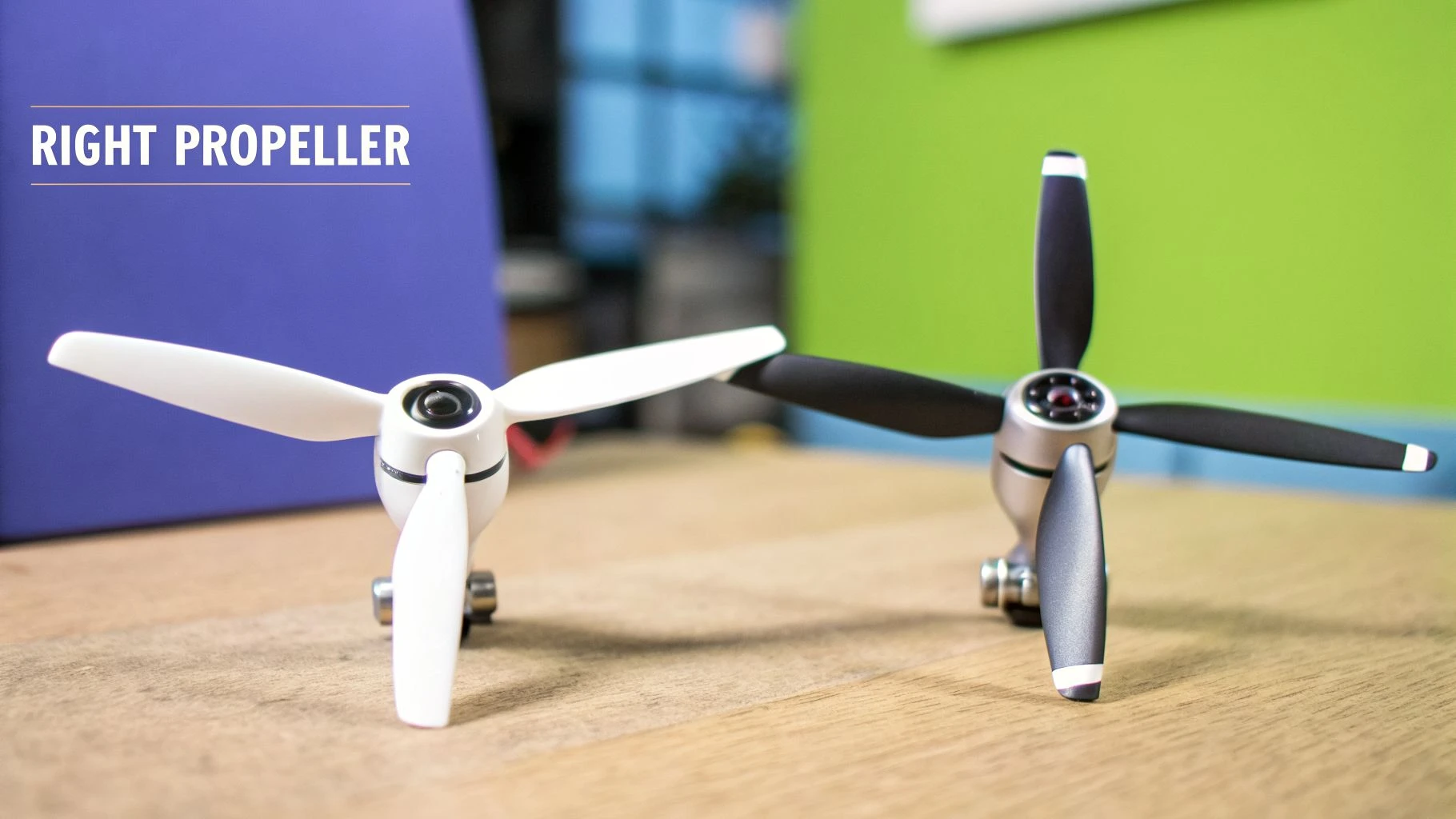
Think picking a propeller is as simple as finding one that fits your drone? Think again. The prop you'd use for a high-speed inspection is the polar opposite of what you need for a 45-minute mapping mission. Each job has its own unique demands, and your choice of propeller pitch is a huge factor in whether you succeed or struggle.
This isn't about guesswork. It’s about making a deliberate choice based on solid data. Using a prop pitch calculator gives you the insights to stop guessing and start tuning your equipment perfectly for the task at hand. Getting this right means more efficient flights, better safety, and ultimately, happier clients.
Matching Pitch To Your Mission Profile
At its core, propeller selection is a balancing act between two things: speed and efficiency. You can think of it like picking a gear on a bike. On one end, you have high-pitch props—your high gear—built for raw speed. On the other, you have low-pitch props—your low gear—designed for endurance and a steady climb.
A high-pitch propeller travels a greater distance forward with every single rotation. This is fantastic for hitting high speeds, but it takes a huge amount of power from the motors to "bite" that much air. This aggressive approach drains your battery much faster, making these props best for short, intense flights where getting there fast is all that matters.
On the flip side, a low-pitch propeller is the marathon runner of the group. It takes smaller, more efficient bites of air, putting far less strain on the motors. The result? Significantly longer flight times and incredibly smooth, stable handling, which is exactly what you need for missions demanding precision and endurance.
High Pitch Vs Low Pitch Propellers A Mission Based Comparison
To make the choice a bit more concrete, let's lay out how these two prop types perform in the real world. This table should help you quickly see which style is the right fit for your next flight.
| Performance Metric | Low-Pitch Propellers | High-Pitch Propellers | Best For Mission Type |
|---|---|---|---|
| Top Speed | Lower | Higher | High pitch for racing, rapid ascent, or chase scenes. |
| Acceleration | Slower, more gradual | Faster, more "punchy" | High pitch for agile maneuvers and quick changes in direction. |
| Flight Time | Significantly longer | Shorter | Low pitch for endurance missions like mapping and surveying. |
| Motor Efficiency | High (less current draw) | Low (high current draw) | Low pitch for preserving battery and motor health over time. |
| Stability & Control | Very high and smooth | More responsive, less stable | Low pitch for capturing smooth video and stable aerial photos. |
| Noise Level | Quieter | Louder | Low pitch for operating in noise-sensitive environments. |
| Wind Resistance | Generally more stable | Can be more "twitchy" | Low pitch often provides a more predictable flight in wind. |
As you can see, there's no single "best" propeller. It always, always comes down to the mission.
The key takeaway is simple: prioritize low pitch for endurance and stability, and choose high pitch for speed and power. Misunderstanding this relationship is one of the most common reasons for poor drone performance.
Actionable Recommendations For Common Missions
With this in mind, you can start building out a "propeller library" for your business. Having the right props ready to go is just as critical as having a set of fully charged batteries.
Here are a few practical pointers for common jobs:
- Aerial Photography and Cinematography: Go for low-pitch propellers every time. Their natural stability is what gives you that buttery-smooth cinematic motion clients love. If you're building a kit for this, our guide to the best drones for cinematography has some great hardware recommendations.
- Surveying and Mapping: For these jobs, endurance is everything. Low-pitch props are non-negotiable, as they'll maximize your flight time and let you cover far more ground in a single battery swap.
- FPV Racing or Freestyle: This is where high-pitch props get to live their best life. You need that instant acceleration and screaming top speed to be competitive on the race course or to pull off those wild acrobatic moves.
- High-Speed Inspections or Emergency Response: When every second counts, a high-pitch prop helps you get on-site and gather data as quickly as possible. It’s all about rapid response.
By plugging these scenarios into a prop pitch calculator, you can move from just understanding the theory to making confident, data-backed decisions. It’s a small step that can make a huge difference in the quality and efficiency of your entire operation.
Avoiding Common Mistakes With Your Calculations
A prop pitch calculator is a brilliant tool, but its answers are only as good as the questions you ask it. The old computer science saying "garbage in, garbage out" has never been more true. Even tiny mistakes in your inputs can lead to wildly inaccurate performance predictions, setting you up for a disappointing flight or even damaged gear.
On top of that, remember that even with perfect data, the calculator gives you a theoretical baseline. It’s working out the numbers in a perfect world, but your drone flies in the real one, with all its messy variables like air density, wind, and humidity. Think of the calculator's output as an educated guess to get you started, not the final word.
Overlooking The Details In Your Inputs
The most common mistakes I see come from small but critical oversights when pilots punch in their drone's specs. A detail that seems minor can completely derail the calculation, pointing you towards a prop that's all wrong for your build.
Keep a sharp eye out for these frequent slip-ups:
- Using Loaded vs. Unloaded RPM: Your motor’s KV rating is its RPM per volt with no propeller attached. As soon as you add a prop, the load drags the RPM down, sometimes by as much as 20-30%. If your calculation doesn't factor this in, your speed and thrust estimates will be pure fantasy.
- Forgetting Battery Voltage Sag: A 4S LiPo is listed as 14.8V, but that's just its nominal voltage. When you punch the throttle, the actual voltage "sags" or drops significantly. Using 14.8V in your calculation for a high-power flight means you're assuming your motors have power that simply isn't there.
- Ignoring Environmental Factors: A drone just doesn't fly the same at sea level in the cold as it does at 5,000 feet on a hot day. The thinner, warmer air provides less "bite" for the props, meaning they have to work harder. Always think about your typical operating altitude and temperature; they have a direct and measurable effect on thrust and efficiency.
A prop pitch calculator is a compass, not a GPS. It points you in the right direction, but you still need to look at the terrain around you to navigate safely and effectively.
From Theory To Reality: A Validation Checklist
Once you've crunched the numbers and picked a propeller, your job isn't over. The last and most important step is to see how those calculations hold up in the real world. This is where you connect the dots between theoretical performance and what you can actually rely on in the field.
Run through this checklist to safely validate your choices:
-
Conduct a Short Hover Test: Start simple. Find a safe, open spot and just hover for a minute. Listen to the motors—do they sound like they're straining or screaming? Land the drone and carefully check the motor and battery temperature with your hand. They should be warm, but never too hot to touch comfortably.
-
Analyze Telemetry Data: If your drone has telemetry, this data is pure gold. After a quick test flight, pull the logs. Compare the actual RPM, current draw, and speed your drone's sensors recorded against what the calculator predicted. This gives you a hard number for "propeller slip" and the true efficiency of your specific setup.
-
Monitor Battery Performance: Take it up for a slightly longer flight, but keep a close eye on your battery. How fast is the voltage dropping? After you land, is the battery much hotter than usual? A hot battery or a rapid voltage drop is a huge red flag that your props are too aggressive, drawing way too much current and putting your whole power system at risk.
Integrating Propeller Data Into Your Workflow
Getting smart about your propeller choice is more than just a tech-nerd deep dive; it’s a real business advantage. When you stop doing one-off calculations and start building this data into your daily ops, you turn theory into profit. It's how you translate hardware knowledge into a more predictable, efficient, and competitive drone business.
The first step is a mental shift. Stop seeing props as disposable, consumable parts and start treating them like strategic assets. By using what you've learned from a prop pitch calculator, you can create a physical and digital "propeller library" for your entire fleet. This isn't just a random box of spares; it's a curated inventory built for your specific jobs.
Building Your Propeller Library
Start by setting up a simple system to sort your propellers. This could be as basic as a few labeled bins in your workshop or as advanced as a digital tag in your fleet management software. The aim is to make it dead simple to grab the right prop for the right job without even thinking about it.
Your system should cover:
- Mission-Based Tagging: Label props for specific tasks, like "Endurance Mapping (Low Pitch)" or "High-Speed Inspection (High Pitch)." This makes sure pilots always fit the best set for the flight ahead.
- Drone-Specific Sets: If you run different drone models, keep dedicated prop sets for each airframe. This simple step stops someone from accidentally using a prop that's inefficient or even unsafe for a particular motor and battery combo.
When you standardize your gear like this, you slash the chances of pilot error and get consistent, repeatable performance across your fleet. It makes your whole operation easier to manage and scale as you grow.
Improving Your Business Operations
The numbers you get from a prop pitch calculator directly affect your bottom line. Once you know exactly how different propellers impact flight time and performance, you can make much sharper business decisions. For example, using calculator data to nail down flight times leads to more accurate job costing and tighter scheduling.
This level of detail is vital. To learn more about how to capture and use this kind of information, have a look at our guide on flight data acquisition for drone professionals.
When you have this kind of operational intelligence, you can bid on jobs with confidence, knowing your time and cost estimates are based on solid data, not guesswork. You can fit more flights into a day, cut down on time wasted swapping batteries, and deliver consistently great results for your clients.
Ultimately, this deep hardware knowledge gives you a serious edge in a crowded market. It turns a simple calculator into a core part of your business strategy.
Frequently Asked Questions About Prop Pitch
Even after you've run the numbers in a prop pitch calculator, a few common questions always seem to pop up. Let's run through some of the practical things we hear most often from pilots trying to dial in their props for the first time.
Does Higher Pitch Always Mean Faster Speed?
You'd think so, but not always. A higher-pitch prop absolutely has the potential to hit a higher top speed, but it's not a given. Think of it like putting a race car's gearing into a double-decker bus—the engine simply can't spin it fast enough to be useful.
It's the same with your drone. A high-pitch propeller is incredibly power-hungry. If your motor can't handle the load and hit the necessary RPM, your performance will actually get worse. You’ll see higher amp draw, and you seriously risk burning out your motors and ESCs. The goal is to find that sweet spot where your motor, battery, and prop all work in sync.
The perfect propeller isn't just about pitch; it's about the entire power system working in harmony. A calculator helps you find this balance before you ever take off.
How Does Altitude Affect My Propeller Choice?
Altitude is a massive factor because the air gets thinner the higher you fly. Less dense air means your props have less to "bite" into, so they have to work much harder to generate the same lift you'd get down at sea level.
To compensate for this, you'll likely need to tweak your setup.
- Increase Pitch: A slightly higher pitch can help your prop "grab" more of that thin air with each rotation.
- Increase Diameter: A bigger prop moves a larger volume of air, which can help claw back some of that lost thrust.
Always think about your typical operating altitude. A drone that's a rocket in Miami might feel sluggish and anemic in Denver if you don't adjust the props accordingly.
Can I Trust The Results From Any Online Prop Pitch Calculator?
Treat them as a very good starting point. Most online calculators are built on the same fundamental physics, but their results are only as good as the numbers you feed them. Garbage in, garbage out.
The smart way to use a prop pitch calculator is to narrow down your choices and establish a solid theoretical baseline. From there, the real work begins. Validate those numbers with a few careful, real-world test flights and see how your specific drone actually behaves in the air.
Ready to stop guessing and start optimizing? Dronedesk gives you the tools to manage your entire fleet, integrate flight data, and turn technical insights into operational excellence. Plan smarter and fly safer with Dronedesk.
 Drone Part 107 Operations: When a Waiver May Be Needed →
 Drone Operating Rules for Managing Contractors and Employees →
 BVLOS Drone Requirements for Building a Safety Case →
 Drone Pilot Test Mistakes That Cost Candidates Marks →
 FAA 107 License vs Part 107 Certificate: What’s the Difference? →
 Drone Airport Rules: A Field Checklist for Site Assessments →
 FAA Part 107 Record-Keeping Rules for Commercial Teams →
 How to Review a DJI Flight Log After an Unexpected Event →
 Drone Laws Around the World: A Pre-Flight Research Framework →
 How to Compare Drone Survey Services for Complex Sites →