
Drone Flight Logging Best Practices for Audit-Ready Records
A drone flight log is more than a diary of take-offs and landings. For a professional operator, it is the evidence trail that proves a job was planned, flown, supervised, reviewed and closed out properly.
That matters when a client asks for proof of work, an insurer reviews an incident, a safety manager investigates a near miss, or a regulator wants to understand how your operation is controlled. Good drone flight logging helps you answer those questions quickly, without searching through emails, spreadsheets, screenshots and pilot notebooks.
Audit-ready records do not happen by accident. They come from a consistent process, a clear minimum data set and a system that connects each flight to the people, aircraft, risk controls and decisions behind it.
What makes a drone flight log audit-ready?
An audit-ready flight log is complete, traceable and easy to retrieve. It should show not only that a flight happened, but that it happened under the right conditions, with the right crew, using suitable equipment, against an approved plan.
For UK operators, the UK Civil Aviation Authority’s drone guidance is the starting point for understanding your operational responsibilities. Your own requirements may also come from your Operational Authorisation, Operations Manual, client contracts, internal safety management system, insurer or sector-specific procedures.
A log becomes genuinely useful when it can answer four questions:
| Audit question | What your records should show | Why it matters |
|---|---|---|
| Who was responsible? | Remote pilot, observers, approving manager and client contact where relevant | Establishes accountability and competence |
| What was flown? | Drone, payload, batteries, firmware or configuration notes | Links the flight to asset, maintenance and defect history |
| Where and when did it happen? | Site, coordinates or operating area, dates, times and weather | Confirms the flight matched the planned operating conditions |
| How was risk managed? | Airspace checks, site hazards, risk assessment, checklists, permissions and deviations | Demonstrates that safety controls were considered and applied |
| What happened afterwards? | Outcomes, incidents, defects, lessons learned and follow-up actions | Supports continuous improvement and investigation readiness |
The goal is not to create paperwork for its own sake. The goal is to make your operation defensible, repeatable and easier to manage.
Start with a standard flight log structure
The most common weakness in drone flight logging is inconsistency. One pilot records detailed notes, another logs only the date and aircraft, and a third stores evidence in a separate folder with a different naming convention. That may work for a small number of flights, but it becomes fragile as soon as you add pilots, sites, clients or complex approvals.
Create a standard structure for every flight log. Keep it simple enough that crews will actually use it, but detailed enough to support audits, safety reviews and client reporting.
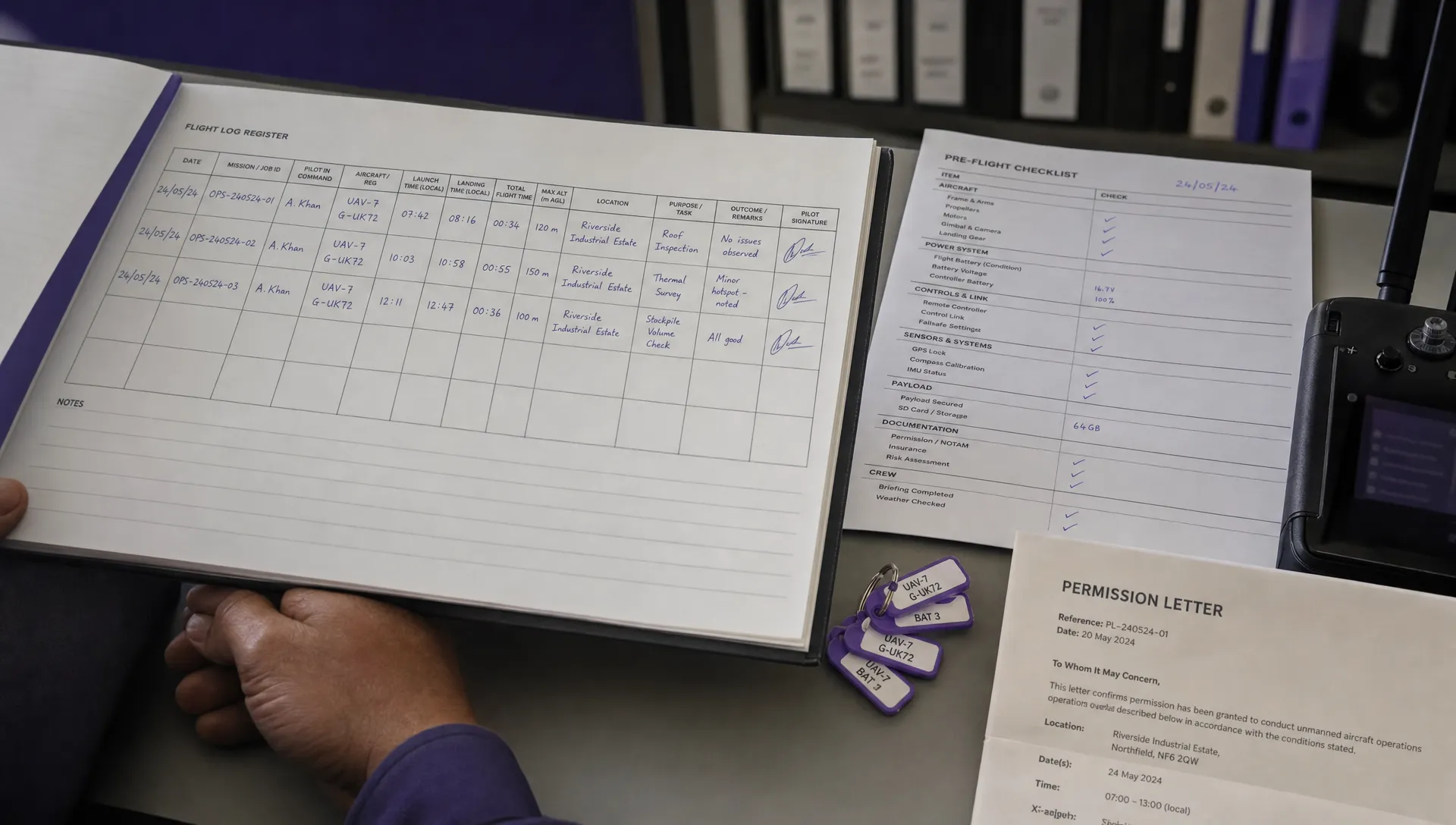
A strong minimum data set usually includes:
- Job or project reference
- Client or internal department
- Operating location, site name and coordinates or boundary
- Remote pilot, observers and any supporting crew
- Aircraft, payload and battery identifiers
- Planned and actual flight date and time
- Weather conditions and visibility
- Airspace, proximity and site hazard checks
- Risk assessment and method statement reference
- Pre-flight and post-flight checklist completion
- Take-off, landing and flight duration details
- Deviations from the plan, incidents, defects or abnormal events
- Post-flight notes, deliverables and follow-up actions
This does not mean every operation needs the same level of detail. A routine visual roof inspection and a multi-site utility inspection will have different risk profiles. The key is to define what is mandatory for all flights, then add extra fields for higher-risk or client-specific work.
Connect the log to the flight plan
A flight log is weakest when it sits apart from the plan. Auditors and safety managers want to see the full chain of evidence: what was planned, what was checked, what was approved and what actually happened.
For every flight, your log should link back to the original flight plan. That plan may include the operating area, site access arrangements, airspace assessment, proximity considerations, emergency procedures, permissions, local contacts and task objectives.
If the flight changed on the day, record the reason. Examples include unexpected site access restrictions, deteriorating weather, a new obstruction, public activity in the operating area, or a client request to adjust the capture sequence. Changes are not automatically a problem. Unrecorded changes are.
The best practice is to make variance visible. A short note such as “launch point moved 80 metres east due to locked gate, no change to operating area or risk controls” is far more useful than a log that suggests the flight was completed exactly as planned when it was not.
Record equipment details that support maintenance decisions
Aircraft and battery records are central to audit-ready drone operations. If a drone develops a fault, you need to know its recent usage, where it was flown, who flew it and whether any unusual behaviour was recorded.
At minimum, each flight log should identify the aircraft and batteries used. For more mature operations, the log should also support maintenance triggers, defect reporting and asset utilisation reporting. This is particularly important for survey companies, utilities and emergency services, where aircraft may be shared across multiple pilots and sites.
| Equipment record | Why it belongs in the flight log |
|---|---|
| Aircraft identifier | Connects the flight to airframe history and maintenance records |
| Battery identifier | Supports battery cycle tracking and performance monitoring |
| Payload or sensor | Confirms the correct equipment was used for the task |
| Defect notes | Captures issues while they are fresh in the pilot’s mind |
| Maintenance follow-up | Shows that faults were actioned rather than forgotten |
Avoid vague entries such as “Mavic drone” or “battery 1” unless those labels are unique and controlled within your fleet system. Ambiguous asset naming is one of the fastest ways to weaken an audit trail.
Capture human factors, not just aircraft data
Drone operations are not only about equipment. They are also about decisions made by people under real-world conditions. A useful flight log should capture who made those decisions and whether the right people were assigned to the task.
For team operations, record the remote pilot, observers, payload operators, supervisors and any handovers. If a pilot is working under a specific internal approval, client induction, site access requirement or role restriction, make sure your records can prove it.
This is especially important for emergency services and utility operations, where crews may deploy quickly, work in challenging environments or coordinate with wider incident command structures. In those contexts, a clean log helps after-action reviews focus on operational learning instead of reconstructing basic facts.
Make checklists part of the record
Checklists are only valuable if they are completed consistently and retained with the job record. A tick-box that disappears after the flight is less useful than a checklist that remains attached to the log, showing what was confirmed before and after the operation.
Pre-flight checks should cover the items that matter for safe launch, such as aircraft condition, battery status, firmware or configuration considerations, weather suitability, site hazards, airspace status and emergency procedures. Post-flight checks should capture aircraft condition, battery status, data capture confirmation, defects and incident notes.
For audit readiness, focus on evidence rather than memory. If your process relies on a pilot saying “I always check that”, the record is not strong enough. If the completed checklist is stored with the flight, you have a much clearer evidence trail.
Use clear time, location and naming conventions
Small formatting choices can make a big difference during an audit. If one pilot logs local time, another uses UTC, and another writes “morning flight”, it becomes harder to reconstruct events accurately.
Set conventions for dates, times, locations and file names. For example, decide whether your operation records local time or UTC, how site references are written, and how job numbers map to client folders. Document the convention and apply it consistently.
For locations, avoid relying only on informal descriptions. “Substation north field” may mean something to the pilot on the day, but it may not be clear to a manager reviewing the record six months later. Add coordinates, map references, site boundaries or asset identifiers where appropriate.
This is particularly valuable for survey and inspection work. If a client later queries whether a specific roof, pylon, span, quarry face or asset was inspected, precise location records prevent confusion.
Log deviations, incidents and near misses honestly
A perfect-looking log is not always a good log. Real operations involve changing conditions, minor snags and judgement calls. Audit-ready records should show that your team recognises, reports and learns from those moments.
Encourage pilots to record deviations, abnormal events, near misses, equipment issues and environmental changes without fear of blame. A strong safety culture depends on honest reporting. If logs only capture successful flights with no context, your organisation loses valuable learning data.
Examples worth logging include:
- Loss of visual line of sight margin that required repositioning
- Unexpected people, vehicles or livestock entering the area
- Control link warnings, compass issues or unexpected aircraft behaviour
- Battery performance concerns
- Weather changes that shortened or cancelled a flight
- Client pressure to fly outside the agreed plan
- Any emergency procedure that was briefed, triggered or considered
The note does not need to be long. It needs to be factual, timely and linked to follow-up action where required.
Protect sensitive records and control access
Drone flight logs often contain sensitive information. They may reveal critical infrastructure locations, emergency service deployments, security arrangements, private client sites or personal data. Audit readiness is not just about keeping records. It is also about controlling them properly.
Access should be appropriate to role. A pilot may need to complete and view assigned flight records. An operations manager may need oversight across the team. A client may need a job pack or evidence of completion, but not internal notes unrelated to their project.
Think carefully before storing logs in general-purpose folders with broad access. For sectors such as utilities, law enforcement and emergency response, record security and controlled sharing are part of operational professionalism.
Review records before they are needed
The worst time to discover gaps in your logs is during an audit, claim or client dispute. Build periodic record reviews into your operating rhythm.
A monthly or quarterly sample review can identify missing fields, inconsistent naming, incomplete checklists or weak defect follow-up. For larger teams, review by pilot, aircraft, client or operating area to spot patterns. If one site regularly generates deviations, that may indicate a planning issue. If one aircraft appears frequently in defect notes, that may indicate a maintenance concern.
Good reviews do not need to be complicated. Select a sample of recent flights and test whether each record can answer the core audit questions: who, what, where, when, why, how and what happened next.
Move away from scattered spreadsheets as you scale
Spreadsheets can work for a very small operation, but they become harder to control as flight volume increases. The main risks are duplicated files, missing attachments, inconsistent versions, weak access control and no easy link between planning, risk assessments, assets and completed logs.
If you are comparing systems, look for software that supports your complete operating workflow rather than just a standalone logbook. Independent resources such as online tool guides can be useful when you are assessing broader digital workflow tools and trying to understand how different platforms fit into your admin stack.
For drone operations specifically, the strongest setup is usually one where the flight log is connected to the job, client, team, aircraft, checklists, risk assessment and reporting. That reduces rekeying, improves consistency and makes evidence easier to retrieve.
Dronedesk is built for this connected approach. Its features include client management, fleet management, team management, airspace intelligence, proximity intelligence, flight planning, flight logging, data reporting, configurable checklists and risk assessments. For operators who need audit-ready records, the value is in keeping those operational elements together rather than scattering them across separate tools.
Build a simple flight logging SOP
A standard operating procedure helps make good logging routine. It should be short, practical and written for the people who will use it in the field.
Your SOP should define:
- Which flights must be logged
- Which fields are mandatory
- When the log must be completed
- Who reviews or approves records
- How deviations and incidents are reported
- Where supporting evidence is stored
- How long records are retained
- Who can access, export or share logs
Retention deserves particular attention. Do not rely on a generic rule of thumb. Check your Operations Manual, Operational Authorisation, client contracts, insurer requirements and internal policies. If requirements differ, apply the stricter standard or seek competent advice.
The SOP should also explain what happens when a record is incomplete. A missing log should trigger correction, not become an accepted part of the process.
Practical checklist for better drone flight logging
If you want to improve your records quickly, start with the basics. Most audit weaknesses come from missing links between the flight, the plan, the aircraft and the people involved.
Use this checklist to assess your current process:
| Best practice | Yes or no |
|---|---|
| Every flight has a unique job or flight reference | |
| Logs link to the flight plan and risk assessment | |
| Aircraft, batteries and payloads are identified clearly | |
| Pilot and crew details are recorded | |
| Weather, airspace and site checks are retained | |
| Pre-flight and post-flight checklists are stored with the record | |
| Deviations, defects and incidents are recorded consistently | |
| Logs are reviewed periodically for completeness | |
| Records can be exported or shared when required | |
| Access to sensitive records is controlled |
If you cannot confidently tick these items, your logs may still be useful, but they are not yet fully audit-ready.
Frequently Asked Questions
What is drone flight logging? Drone flight logging is the process of recording the details of each drone operation, including the pilot, aircraft, location, timing, conditions, checks, risk controls, outcomes and any issues encountered.
What should be included in a professional drone flight log? A professional log should include the job reference, client or site, pilot and crew, aircraft and battery identifiers, flight times, location, weather, airspace and hazard checks, risk assessment reference, checklist completion, deviations, incidents and post-flight actions.
How long should drone flight logs be kept? Retention requirements depend on your Operational Authorisation, Operations Manual, client contracts, insurer requirements and internal policies. Avoid guessing. Define a retention period in your procedures and make sure it satisfies the strictest applicable requirement.
Are spreadsheets enough for drone flight logging? Spreadsheets may be enough for a very small operation, but they often become difficult to manage as teams, aircraft, clients and sites increase. Connected operations software can make it easier to link logs with planning, risk assessments, checklists, fleet records and reporting.
Why do audit-ready drone records matter? Audit-ready records help prove that flights were planned, authorised, risk assessed, flown and reviewed properly. They also support client reporting, insurance queries, internal safety reviews and continuous improvement.
Make every flight easier to evidence
Audit-ready drone flight logging is not about adding admin for the sake of it. It is about making your operation safer, more professional and easier to defend when someone asks for evidence.
If your current records are spread across spreadsheets, folders, emails and pilot notebooks, it may be time to centralise the process. Dronedesk brings flight planning, flight logging, risk assessments, checklists, fleet management, team management and reporting into one drone operations platform, helping operators keep clearer records from planning through to close-out.
Explore Dronedesk at dronedesk.io and see how a connected operations system can support more consistent, audit-ready drone records.
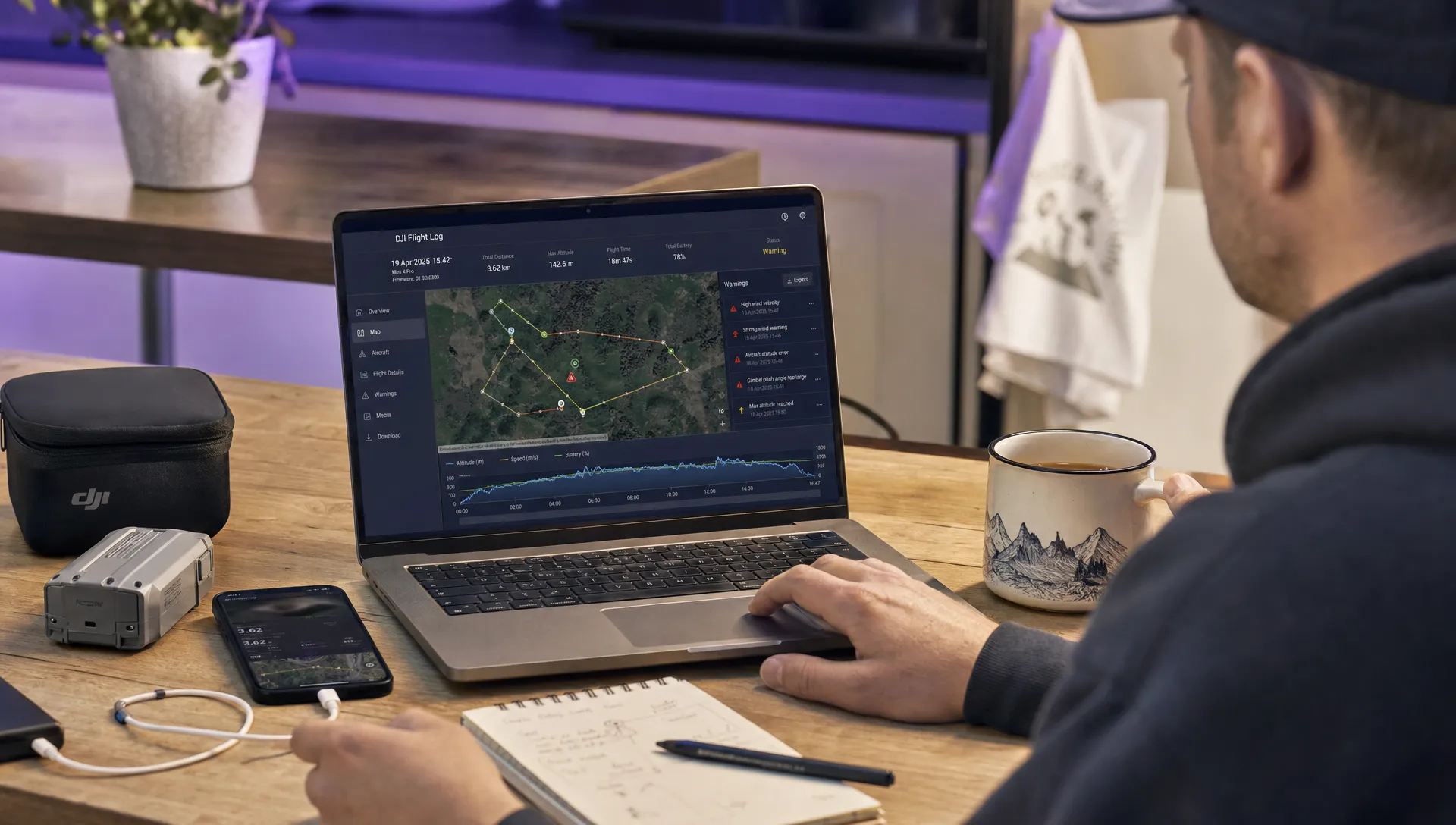 How to Review a DJI Flight Log After an Unexpected Event →
 Drone Laws Around the World: A Pre-Flight Research Framework →
 How to Compare Drone Survey Services for Complex Sites →
 How to Start a Drone Mapping Business With a Clear Workflow →
 Class C Airspace Drone Rules for Commercial Flights →
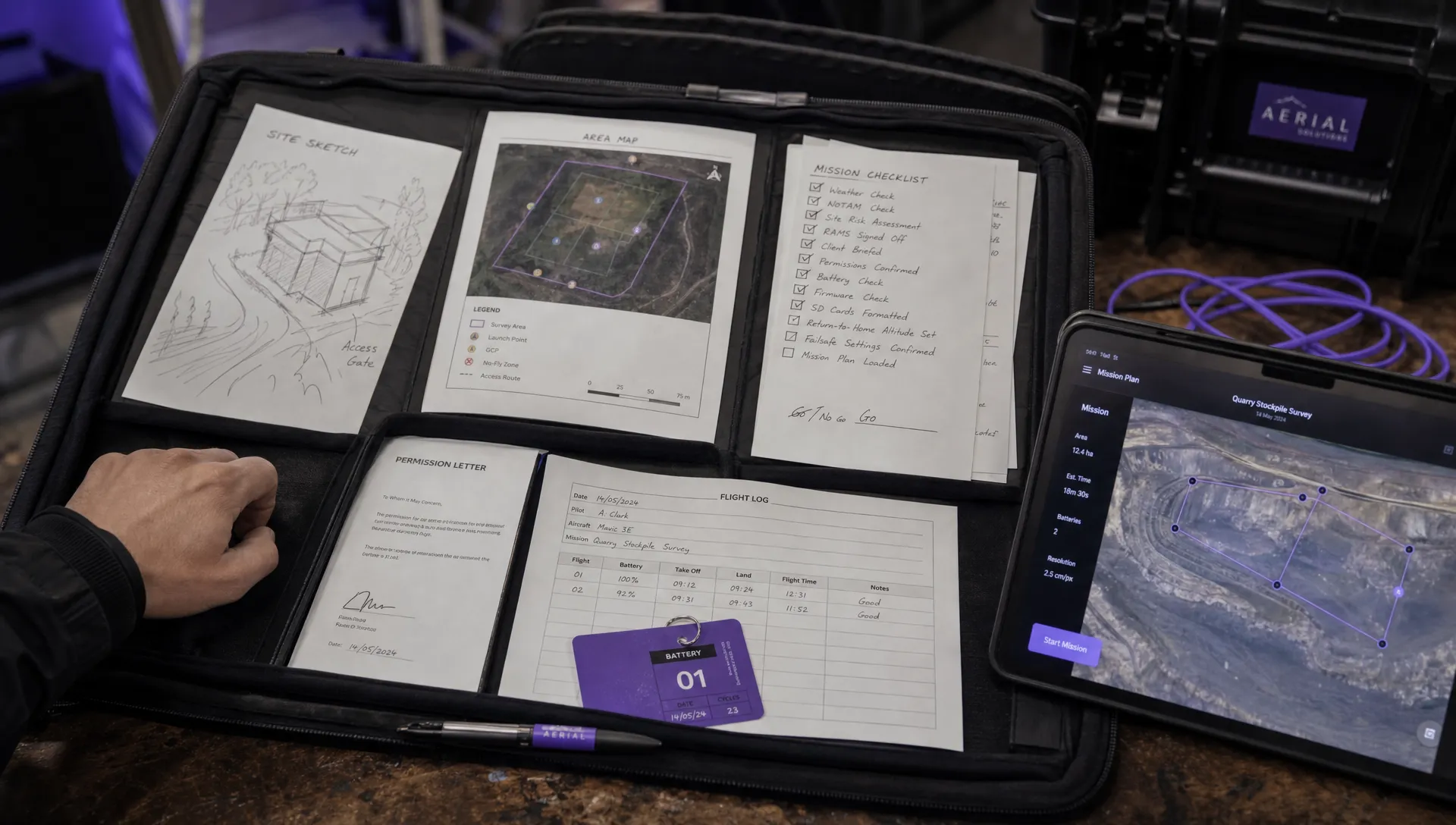 How to Create a Drone Job Pack for Every Mission →
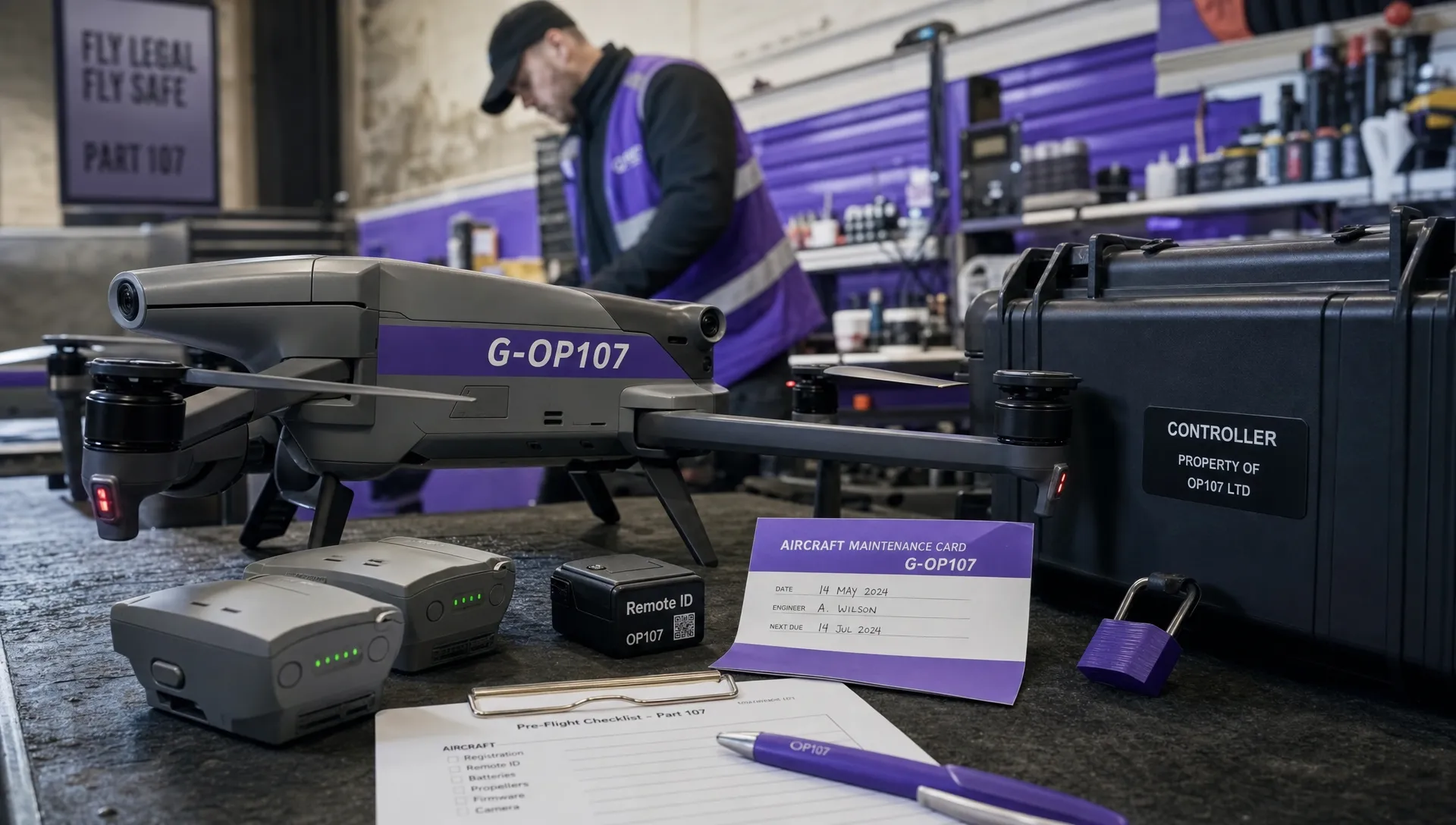 FAA Small UAS Rule: Key Requirements for Operators →
 How to Build a Drone Pilot Flight Log That Is Audit Ready →
 FAA Drone Licence Requirements for Commercial Pilots →
 FAA BVLOS Waivers Granted: What Successful Cases Show →