
Unlocking Longer Drones Flight Time A Practical Guide
That flight time printed on the box—the one promising a lofty 30 to 45 minutes—is the drone equivalent of a perfect laboratory experiment. For professional pilots, the real job is understanding the immense gap between that marketing number and what you'll actually get in the field. Your success, safety, and even your profitability depend on it.
The Reality Behind Drone Flight Time Specifications
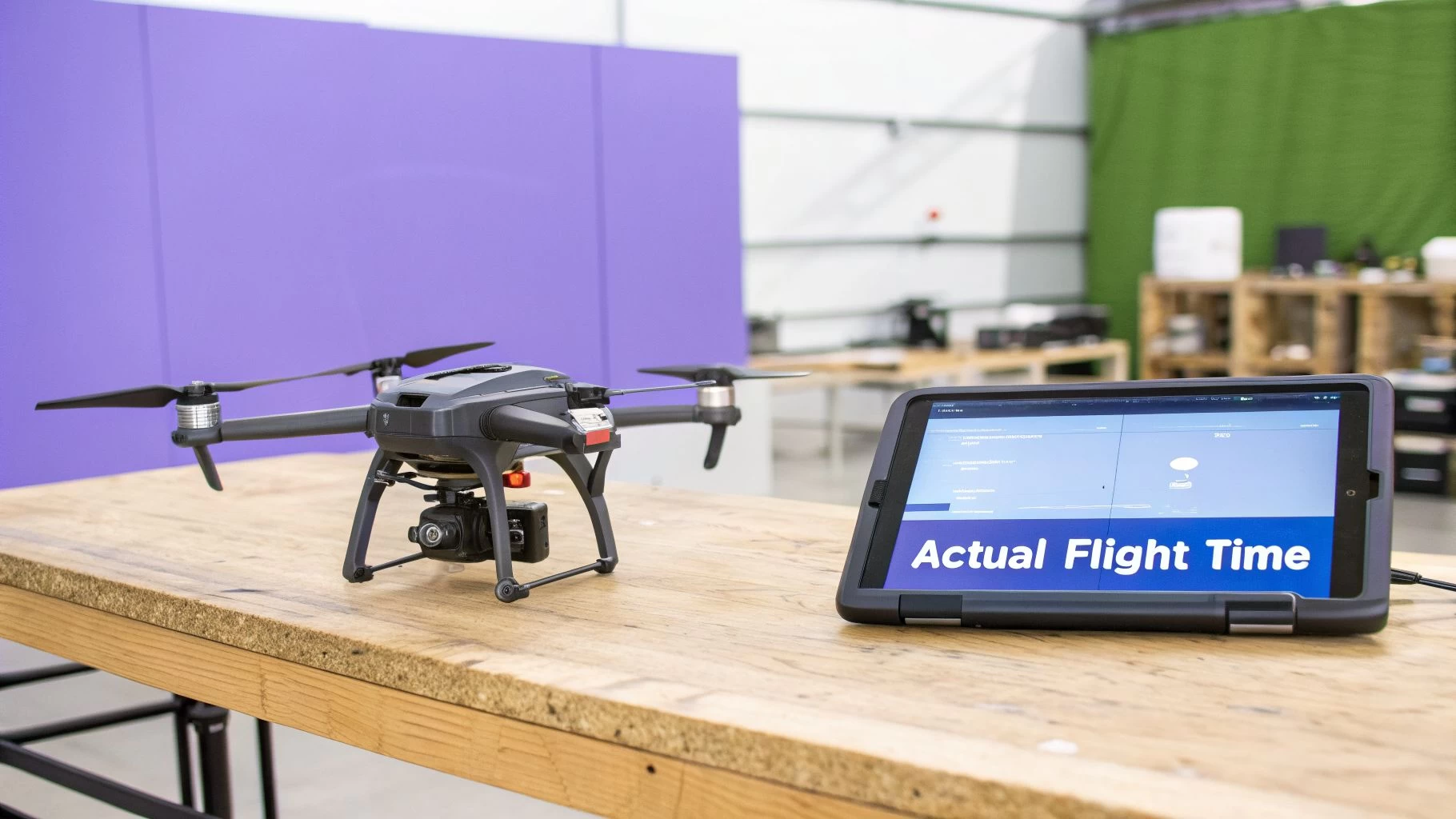
Think of your drone's advertised flight time like a car’s official miles-per-gallon (MPG) rating. That number gets clocked on a flat, straight road with no wind, zero extra weight, and a perfectly steady foot on the gas. But your daily commute is full of hills, traffic, and maybe a boot full of gear, all of which chip away at your actual MPG. It’s the same story in the sky.
Drone flight time isn't a fixed number; it's a dynamic resource that changes with every single mission. The figure on the box is almost always measured with the drone just hovering, in a room with no wind, carrying no payload, and powered by a brand-new battery. It's a scenario you'll practically never encounter on a professional job.
Why Advertised Time Is Just a Starting Point
For any commercial operator, blindly trusting the box spec is a recipe for disaster. That survey mission in a gusty coastal area? Or a cinematic shoot carrying a heavy camera lens? Both will slash your available airtime, sometimes dramatically. The real challenge isn't knowing the maximum time; it's accurately predicting the usable time for a specific job, on a specific day.
Getting this right completely changes your approach from being reactive to strategic. Instead of getting caught off guard by an early low-battery warning, you start planning missions with real confidence. This understanding has a direct impact on your bottom line by:
- Improving Mission Efficiency: You can schedule battery swaps and map out flight paths far more effectively, letting you get jobs done faster.
- Enhancing Safety: Solid planning ensures you always have enough juice for a safe Return to Home (RTH), even if something unexpected happens.
- Increasing Profitability: When you can estimate your time accurately, you can quote jobs better and avoid costly re-flights because you ran out of power.
The true measure of a professional pilot isn’t how long their drone can fly, but how accurately they can predict its endurance for the task at hand. That foresight is what separates the amateurs from the experts.
At the end of the day, your actual time in the air comes down to a few core factors: the health of your batteries, the weight of your payload, the day's weather, and even your own flying style. Once you move past the marketing hype and focus on these real-world variables, you gain control over your most valuable operational asset—time.
What Actually Determines Your Drone's Airtime
To really get a handle on your drone’s flight time, you need to understand the forces constantly trying to bring it back to earth. It’s less like a simple countdown timer and more like a complex, real-time energy budget. Four key variables—battery health, payload weight, weather conditions, and your own piloting style—are always making withdrawals from that budget.
Getting the most out of your drones flight time starts with a deep respect for its power source. Your drone’s battery isn’t just a fuel tank; it's a sophisticated chemical engine, and its performance changes over time and with the environment.
The Heart Of The Drone: Your LiPo Battery
The Lithium Polymer (LiPo) batteries that power most professional drones are little miracles of energy density, but they’re also a bit sensitive. A brand-new, perfectly cared-for battery on a mild day will deliver power smoothly and predictably. An older battery with 100+ charge cycles, on the other hand, just can't hold as much juice and will struggle to deliver power when you push it.
This is where you run into a phenomenon called voltage sag. When you demand a sudden burst of power—like punching the throttle to fight the wind—an older battery’s voltage can drop off a cliff. Your drone's flight controller sees this sudden drop and might trigger a premature Return to Home (RTH), even if the battery percentage still looks okay.
A battery's C-rating tells you its maximum safe discharge capability. If you push a battery beyond this limit, often by flying too aggressively with a heavy payload, you won't just shorten that single flight—you'll cause permanent damage to the battery cells.
And then there's temperature. It plays a massive role. Flying in cold weather (below 15°C or 60°F) can slash a LiPo battery’s effective capacity by up to 50%. The chemical reactions that release energy simply slow right down, meaning your "full" battery starts behaving like it's half-empty from the get-go.
The Burden Of Weight: The Payload Factor
Every single gram your drone carries costs energy to lift and keep in the air. Simple as that. A drone might be rated to handle a heavier camera or sensor, but it does so by pulling more current from the battery, which directly eats into your total flight time. It’s a basic law of physics with very real-world consequences.
Think of your drone as a hiker. A short walk with an empty backpack is a piece of cake. Now, load that same backpack with 2 kilograms (about 4.4 lbs) of gear. The hiker can still do the walk, but they'll be working much harder and will be out of energy a lot sooner.
It’s easy to see how different payloads change the game:
- A lightweight mapping camera: Might only knock off 5-10% of your flight time.
- A mid-weight LiDAR sensor: Could easily cut flight time by 20-25%.
- A heavy cinema camera rig: May slash your available time in the air by 40% or more.
This is exactly why mission planning is so critical. Before you even head out to the site, you have to account for your payload's weight and adjust your expectations. This is a fundamental part of any professional pre-flight routine, something we cover in our guide to the essential pre-flight checklist for drones.
Fighting The Invisible Forces: Weather And Environment
Your drone is in a constant dogfight with the air around it. Wind is the most obvious opponent. Flying into a 15 mph headwind forces the motors to spin much faster just to hold position, let alone make any headway. That increased power draw is a huge drain on the battery.
But it’s not just wind. Air density, which is affected by altitude, temperature, and humidity, also plays a huge part.
- High Altitude: The air is thinner at higher elevations, meaning the propellers have less to "bite" into. This forces the motors to work harder just to generate the same amount of lift.
- Hot Weather: Hot air is less dense than cold air, which creates a similar effect to flying at high altitude and makes the motors less efficient.
A mission flown at sea level on a cool, calm day will always give you longer flight times than the exact same mission flown in hot, windy conditions up in the mountains.
The Pilot's Impact: How You Fly Matters
In the end, the biggest variable can often be the person on the sticks. Smooth, deliberate control inputs are far more energy-efficient than aggressive, jerky manoeuvres. Every rapid acceleration, hard stop, or sharp turn is like flooring the gas pedal in your car—it burns through a ridiculous amount of fuel for very little gain.
A pilot flying a smooth, pre-planned survey grid will get a much longer flight than someone performing dynamic, acrobatic shots for a film. By flying with energy conservation in mind—using the drone's momentum, planning gentle turns, and avoiding unnecessary "punch-outs"—you can realistically add several crucial minutes to every single flight.
Calculating Usable Flight Time For Real Missions
The flight time printed on the box is a best-case scenario, a lab-tested number under perfect conditions. But your missions don’t happen in a lab. Bridging the gap between that marketing spec and your operational reality is absolutely crucial for flying safely and successfully. It's time to move from a vague estimate to a reliable calculation of your usable flight time.
The number one rule for any professional pilot is simple: never, ever fly a battery until it’s empty. You have to leave a safety buffer to handle a sudden gust of wind, navigate around an unexpected obstacle, or just give yourself a stress-free return and landing. Best practice in the industry is to always land with a battery reserve of 25-30%.
Think of this buffer as the drone's "reserve fuel tank." You wouldn’t plan a road trip intending to coast into the final petrol station on fumes, and you shouldn't plan a drone flight with zero margin for error. This reserve isn't optional; it's the foundation of every safe mission plan.
From Theory To Reality: A Simple Formula
Keeping that safety margin in mind, we can use a straightforward formula to figure out your actual usable flight time for any given battery.
- Find the Advertised Time: Start with the manufacturer's maximum flight time. Let's say it's 30 minutes.
- Calculate Your Safety Reserve: Multiply that max time by your reserve percentage. Using a 30% buffer, that's 30 minutes * 0.30 = 9 minutes.
- Determine Usable Flight Time: Now, just subtract the reserve from the maximum time. 30 minutes - 9 minutes = 21 minutes.
This 21 minutes is your new, realistic maximum mission time under ideal conditions. It’s the number you should be using for your planning, not the 30 minutes on the box.
Establishing Your Own Performance Benchmarks
This calculation gives you a great starting point, but the true variables are your specific drone, your typical payload, and the environment you usually fly in. The next step is to run a simple, controlled test to see how your gear actually performs.
It’s easier than it sounds. Just take your drone out on a calm day with the payload you use most often. Fly a normal mission profile—don’t just hover—and time how long it takes to hit that 30% battery level. That real-world number becomes your personal performance benchmark. You can get even more precise by digging into your flight logs. For a deeper dive, check out our guide on how to analyze drone flight log files in our guide.
This diagram shows how these key factors constantly tug at your drone's real-world endurance.
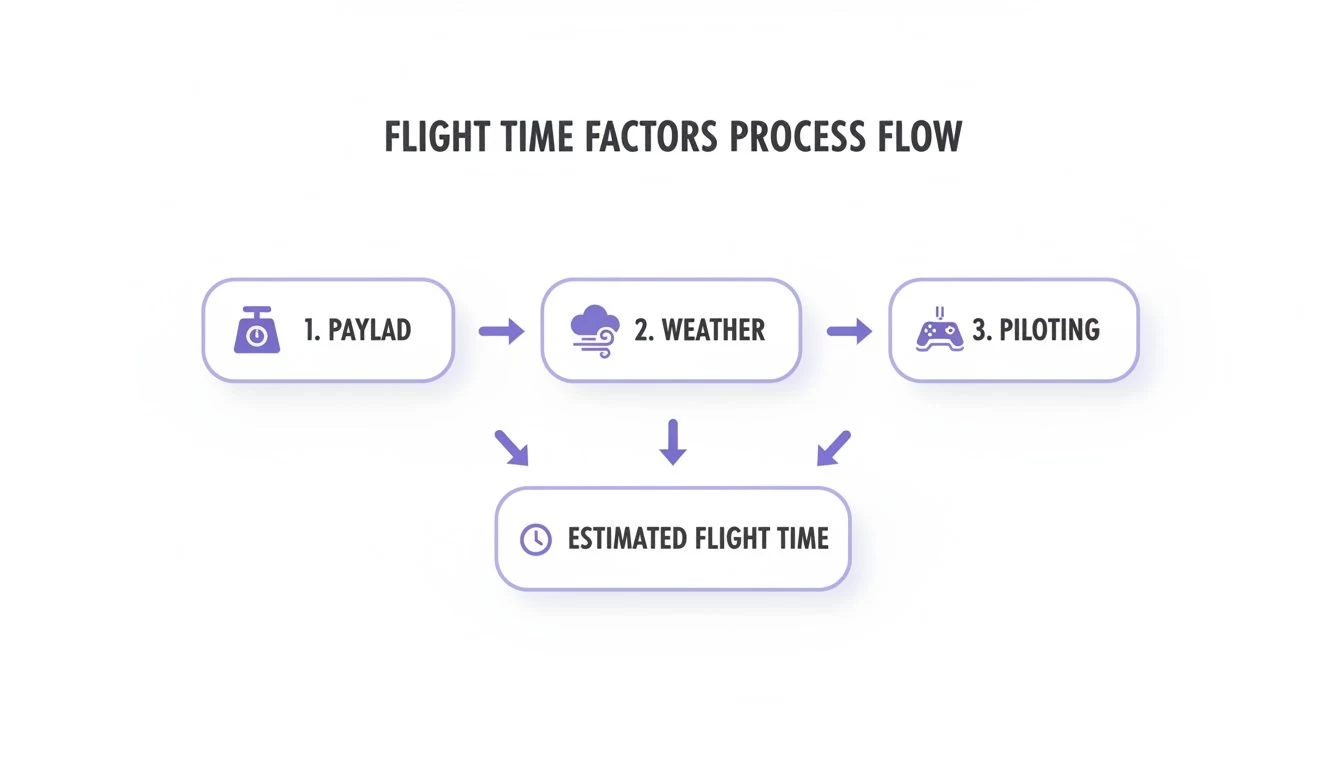
As you can see, every mission's flight time is a direct result of the interplay between what you're carrying, the conditions you're flying in, and how you're flying the drone.
Advertised Vs Realistic Drones Flight Time Comparison
To really see how dramatically flight time can change, let's look at a few popular professional drones. The table below highlights the stark difference between the advertised maximum and what a pilot can realistically expect when facing real-world challenges like wind and a payload.
| Drone Model | Advertised Time (Mins) | Realistic Time Calm No Payload (Mins) | Realistic Time Windy With Payload (Mins) |
|---|---|---|---|
| DJI Mavic 3 Pro | 43 | ~30-32 | ~22-25 |
| DJI Matrice 300 RTK | 55 | ~38-40 | ~28-32 |
| Autel EVO II Pro | 40 | ~28-30 | ~20-23 |
| DJI Air 3 | 46 | ~32-34 | ~24-27 |
The pattern is clear: even in calm weather, your usable time drops significantly once you factor in a safety buffer. Add a real payload and a bit of wind, and the achievable drones flight time can plummet by 30-40% or more from what's on the box.
By adopting this approach of calculating and testing, you can plan your missions with confidence, ensuring you always have the endurance to get the job done safely.
Practical Strategies to Extend Your Drone's Flight Time
Knowing the theory behind your drone's endurance is one thing, but actively extending it is where professional pilots gain a real edge. Squeezing extra minutes from every battery isn’t about luck—it’s about adopting a series of small, deliberate habits before and during your flight. These are the actionable techniques in your playbook for maximising every second in the air.
Think of it as the difference between a casual driver and a hypermiling expert. Both get to their destination, but one uses smart, efficient techniques to go much further on the same tank of fuel. The same principle applies directly to improving your drone's flight time.
Pre-Flight Preparations for Maximum Endurance
The quest for longer airtime begins long before you power on the drone. Smart preparation and the right equipment choices create the foundation for an efficient flight.
- Intelligent Battery Management: Healthy batteries are efficient batteries. Always charge them to 100% shortly before your mission, not days in advance. To preserve their long-term health and capacity, store them at a partial charge (around 50-60%) in a cool, dry place.
- Firmware and Software Updates: Manufacturers frequently release firmware updates that include optimisations for power management. Making sure your drone, controller, and batteries are all running the latest versions can provide small but meaningful efficiency gains.
- Propeller Selection and Condition: Not all propellers are created equal. High-efficiency or "low-noise" props can sometimes offer a slight improvement in flight time. More importantly, always inspect your propellers for nicks or damage—even minor imperfections force the motors to work harder, wasting precious energy.
- Shed Unnecessary Weight: Just like with any aircraft, weight is the enemy of endurance. Before you take off, do a quick "payload audit." Are you carrying any brackets, mounts, or accessories that aren't absolutely essential for this specific mission? Getting rid of even a few grams can make a difference. Exploring advanced power solutions like rechargeable lithium battery packs can also be a game-changer for maintaining longer operational times.
Your pre-flight routine is the most powerful tool you have for influencing flight time. Five minutes of careful preparation on the ground can easily translate into several extra minutes of productive time in the air.
In-Flight Tactics for Energy Conservation
Once your drone is airborne, your piloting style becomes the single biggest factor affecting battery drain. The key to conserving power and stretching out your mission is to fly smoothly and deliberately.
Master Smooth and Efficient Piloting
Every sudden, jerky movement is an energy spike. Rapid ascents, hard stops, and sharp turns all demand a huge surge of power from the battery. Your goal should be fluid, graceful control inputs instead.
Think of your drone's momentum as a resource. Rather than fighting it with abrupt stops, ease into your turns and allow the drone to glide through manoeuvres. This "driving for fuel economy" approach to flying has a dramatic and immediate impact on your battery's performance.
Optimise Your Flight Path
A little strategic flight planning can significantly reduce the energy you need to complete a mission.
- Fly With the Wind, Not Against It: When you can, plan your flight path to take advantage of tailwinds, especially on the longest leg of your mission. Fighting a headwind on the return journey when the battery is already low is a common and avoidable mistake.
- Maintain a Steady Altitude: Constant changes in altitude, especially climbing, are major power drains. For survey or mapping missions, lock in your target altitude and stick to it as consistently as possible.
- Avoid "Punching Out": Rapidly ascending at full throttle is known as "punching out," and it's one of the fastest ways to kill your battery. Unless it's absolutely necessary for safety, always climb at a moderate, steady rate.
By combining these pre-flight checks with mindful, energy-conscious piloting, you shift from being a passive observer of your battery meter to an active manager of your drone’s most critical resource. Once these habits become ingrained, they become second nature, consistently delivering longer, safer, and more productive flights.
Optimizing Flight Operations With Dronedesk
Getting a real handle on the variables that drain your drones flight time is what separates reactive pilots from proactive operational managers. This is precisely where a dedicated platform like Dronedesk becomes your secret weapon, turning raw flight data into intelligence you can actually use to improve safety, efficiency, and your bottom line.
Instead of relying on guesswork and back-of-the-napkin calculations, you can use a single set of tools to manage every aspect of your flight time. It all becomes part of a system, from planning the mission to analysing your battery's health over the long haul. This transforms flight time from a nagging worry into a resource you can manage and predict.
Data-Driven Flight Planning for Peak Efficiency
Smart flight time management begins long before the drone's rotors start spinning. With Dronedesk’s flight planning tools, you can build energy efficiency into your missions right from the get-go. This means you can map out the smartest routes, factor in terrain and known obstacles, and get a solid understanding of the mission's demands before a single battery is pulled from the case.
This kind of detailed prep work lets you:
- Design Energy-Efficient Routes: Plot flight paths that cut out unnecessary travel, avoid major altitude shifts, and even account for prevailing winds.
- Accurately Allocate Resources: Know with confidence how many batteries you’ll need for a job, so you’re not hauling extra weight or, even worse, caught short on-site.
- Set Realistic Expectations: Give clients accurate timelines based on data-backed estimates for airtime, which builds trust and shows you’re a true professional.
This approach ensures every flight is set up for maximum endurance. You can see how this all fits together by exploring how Dronedesk cuts drone admin time in half.
Automated Telemetry Logging for Unmatched Insight
The real magic of optimization happens when you start collecting and analysing detailed performance data. Of course, manually logging flight details is a chore and a surefire way to introduce errors. Dronedesk takes care of this by automatically syncing and logging flight data straight from your DJI drones, capturing a trove of information without you lifting a finger.
For instance, flight logs from popular DJI drones reveal total accumulated hours, a crucial indicator of the aircraft's health. It’s not uncommon to see over 26 hours on a Mini 3 Pro after routine professional use. This data is locked away in internal .dat files, which is why a tool like Dronedesk is so valuable for syncing them into a permanent, accessible record. Enterprise managers, in particular, love platforms that can process over 80 telemetry types, turning raw numbers into compliance reports in seconds.
The system grabs everything—from flight duration and distance to battery voltage and temperature—giving you a granular look at every single mission. This rich dataset then becomes the bedrock for smarter fleet and battery management.
Proactive Fleet and Battery Management
Once Dronedesk starts automatically logging detailed telemetry from every flight, its fleet and battery management modules can really shine. You're no longer just looking at one-off flights; you're seeing the entire lifecycle of your equipment.
By tracking performance over time, you can move from a reactive "replace when it fails" model to a proactive, predictive maintenance schedule. This shift is fundamental to running a safe and cost-effective professional drone operation.
The system uses historical data to monitor the health of each battery, keeping tabs on its charge cycles, internal resistance, and how it's actually performing in the field. The platform can flag a battery when its capacity starts to fade, letting you retire it from critical missions before it becomes a liability. This isn't just about protecting your expensive gear; it's about protecting your reputation.
For anyone managing a team of pilots, these analytics are pure gold. You can compare the average flight times achieved by different pilots or with different drone models. This helps you spot opportunities for extra training or identify which gear is giving you the best return. This fleet-wide perspective turns isolated data points into powerful business insights, allowing you to fine-tune everything from pilot technique to your next hardware purchase. With a system like Dronedesk, you stop guessing and start knowing, making every minute in the air count.
Your Flight Time Is a Strategic Business Asset
Getting a real handle on your drone's flight time is more than just a technical exercise; it’s a core business skill that separates the pros from the amateurs. We’ve looked at the physics that keep your drone from staying up forever, how to calculate what you'll actually get in the field, and a few tricks to squeeze out some extra airtime. The real takeaway here is a mind shift—from just flying, to flying smart.
This isn't just about trying to keep the drone in the air for longer. It's about recognising that every single second of flight is a valuable asset. When you start managing that asset properly, the positive effects ripple through your entire operation, giving you a serious competitive advantage.
The Real Impact on Your Operations
When you get flight time management right, the improvements are tangible and immediate:
- Safer Missions: Knowing your absolute limits and always flying with a safety buffer means you all but eliminate the risk of a sudden low-battery panic.
- More Productive Days: Proper planning leads to fewer battery swaps, smarter flight paths, and ultimately, more jobs completed in a single day.
- Happier Clients: Delivering results on time and on budget because you accounted for real-world conditions builds a rock-solid reputation for professionalism and reliability.
At the end of the day, optimising your drone's flight time isn’t some abstract goal. It’s a direct investment in your business’s safety, efficiency, and bottom line, making every mission a more calculated and successful venture.
By treating flight time not as a frustrating limitation but as a strategic resource you can manage, you ensure that every moment your drone is airborne is delivering maximum value. This proactive approach is the hallmark of a truly professional drone operation, allowing you to tackle bigger, more complex projects with confidence and a clear edge over the competition.
Drone Flight Time: Your Questions Answered
Let's tackle some of the most common questions pilots have about getting the most out of their drone's air time. This is where we get into the practical, on-the-ground stuff that the spec sheets don't always cover.
Can I Use Third-Party Batteries to Get Longer Flight Times?
It’s a tempting thought, especially when you see off-brand batteries promising a few extra minutes in the air. For professional work, though, it's a risk that's just not worth taking. Your drone’s manufacturer-approved batteries aren't just power packs; they're smart devices that talk constantly to the flight controller, giving you dead-accurate data on voltage, temperature, and what you’ve got left in the tank.
Third-party batteries can be a bit of a black box. They might give you inaccurate power readings, or worse, have a higher risk of failing mid-flight. Sticking with OEM (Original Equipment Manufacturer) batteries means you’re flying with a power source built to exacting safety and performance standards. It's the best way to protect your drone, your client's project, and your reputation.
How Much Flight Time Do I Really Lose in the Cold?
Flying in chilly weather (anything below 15°C or 60°F) can be a real shock to your batteries. It's not uncommon to see your flight time slashed by 40-50%. The cold slows down the chemical reactions inside a LiPo battery, which chokes its ability to deliver power when the motors are demanding it.
Think about it this way: a battery that gives you a solid 30 minutes on a warm summer day might only deliver 15-18 minutes when the temperature drops near freezing. Always warm your batteries to room temperature before taking off and keep a very close eye on their voltage during the flight.
Does Flying at High Altitudes Affect My Endurance?
Absolutely. Altitude has a major impact on your drone's flight time. As you go higher, the air gets thinner, meaning the propellers have less air to "bite" into. To compensate and generate the same amount of lift, the motors have to spin much faster, which burns through your battery at a surprising rate.
A good rule of thumb is to expect a loss of about 3-5% of your total flight time for every 1,000 feet (around 300 meters) you climb above sea level. If you're planning missions in mountainous areas or other high-altitude terrain, you absolutely have to factor this into your flight planning.
The professional drone industry is huge and still growing. According to FAA data, there are 855,860 registered drones in the US alone, with 37% of them working in a market valued at $43 billion. In this competitive space, every minute counts. Tools like Dronedesk help operators dig into their flight logs and fine-tune their routes, which can boost effective flight time by up to 30% in real-world missions. You can learn more about how to get these insights from drone flight log analysis.
Ready to stop guessing and start managing your flight time with precision? Dronedesk gives you the tools to plan smarter missions, monitor battery health, and analyze performance across your entire fleet. See how you can maximize every minute in the air by visiting https://dronedesk.io.
 How to Start a Drone Mapping Business With a Clear Workflow →
 Class C Airspace Drone Rules for Commercial Flights →
 How to Create a Drone Job Pack for Every Mission →
 FAA Small UAS Rule: Key Requirements for Operators →
 How to Build a Drone Pilot Flight Log That Is Audit Ready →
 FAA Drone Licence Requirements for Commercial Pilots →
 FAA BVLOS Waivers Granted: What Successful Cases Show →
 How to Export DJI Flight Logs for Incident Reviews →
 Drone Safety and Legal Duties for Business Operations →
 EASA Drone Regulations: Open, Specific and Certified Categories →