
Master Your 2026 FAA Inspection Authorization Renewal
March creeps up fast when you've been buried in inspections, squawks, logbooks, and shop paperwork. Then one day you look at the calendar and remember your FAA inspection authorization renewal isn't a paperwork chore you can knock out in an afternoon. It's the result of what you did, or failed to do, across two separate years.
That catches a lot of good mechanics off guard. Not because they don't know the rules, but because IA renewal punishes delay. If you didn't meet the activity requirement in the first year, you can't clean it up at the last minute by dumping a pile of second-year records into IACRA and hoping the FSDO sorts it out.
If this is your first renewal, treat it like a compliance exercise backed by maintenance-grade discipline. Keep your dates straight, choose the activity path that matches the work you perform, and submit a package that an inspector can review without guessing what you meant.
Understanding Your IA Renewal Mandate
A mechanic usually realizes the true deadline when the calendar flips into March and the records still are not sorted by year. That is when first-time IA renewals go sideways. The FAA does not treat renewal as one pile of activity gathered over two years. It expects qualifying activity in each year of the cycle, and that distinction decides whether your application goes through cleanly or stalls.
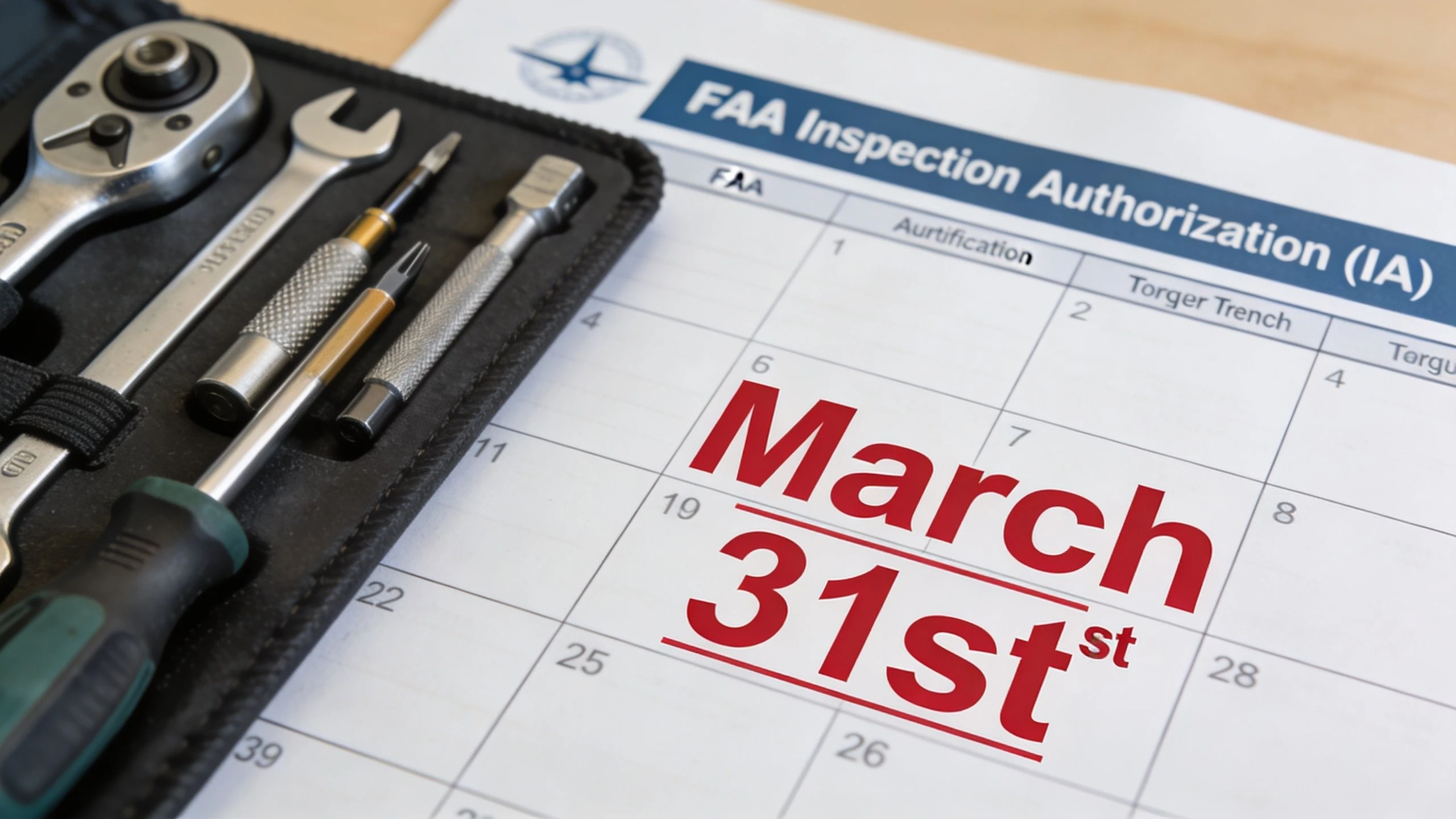
The date to keep in front of you is March 31 of each odd-numbered year. The renewal cycle runs on two separate yearly checkpoints inside that two-year period. If you satisfied the requirement in year two but came up short in year one, you have a problem no matter how busy the second year was.
That catches mechanics who do solid work but treat IA renewal like a logbook cleanup project. It is not. It is a compliance record tied to specific dates, specific activities, and documentation an inspector can verify without guessing what happened.
An IA carries authority an A&P alone does not have. Annual inspections, approval for return to service after certain major repairs or alterations, and other IA-signoff work all depend on that authorization being current. If the IA expires, the authority stops on that date. Your experience still matters in the shop, but it does not substitute for a current authorization in the paperwork.
The part many mechanics misunderstand
The hard part is not usually doing the work. The hard part is proving the right work happened in the right year.
Mechanics who also fly drones mix this up all the time. Part 107 currency and aircraft IA renewal are separate systems with separate standards. A current remote pilot status does nothing for your IA. The reverse is also true. If you operate in both worlds, keep those records and deadlines in separate lanes from day one.
The same rule applies inside your IA file. Do not combine first-year and second-year records into one undifferentiated stack and expect IACRA or the FSDO to sort it out for you. They will review what you submit. They will not reconstruct your compliance history.
What to verify before you start the application
Check these items before you log into IACRA:
- Cycle timing: Confirm you are in the current renewal cycle and identify which documents belong to year one versus year two.
- Qualifying method by year: Be clear on what activity satisfied each year. Training in one year and annual inspections in the other can be fine, but your records need to show that plainly.
- Supporting records: Gather logbook entries, course completion records, inspection documentation, and any other evidence before you begin the application.
Keep it organized in a way another person can follow in five minutes. That is the standard that matters.
Paper folders still work if you maintain them. A simple digital archive works better for many mechanics because it reduces the usual mistakes: wrong year, missing certificate, incomplete inspection entry, or a scanned document nobody can read. Shops that want a cleaner system often borrow ideas from aircraft maintenance tracking software even if they still keep official records in PDFs and paper binders.
Why the FAA handles IA renewal this way
The agency wants continuing activity, not a long gap followed by a rush at the end of the cycle. From a maintenance standpoint, that makes sense. An IA is supposed to reflect current involvement in inspection, approval, training, or testing, not just prior experience.
That is the practical takeaway. Treat IA renewal records the same way you treat maintenance entries on a job with liability attached. Date them correctly, file them as you go, and make sure another inspector can follow the trail without calling you for an explanation.
Choosing Your IA Renewal Activity Path
An IA renewal gets messy fast when a mechanic picks the wrong qualifying activity in January, then tries to prove it in March. I see that a lot with people who split time between manned aircraft maintenance and drone work. Part 107 currency and IA renewal are two different systems with two different standards. Staying current as a remote pilot does nothing for your IA unless you also meet one of the FAA's IA renewal activities and can prove it.
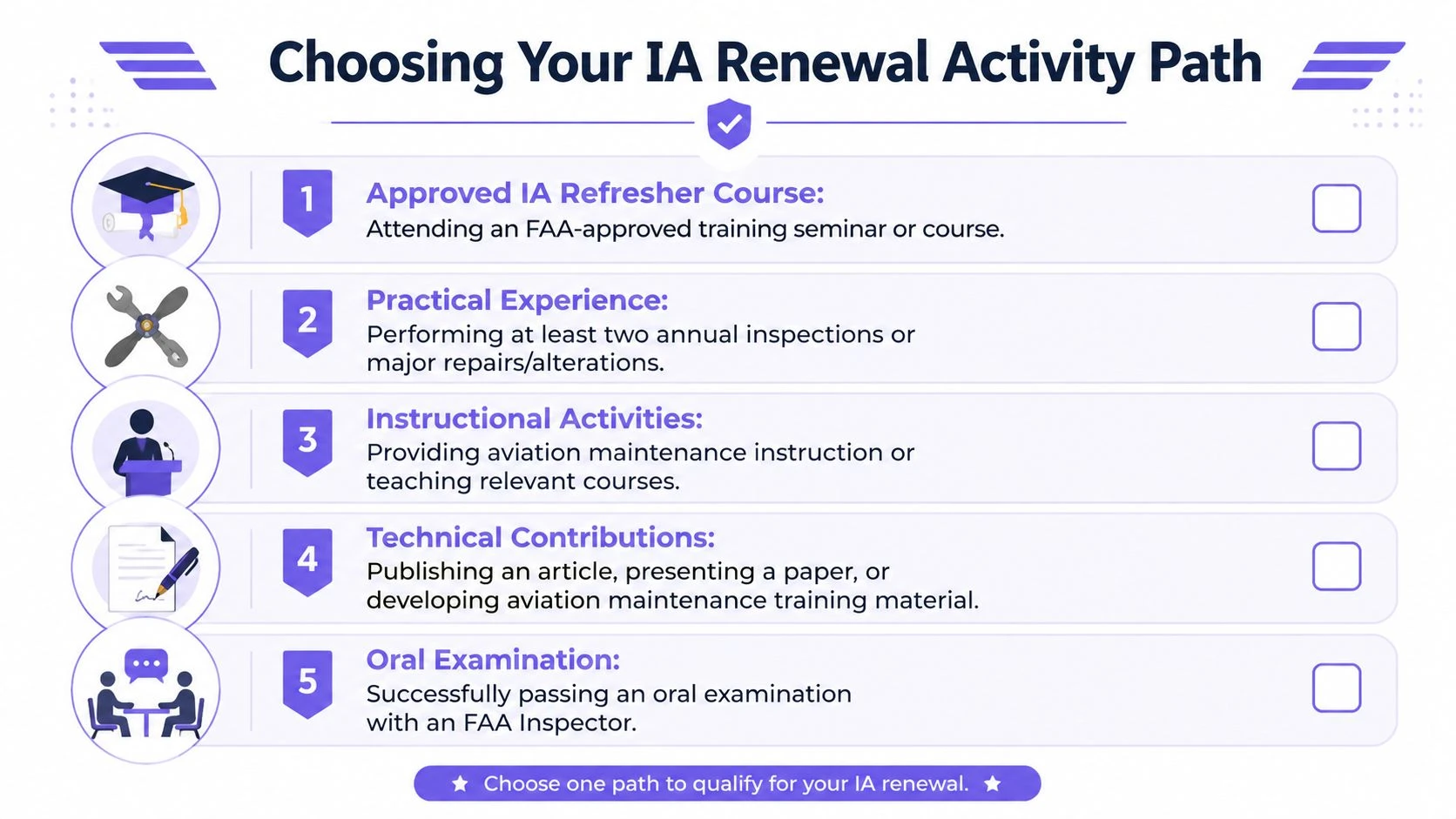
The five qualifying paths
The FAA gives you five basic ways to renew: four annual inspections, eight major repairs or alterations, one complete progressive inspection, eight hours of approved training, or an oral test with an Aviation Safety Inspector.
The right choice depends less on preference and more on what your records can support without explanation.
| Path | Best fit | What works well | What causes problems |
|---|---|---|---|
| Four annual inspections | IA doing recurring inspection work and controlling the signoff process | Familiar workflow and straightforward evidence when entries are complete | Shared jobs, vague entries, or uncertainty about your direct role |
| Eight major repairs or alterations | Shops doing steady return-to-service work on qualifying jobs | Useful when annuals are not your normal volume | Poor backup paperwork or work that does not clearly meet the standard |
| One complete progressive inspection | Operators already using a progressive program | Efficient if the full sequence is documented from start to finish | Gaps between phases or records scattered across multiple files |
| Eight hours of approved training | IA holders who want a predictable, document-based path | Usually the cleanest option if certificates are saved correctly each year | Missing a year, losing a certificate, or assuming one course covers the full cycle |
| Oral test with ASI | Mechanics who missed the other paths or have unusual circumstances | A valid recovery option when scheduled in time | FSDO scheduling, preparation, and deadline pressure |
Training is usually the cleanest path
For a lot of first-time renewals, training is the least troublesome route because the proof is simple. You complete approved instruction, keep the completion record, and submit it. ARSA's IA guidance explains that the 8-hour annual training requirement must be met for both years in the renewal cycle, with graduation certificates to support it.
That annual piece is where mechanics get burned.
They remember taking a course sometime during the cycle and assume they are covered. They are not. If you use training, treat those certificates the same way you treat signed maintenance records. Save them the day you receive them, label them so the year is obvious, and keep a backup copy. A simple system like an electronic logbook workflow for pilots and operators can also help mechanics keep renewal documents sorted by year instead of buried in a downloads folder.
ARSA also notes that the FAA changed how training approval is handled, shifting from individual course acceptance toward provider-level standards through Form 8610-6. That makes course administration cleaner on the provider side. Your side of the job stays the same. Keep the certificate. Keep the right year attached to it. Keep both years.
Work-based paths are efficient only if your paperwork is already tight
Annual inspections, major repairs and alterations, and progressive inspections can all be good renewal paths. I tell mechanics to use them only when the records already make the case on their own.
That is the trade-off. Work-based renewal can save you from taking a class you do not need, but it demands better discipline from the start. If your annuals are signed cleanly, your role is obvious, and the aircraft records are easy to follow, the annual-inspection path makes sense. If the work was spread across multiple people and the entries leave room for questions, training may be the safer choice even if you technically did enough shop work.
The same applies to major repairs or alterations. Some shops do plenty of substantial work, but the document trail is weak. The job may have been legitimate. Renewal still gets harder if the package requires a long explanation about what counted and why.
Progressive inspection is no different. It works well for operators who already run a disciplined program. It becomes a headache when the file is fragmented.
The oral test is a real option, but it is not a casual one
The oral route exists for a reason. It can save a renewal when the other paths were not met cleanly. ARSA's IA guidance states that the oral examination is administered by an Aviation Safety Inspector and focuses on current regulatory knowledge and practical maintenance scenarios.
Use that path early if you need it. Do not wait until the deadline is close and assume the local FSDO can fit you in on your timetable.
My practical advice is simple. Pick the activity path that matches the work you do, requires the fewest judgment calls, and produces evidence another inspector can understand without a phone call. Good renewal strategy is not about choosing the most impressive path. It is about choosing the one that will hold up when someone else reviews the file.
Assembling and Submitting Your Renewal Package via IACRA
Once your activity is done, the next job is proving it in a way the FAA can process without chasing you for clarification. That's where most otherwise qualified renewals get bogged down. IACRA is faster than the old paper routine, but it still depends on the quality of what you upload.
What IACRA improves and what it doesn't
The CD Training Academy article on IA renewal explains that IACRA automates FAA Form 8610-1 generation and supports remote processing, cutting historical paper-based delays from 4 to 6 weeks down to 1 to 2 weeks. That's a real improvement.
The same source also notes that incomplete or disorganized documentation remains a leading cause of delay, with an estimated 15 to 20 percent of initial submissions needing resubmission based on FSDO feedback. That tracks with what mechanics see in practice. The system is quicker, but it won't rescue a sloppy package.
Shop-floor truth: IACRA speeds up processing. It does not fix weak records, missing PDFs, or attachments named “scan001.”
Build the package before you log in
The easiest way to get through IACRA is to prepare everything outside the portal first. Don't open the application and then start hunting for files. Build one renewal folder on your desktop or secure drive and put everything in it.
Use a simple structure:
-
Year-one evidence
Training certificate, annual inspection logs, repair records, or oral-test paperwork tied to the first-year requirement. -
Year-two evidence
Matching proof for the second-year requirement. -
Support documents
Any additional records that make your compliance obvious, such as organized inspection entries or repair documentation. -
Final PDFs
Clean, readable files with names that tell the inspector what they are.
Good file names matter more than people think. “2025_IA_Training_Certificate.pdf” is useful. “Document2.pdf” is not. Every minute the inspector spends decoding your upload is a minute that can turn into a request for resubmission.
What to upload and how to present it
IACRA still requires applicants to manually compile and upload supporting documentation as PDF attachments. That includes items such as inspection logs, training certificates, and repair records, as noted in the same CD Training Academy guidance.
A practical standard works well:
- Use PDFs only: Avoid mixed image formats when possible.
- Keep scans legible: If a signature, date, or certificate number is blurry, rescan it.
- Group records logically: Don't combine unrelated documents into one long file with no separation.
- Lead with the clearest proof: Put the certificate or decisive record first, then the supporting pages.
If you manage records digitally already, the process is easier. Mechanics often use ordinary cloud folders, shop document systems, or logbook platforms. Teams that also handle drone operations sometimes use tools like electronic logbook systems for pilots to standardize naming, storage, and retrieval habits across aviation records, even though the IA submission itself still has to satisfy FAA requirements directly.
How to keep the submission from stalling
Here's the trade-off with IACRA. It's convenient, but convenience makes people rush. They assume online means informal. It doesn't.
Use this checklist before you hit submit:
- Match each year to one qualifying activity: The reviewer should be able to see the first-year and second-year compliance without interpreting your intent.
- Confirm both training certificates if you used training: Missing the current-year certificate is a common denial point.
- Verify personal performance where it matters: If your records suggest supervision more than direct accomplishment, tighten the documentation.
- Review the attachments on another screen: Open every file as if you were the inspector seeing it for the first time.
A clean IACRA package reads like a well-written maintenance entry. It is complete, legible, and easy to follow. That's what gets approvals through without unnecessary back-and-forth.
Common Renewal Pitfalls and How to Avoid Them
Most IA renewal failures aren't caused by complex regulations. They come from ordinary shortcuts. A mechanic assumes the FAA will infer what happened, accepts weak paperwork because “the shop knows the job was done,” or realizes too late that one missing document breaks the whole renewal chain.
Mistaking a two-year cycle for a single bucket
This is the big one. Mechanics hear “biennial renewal” and think they can stack all qualifying activity near the end. That's not how the requirement works. The activity is split across two years, and each year has to stand on its own.
Avoid that mistake with a calendar habit. At the end of each first year, ask one question: “If I had to prove compliance today, what document would I hand over?” If the answer is vague, you're already behind.
Confusing supervision with personal performance
This problem shows up in larger shops and contracted maintenance environments. The paperwork may reflect that the job moved through your department, but the renewal issue is whether your records support that you personally performed the qualifying work where that distinction matters.
ARSA specifically warns that for operators using contracted maintenance facilities, documenting that employed mechanics personally performed inspections and returned aircraft to service, rather than merely supervising, is a technical requirement that gets overlooked in multi-operator fleet environments. If the responsibility chain is muddy, clean it up before renewal time.
If your documentation makes the inspector ask, “Who actually did this?”, you haven't documented it well enough.
A simple prevention step is to standardize sign-off language and save supporting pages together, not separately.
Treating annual training like a one-time checkbox
This catches even experienced IAs. They complete approved training once during the cycle and mentally mark the item done. Then renewal comes around and they don't have the second certificate.
Don't trust memory here. Put your completion certificate into your renewal folder the same day you earn it. If your shop has an admin lead, have that person verify the file exists before March every year. If you work alone, set a recurring calendar reminder tied to document storage, not just course completion.
Waiting until the deadline to discover gaps
Late submission is rarely the only problem. The core issue is late discovery. A missing signature, an unreadable scan, a certificate buried in an email thread, or uncertainty over whether a repair record is the right supporting document becomes much harder to fix when the deadline is close.
The better approach is boring and effective:
- Do a mid-cycle file review: Open your renewal folder before each March and confirm the evidence is complete.
- Keep one master folder: Don't split records across text messages, personal email, desk drawers, and shop computers.
- Use plain file names: Year, activity, aircraft or course, then document type.
- Leave time for FSDO friction: If a local office needs clarification or identity verification, you want room in the calendar.
Renewal problems usually look administrative. Underneath, they're process problems. Mechanics who build a simple repeatable system almost always have the easiest renewals.
IA Renewal vs Drone Pilot Currency A Critical Distinction
A lot of professionals now work on both sides of aviation. They may hold an A&P with IA, fly under Part 107, manage drone teams, or support operators who move between manned aircraft and unmanned systems. That mix creates one specific compliance mistake. People assume these renewals are variations of the same FAA process. They aren't.
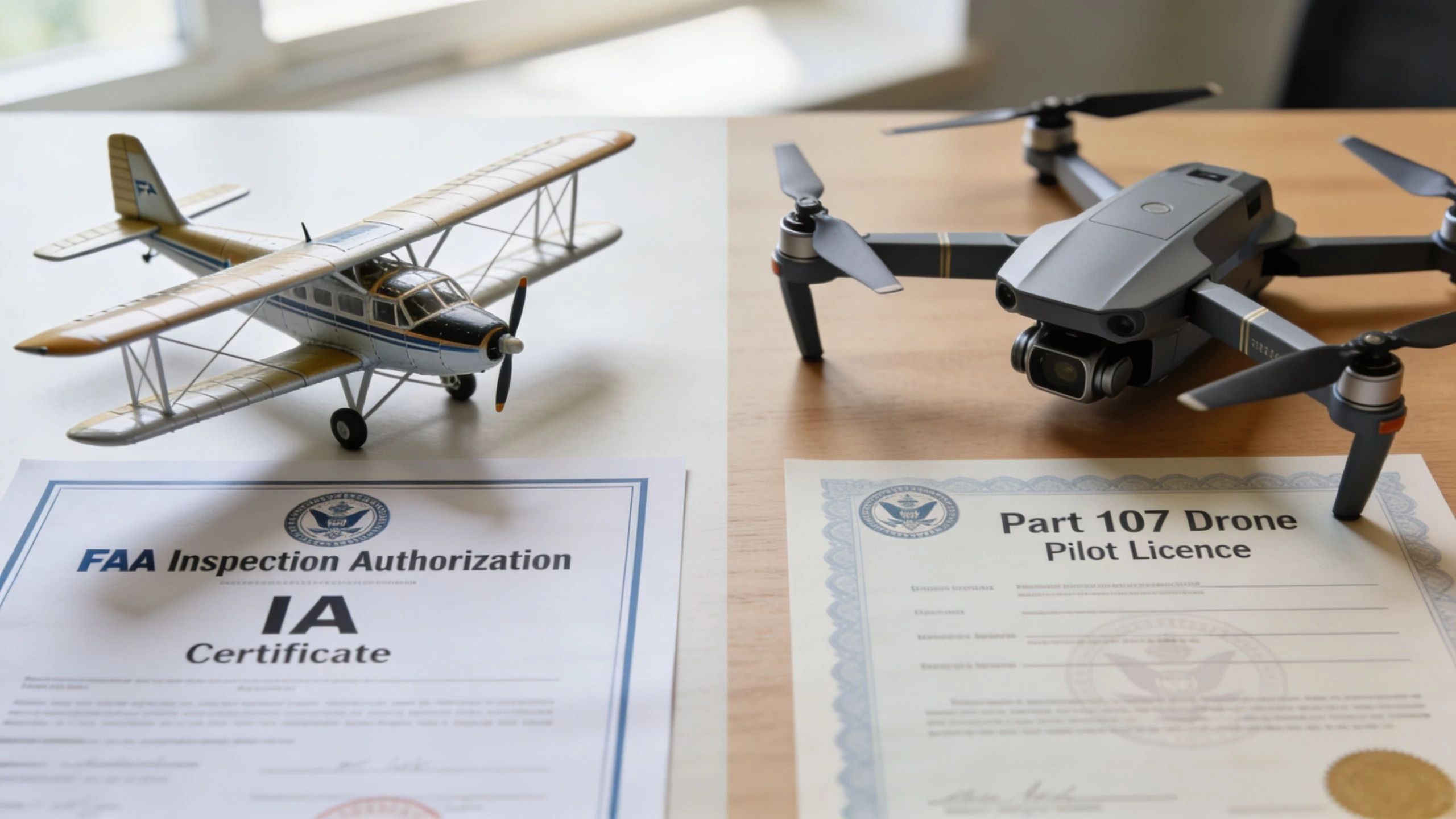
Side-by-side, they are different jobs
According to 14 CFR 65.93 guidance summarized here, aircraft mechanic IA renewals occur every two years in March of odd-numbered years, while Part 107 remote pilot certificate currency requires recurrent training every 24 calendar months on a flexible schedule. One system is tied to mechanic inspection authority. The other is tied to remote pilot currency.
Here's the clean comparison:
| Topic | IA renewal | Part 107 currency |
|---|---|---|
| Who it applies to | A&P mechanics holding Inspection Authorization | Remote pilots operating under Part 107 |
| What it governs | Inspection and maintenance authority | Drone pilot operational currency |
| Timing | March of odd-numbered years | Every 24 calendar months on a flexible schedule |
| Proof focus | Maintenance activity, training, or oral exam evidence | Recurrent training completion |
That distinction matters for mixed operations. A utility inspector may fly a drone for survey work and also work around certificated aircraft maintenance. Aerial service providers may contract maintenance while running Part 107 operations. The FAA treats those roles separately, and your compliance system should too.
Where people cross the wires
The confusion usually starts with the word “renewal.” Drone operators think their pilot recurrent training somehow updates maintenance authority. Mechanics assume staying current under Part 107 checks a box for aviation compliance more broadly. It doesn't.
If your work touches real estate imaging, inspection, or commercial drone services, a practical reference on drone-specific compliance is Florida real estate drone legal requirements. It's useful because it reflects the operational side of Part 107 obligations rather than mechanic authorization.
For drone-specific certificate upkeep, keep a separate process and review Part 107 renewal guidance on its own terms. Don't file it mentally under IA work. Different regulation, different evidence, different consequences.
One certificate lets you exercise inspection authority on the maintenance side. The other keeps you current as a remote pilot. Mixing them up is how good operators fall out of compliance in both worlds.
Your Post-Renewal Strategy and Downloadable Checklist
A successful renewal should make the next one easier. Too many mechanics breathe out after approval, stash the paperwork wherever there's room, and recreate the same scramble in the next cycle.
Keep the closeout simple. Archive the submitted package, the final supporting PDFs, and any confirmation tied to the completed renewal. Save it in one folder labeled by cycle, then create the next cycle's folder immediately.
The checklist to keep on your desk
Use this as your working checklist for the next cycle:
- Mark the cycle dates: Track the odd-year March renewal point and the two separate yearly compliance deadlines.
- Choose your activity path early: Use the route that matches your real work and produces clear records.
- Save evidence when earned: Training certificates, inspection records, and repair documentation go into the renewal folder the same day.
- Review your file before each March: Don't wait for renewal year to find missing proof.
- Prepare PDFs before IACRA: Build the package first, then complete the application.
- Archive the final submission: Keep the exact set of documents you used for approval.
The mechanic who treats IA renewal like a continuous recordkeeping task usually has the least stressful experience. That's the key takeaway. Compliance gets easier when you stop treating it like a once-every-two-years event.
Dronedesk helps drone operators track operational records, aircraft details, authorizations, and renewal deadlines in one place. If your work spans unmanned operations as well as traditional aviation paperwork, Dronedesk can support the compliance side of that workflow without replacing the FAA's own renewal systems.
 How to Review a DJI Flight Log After an Unexpected Event →
 Drone Laws Around the World: A Pre-Flight Research Framework →
 How to Compare Drone Survey Services for Complex Sites →
 How to Start a Drone Mapping Business With a Clear Workflow →
 Class C Airspace Drone Rules for Commercial Flights →
 How to Create a Drone Job Pack for Every Mission →
 FAA Small UAS Rule: Key Requirements for Operators →
 How to Build a Drone Pilot Flight Log That Is Audit Ready →
 FAA Drone Licence Requirements for Commercial Pilots →
 FAA BVLOS Waivers Granted: What Successful Cases Show →