
Mastering Drone Services Pricing: 2026 Guide
A client inquiry lands in your inbox. It looks promising. They want a roof inspection, a construction update, or a map of a site. Then they ask the question that stops a lot of operators cold.
What do you charge?
That hesitation is normal. Most new pilots don't struggle with flying. They struggle with pricing. Flying feels concrete. Pricing feels personal, risky, and easy to get wrong. Quote too low and you win unprofitable work. Quote too high and you worry the lead disappears.
The problem gets worse because drone services pricing isn't one thing. A simple media shoot, a thermal inspection, and a repeat construction mapping job shouldn't be priced the same way. Different deliverables, different risk, different admin load, different client expectations.
Good pricing starts when you stop asking, "What are other pilots charging?" and start asking, "What does this job cost me to deliver well, and what is the result worth to the client?" If you want a useful parallel outside the drone world, look at how agencies frame general services and pricing. The same principle applies here. Clear scope, clear outcomes, clear pricing logic.
The Drone Operator's Dilemma How to Price Your Services
New operators often treat pricing like a guess wrapped in confidence. They pick a number that feels reasonable, send it, and hope they didn't just undercut themselves by half.
That approach creates two bad outcomes. First, you train clients to shop you on price alone. Second, you build a business where every job feels busy but the bank balance says otherwise.
Why pricing feels harder than flying
Flying has rules, checklists, and muscle memory. Pricing forces you to account for equipment, travel, processing, revision rounds, weather risk, airspace planning, and client communication. Some of that work is visible to the client. A lot of it isn't.
The hidden part is where most operators lose money.
You’re not charging for propellers in the air. You’re charging for the whole job getting done safely, legally, and in a format the client can use.
A new pilot might quote a short aerial shoot as if the only cost is one hour on site. But the job also includes planning, transit, setup, battery management, file handling, editing, delivery, and follow-up. If the client needs approvals, extra formatting, or a second visit because of weather, a cheap quote becomes expensive for you.
What good drone services pricing actually does
Strong pricing does more than cover costs. It sets expectations. It tells the client what is included, what isn't, and how changes will be handled. It also helps you filter the right type of buyer.
A solid pricing approach should do four things:
- Protect margin: Every quote should cover the actual cost of delivery, not just flight time.
- Match the service type: Mapping, inspections, and media work need different pricing logic.
- Reward efficiency: If you run jobs well, your profit should rise instead of falling.
- Make quoting repeatable: You shouldn't reinvent your pricing every time an email comes in.
The shift that changes everything
Most operators begin with hourly pricing because it feels simple. But simple isn't always profitable. The more efficient you get, the more hourly pricing can punish you unless the scope is completely open-ended.
That's why experienced operators move toward pricing built around outcome, deliverable, and operational control. The pilot who understands both cost and workflow can quote confidently. The pilot who doesn't usually stays trapped in reactive pricing.
Calculating Your True Costs Before You Quote
A new operator lands a two-hour roof inspection and quotes for two hours of flying. By the time the job is done, they have spent half a day on planning, driving, check-in, battery changes, file cleanup, report prep, and client follow-up. The flight was the easy part. The margin disappeared everywhere else.
That is why cost tracking has to start before you set a rate. If you do not know what a job really costs to deliver, you end up guessing. Guessing usually leads to underpricing.

Fixed costs you carry whether you fly or not
Some costs are attached to the business itself, not to a specific mission. They still have to be recovered through your pricing.
For construction and infrastructure monitoring, UAV Coach notes that project-based pricing averages $1,000 to $3,000 per project, with key cost drivers including insurance at $5,000 to $10,000 per year, travel at 10% to 20% of the bid, and the need for multi-flight redundancy for 99% coverage.
Those numbers matter because they reflect what serious operators are paying to stay reliable. Clients are buying more than airtime. They are buying a business that shows up prepared, insured, organized, and capable of re-flying if conditions change.
Your fixed costs usually include:
- Aircraft and payload investment: Airframes, batteries, controllers, cases, chargers, and specialty sensors.
- Software stack: Editing, mapping, reporting, cloud storage, and workflow tools.
- Insurance and compliance: Annual policies, renewals, recordkeeping, and documentation.
- Business overhead: Website, accounting, CRM, proposals, and sales admin.
- Training and currency: Time and money spent staying current on aircraft, sensors, and operating procedures.
Variable costs that change job to job
New operators lose money fastest when they see a short site visit and quote it like a short job, even though the variable workload causes significant margin loss.
A simple media shoot might need a quick edit and delivery. A mapping mission can require extra ground time, more batteries, more data checks, and much heavier processing back at the desk. Same drone. Very different cost profile.
Common variable costs include:
- Travel time and transport: Fuel, tolls, parking, vehicle wear, and hours lost in transit.
- Pre-flight planning: Site review, airspace checks, risk assessments, permits, and client coordination.
- Field time: Setup, calibrations, launches, reflights, battery swaps, and waiting for access.
- Post-processing: Sorting files, editing, stitching, QA checks, exports, and report writing.
- Revisions and handover: Alternate formats, revised outputs, re-exports, and clarification loops.
Practical rule: If the client needs it to get usable output, it belongs in your cost base.
Admin time is not free
Admin work gets ignored because it does not feel like production. It still takes time from your week, and time is what you sell.
Flight logs, ops paperwork, maintenance records, client messages, approvals, report packaging, and invoice chasing all reduce the number of hours left for paid delivery. Operators who run this manually often respond by charging lower rates to stay competitive. That is the wrong fix. The better fix is to run the business more efficiently so your quote reflects value, not chaos behind the scenes.
That is one reason operators using systems like Dronedesk can justify stronger pricing. If your planning, documentation, job tracking, and reporting are tighter, your delivery is faster, your errors drop, and your client experience improves. That gives you room to price on outcome and reliability instead of trying to win on a cheap hourly number. If you want a practical breakdown of where margin gets lost, read this guide on reducing operational costs in drone work.
Build your pricing floor first
You do not need a fancy spreadsheet on day one. You do need a floor number that protects you.
Start with a simple table like this:
| Cost area | What to include |
|---|---|
| Equipment | Drone, batteries, accessories, repairs, replacement planning |
| Software | Editing, mapping, reporting, storage, recurring tools |
| Insurance | Annual premiums and coverage-related admin |
| Travel | Vehicle costs, fuel, time on the road, parking |
| Labor | Planning, flying, processing, delivery, communication |
| Risk buffer | Reflights, weather disruption, scope friction |
Once you list the full job, your quoting gets sharper. You can see which work is profitable, which clients create avoidable admin, and where efficiency gives you a real pricing advantage.
The operators who stay profitable are not always the cheapest or the busiest. They know their delivery cost, control their workflow, and quote from numbers instead of hope.
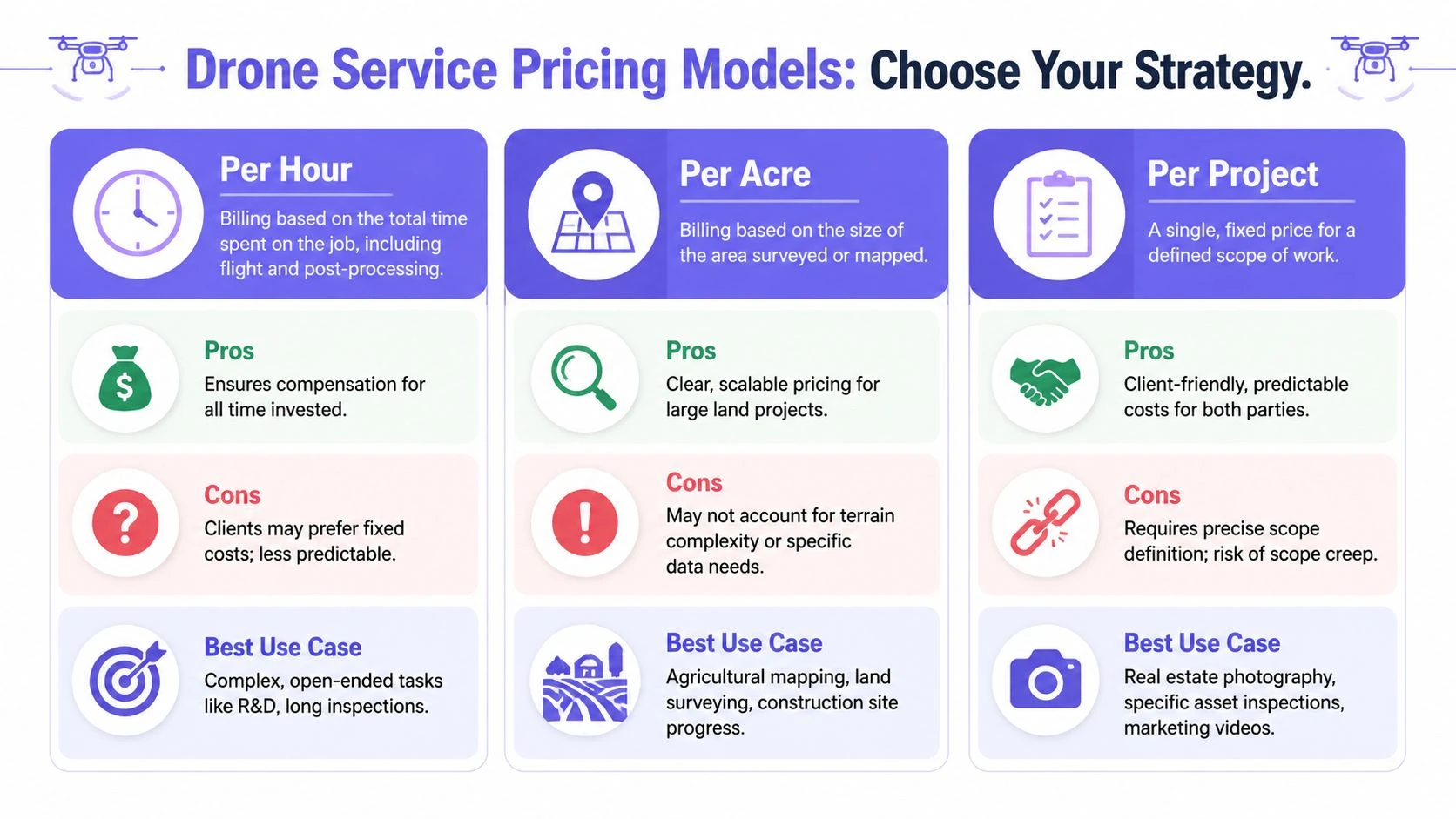
Drone Pricing Models Per Hour Per Acre or Per Project
A new operator often prices the first few jobs by copying what someone else charges. Then the problems start. A two-hour site visit turns into half a day once planning, client calls, travel, data handling, and revisions are counted. The pricing model was the primary mistake.
Your pricing model is the billing structure the client sees. It needs to match how the work is delivered, where the risk sits, and how much control you have over the scope. Pick the right model and the quote feels clear. Pick the wrong one and you either confuse the client or give away margin.
Per hour when the job is hard to define upfront
Hourly pricing is the simplest model to explain. It works when the scope can change on site and neither side can define the full workload before takeoff.
Use it for jobs like:
- Exploratory site visits
- Inspections with uncertain access or coordination
- Creative shoots with evolving shot lists
- Call-out work where timing is unpredictable
The trade-off is simple. If you get faster, better organized, and more consistent, hourly billing can cap your upside unless your rate rises with your skill.
Clients also struggle with hourly quotes when they need internal approval. A procurement manager, site lead, or marketing client usually wants a number they can sign off without worrying about where the clock stops. If you use hourly pricing, define what counts as billable time. Planning, travel, flight time, processing, and revisions all need to be stated clearly.
Per acre when coverage is the main driver
Per-acre pricing fits agricultural mapping, stockpile work across broad sites, and other repeatable collection jobs where area is a reliable predictor of effort. It gives the client a framework that scales cleanly. It also makes quoting faster once you know your minimum charge, site complexity limits, and processing assumptions.
Per-acre pricing makes sense when:
- The site size is known before the job
- Flight plans are systematic
- Outputs are standardized
- The client already budgets by acreage or coverage
The weakness is that acres do not tell the full story. Ten easy acres in open terrain can be more profitable than three acres around trees, structures, restricted access points, and multiple takeoff positions. I would never quote acreage alone without checking access, airspace, terrain, turnaround time, and deliverable requirements.
A practical fix is to price with a base per-acre rate plus clear add-ons for complexity.
Per project when the client is buying an outcome
Project pricing is usually the strongest model once the scope is clear. It lets you price the result, not just the time in the field.
That matters because clients rarely care how efficient your admin is. They care that the report is accurate, the media package is delivered on time, the inspection is documented properly, and they are not chasing you for updates. Operators who run a tighter workflow can charge more here because efficiency improves the service, not just the internal cost.
That is where systems matter. If you can plan jobs faster, keep flight records in order, track recurring work, and send polished deliverables without delays, you have a stronger case for premium pricing. A platform like Dronedesk helps create that advantage because it cuts admin drag and reduces the small mistakes that eat profit. The client experiences that as reliability, and reliability sells better than an hourly bargain.
Project pricing is a good fit for:
- Real estate media packages
- Recurring construction progress reports
- Asset inspections with a defined report
- 3D models, orthomosaics, or survey outputs with named deliverables
If you want more examples of service types that suit fixed-fee pricing, this guide on ways to earn money with drone services gives a useful breakdown by job type.
Fixed pricing works best when the scope, deliverables, revision limits, and timeline are written clearly.
Here is the practical comparison:
| Model | Best for | Main advantage | Main risk |
|---|---|---|---|
| Per hour | Uncertain or changing scope | Flexible when time is unclear | Efficiency can reduce revenue |
| Per acre | Mapping and coverage-based jobs | Scales well on repeatable land work | Can underprice difficult sites |
| Per project | Defined outputs and business outcomes | Clear for the client and protects margin | Weak wording leads to scope creep |
How to choose without boxing yourself in
The right answer is not one model for every job. Good operators mix them.
A media client may get a fixed project fee with a stated revision limit. A consultant asking for a half-day exploratory inspection may get hourly. A farm mapping client may get per-acre pricing with a minimum charge and separate processing fee. Hybrid quotes are often the most profitable because they reflect how the work happens.
The best pricing model is the one that protects margin and makes the buying decision easy. If your operation runs cleanly, your scheduling is under control, and your reporting is consistent, you can quote for value with much more confidence.
Typical Price Ranges for Common Drone Services
A new operator wins a job at what feels like a fair rate, then spends twice as long on planning, travel, file management, edits, and reporting as expected. That is why published price ranges are useful. They give you a market reference, but they do not protect your margin unless your operation is efficient.
The market is growing, and buyers are more comfortable paying for drone work than they were a few years ago. According to the Technavio market analysis, the drone services market is projected to grow by USD 34.22 billion from 2024 to 2029 at a 20.2% CAGR. That supports demand. It does not remove the need to price for the actual cost of delivery.
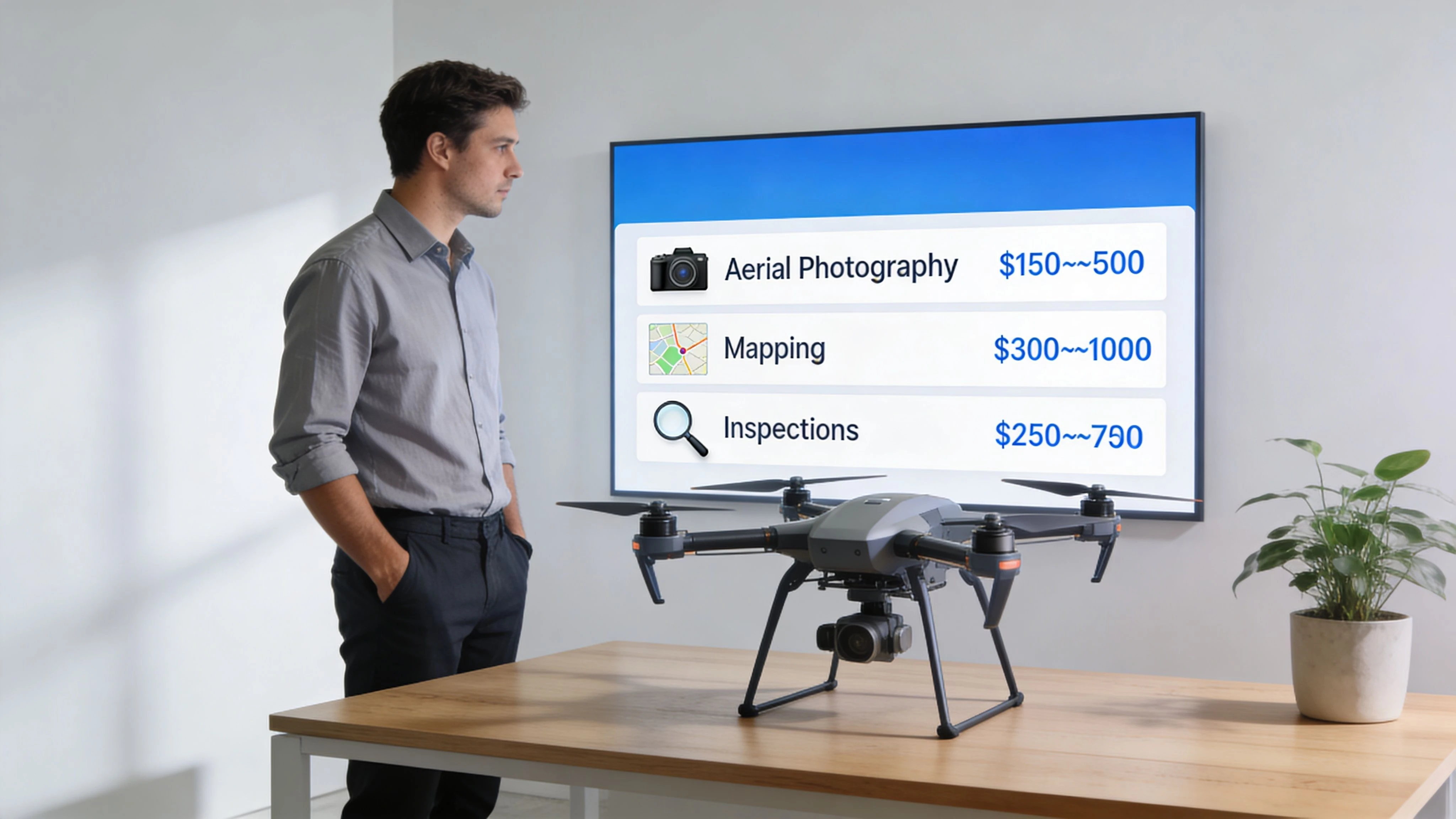
Aerial photography and media work
Aerial media is often the first service operators sell. It is also where many underprice because the flight looks simple.
Benchmark: Aerial photography commonly falls in the $150 to $400 hourly range.
The low end fits short, local shoots with clear deliverables and minimal editing. The high end fits jobs with tighter scheduling, more location variables, multiple shot lists, faster delivery, and polished exports for web, print, or paid campaigns. If a client needs more than raw captures and a few edited selects, charge for the production work, not just the time in the air.
Operators with a clean workflow usually do better here. If you can schedule faster, brief the client clearly, keep documents in one place, and turn around files without chasing admin, you can quote as a reliable commercial service rather than a pilot selling cheap flight time.
Surveying and mapping jobs
Mapping prices swing wider because the output matters more than the aircraft.
Benchmark: Drone surveys typically range from $200 to $800 for small sites under 10 acres, $800 to $3,000 for sites from 10 to 100 acres, and $3,000 to $10,000+ for sites over 100 acres.
Those numbers are only a starting point. A flat, open site with simple deliverables prices very differently from a site with poor access, airspace friction, GCP requirements, repeat visits, or a client who needs cleaned data and formal reporting. New operators often focus on acreage and forget processing time, QA, upload time, and client communication.
If you want a broader view of where mapping, media, inspections, and other jobs fit commercially, this guide on ways to earn money with drone services is a useful reference.
This is also where operational efficiency has a direct pricing effect. If your mission planning, job records, risk assessments, and deliverables process are organised in one system like Dronedesk, you spend less time on admin and rework. That gives you room to hold a stronger fixed fee and defend it.
Inspections and thermal work
Inspection clients pay for usable information, not airtime.
Benchmark: Thermal inspections commonly run $300 to $700 per hour.
That range reflects planning, safety, sensor setup, interpretation, and reporting. A quick roof scan is one thing. An inspection with restricted access, multiple elevations, thermal anomalies that need documenting, and a client who expects a structured report is another. If your findings may influence maintenance decisions or contractor disputes, the value is higher and the liability is real.
The operators who keep good records and deliver consistent reports tend to command better rates in this category. Clients notice when the process is controlled.
How to use benchmarks without becoming a commodity
Market ranges help you avoid obvious mistakes, but they are not a pricing strategy.
Use them to sense-check your quote, then adjust for the parts that affect profit:
- Deliverables: Raw files, edited media, orthomosaics, 3D models, thermal findings, or formal reports
- Site complexity: Access, obstacles, airspace, permissions, and safety controls
- Turnaround: Standard delivery versus urgent delivery
- Client risk and expectations: Homeowner, contractor, insurer, engineer, or enterprise team
- Operational efficiency: How much admin, revision handling, and reporting time your process adds
Two operators can quote the same job at different prices and both be right. The one with stronger systems often earns more because they can deliver faster, communicate better, and reduce friction for the client. That is a premium service. It is also one of the clearest reasons to use a platform like Dronedesk instead of competing on the cheapest hourly number.
How to Set Your Drone Service Rates with Confidence
You send a quote for £450. Another operator sends one for £300. The client asks why you're higher.
If your answer starts with flight time, battery count, or drone model, you're already defending the wrong thing. Strong pricing comes from tying your rate to the client outcome, the deliverable standard, and how reliably you can deliver it without creating extra work for them.
That is where newer operators often lose margin. They quote the visible part of the job and miss the business value sitting in planning, processing, reporting, revisions, and client communication.
Start with the result the client is paying for
Clients are buying a usable outcome. That might be marketing content, a roof inspection report, progress documentation, an orthomosaic, or a 3D model that supports a claim or a decision.
That distinction matters because deliverables often carry more value than airtime. According to SkyeBrowse, pilots offering high-value 3D models can command $500 to $1,500 per model because post-flight processing captures 60% to 80% of total project value. SkyeBrowse also notes that per-deliverable billing can improve provider margins by 40% to 50%.
If you price by the hour alone, you cap yourself at the least valuable part of the workflow.
Use a quoting process you can repeat
Confident pricing usually comes from a simple sequence you use on every lead.
-
Define the deliverable
Get specific about what the client will receive. Raw photos, edited video, thermal findings, annotated defects, a 3D model, a recurring site report, or a packaged report for internal stakeholders all justify different pricing. -
Ask how the output will be used
A dataset used for internal reference is not priced the same as one being used for insurance, maintenance planning, or contractor accountability. The flying may look similar. The responsibility is not. -
Check what could slow the job down
Travel, restricted access, airspace review, safety controls, waiting on site, stakeholder sign-off, and revision requests all affect your real time on the job. -
Choose the pricing structure that fits the scope
Hourly pricing works for uncertain scope. Per-acre can work for straightforward mapping. Fixed project pricing is usually strongest when the output and revision limits are clear. -
Set boundaries in writing
State what is included, what triggers extra charges, and how many revisions the client gets. This protects both sides and stops small extras from eating your margin.
Operators who follow the same process every time quote faster, miss fewer costs, and sound more credible in sales calls.
Price the workflow, not just the flight
A 20-minute flight can still be a high-value assignment.
If the client needs planning, permissions, careful capture, processing, QA, and a report they can act on, your rate should reflect the whole workflow. That is one reason good systems matter so much. Operators who run quoting, planning, records, and reporting through one process can hold firmer prices because they deliver a cleaner service with less delay and less back-and-forth. If you want a practical example, see how Dronedesk cuts drone admin time in half from flight planning to reporting.
That efficiency is not just a back-office benefit. It supports premium pricing because clients feel the difference in faster turnaround, clearer communication, and more consistent deliverables.
Handle price objections without cutting your margin first
When a client says your quote is high, reduce scope before you reduce price.
That might mean fewer deliverables, standard turnaround instead of rush delivery, one visit instead of two, or a simpler reporting format. Keep the rate matched to the work.
A practical way to respond:
- Budget is tight: Offer a smaller package with fewer outputs.
- Scope is still fuzzy: Quote hourly or include a clear variation clause.
- The client is comparing operators: Explain the business use of the deliverable and the standard of reporting, not the aircraft you fly.
You do not need to win every quote. You need to win work that pays properly, runs cleanly, and leaves enough margin to grow the business.
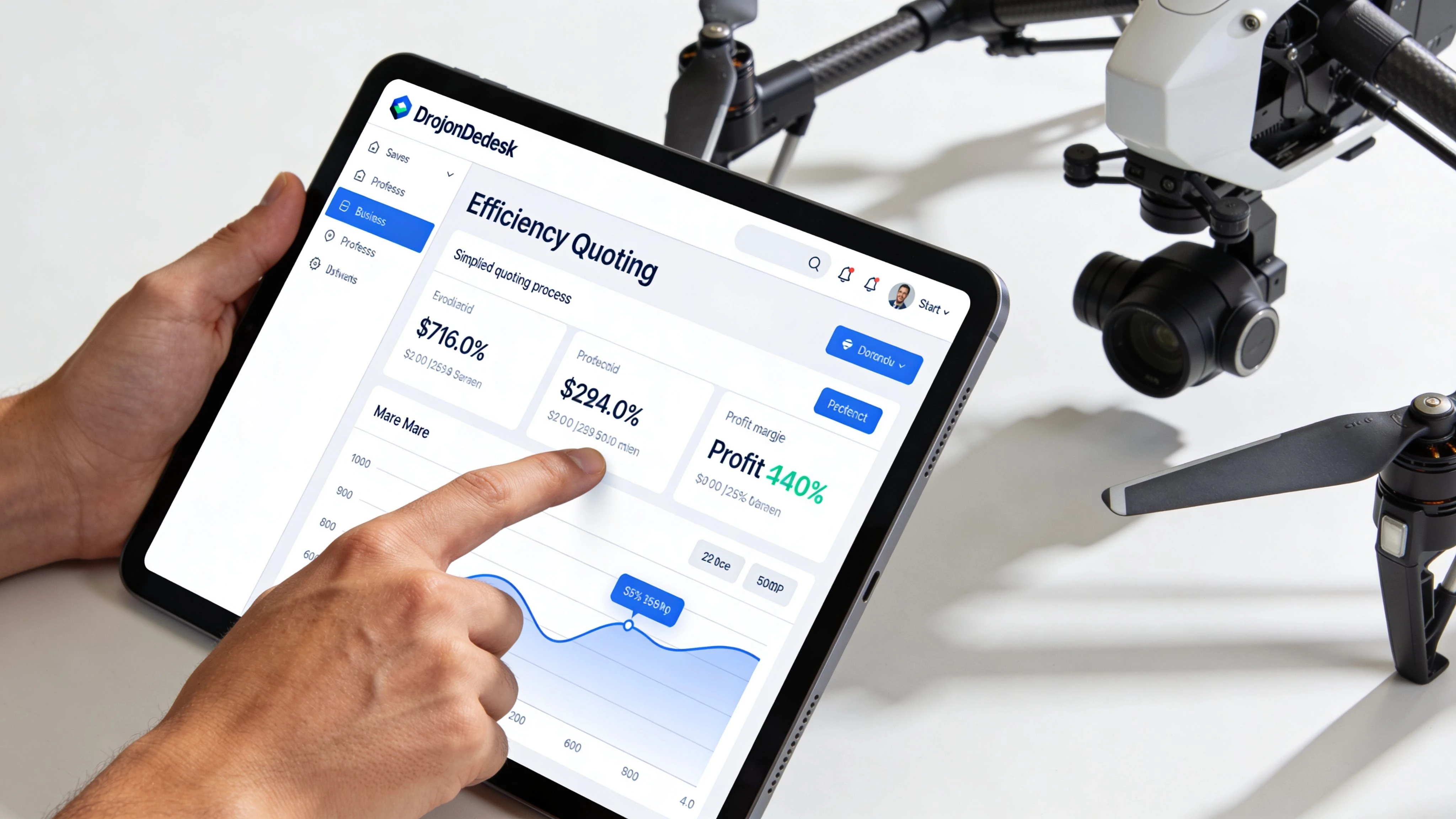
How Dronedesk Streamlines Quoting and Boosts Profit Margins
A new operator wins a job at a rate that looks fine on paper, then gives half the profit back in admin. The flight is only part of the work. The quote, planning, risk assessment, client updates, flight logs, compliance records, and final reporting all take time, and if those steps live across emails, spreadsheets, and separate apps, margin disappears fast.
The margin leak most operators tolerate for too long
Software is part of your cost base, whether you account for it properly or not. The Drone Pilot Ground School pricing discussion notes that software costs can run $3,500 to $8,000 per year, and that operations platforms can reduce admin time by up to 50%, enabling operators to take on 20% more jobs.
That matters because admin rarely appears as a separate line on an invoice. It comes out of your evenings, your turnaround time, or your actual hourly return. If you quote a job at a healthy margin but spend too long preparing documents, chasing approvals, and assembling reports, the rate was never as strong as it looked.
I have seen operators blame pricing when the actual problem was workflow. They were charging enough for the mission. They were just running the job through too many disconnected steps.
Why Dronedesk supports stronger pricing
Clients usually do not ask what platform you use. They do care that the quote is clear, the prep is organised, the paperwork is right, and the deliverable arrives on time.
That is where a system like Dronedesk changes the pricing conversation. It helps you run quoting, planning, compliance, fleet records, and reporting in one place. Fewer handoffs mean fewer mistakes, less rework, and less unpaid time between the enquiry and the invoice.
That operational control gives you room to price on value instead of falling back to an hourly race to the bottom.
Operators who use their systems well can charge premium rates for practical reasons:
- Faster quoting: You can respond while the client is still comparing options.
- Cleaner scope control: Fewer missed details means fewer unbilled extras.
- More consistent delivery: Reliable reporting and records justify a higher standard of service.
- Better capacity planning: You can take the right jobs, not just any job that fills the diary.
For a closer look at the workflow itself, see how Dronedesk cuts drone admin time in half from flight planning to reporting.
What this changes in your pricing strategy
Efficient operators have more choices. That is the advantage.
You can keep your rates where they are and improve margin. You can build fixed-fee packages with more confidence because your estimating is tighter. You can include better reporting, clearer communication, or faster turnaround without eating the cost in admin hours. You can also walk away from low-value work because your business is not relying on volume alone.
This is the part many new operators miss. Good software should not push you to become the cheapest option. It should help you become the operator who is easiest to hire, easiest to work with, and most likely to deliver without drama. That position supports better pricing.
The financial side matters too. Software subscriptions, admin efficiency, and business overhead all affect what you keep after the job. If you want a practical reference on that side of the business, this expert guide to small business tax is worth reading.
Dronedesk is not valuable because it saves clicks. It is valuable because tighter operations protect margin and make value-based pricing easier to defend.
Pricing for Profit Your Path to a Sustainable Drone Business
Profitable drone services pricing has less to do with bravado and more to do with discipline. Know your costs. Match the pricing model to the work. Quote around outcomes, not around your excitement to win the job.
The operators who last don't build their business on cheap flights. They build it on clear scope, solid process, and rates that make sense after the work is done. That's the difference between being busy and being profitable.
Keep your pricing grounded in the actual operation behind the mission. A well-run drone business has to account for admin, planning, compliance, processing, travel, and the quality of the final deliverable. If you ignore those pieces, the quote may look competitive while the business slowly weakens.
It's also worth getting the financial side of the business right early. Tax treatment, deductions, and business structure affect what your pricing leaves you with. If you need a practical non-drone example of how to think about that side, this expert guide to small business tax is a useful reference.
Price to stay in business long enough to get good clients, refine your workflow, and build a reputation worth paying for.
You won't win every quote. You shouldn't want to. The goal is a sustainable operation that pays for the aircraft, the software, the admin load, and your time. When your pricing reflects that reality, you stop chasing random jobs and start building a real company.
If you want to stop guessing and build a more efficient quoting and operations process, Dronedesk gives you one place to manage planning, compliance, records, and workflow so your drone services pricing can reflect real operational control instead of wishful thinking.
 How to Review a DJI Flight Log After an Unexpected Event →
 Drone Laws Around the World: A Pre-Flight Research Framework →
 How to Compare Drone Survey Services for Complex Sites →
 How to Start a Drone Mapping Business With a Clear Workflow →
 Class C Airspace Drone Rules for Commercial Flights →
 How to Create a Drone Job Pack for Every Mission →
 FAA Small UAS Rule: Key Requirements for Operators →
 How to Build a Drone Pilot Flight Log That Is Audit Ready →
 FAA Drone Licence Requirements for Commercial Pilots →
 FAA BVLOS Waivers Granted: What Successful Cases Show →