
Do I Have to Register My Drone A Global Guide
So, do you have to register your drone? The short answer is almost always yes, particularly if it’s bigger than a small toy. Think of it like a license plate for your car—it’s a straightforward system to ensure safety and accountability in the sky, a space we all share.
Why Drone Registration Is Now the Global Standard
Flying a drone is an incredible experience, but it comes with real responsibilities. Just like cars are registered to keep the roads safe, drones need to be registered to keep our skies safe. This isn't about throwing up hurdles for pilots; it’s about creating a clear system of accountability.
Imagine a drone gets lost and ends up in someone's backyard, or worse, interferes with an emergency response. A simple registration number lets authorities quickly track down the owner and sort things out. It’s a small step that protects everyone involved, from the pilot to the general public.
The core reasons are pretty much the same everywhere you go:
- Accountability: It links a drone back to its operator, which is vital if it's lost, stolen, or involved in an incident.
- Safety: The registration process often includes a quick educational component, making sure pilots know the basic rules of the air before they take off.
- Airspace Security: It helps authorities manage the increasingly busy low-altitude airspace and prevent conflicts with planes and helicopters.
The Magic Number: 250 Grams
If you look at drone regulations across the globe, one number keeps popping up: 250 grams (that's about 0.55 pounds). This is the most common weight that separates a simple toy from a more capable aircraft that needs to be registered. Anything heavier has a greater potential to cause damage or injury if something goes wrong.
This simple flowchart breaks down the first, most fundamental question for any drone pilot: is your drone heavier than 250g?
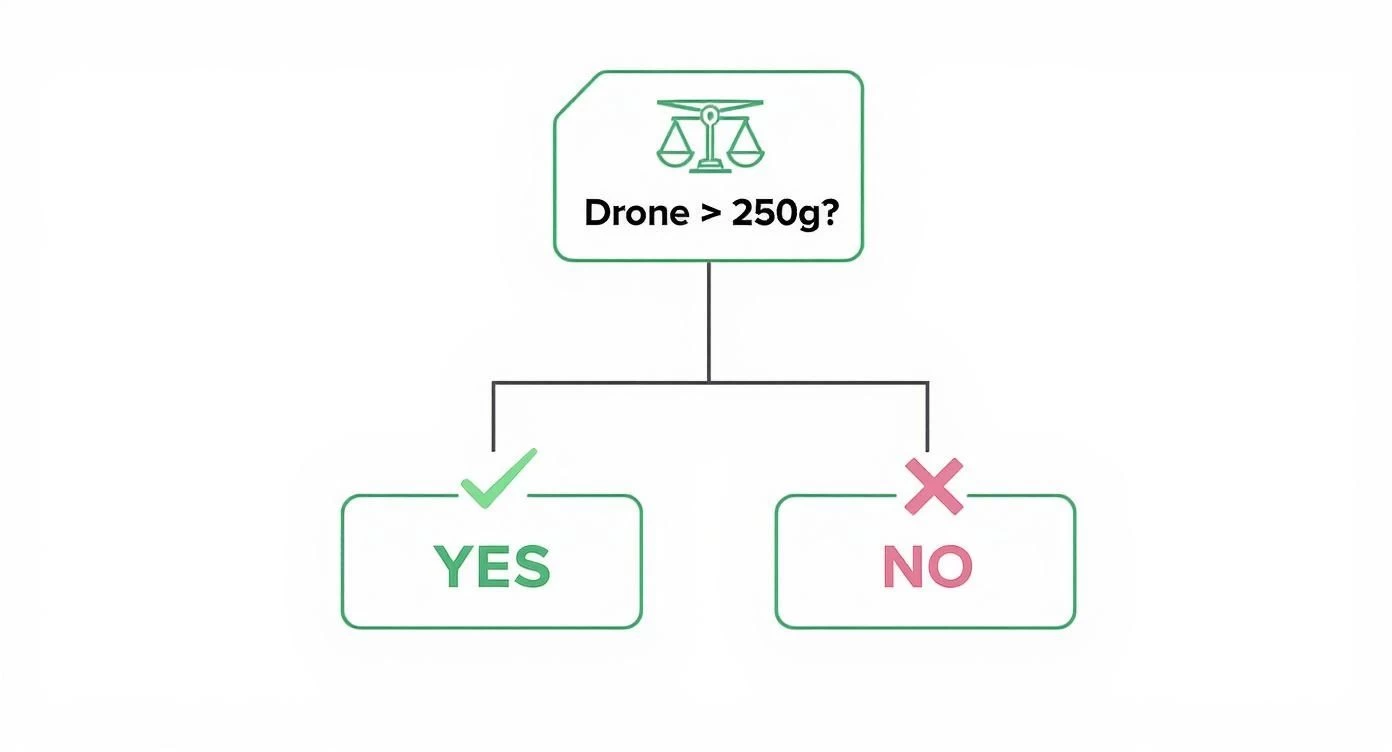
As you can see, crossing that weight limit almost always means you need to register. It’s the first thing you should check.
To give you an idea of the scale, just look at the United States. The Federal Aviation Administration (FAA) oversees a massive fleet. As of October 2025, there are 855,860 drones registered, and recreational models make up a whopping 63% of that figure. These numbers show just how popular drone flying has become and underscore why a structured registration system is so important. You can dig into more of the FAA's drone stats and rules on their official site.
Here's a quick reference to help you figure out where your drone might stand.
Drone Registration Quick Guide by Weight and Use
| Drone Weight / Feature | Registration Likelihood (Most Regions) | Common Use Case |
|---|---|---|
| Under 250g (no camera) | Very Low | Toy, indoor flyer |
| Under 250g (with camera) | High (Operator registration) | Hobbyist photography, Mini drones |
| 250g - 2kg | Almost Certain (Aircraft registration) | Prosumer photography, mapping |
| 2kg - 25kg | Guaranteed (Aircraft registration) | Professional cinema, delivery, inspection |
| Used for Commercial Work | Guaranteed (Regardless of weight) | Any paid work or business use |
This table isn't a substitute for checking local laws, but it gives you a solid starting point for understanding what's likely required.
Key Takeaway: Drone registration isn’t just red tape. It’s a core part of being a responsible pilot and doing your bit to keep the skies safe for everyone. It’s your ticket to flying with total peace of mind.
Understanding FAA Drone Rules in the United States
When flying a drone in the United States, you're playing by the rules of the Federal Aviation Administration (FAA). So, when people ask, "do I have to register my drone?", the answer nearly always boils down to one magic number: 250 grams. That's about half a pound, and it's the official line in the sand between a simple toy and an aircraft that needs to be on the books.
If your drone, with everything attached—battery, camera, propellers, the lot—tips the scales at more than 250 grams at takeoff, you absolutely have to register it with the FAA. It doesn't matter if you're just buzzing around your garden for fun or flying for a client; that weight rule is the first hurdle to clear.

The reason for this is pretty straightforward: accountability. A registered drone has a unique number that ties it back to its owner. In an increasingly crowded sky, this is a simple but vital way to make sure everyone is flying safely and responsibly.
Two Paths for Pilots: Recreational vs. Commercial
The FAA has laid out two very different paths for drone pilots, and the one you follow depends entirely on why you're flying.
- Recreational Flying (The Exception for Recreational Flyers): This route is for hobbyists—people flying just for the fun of it. If you're shooting videos of a family BBQ or just enjoying the view from above with zero commercial intent, you're in this camp.
- Commercial Flying (Part 107): This is for anyone using a drone to make money or as part of a business. It covers the obvious stuff like real estate photography and site inspections, but also things like using drone footage to promote your own business.
Figuring out which category you fit into is your first job, because the rules for certification and flying are worlds apart. If you're ever on the fence, the FAA's advice is clear: stick to the more rigorous Part 107 rules.
Requirements for Recreational Hobbyists
Getting into drones for fun is how most people start, but it still comes with a few non-negotiable responsibilities. To fly recreationally in the US, you need to:
- Pass The Recreational UAS Safety Test (TRUST): This is a free, pretty quick online test covering the basic rules of the sky. Once you pass, you have to carry proof with you whenever you fly.
- Register Your Drone: If it's over 250g, you must register it on the FAA's DroneZone website. Look for the "Exception for Recreational Flyers" section. It costs $5 and your registration is good for three years.
- Follow Safety Guidelines: This means always keeping your drone within your visual line of sight, staying well clear of manned aircraft, and abiding by the safety rules of an FAA-recognized Community Based Organization (CBO).
These simple steps make sure that even casual flyers know how to operate safely.
Key Insight: As a recreational pilot, you get one registration number that covers all the drones you own. Just make sure you mark each one of your aircraft with that single number.
Rules for Commercial Professionals
If your drone is a tool of the trade, you're flying under the FAA's Part 107 rules. This is the official, professional pathway and it's a bit more involved.
To fly commercially, you'll need to:
- Get a Remote Pilot Certificate (Part 107): This involves passing a proper aeronautical knowledge exam at an FAA-approved testing center. You also have to be at least 16 years old.
- Register Each Drone: This is a key difference. Commercial pilots must register every single drone they use for work. The cost is still $5 per drone, and each registration lasts for three years.
- Mark Your Drone: Every commercially operated drone must have its unique registration number clearly visible on its exterior.
This certification process guarantees that commercial operators have a much deeper knowledge of things like airspace classifications, weather patterns, and operational safety. If you want to dig deeper into which models need registering, our guide on what drones need to be registered breaks it all down for you: https://blog.dronedesk.io/what-drones-need-to-be-registered/
Don't be tempted to skip the registration process. The FAA doesn't mess around. Civil penalties for failing to register can hit $27,500. In more serious cases, criminal penalties can rocket up to $250,000 and could even include up to three years in prison. The message is crystal clear: the rules are there for a reason, and the consequences for ignoring them are severe.
Flying in Europe? Here’s How EASA Handles Drone Laws
If you’re planning a trip to Paris or Rome with your drone, you’ll be glad to know Europe takes a much more unified approach to regulations. The whole system is managed by the European Union Aviation Safety Agency (EASA), which has created a single set of rules for all member states. It makes flying across the continent a whole lot simpler.
The biggest difference you'll notice from the US system is a complete shift in philosophy. In Europe, you don't register individual drones. Instead, you register yourself as a drone operator. This is a critical distinction to grasp.
Once you register in any EASA member country, you’re given a unique operator ID number. That single number is valid across the entire European Union, plus Iceland, Liechtenstein, Norway, and Switzerland. All you have to do is slap that ID on every drone you own and fly.
When You Absolutely Must Register as an Operator
Under EASA rules, you’re required to register as an operator if your drone meets either of these conditions:
- It weighs 250 grams or more. Just like in the US, this weight is the key benchmark for accountability.
- It has a camera or any sensor that can capture personal data, no matter how little it weighs. This is a major departure from the FAA’s weight-first approach and shows a serious commitment to privacy.
That second point is huge. It means even if you're flying a tiny sub-250g drone like a DJI Mini, you must register as an operator simply because it has a camera. This rule pretty much covers every popular photography and videography drone on the market.
This unified registration system, which was fully rolled out between 2021 and 2024, means safety rules are standardized across Europe. Whether you’re a resident or just visiting, the core requirements are the same, making life much easier for pilots. You can read more about the latest updates here.
Europe’s Focus on Pilot Knowledge
EASA doesn’t just stop at registration; they put a heavy emphasis on making sure operators know what they're doing. Before you can legally fly most drones, you have to complete some online training and pass a straightforward online theory exam. It’s all designed to make sure every pilot understands the basic rules of the air.
The process is pretty simple:
- Find your National Aviation Authority: Registration is handled by the country you live in. If you're a visitor, you'll register in the first EASA country you plan to fly in.
- Complete the Online Training: The course covers the essentials—safety, privacy, airspace rules, the lot.
- Pass the Online Test: It's a simple multiple-choice test, usually around 40 questions, to make sure you were paying attention.
Once you pass, you get a certificate of completion. You’ll want to have this handy whenever you’re flying, right alongside your operator registration details.
Key Takeaway: In Europe, the system is built around the pilot's knowledge and accountability. Registering yourself as an operator and completing the training are the two absolute must-dos before you can fly legally and safely across the continent.
Practical Steps for Residents and Visitors
If you're a European resident, the process couldn't be easier: just register with the aviation authority in your home country.
For visitors, it’s just as simple. You register with the national aviation authority of the first EASA country you intend to fly your drone in.
So, let's say you're a tourist from the US and your European vacation kicks off in Ireland. You'd register as a drone operator with the Irish Aviation Authority (IAA). The operator ID they give you is then good to go for flights in Germany, Spain, Italy, and every other EASA member state for your entire trip.
This "one and done" approach is a game-changer for travellers and commercial pilots. It completely removes the headache of learning a new set of registration rules for every border you cross, creating a predictable and pilot-friendly environment across a massive region.
Drone Registration Rules in Other Major Countries
While the US and EU frameworks cover a huge slice of the drone world, the rules can change in a heartbeat the moment you cross a border. Getting a handle on local regulations is non-negotiable for any pilot, whether you're just taking your drone on holiday or working on a big international project.
Answering that classic question, "do I have to register my drone?" means digging into the specific rules for each country. Let's take a look at the requirements in a few other major hubs for drone activity.
United Kingdom CAA Regulations
After Brexit, the UK went its own way with drone regulations, now managed by the Civil Aviation Authority (CAA). The British system will feel pretty familiar if you know the EASA model in Europe, as it focuses on registering the operator, not each individual drone.
You’ll need to register with the CAA if your drone weighs 250 grams or more. But here's the kicker: even if your drone is lighter, you still have to register if it has a camera. That covers just about every popular consumer model on the market.
- Operator ID: Once you've registered, you get an Operator ID. This number has to be clearly marked on every drone you own and fly.
- Flyer ID: Before you can get your Operator ID, you have to pass a free online theory test to get a Flyer ID. This just proves you’ve grasped the basic safety rules laid out in the UK's Drone and Model Aircraft Code.
This two-part system is smart. It makes sure pilots are both accountable (with the Operator ID) and educated (with the Flyer ID) before they even think about taking off.
Canada's Weight-Based System
Canada keeps things straightforward with a weight-based approach that's a lot like the FAA model in the United States. Transport Canada sets the rules, which are split into two main categories depending on how much your drone weighs.
Any drone tipping the scales between 250 grams and 25 kilograms is considered a "small remotely piloted aircraft" and absolutely must be registered with Transport Canada. Flying an unregistered drone in this weight class isn't just a bad idea—it's illegal.
Heads Up: Unlike some other places, Canada makes no distinction between flying for fun and flying for work when it comes to registration. If your drone is 250g or heavier, it needs to be registered. End of story.
The whole process is done online. Once registered, you have to mark your drone with its unique registration number. Pilots also need to pass an online exam to get a Pilot Certificate, with different levels for "Basic" and "Advanced" operations.
Australian Rules by CASA
Down under, the Civil Aviation Safety Authority (CASA) is in charge of drone laws, and they draw a very clear line between flying for fun and flying for work.
If you're a recreational pilot, registration is free but mandatory for any drone weighing more than 250 grams. You also have to play by CASA's standard rules, known as the drone safety rules.
For commercial pilots, things get a bit more serious. Anyone flying for business or as part of their job is required to:
- Register their drone (no matter the weight).
- Get an operator accreditation for simple jobs or a more advanced Remote Pilot Licence (RePL) for more complex flights.
This tiered system makes perfect sense—it ensures the level of oversight matches the level of risk involved with the flight.
Global Drone Registration Requirements At a Glance
It's easy to get the rules mixed up when jumping between countries. This table gives you a quick side-by-side comparison of the key triggers for registration in the UK, Canada, and Australia.
| Country | Governing Body | Primary Registration Trigger | Registration Type |
|---|---|---|---|
| United Kingdom | Civil Aviation Authority (CAA) | Drone weighs 250g+ OR has a camera | Operator ID |
| Canada | Transport Canada | Drone weighs 250g - 25kg | Aircraft Registration |
| Australia | CASA | Drone weighs 250g+ (Recreational) | Aircraft Registration |
As you can see, while the weight thresholds are similar, the philosophy behind what you're registering—the pilot or the aircraft—can be quite different. Always double-check the local governing body's website for the full details.
India's Digital Sky Platform
India has jumped ahead with a genuinely modern approach to managing its airspace. With the landmark Drone Rules of 2021, the government launched a platform called Digital Sky, making it mandatory to register pretty much every drone. Every aircraft needs a unique identification number before it can legally fly, with just a few exceptions.
This policy is a cornerstone of India's larger vision to build a world-class, self-reliant domestic drone industry. You can dive deeper into the framework and learn more about India's drone regulations to see the full picture.
By creating a comprehensive, real-time map of all drone activity, the Digital Sky system is a massive step forward for safety and security. It's one of the most structured and centralized approaches to drone management anywhere in the world, showing just how serious India is about becoming a global leader in drone technology.
Your Step-by-Step Guide to Registering a Drone

Knowing the rules is one thing, but actually navigating the official websites can feel like a whole different challenge. The good news? Registering your drone is usually a simple, low-cost process just about everywhere.
This guide will walk you through the exact steps for the US and Europe, so you can stop reading and start doing. Think of this as the final pre-flight check before you’re officially cleared for takeoff. Getting this right means you're not just compliant, but a responsible member of the aviation community.
Registering a Drone in the United States
In the US, the Federal Aviation Administration (FAA) handles all drone registrations through a single online portal. The whole thing is pretty quick and you can easily knock it out in one sitting.
Step 1: Go to the Official FAA DroneZone Website
This is critical: only use the official government website, FAADroneZone. You'll find plenty of third-party sites that look official but will charge you extra fees for the exact same service. The FAA is the only game in town for legitimate drone registration in the US.
Step 2: Create Your Account and Choose Your Registration Type
You’ll need to set up an account with your email address and a password. Once you're logged in, you’ll have to pick one of two paths:
- Under The Exception for Recreational Flyers: This is your pick if you fly strictly for fun. It costs just $5, and you get a single registration number that covers all the drones you own.
- Under Part 107: Choose this if you're flying for any commercial purpose. The fee is $5 per drone, and each aircraft gets its own unique registration number. This registration is good for three years.
Important Note: You have to be at least 13 years old to register a drone yourself. If you’re younger, a parent or another responsible adult will need to do it for you.
Step 3: Provide Your Information and Pay the Fee
Next, you'll fill out some basic personal details—name, physical address, and phone number. From there, you'll be sent to a secure payment page to cover the $5 fee with a credit or debit card.
Registering as a Drone Operator in Europe
Across EASA member states, the system is a little different. They focus on registering the operator (that's you), not the individual drone. Thankfully, the process is just as straightforward, but it's managed by each country's national aviation authority.
Step 1: Locate Your National Aviation Authority (NAA)
First, you need to find the official website for your country’s aviation authority—for example, the IAA in Ireland or the LBA in Germany. If you’re visiting from outside the EU, you just register with the NAA of the very first EASA country you plan to fly in.
Step 2: Complete the Online Registration and Training
On the NAA's website, you'll find their drone operator portal. The process involves a simple online training course followed by a multiple-choice theory test, which is usually free. It’s designed to make sure you've got a solid grasp of the core EASA drone rules.
Step 3: Receive and Display Your Operator ID
Once you pass the test, you'll be issued a unique digital Operator ID. This is the number you need to put on every drone you fly anywhere in EASA countries.
For a more detailed walkthrough, our complete guide to registering a drone has extra tips and covers more specific scenarios: https://blog.dronedesk.io/registering-a-drone/
The Final and Most Crucial Step: Label Your Drone
You're not done until the registration number is physically on your drone. This is a small but absolutely essential final step.
The number must be:
- Legible and durable.
- Clearly visible on the outside of the drone.
Honestly, a simple sticker from a label maker or a fine-tipped permanent marker works perfectly. This tiny action is what officially links the aircraft back to you in the eyes of the authorities, completing your journey to becoming a fully legal and compliant pilot.
Common Questions About Drone Registration
Getting your head around the main drone registration rules is the first step. But let's be honest, the real world loves to throw us a curveball, and it's usually the practical, last-minute questions that trip people up. This section is all about tackling those common points of confusion head-on.
Think of this as your final pre-flight briefing. We’ll give you clear, direct answers to the questions pilots ask us all the time, so you can fly not just with compliance, but with real confidence.
What Happens If I Fly an Unregistered Drone?
Let's cut to the chase: ignoring registration is one of the worst mistakes you can make as a pilot. This isn't a minor slip-up; it's a direct violation of aviation law, and the consequences are designed to be a serious deterrent.
The penalties can be eye-watering. In the United States, the FAA can hit you with civil fines up to $27,500. If a flight is deemed to have recklessly endangered someone, things can escalate to criminal penalties of up to $250,000 and even three years behind bars. On top of that, authorities can confiscate your drone right there on the spot.
The Bottom Line: These rules exist for a reason—accountability and public safety. The massive financial and legal risks of flying an unregistered drone are never, ever worth skipping a simple, cheap registration process.
Other countries are just as strict. The message from aviation authorities globally is loud and clear: registration is a non-negotiable part of flying drones safely and legally.
Do I Have to Register My Drone to Fly in My Backyard?
This is a big one for new pilots, and the answer is almost always yes, the rules still apply. Drone registration laws are based on the drone’s weight and capabilities, not where you plan on flying it.
While your backyard is your private property on the ground, the sky above it is national airspace. It's regulated by your country's aviation authority. If your drone hits the registration weight threshold—like being over 250 grams in the US—it has to be registered, even if it never leaves the confines of your garden fence.
The same logic applies to all the other flight rules, too. You still need to follow the rules on altitude, stay away from people, and respect no-fly zones, whether you're over a public park or your own lawn.
Is My Home Country Registration Valid Abroad?
Generally, no. Drone registration is almost always specific to the country you're in and doesn't transfer internationally. Your FAA registration is great for flying in the United States, but if you pack your drone for a trip to Canada or Australia, you'll need to register with their local authorities before you can fly.
The big exception to this is within the European Union. Thanks to EASA's unified rules, if you register as an operator in one member state, that registration is valid across all other EASA countries. It makes life much easier for pilots travelling around Europe.
Outside of that EU bubble, however, you should always assume your registration is no good. Before you travel, make it a top priority to research and follow the drone laws of your destination.
My Drone Is Under 250g. Am I Free from All Rules?
Not a chance. Flying a sub-250g drone often gets you out of the registration requirement for recreational flying, but it's not a free pass to ignore all other aviation rules. This weight class is meant to lower the barrier to entry, but it absolutely does not remove your responsibilities as a pilot.
For instance:
- The EU Camera Rule: In Europe, if your sub-250g drone has a camera—and most do—the operator must still be registered.
- Remote ID: Many new drones now come with Remote ID, which acts like a digital license plate, broadcasting your drone's location and registration info. It's quickly becoming a standard requirement. To get the full picture, check out our complete guide on Remote ID for drones.
- Flight Rules Still Apply: You must always fly within your visual line of sight, steer clear of crowds, stay away from airports and restricted airspace, and respect local privacy laws.
The sub-250g category makes it easier to get started, but the core principles of safe flying always apply, no matter how small your drone is.
Juggling flight logs, maintenance schedules, and registration details for multiple drones can turn into a real headache. With Dronedesk, you can bring all your operational data into one place, making it easy to stay compliant and organized without the stress. Take control of your drone operations by visiting https://dronedesk.io today.
 Drone Risk Assessment Controls That Work in the Field →
 FAA Drone License Costs Beyond the Knowledge Test →
 Drone Part 107 Operations: When a Waiver May Be Needed →
 Drone Operating Rules for Managing Contractors and Employees →
 BVLOS Drone Requirements for Building a Safety Case →
 Drone Pilot Test Mistakes That Cost Candidates Marks →
 FAA 107 License vs Part 107 Certificate: What’s the Difference? →
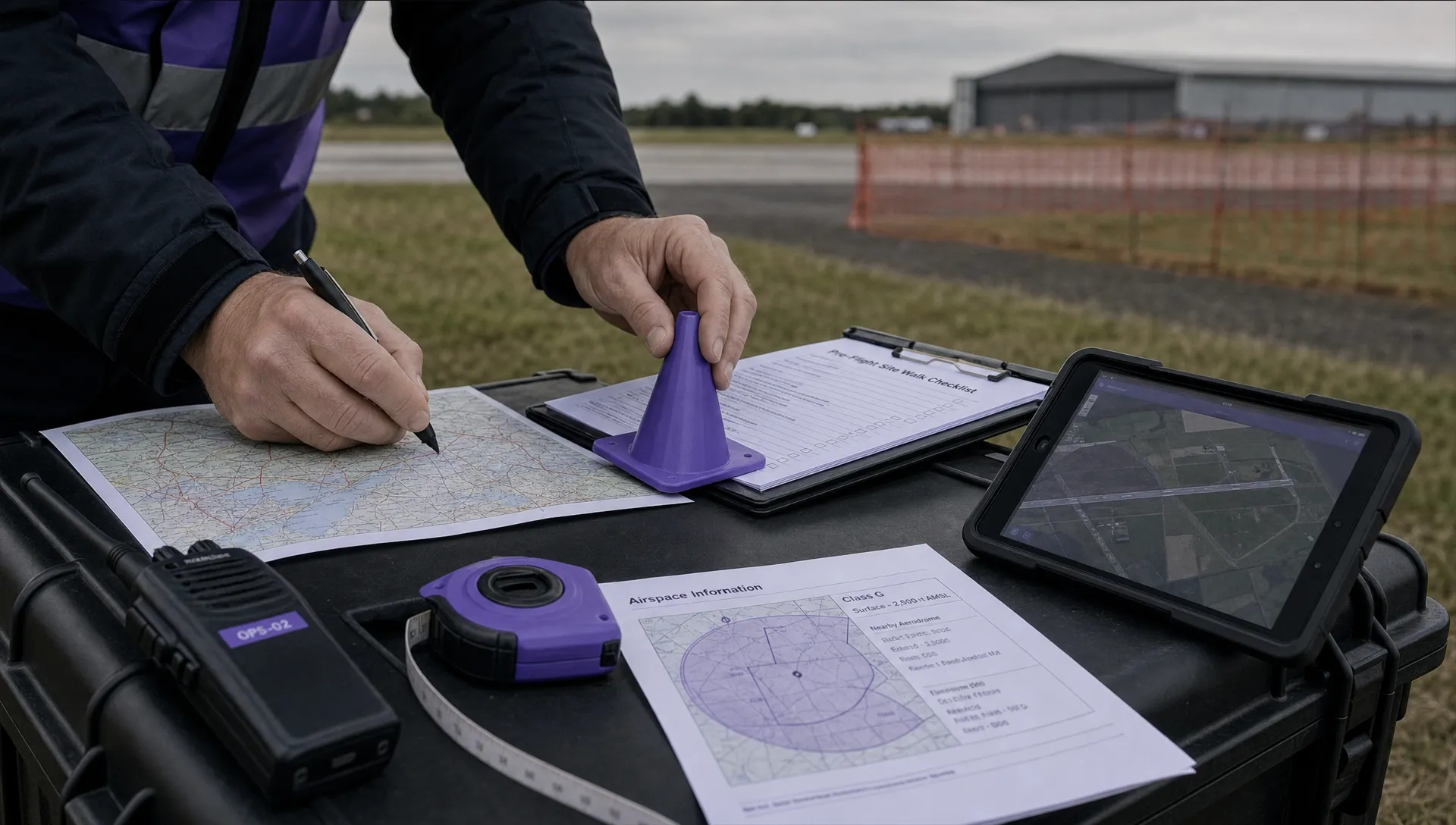 Drone Airport Rules: A Field Checklist for Site Assessments →
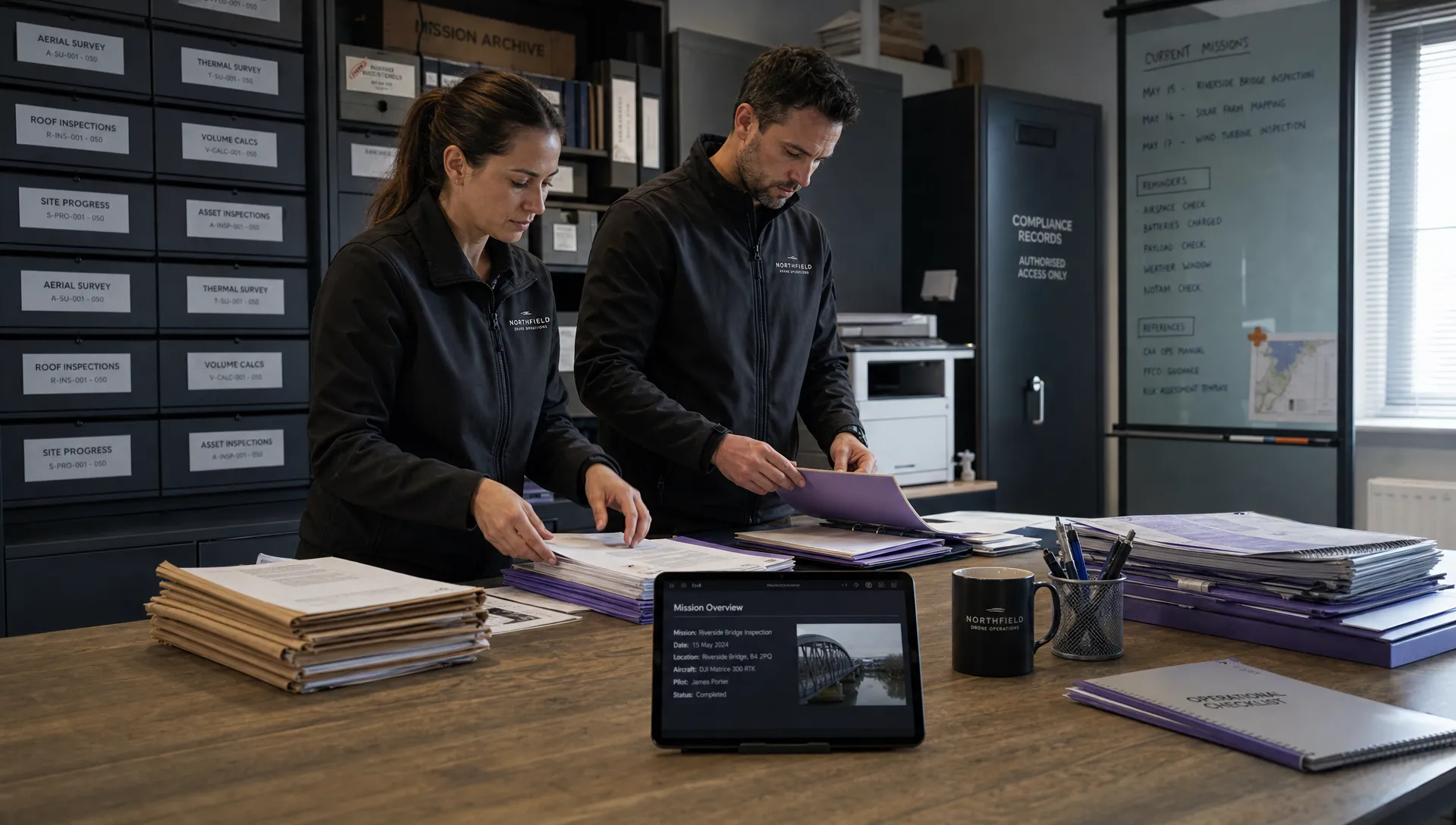 FAA Part 107 Record-Keeping Rules for Commercial Teams →
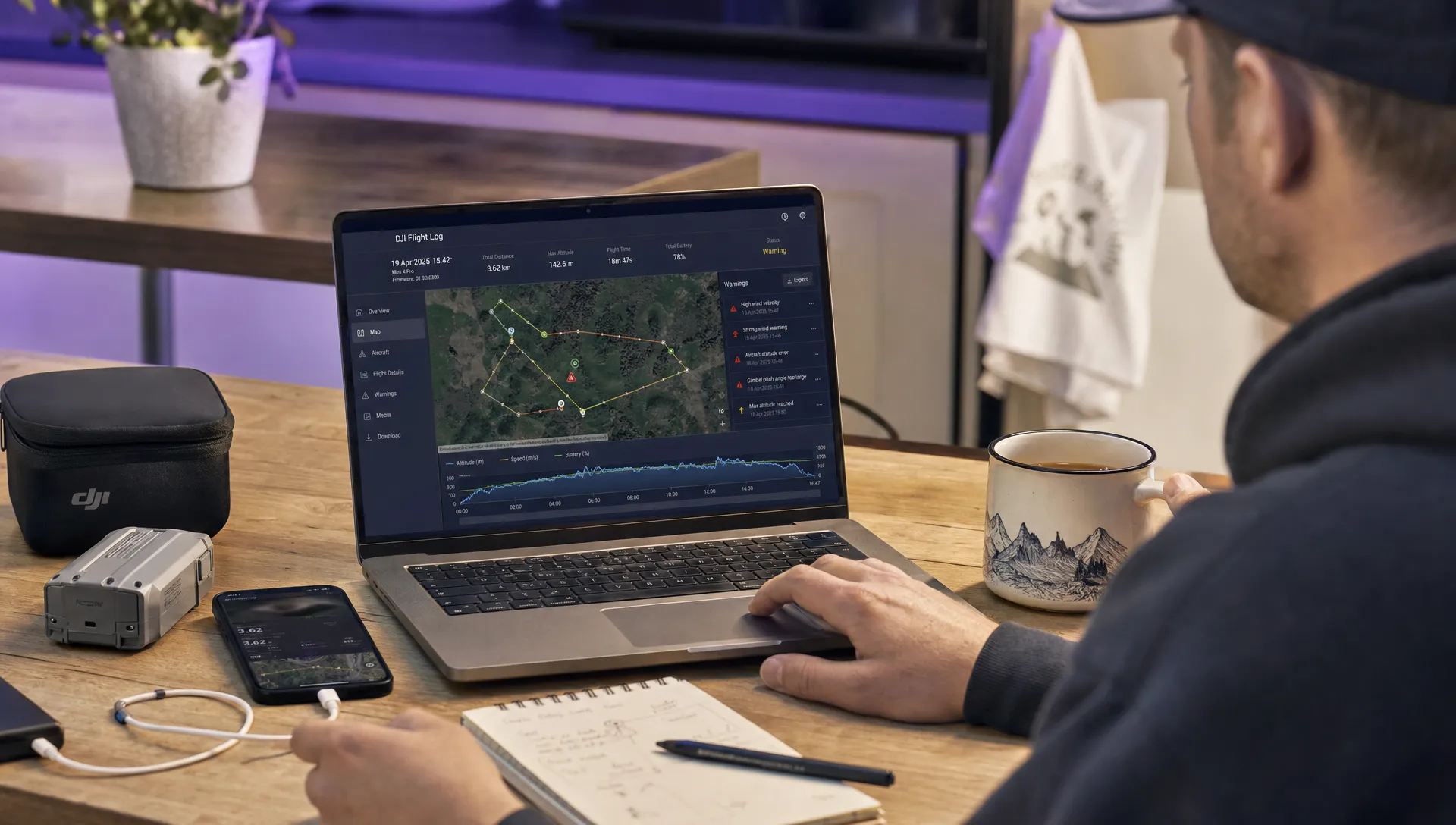 How to Review a DJI Flight Log After an Unexpected Event →