
Crash Data Group: Drone Pilot Incident Guide
A drone has just gone in hard. The propellers are bent, the payload is hanging loose, and your phone is already buzzing with messages from the client, your operations lead, or your insurer. Most pilots feel the same pull in that moment. Get the aircraft back, power it up, see if it still works, and try to explain what happened from memory.
That instinct causes problems.
In commercial operations, the minutes after an incident matter as much as the incident itself. If you guess, reboot, delete, or casually move files around, you can lose the evidence that tells you whether the cause was pilot input, environmental conditions, a system warning, maintenance history, or a hardware fault. That evidence is what turns a stressful event into a defensible report.
The automotive world solved this problem years ago with structured crash investigation. For drone teams, the same discipline works. You need your own crash data group. Not a single file. Not just the flight log. A complete body of evidence that lets you reconstruct what happened, protect your position, and improve operations.
The Moment After Impact What Happens Next
A common scenario goes like this. The aircraft was flying a routine inspection leg, the pilot saw an unexpected movement, video broke up, and the drone clipped a structure on descent. Everyone on site has an opinion within seconds. Wind gust. Compass issue. Pilot error. Signal loss. Battery problem.
Most of those early opinions are wrong, or at least incomplete.
The first reports after a drone crash usually come from memory, and memory is a poor recorder under stress. One crew member swears the aircraft drifted left. Another says it climbed first. The pilot is certain the controller warned about obstacle sensing, except the wording of the alert is already fuzzy.
Practical rule: The first verbal explanation is only a working hypothesis, not the incident record.
A professional crash data group mindset changes the outcome. Instead of asking, "What do we think happened?" you ask, "What data exists, where is it stored, and how do we preserve it before anything changes?" That shift is what separates hobby-level guesswork from an operational safety process.
If you manage drone work for clients, regulators, or insurers, the job after impact isn't to sound confident. It's to secure facts.
Decoding the Crash Data Group Concept
Right after a drone strike, one question decides whether your investigation will hold up later. Are you collecting a single flight log, or are you building the full case file?
The phrase crash data group comes from the automotive investigation field. There, it refers to the discipline of collecting recorder data and the surrounding evidence needed to reconstruct a collision. Crash Data Group, the vehicle forensics company, was founded in August 2004 and became known for Event Data Recorder tools used to retrieve pre-crash and crash information, in a role that gained importance as EDR requirements became more formal in the U.S., according to Crash Data Group company information.

What automotive investigators actually mean
In a vehicle case, the recorder is only one part of the investigation. Analysts pull EDR data, then compare it with physical damage, scene evidence, restraint use, and the timeline of driver actions. The method matters as much as the tool.
That principle transfers well to drone operations.
A professional drone team can borrow the same logic even though the hardware is different. Cars often center the investigation on one recorder. Drones usually spread evidence across the aircraft, controller, mobile device, cloud sync, maintenance records, and operation-specific documents. Your job is to treat those pieces as one coordinated evidence set.
What it means for drone operations
For drone pilots, a crash data group is the organized collection of records tied to one event, preserved in a way that supports reconstruction, reporting, insurance review, and internal safety action.
It works like a maintenance discrepancy package in manned aviation. One document rarely explains the event on its own. The picture becomes clear when you line up the technical record, the human decisions, and the operating conditions in the same timeline.
That usually includes:
- Aircraft logs that record flight path, system state, and onboard warnings
- Controller and app records that show pilot inputs, alerts, and sync history
- Mission planning records such as route design, altitude limits, and task notes
- Maintenance and configuration history including firmware status, battery cycles, repairs, and recent changes
- Site and environmental records such as weather, obstacles, RF conditions, and airspace authorizations
- Crew and procedural records showing who was assigned, what brief was given, and which go or no-go decisions were made
Pilots often make one specific mistake. They treat the exported flight log as the whole investigation file.
It is only one layer of evidence.
A log may show descent rate, GPS movement, warning messages, and control inputs. It usually will not show whether the operation launched with a known battery concern, whether the site survey missed a new obstruction, whether the pilot was flying a revised mission plan, or whether the crew deviated from the brief. That is why teams should understand what a flight recorder means in drone operations before they need the data under pressure.
The practical lesson is simple. In automotive work, EDR data helps investigators anchor the event to recorded system behavior. In drone work, you need to build that discipline yourself by defining, ahead of time, which records belong in your incident file and how they will be preserved. That is the drone industry version of a crash data group, and it is what turns a scattered pile of files into evidence you can use.
Anatomy of Your Drone’s Digital Black Box
Automotive Event Data Recorders capture a focused pre-crash window. Crash Data Group notes that vehicle EDRs can capture up to 5 seconds of pre-crash data, including speed and braking, and ties that capability to the importance of objective reconstruction in a year when 40,901 U.S. motor vehicle deaths were recorded in 2023, as described in the automotive EDR industry report. A drone gives you a different advantage. Instead of a short snapshot, you often have a richer stream of telemetry and operational metadata.
The challenge is knowing where to look.
The evidence is spread across systems
Drone pilots often expect one export to contain everything. In practice, incident evidence usually sits in multiple places. The aircraft may store core flight data. The controller may hold sync records. The mobile app may capture warnings and mission details. Your operations platform may hold planning, crew assignment, and asset history.
If you haven't reviewed what a flight recorder means in drone operations, it's worth doing before you have an incident. The biggest mistake I see is pilots discovering their data situation only after a crash.
Drone Crash Data Components
| Data Type | Common Source | Investigative Value |
|---|---|---|
| GPS track and position history | Aircraft log, flight app | Reconstructs route, hover points, drift, and final path |
| Altitude and vertical speed | Aircraft telemetry | Shows climb, descent, abrupt sink, or altitude deviations |
| Ground speed and heading | Aircraft telemetry | Helps compare commanded movement with actual movement |
| Pilot stick inputs | Controller or synced flight record | Confirms what the pilot asked the aircraft to do |
| Flight mode changes | Flight app, aircraft log | Shows transitions such as normal mode, failsafe, return-to-home, or attitude mode |
| Warning messages | Mobile app, controller display | Captures system alerts that memory often misses |
| Battery status and voltage behavior | Battery logs, aircraft telemetry | Helps assess power issues, sag, or low-voltage response |
| Satellite and positioning quality | Aircraft telemetry | Useful when checking GPS degradation or poor positioning confidence |
| Compass and IMU status | Aircraft diagnostics, logs | Supports analysis of navigation anomalies and sensor disagreement |
| Motor and propulsion indicators | Aircraft diagnostics | Helps distinguish control issues from propulsion issues |
| Payload state | Camera metadata, mission records | Shows whether added equipment affected handling or endurance |
| Gimbal angle and video timing | Media metadata, app records | Helps sync visual evidence with aircraft motion |
| Firmware version | Aircraft, controller, maintenance system | Establishes software environment at time of incident |
| Maintenance records | Fleet system, technician notes | Reveals unresolved defects, repairs, and recurring faults |
| Mission plan and site notes | Operations software, crew briefing records | Provides intent, constraints, geofence considerations, and hazards |
| Crew assignments and authorizations | Operations records | Clarifies who performed each role and under what approval |
What pilots miss most often
The subtle data points usually solve the case. Not the obvious ones.
A GPS line might show drift, but the controller input log may show the pilot was already correcting. A warning banner may explain why the aircraft shifted mode. A maintenance record may reveal the same battery had been flagged on the previous job. A timestamped mission plan may show the team expected a different obstacle layout than the one they encountered.
The strongest investigations don't rely on one perfect file. They cross-check several imperfect records until the timeline becomes clear.
Treat your drone as a system of recorders, not a single recorder.
Preserving Evidence The First 60 Minutes After a Crash
The first hour is where many otherwise solid operators damage their own case. They reboot the aircraft, swap batteries, relaunch to "see if it happens again," or hand the controller to someone else to inspect. Each of those actions can alter logs, create confusion, or break chain of custody.
What to do immediately
Start with the site, not the software.
- Secure people first. If anyone is injured or exposed to a continuing hazard, address that before touching equipment.
- Isolate the aircraft. Prevent unnecessary handling. If batteries are damaged or hot, manage them safely.
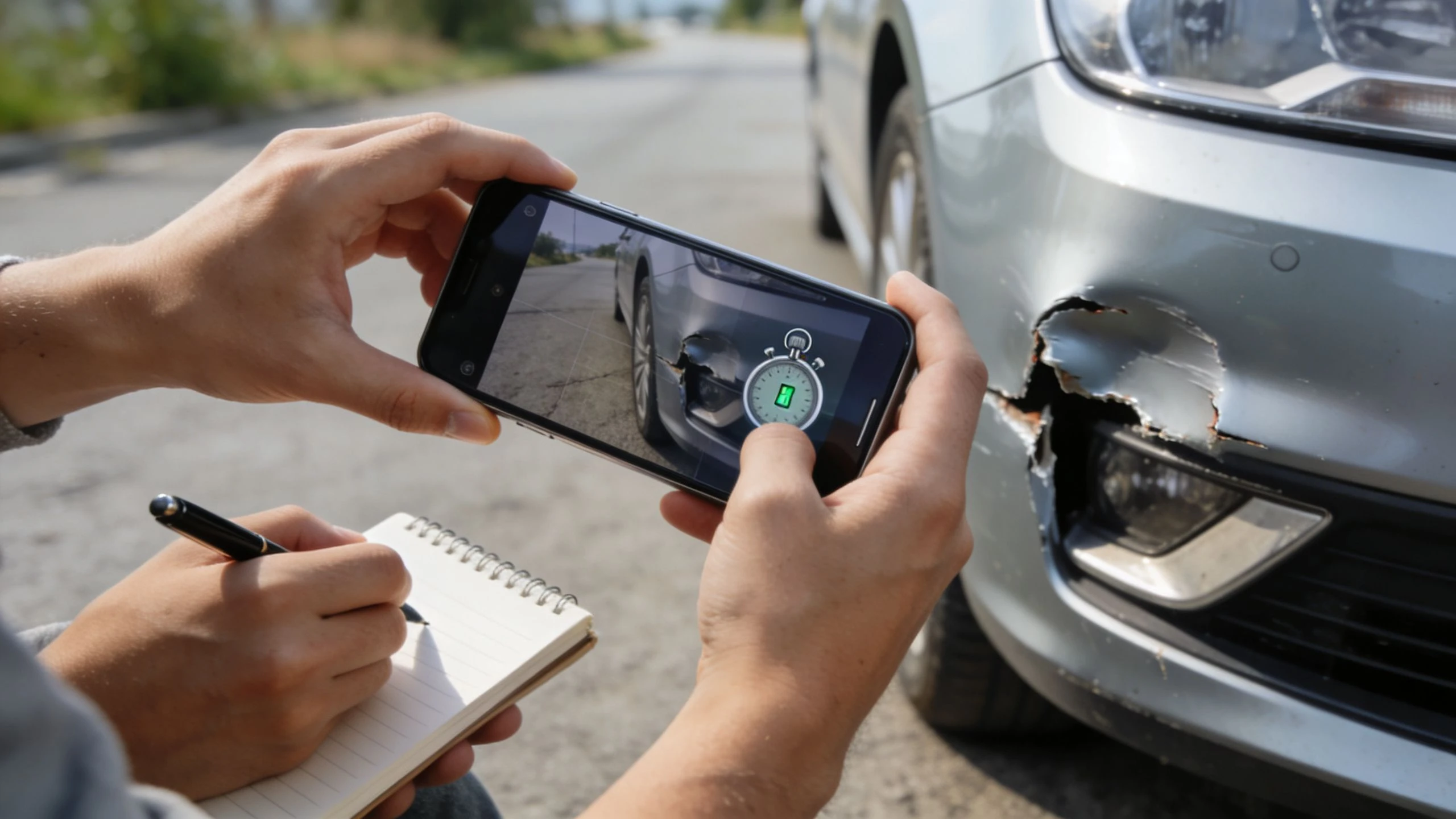
- Freeze the scene. Take photographs before moving components if conditions allow.
- Separate involved hardware. Aircraft, controller, batteries, payload, and memory cards should be identified and kept together as incident items.
- Record basic facts. Time, location, crew present, weather observations, and witness names.
What not to do
These are the actions that regularly destroy useful evidence:
- Don't power-cycle casually. Restarting hardware can overwrite temporary records or complicate timing.
- Don't sync and clean up files first. Pull raw data before anyone starts organizing or deleting.
- Don't merge accounts or devices. Keep the original data path intact.
- Don't rely on screenshots alone. They support the record. They don't replace exported logs.
If your team hasn't dealt with evidence handling before, legal concepts such as what spoliation of evidence is can help explain why altered or lost records create serious downstream problems. The legal language comes from another field, but the practical lesson applies directly to drone incidents.
A workable chain of custody routine
Use a simple, repeatable method:
- Label the items: Aircraft serial, controller serial, battery identifiers, payload, and storage media.
- Export before analysis: Create raw copies of logs before opening them in tools that may generate derived files.
- Timestamp the collection: Note who collected each item and when.
- Create two backups: One working copy for analysis, one protected archive.
- Restrict access: One person should control the evidence set until handoff is documented.
If you can't show where a file came from, when it was collected, and who handled it, someone else can question whether the file reflects the incident at all.
That challenge doesn't only appear in court. It comes up in insurer reviews, internal investigations, and client disputes.
From Raw Logs to Root Cause Analyzing Crash Data
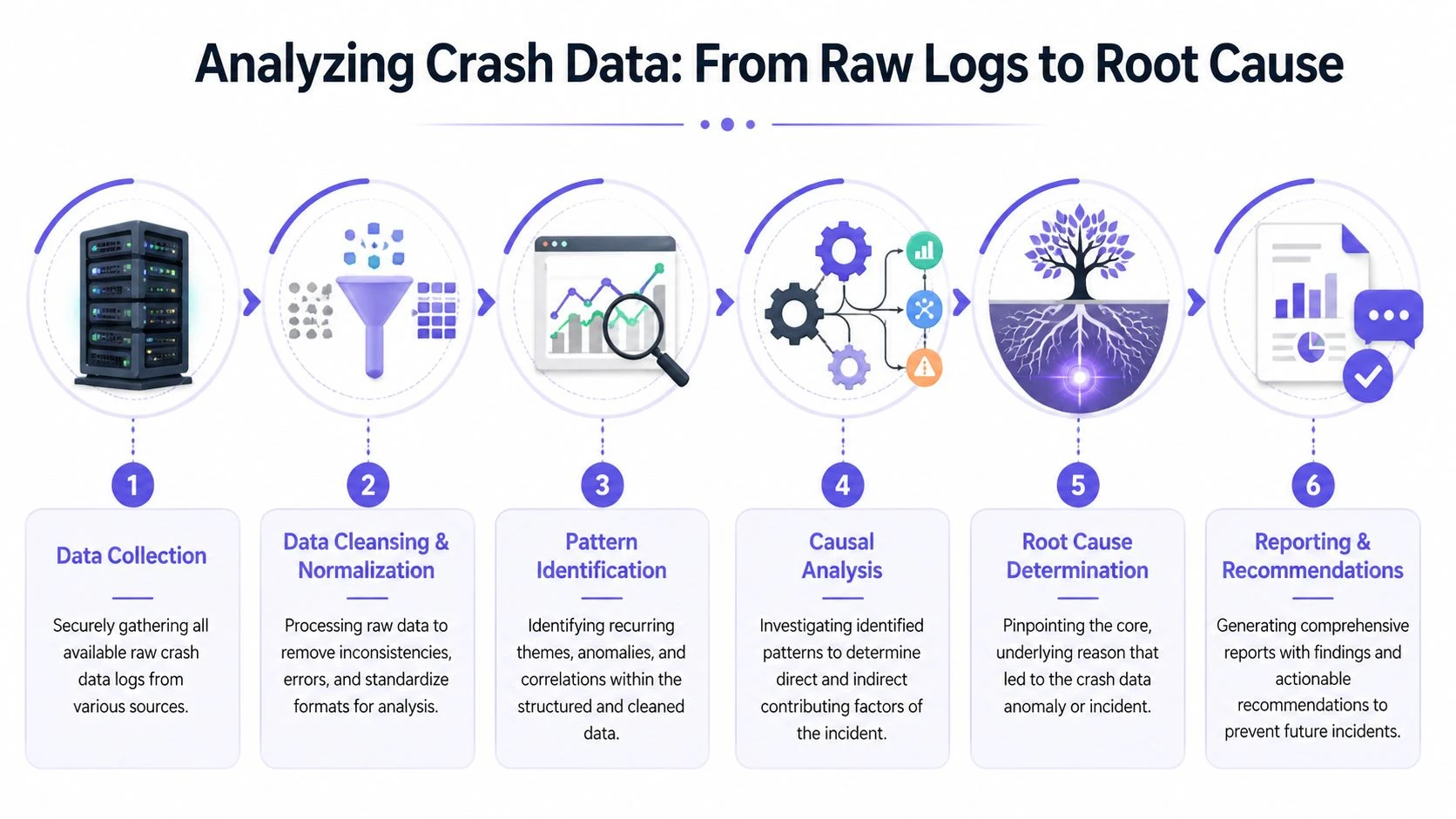
Raw data isn't the answer. It's the starting point. The essential work is correlation. You line up time, aircraft behavior, pilot input, warnings, environmental context, and maintenance background until they tell one coherent story.
Crash Data Group's explanation of EDRs highlights why this matters. In automotive forensics, EDRs capture precise information such as Delta-V and approximately 5 seconds of pre-crash dynamics, which can correct witness statements. That same principle applies to drone logs, where high-frequency records allow reconstruction based on recorded behavior rather than pilot memory, as described in Crash Data Group's EDR overview.
Build the timeline first
Before you assign cause, create a minute-by-minute, then second-by-second sequence.
A disciplined timeline usually answers these questions:
- What was commanded by the pilot at each stage?
- What did the aircraft do in response?
- What warnings or mode changes appeared before control was lost?
- What environmental or mission factors were present at that exact point?
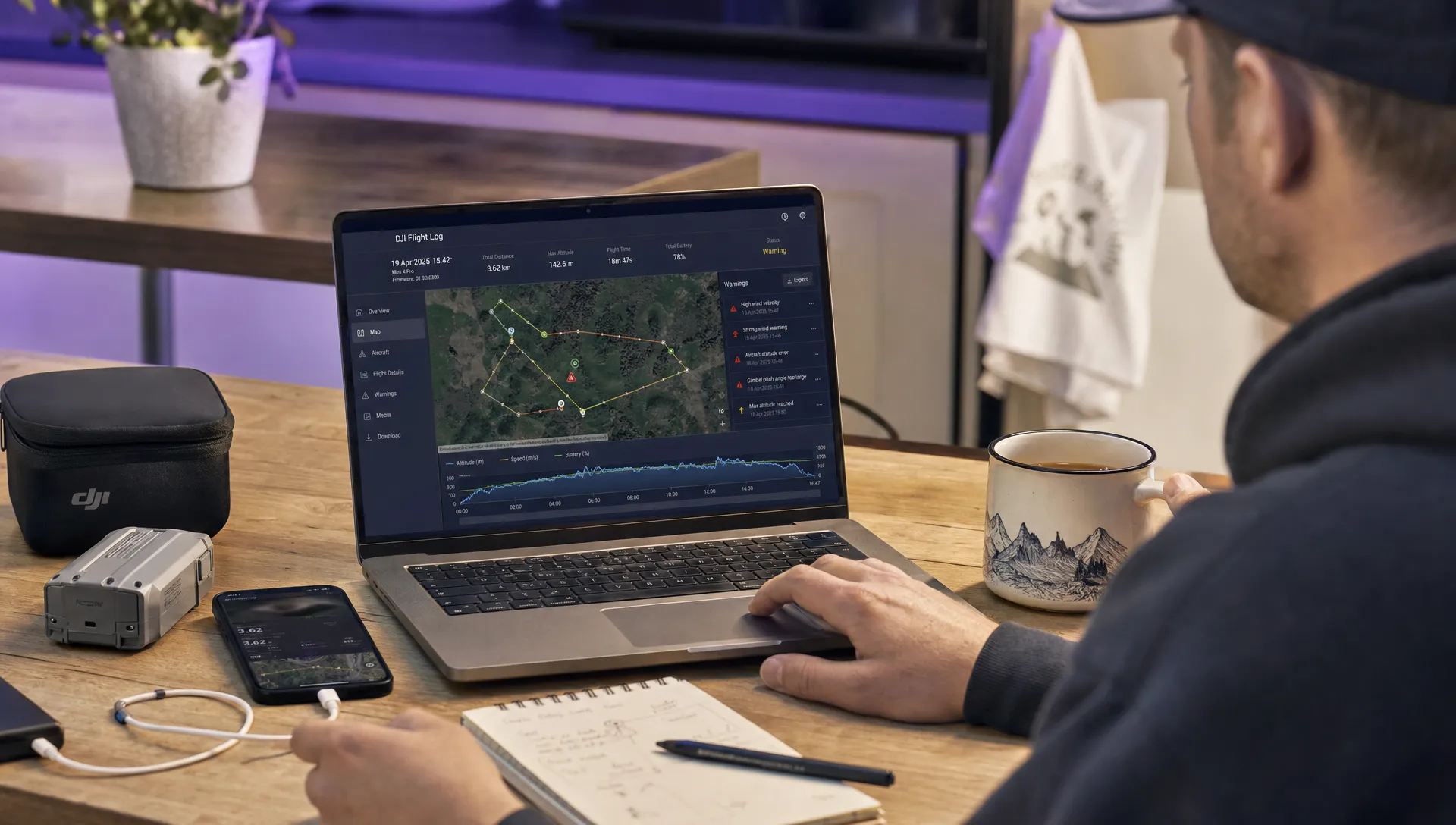
Analysis tools prove helpful. A flight log viewer can reveal altitude trace, heading changes, stick movement, and warning states in one frame. If you need a starting point for the mechanics, how to analyze a drone log file is a practical walkthrough.
Common patterns that point to cause
You don't need exotic software to spot meaningful signatures. You need disciplined comparisons.
-
Pilot input doesn't match aircraft movement
If the pilot commanded hover or braking and the aircraft continued on a different vector, look at mode changes, positioning quality, or propulsion issues. -
Multiple warnings cluster before impact
A single alert may be noise. Several alerts close together often show a system under stress. -
Power behavior changes abruptly
If battery or power indications change sharply just before the event, inspect the battery history, contacts, and any prior notes tied to that pack. -
The video story and telemetry story differ
Camera footage can make a movement look aggressive when the logged path shows something else. Trust synchronized records over perception.
Root cause isn't the last thing that happened. It's the earliest condition that made the outcome likely.
That distinction matters. "Hit a structure" is the event. "Lost positional confidence after launch near reflective infrastructure and continued the task despite warnings" may be much closer to cause.
For teams that want a broader engineering frame, this overview of root cause analysis engineering is useful as a general method reference. Use that mindset carefully. You aren't hunting for blame. You're identifying the controllable condition that can be corrected.
Incident Response and Reporting Workflows
The aircraft is on the ground. The crew is safe. A client is asking what happened, management wants an update, and someone has already started pulling files onto a personal laptop.
That is the point where a good investigation can start to drift.
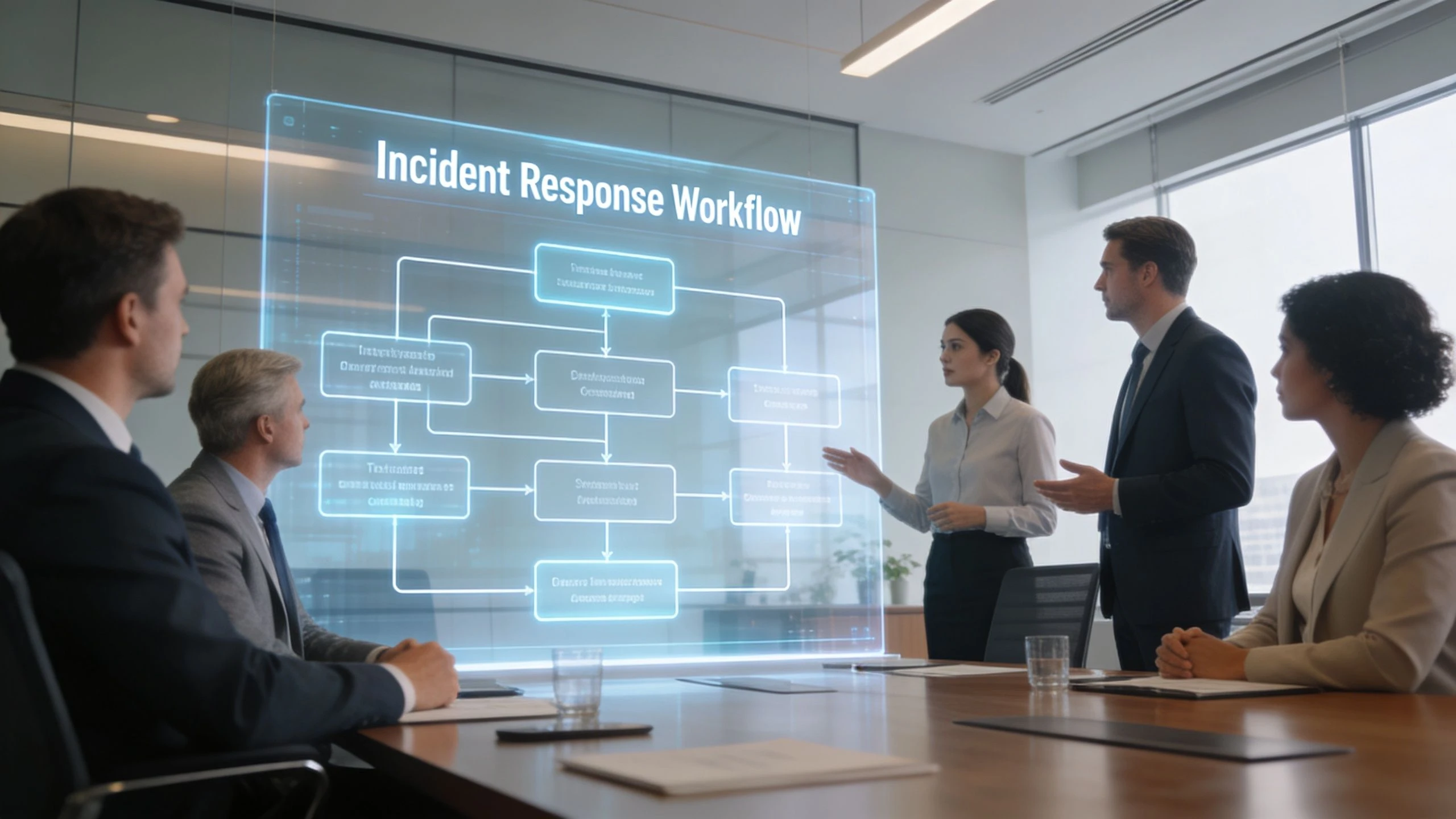
Professional drone teams need a reporting workflow that treats incident data the way the automotive sector treats a crash data group from an EDR. One controlled record. One agreed sequence. One case file that follows the event from field recovery to final corrective action. A practical model is secure, collect, analyze, report, improve.
Why one workflow matters
A drone incident creates several reporting needs at once. The chief pilot needs the operational sequence. Management needs business impact and exposure. The insurer needs preserved evidence. A regulator may require notice. The client needs a clear account of what changed before the next job.
If each group gets a different version, your credibility weakens and your timeline gets harder to defend.
A single workflow fixes that problem by making the incident file the master record. Every later document should come from that file, not from memory, chat messages, or separate spreadsheets built by different departments.
Build the incident file like a drone crash data group
Automotive investigators do not rely on one dramatic clue. They assemble a defined packet of records around the event. Drone operators should do the same.
Your incident file should usually include:
- Occurrence summary with date, time, location, mission purpose, aircraft, crew, and operating conditions
- Evidence register listing the aircraft, battery, controller, payload, media cards, logs, photos, witness notes, and chain of custody
- Operational timeline showing launch, task phases, anomalies, crew actions, impact, and recovery actions
- Analysis summary stating what was examined, what was ruled out, and the most likely causal chain
- Decision log recording who grounded equipment, paused operations, notified clients, or approved return to service
- Reporting outputs prepared for internal leadership, insurer, customer, or authority
- Corrective action record assigning changes to training, maintenance, firmware control, site procedures, or mission approval
This works like a maintenance release package. If one sheet is missing, the whole record becomes harder to trust.
Turn findings into actions, not just paperwork
A filed report is not the finish line. It is the handoff point between investigation and operational control.
Use the completed case to answer three practical questions:
- What must change before the next similar mission?
- Who owns that change?
- How will the team verify that the change happened?
That last point is where many operators fall short. A recommendation without an owner and a due date is only a note.
A workable reporting path for drone teams
For most professional operations, the workflow looks like this:
- Field team opens the case and submits the first incident summary with preserved evidence references.
- Operations lead reviews severity and decides whether to ground equipment, pause a mission type, or escalate internally.
- Technical reviewer examines logs and hardware records and writes the factual sequence.
- Accountable manager approves the report package for external use, so the insurer, client, and internal team all receive aligned information.
- Safety or training lead tracks corrective actions until each one is closed and documented.
This structure prevents a common failure mode. The pilot writes one account, maintenance writes another, and management sends a third version outside the company.
Standardize before the next incident
The best time to build the workflow is before you need it. Create templates, define approval authority, and decide where incident files live. If your operation is formalizing those controls, this guide to commercial drone compliance requirements is a useful reference.
A crash data group only improves safety when it changes how the organization works after the report is signed.
Navigating Legal and Compliance Requirements
A drone strikes a structure on a client site. The aircraft is recovered, the battery is isolated, and the flight logs are copied. Ten minutes later, critical pressure begins. The client wants answers, the insurer wants documentation, and your operations manager needs to know whether this becomes a reportable event.
That is why legal and compliance work cannot begin at the reporting form. It begins with records that were created before the flight and preserved after the impact.
Automotive precedent is useful here. Rules governing vehicle Event Data Recorders have pushed that industry toward standardized pre-crash data, survivable recording, and consistent retrieval methods. Drone operators can apply the same principle without waiting for drone-specific rules to catch up. Build your own crash data group so that flight logs, mission plans, maintenance status, crew assignments, payload details, weather records, and pilot inputs can be reviewed as one evidence set.
What regulators, insurers, and clients will actually test
After an incident, outside reviewers usually focus on four questions.
- Was the event reportable? Your team should know the trigger thresholds for your jurisdiction, aircraft category, and operating approval.
- Can you reconstruct the flight? Planned route, actual path, control inputs, warnings, and system status should line up in the record.
- Can you show the aircraft was fit for flight? Inspection history, deferred defects, firmware status, battery condition, and payload configuration matter.
- Can you show the evidence was controlled? You need a clear record of who collected each file, when it was copied, where it was stored, and whether any version was altered for analysis.
This works like chain of custody in any other safety investigation. If a log file appears without context, reviewers may question the file. If the file is tied to a named aircraft, mission, pilot, storage location, and collection time, the evidence is much easier to defend.
If your team is formalizing those controls, this guide to commercial drone compliance requirements is a useful operational reference.
Apply the automotive lesson to drone operations
The useful lesson from automotive crash analysis is not "copy car regulations into aviation." It is standardize the evidence set before the next incident.
For drone programs, that means deciding in advance which records belong in your crash data group and how long they are retained. It also means making sure those records are readable by more than one person in the company. A file that only one pilot knows how to export is a weak point. A repeatable process that any trained reviewer can follow is far stronger for compliance, claims handling, and internal accountability.
Good records do not guarantee a favorable result. They do give your team a defensible account of what happened, what was airworthy, what was authorized, and what changed after the event. In a serious incident, that difference shapes the entire investigation.
Conclusion Building a Safer and Smarter Drone Program
A crash data group shouldn't live only in your emergency binder. It belongs inside your normal operating system.
When teams collect flight data, maintenance history, mission records, and crew decisions in a consistent way, incident response gets sharper. A key benefit is improved near-miss review. You start catching weak signals before they become damaged aircraft, client disputes, or regulatory headaches.
That's the essential value of borrowing from automotive crash investigation. The lesson isn't just "download the logs after a crash." It's "build an operation where the facts are already organized."
Professional drone work is data-driven. The operators who treat evidence handling, reconstruction, and corrective action as routine safety practice will build programs that are easier to defend, easier to improve, and safer to run.
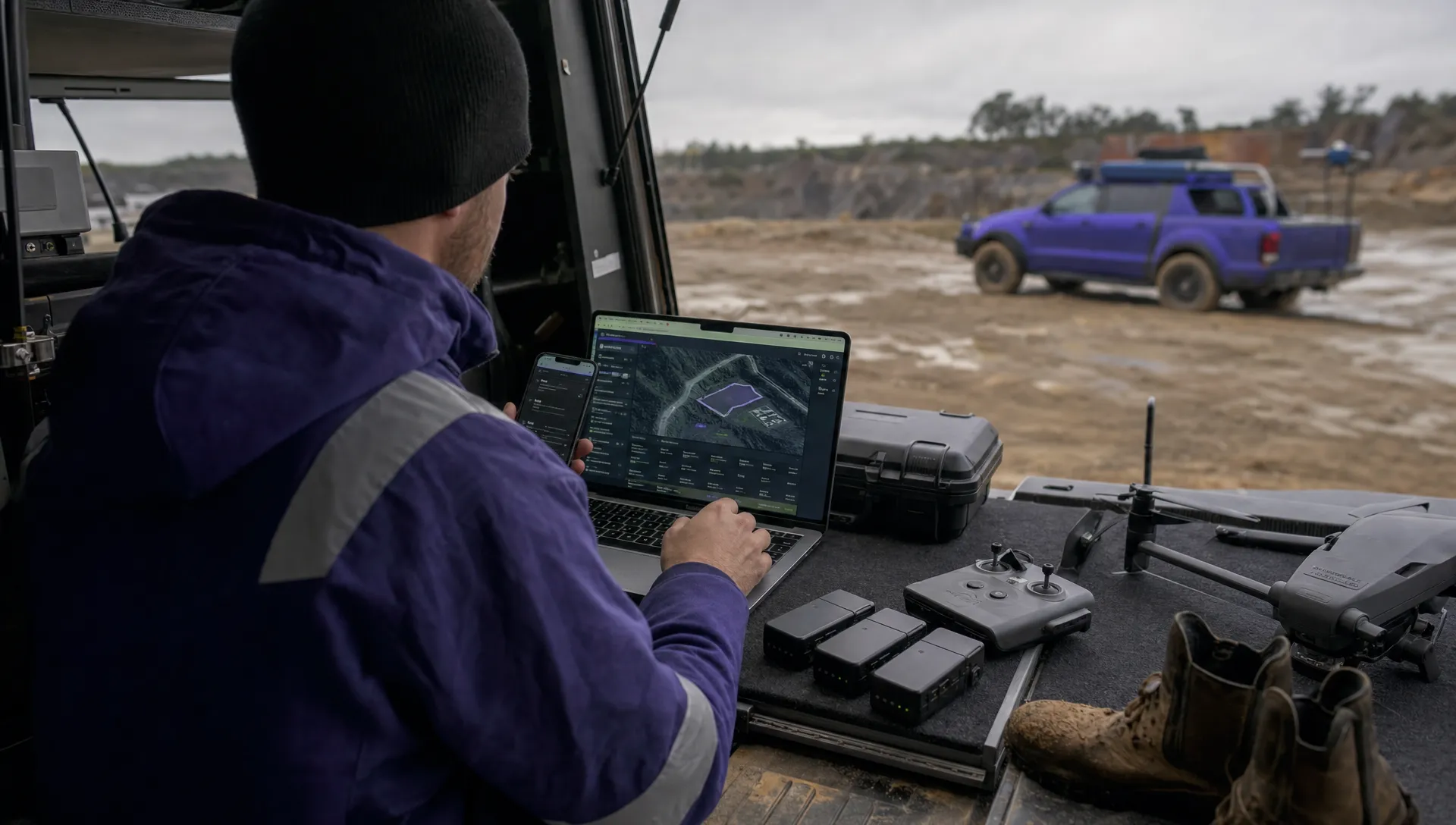
If you want a practical system for organizing flight records, planning data, fleet history, and compliance documentation in one place, Dronedesk gives professional drone teams a structured foundation for safer operations and cleaner incident reporting.
 Drone Operating Rules for Managing Contractors and Employees →
 BVLOS Drone Requirements for Building a Safety Case →
 Drone Pilot Test Mistakes That Cost Candidates Marks →
 FAA 107 License vs Part 107 Certificate: What’s the Difference? →
 Drone Airport Rules: A Field Checklist for Site Assessments →
 FAA Part 107 Record-Keeping Rules for Commercial Teams →
 How to Review a DJI Flight Log After an Unexpected Event →
 Drone Laws Around the World: A Pre-Flight Research Framework →
 How to Compare Drone Survey Services for Complex Sites →
 How to Start a Drone Mapping Business With a Clear Workflow →