
Your Guide to the UAS Operator Certificate
So, what exactly is a UAS operator certificate? In simple terms, it's your official green light to fly a drone for any reason other than just for fun. Think of it as a professional pilot's license for the skies. It’s the document that proves you know the rules of the road—safety protocols, airspace regulations, and how to fly responsibly.
Decoding the UAS Operator Certificate

Here’s a good analogy: it’s a bit like a commercial driver's license. Sure, anyone with a standard license can drive their own car, but if you want to operate a big rig for a living, you need that special certification. Drones are no different. Flying in your back garden for a bit of fun is one thing, but getting paid to capture aerial photos of a property for a real estate agent? That's a whole different ball game.
This certificate draws a very clear line in the sand between being a hobbyist and a commercial operator. Without it, any flight you do for business purposes is illegal and could land you in hot water with some hefty fines. Even something that seems small, like taking a few shots for a friend's company website, counts. If you plan to make money with your drone, this certificate is non-negotiable.
More Than Just a Piece of Paper
Getting certified isn't just about ticking a legal box; it’s a statement of professionalism and a commitment to safety. It signals to your clients, regulators, and the public that you're a trained professional who gets the risks and responsibilities of operating an aircraft in shared airspace.
This credential is your key to unlocking a ton of career opportunities. Certified pilots are in high demand across a surprising number of industries:
- Cinematic Filmmaking: Capturing those jaw-dropping aerial shots for movies and ads.
- Precision Agriculture: Using drones to keep an eye on crop health and boost farm yields.
- Infrastructure Inspection: Safely checking out bridges, power lines, and wind turbines without putting people at risk.
- Real Estate Marketing: Creating stunning property videos that make buyers sit up and take notice.
The explosive growth of the drone industry really highlights how important proper certification is. In the United States alone, the Federal Aviation Administration (FAA) has already issued over 100,000 remote pilot certificates since it brought in its Part 107 regulations. That number speaks volumes about the demand for qualified, professional pilots. If you're curious about the bigger picture, the Association for Unmanned Vehicle Systems International has some great insights on global drone trends.
The Foundation of a Professional Career
At the end of the day, a UAS operator certificate is the bedrock of any professional drone career. It's the absolute first—and most critical—step for anyone serious about going from a drone enthusiast to a trusted commercial operator.
This single document is what separates you from casual flyers, establishing your credibility and granting you the legal authority to participate in the fast-growing commercial drone economy. It’s not just about flying; it’s about flying professionally, safely, and legally.
Navigating Global Drone Regulations
Getting a UAS operator certificate isn't a simple, one-size-fits-all deal. Think of drone laws like local dialects—they can change dramatically from one country to the next. For any pilot with ambitions beyond their own backyard, figuring out these differences is absolutely critical to flying legally and safely.
It’s a bit like driving a car across continents. You already know how to steer and brake, but the road signs, speed limits, and traffic laws are completely different once you cross a border. Your piloting skills are universal, but your legal permission to fly commercially definitely isn't. A certificate you earn in one place is rarely valid somewhere else without jumping through a few more hoops.
This is especially true when you look at the two biggest players in aviation regulation: the FAA in the United States and EASA in the European Union. Each has built its own distinct rulebook that dictates how, when, and where a certified pilot can take to the skies.
The FAA's Part 107: A Standardized Approach
Over in the United States, the Federal Aviation Administration (FAA) keeps things relatively straightforward with its Part 107 regulations. This is the go-to framework for most commercial drone operations involving aircraft under 55 pounds.
To get your Part 107 Remote Pilot Certificate, the main hurdle is passing a standardized aeronautical knowledge test. Once you’re certified, you operate under one core set of principles, no matter where you are in the country:
- Fly below 400 feet in most airspace.
- Always keep the drone within your visual line of sight (VLOS).
- Don’t fly over people or moving vehicles unless you have a specific waiver.
- Night flights are a no-go unless you have proper anti-collision lights and have completed the required updated training.
This standardized system creates a predictable and consistent environment, making it pretty clear what is and isn't allowed for commercial pilots across all 50 states.
EASA's System: A Risk-Based Framework
The European Union Aviation Safety Agency (EASA) decided to go a different route. Instead of a single rulebook, EASA uses a risk-based model that sorts drone flights into three categories depending on how dangerous the operation is.
- Open Category: This is for your low-risk flights. It covers most consumer drones and some professional work, but with firm limits on drone weight (under 25 kg) and how close you can get to people. To fly in this category, pilots usually just need to complete some basic online training and pass a simple exam.
- Specific Category: When an operation is a bit riskier and falls outside the Open category—like flying beyond visual line of sight (BVLOS) or using a heavier drone—it lands here. This requires a detailed risk assessment and special permission from the national aviation authority.
- Certified Category: This is the big leagues, reserved for high-risk operations on par with manned aviation. We're talking about large-scale cargo drones or flying over big crowds. It involves a super-strict certification process for the drone, the pilot, and the operator.
This tiered system offers more flexibility but definitely adds a few layers of complexity to the mix. If you want to get into the nitty-gritty, you can learn more about what new drone regulations mean for UK and EU operators in our detailed guide.
EASA’s approach is tailored to the specific risk of each flight, while the FAA’s Part 107 provides a uniform baseline for all commercial operations. Neither is better, but they represent fundamentally different philosophies on managing drone safety.
The growth of the drone industry in Europe shows these regulations are having a real impact. In Denmark, for instance, the number of remote pilot certificates shot up from around 14,000 in 2017 to over 28,000 in 2018, a clear sign of the continent's booming drone economy.
UAS Certificate Requirements FAA vs EASA at a Glance
To really spell out the differences, it helps to see the core requirements for the most common commercial scenarios side-by-side. This table breaks down what you need to know when comparing the FAA's Part 107 with EASA's Open Category.
| Requirement | FAA (Part 107 - USA) | EASA (Open Category - EU) |
|---|---|---|
| Governing Rule | A single set of rules for most commercial operations. | A risk-based framework with multiple categories (Open, Specific, Certified). |
| Pilot Certification | Pass an in-person aeronautical knowledge test. | Complete online training and pass an online theory test for subcategories A1/A3. |
| Minimum Age | 16 years old. | 16 years old (can be lowered by individual EU states). |
| Operational Limits | Generally must maintain visual line of sight (VLOS) and stay below 400 feet. | Varies by subcategory; VLOS is required, and flights near people are highly restricted based on drone weight. |
| Night Flying | Permitted with anti-collision lights after completing updated training. | Generally not permitted in the Open category without specific authorization. |
Ultimately, the right UAS operator certificate for you boils down to one simple question: where do you plan to fly? Getting a solid handle on these global differences is the first step toward building a successful—and compliant—international drone operation.
Your Step-by-Step Path to Certification
Getting your UAS operator certificate can feel a bit like prepping for a major flight mission. It might seem intimidating at first, but with a clear, step-by-step plan, it's completely manageable. Think of this guide as your flight plan, designed to walk you through every critical milestone, from the initial eligibility checks to finally having that certificate in your hand.
Don't look at this as one massive task. Instead, see it as a series of smaller, achievable waypoints. Each step builds on the last, getting you closer to your goal of becoming a certified commercial drone pilot. With the right prep and a solid understanding of the roadmap, you'll tackle this with confidence.
Confirm Your Eligibility First
Before you even start looking at study guides or exam dates, your first checkpoint is to make sure you meet the basic requirements. For most aviation authorities, like the FAA in the United States, these are straightforward but absolutely non-negotiable.
You'll generally need to meet these criteria:
- Be at least 16 years old to take the aeronautical knowledge test.
- Be able to read, speak, write, and understand English.
- Be in a physical and mental condition to safely fly a drone.
This first step is crucial. It stops you from pouring time and money into a process you aren't yet qualified for. It’s a simple check that lays the groundwork for everything that follows.
Create Your Official Pilot Profile
Once you've ticked the eligibility box, your next move is to get yourself into the system with the official aviation authority. In the U.S., this means creating a profile in the FAA's Integrated Airman Certification and Rating Application (IACRA) system.
This is where your journey becomes official. You’ll get a unique FAA Tracking Number (FTN), which you'll need for every single step that comes next, from scheduling your exam to submitting your final application. It's essentially your digital pilot logbook for the entire certification process.
Master the Aeronautical Knowledge Test
This is the heart of the mission: passing the aeronautical knowledge test. This exam is there to make sure you truly understand the rules of the sky. It covers critical topics like airspace classifications, weather, drone regulations, and what to do in an emergency.
Don't underestimate this exam. While it’s not designed to trick you, it definitely requires dedicated study time. There are tons of high-quality online courses, practice tests, and official study guides out there. For pilots in the US, you'll need to focus on the specifics of the FAA Part 107 drone rules. A great place to start is this comprehensive guide to FAA Part 107, which breaks down exactly what's on the test.
The knowledge test isn't just about memorising facts; it's about developing the situational awareness and decision-making skills of a responsible pilot. Your goal is to understand why the rules exist, not just what they are.
Schedule and Pass Your Exam
With your FTN ready and your knowledge sharp, it's time to book your in-person knowledge test. These exams are held at FAA-approved testing centres, which you can find and schedule online.
On the day of the test, make sure you bring a valid, government-issued photo ID. The exam is typically multiple-choice and done on a computer. Once you pass, you'll get an official test report. Hold onto this document! You'll need the exam ID from it to complete your final application.
The infographic below gives you a high-level visual comparison of the regulatory frameworks in the USA and Europe.

This visual helps clarify how different authorities handle key aspects of certification and day-to-day operations.
Complete the Final Application and Security Screening
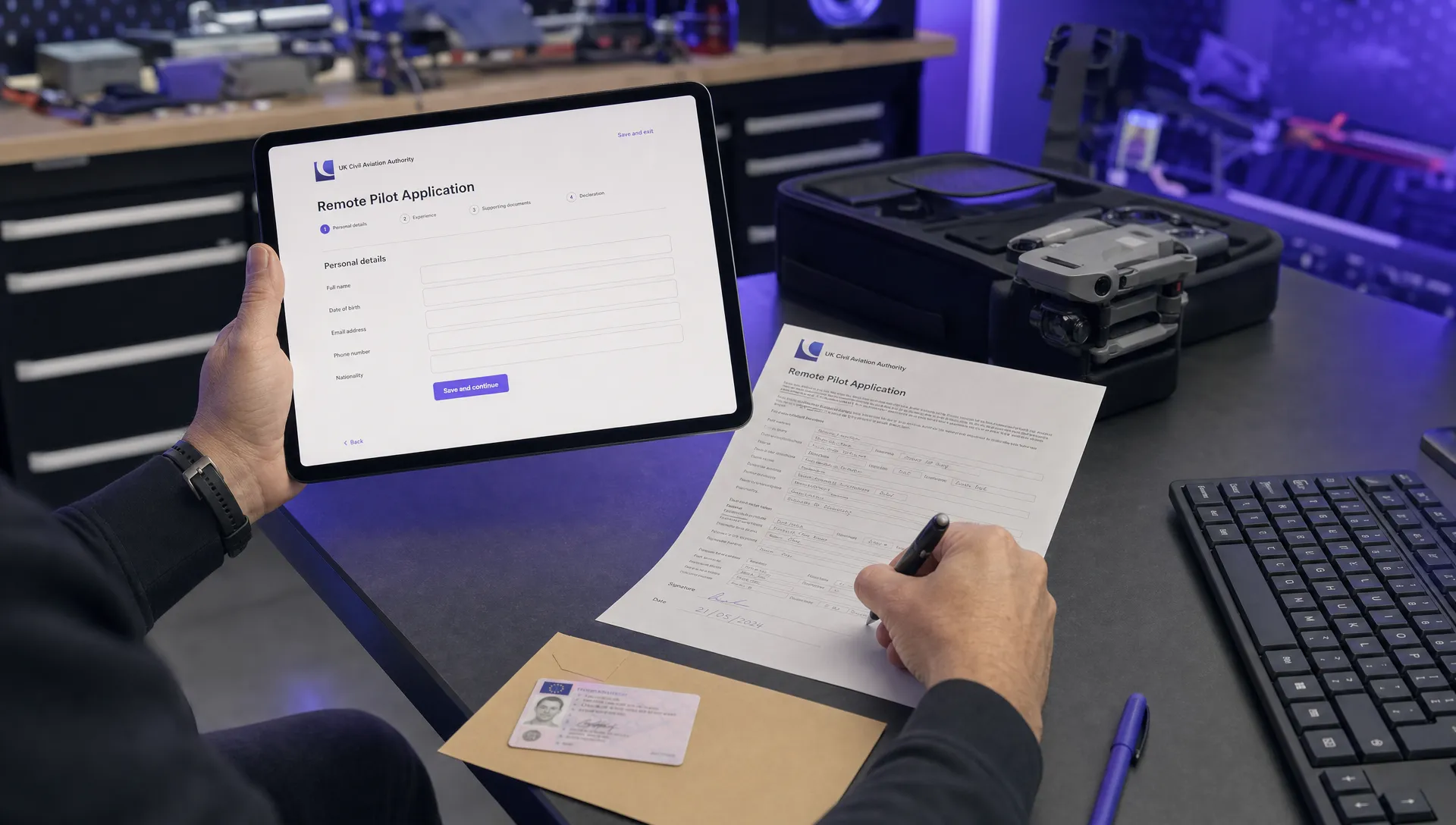
You've passed the test—congratulations! The final leg of your journey is submitting your official application through the IACRA portal you set up earlier. You'll log in, fill out Form 8710-13, and plug in your knowledge test exam ID.
After you hit submit, the Transportation Security Administration (TSA) will conduct a routine background security check, which is standard for all airman certificates. Once you're cleared, which usually takes a few weeks, you’ll get a temporary certificate by email. Your permanent plastic card will show up in the mail shortly after, officially making you a certified UAS operator.
Understanding the Costs, Timelines, and Paperwork
Getting your UAS operator certificate sorted involves juggling a bit of time, money, and paperwork. While it's a pretty straightforward process, knowing what to expect financially and how long it all takes will save you a world of frustration and delay. A solid grasp of the required documents means your application will sail through without a hitch.
Think of it like planning a road trip. You need to budget for fuel and snacks, map out your route to figure out how long you'll be on the road, and make sure your driver's license is valid before you even turn the key. Getting certified is no different—a little prep work goes a long, long way.
Breaking Down the Certification Costs
One of the first questions on every aspiring pilot's mind is, "How much is this going to set me back?" The good news is that becoming a certified operator is surprisingly affordable. The expenses really fall into two camps: mandatory fees and optional (but often smart) investments.
- Aeronautical Knowledge Test Fee: This is the main one you can't avoid. In the U.S., the FAA's Part 107 exam fee usually lands at around $175. You'll pay this directly to the approved testing center when you book your slot.
- Study Materials: Some people are happy to self-study using free resources from aviation authorities, and that's perfectly fine. Many others, though, prefer the structure of paid online courses or study guides. These can range from $50 to $300 and often come packed with video lessons, practice exams, and instructor support.
- Optional Flight Training: While you don't need it to pass the knowledge test, getting some hands-on flight training is a fantastic way to build real-world skills and confidence. A pro instructor might charge anywhere from $100 to $500 for a few hours of one-on-one coaching.
At the end of the day, your total investment could be just the exam fee itself, or it could be a bit more if you decide to gear up with extra training to nail it on your first attempt.
Mapping Your Certification Timeline
Patience is a virtue here. The journey from hitting the books to holding your physical certificate has a few key stages. Everyone's experience is a little different, but a typical timeline looks something like this.
From the moment you crack open a study guide to having that official certificate in your wallet, the whole process generally takes between 4 to 8 weeks. How fast it moves really depends on your study habits and the government's processing times.
- Study Period (1-4 Weeks): Most people put in about 15 to 25 hours of study time for the knowledge test. If you can dedicate a few hours every day, you could knock this out in a week. If you're chipping away at it in your spare time, it might take closer to a month.
- Exam and Application (1-2 Weeks): Once you've passed the test (congrats!), you'll submit your application online. The initial processing and background check, usually handled by the TSA in the US, typically takes about one to two weeks.
- Certificate Issuance (2-6 Weeks): As soon as your security check clears, you'll get a temporary certificate by email. This is your green light—you can start flying commercially right away! The permanent plastic card will follow in the mail a few weeks later.
Your Essential Paperwork Checklist
Getting your documents in order is the final piece of the puzzle. Staying organised here is the key to avoiding silly admin mistakes that can stall your progress. Before you kick things off, make sure you have these items ready to go.
- Valid Government-Issued Photo ID: You'll need this for everything—registering your pilot profile, scheduling the exam, and proving who you are at the testing center. A driver's license or passport is perfect.
- Proof of Passing the Knowledge Test: After you pass, the testing center will hand you an official test report. This little piece of paper has a unique Exam ID number on it, which is absolutely critical for completing your final certificate application.
- Completed Application Form: For pilots in the U.S., this means filling out FAA Form 8710-13. It’s all done electronically through the IACRA portal. Just double-check that all the information is spot-on and matches your photo ID exactly.
Keeping Your Certificate Active and Compliant

Earning your UAS operator certificate is a huge milestone, but it’s definitely not a one-and-done achievement. Think of it less like a diploma you hang on the wall and more like a professional subscription—it needs regular updates to stay valid.
This credential is a living document. It shows that your knowledge is fresh and your skills are sharp, keeping you in line with today's safety standards. As the drone industry sprints forward, so do the rules. Aviation authorities need pilots to stay on top of their game to keep the skies safe for everyone.
Understanding Recurrent Training Requirements
The heart of certificate maintenance is recurrent training. It’s all about periodically refreshing your aeronautical knowledge so you don't fall behind.
In the United States, for instance, the FAA requires Part 107 certificate holders to complete a free online recurrent training course every 24 calendar months. This isn’t just bureaucratic red tape. It's a practical way to keep pilots briefed on crucial updates to things like:
- New rules for flying at night or over people.
- Changes to airspace classifications or flight restrictions.
- Emerging tech and how it fits into the regulations.
This continuous training ensures every certified pilot is working from the same, current playbook.
Staying Ahead of Evolving Drone Regulations
The world of drone regulation is anything but static. New rules pop up constantly to address safety, security, and privacy. A perfect example is the rollout of Remote ID, which fundamentally changed how drones are tracked and identified in the air.
Staying on top of these shifts isn't just a good idea; it's your professional duty.
Letting your knowledge lag is a direct risk to your career. An outdated understanding of the rules can easily lead to accidental non-compliance, which could mean fines, certificate suspension, or even legal trouble if something goes wrong.
Proactive learning is the only way to go. Make it a habit to check official aviation authority websites, subscribe to industry newsletters, and hang out in professional forums. If you want a deeper look into recent regulatory changes, our guide on understanding Remote ID for drones is a great place to start.
The Consequences of an Expired Certificate
Letting your UAS operator certificate expire brings immediate and serious problems. The second it lapses, your legal right to fly commercially is gone. Poof. Any flight you conduct for business becomes illegal, opening you up to some pretty hefty fines.
A lapse can also wreck your professional reputation. Clients expect pilots to be fully compliant and current. An expired certificate screams a lack of professionalism and attention to detail, making it tough to land jobs or win contracts.
Don’t let it happen. Set calendar reminders at least three months before your expiration date. That gives you plenty of time to knock out the training and any admin tasks without the last-minute panic, ensuring your professional drone career continues without a hitch.
Common Certification Mistakes and How to Avoid Them
Getting your UAS operator certificate should be a pretty straight line from A to B. But, as with any official process, there are a few common tripwires that can turn it into a frustrating, expensive, and time-sucking mess. The best way to have a smooth ride? Learn from the mistakes others have made.
Think of it as a pre-flight check for your application. Knowing where the turbulence usually hits lets you fly right around it, saving you a ton of stress and getting you in the air faster. Let's dig into the most common errors aspiring pilots make and, more importantly, how you can sidestep them completely.
Underestimating the Knowledge Test
This is the big one. By far the single biggest mistake is not taking the aeronautical knowledge test seriously. So many applicants figure it's mostly common sense, skim a study guide or two, and then get a rude awakening at the testing center. That approach usually ends with a failed test, a wasted exam fee, and a major setback.
Don't forget, this test gets into the nitty-gritty of airspace classifications, weather theory, and some pretty specific regulations. You've got to put the work in.
- How to Avoid It: Treat this like any other professional exam. Block out a solid 15-20 hours of real study time. Invest in a good online course, buy current study materials, and hammer practice tests until you’re consistently scoring well above the pass mark. The goal is to actually understand the material, not just memorize answers for an hour.
Failing the exam isn’t just an inconvenience; it’s a red flag showing a real knowledge gap. Rushing it undermines the very safety principles the certificate is meant to guarantee.
Fumbling the Paperwork
You wouldn't believe how often simple administrative errors jam up the whole process. A misspelled name, an old address, or forgetting to enter your knowledge test ID correctly on the final application can put your certificate on hold for weeks. The automated systems used by aviation authorities are sticklers for detail—they don’t do well with typos.
Another critical error is flying commercially with your temporary certificate before your background check clears. That temporary ticket is only valid after you get the official confirmation that you've passed the security screening.
How to Avoid It:
- Triple-Check Everything: When you’re setting up your pilot profile (in IACRA, for example), make sure the name you use is an exact match to what’s on your government-issued photo ID. No nicknames, no shortcuts.
- Wait for the Green Light: Don't even think about a commercial flight until you have that official email in your inbox confirming your temporary certificate is good to go.
- Go to the Source: Always pull forms and follow instructions directly from the official aviation authority’s website. Using a guide you found on a forum from two years ago is asking for trouble.
Your Top Questions About UAS Certificates, Answered
Heading into the world of professional drone operations always brings up a few last-minute questions. It’s totally normal. As you get closer to becoming a certified pilot, you want to be sure you’ve got all your bases covered.
Think of this section as your final pre-flight check. We’ll clear up some of the most common points of confusion so you can move forward with confidence.
Can I Use My UAS Operator Certificate in Another Country?
In a word, no. A UAS operator certificate, like the FAA's Part 107 in the US, is only valid in the country that issued it. It’s not an international passport for your drone.
If you’re planning a commercial flight in another country, you’ll need to play by their rules. That almost always means getting a separate, local certification. An FAA certificate, for instance, won't get you anywhere in the European Union; you'd need to follow EASA regulations instead. Before you even think about flying abroad, you have to research and comply with the local aviation authority's laws.
Your certificate is proof you know a specific country's aviation rules. When you cross a border, the rules change, and that’s why a new certification is almost always required.
What's the Difference Between a Certificate and Registration?
This is a big one, and it trips up a lot of new pilots. Your UAS operator certificate and your drone's registration are two completely different things, and you need both.
Here’s an easy way to remember it:
- The Certificate (Your License): This is all about you, the pilot. It proves you have the aeronautical knowledge to fly a drone safely and legally for work.
- The Registration (The License Plate): This is about the drone itself. It’s a unique number that links the aircraft back to you, the owner.
It’s just like driving a car. You need a driver's license (the certificate) to operate the vehicle, and the car needs a license plate (the registration). Most countries require any drone over a certain weight—like 250 grams or 0.55 lbs—to be registered.
What Happens If I Fly Commercially Without a Certificate?
Flying a drone for commercial purposes without the proper UAS operator certificate is a really bad idea. It’s illegal, and the penalties are no joke. Aviation authorities like the FAA can hand out some hefty fines, often running into thousands of dollars for every single violation.
But it’s not just about the money. You could also face legal action, and they can confiscate your drone. Worse, it leaves you and your business wide open to massive liability risks if something goes wrong. For more answers on this topic, have a look at these general FAQs about certification.
Juggling certifications, flight logs, and all the compliance paperwork can feel like a full-time job. Dronedesk brings all your essential documents, renewal dates, and operational data into one simple, secure platform, letting you focus on what you do best: flying. Learn more at Dronedesk.
 How to Evaluate a Free Drone Logbook Before Using It →
 FAA Part 107 Test: How to Master Airspace Questions →
 Drone Risk Assessment Controls That Work in the Field →
 FAA Drone License Costs Beyond the Knowledge Test →
 Drone Part 107 Operations: When a Waiver May Be Needed →
 Drone Operating Rules for Managing Contractors and Employees →
 BVLOS Drone Requirements for Building a Safety Case →
 Drone Pilot Test Mistakes That Cost Candidates Marks →
 FAA 107 License vs Part 107 Certificate: What’s the Difference? →
 Drone Airport Rules: A Field Checklist for Site Assessments →