
Flying Into 2025 - New UK & EU Drone Rules Explained
Come 2025, the new drone regulations for UK and EU operators aren't about adding more red tape. Instead, they’re about shifting to a smarter, risk-based system. The goal is simple: to standardize safety, make cross-border flights less of a headache, and give pilots clear guidance on where and how they can fly using straightforward drone class labels.
The New Flight Plan for UK and EU Drone Pilots
The skies are changing, and the rules are changing with them. For years, drone pilots across the UK and EU have had to juggle different, and sometimes confusing, regulatory frameworks. The 2025 changes are a logical and welcome step forward, designed to create a much more cohesive and intuitive system for everyone.
It's best to think of this not as a whole new set of restrictions, but as a unified language for drone safety. The core idea is to move away from a one-size-fits-all model. Instead, we're getting a system that intelligently sorts drone operations based on their potential risk. In practice, this means the rules for flying a tiny drone in an open field will be vastly different—and much simpler—than those for a heavy, specialized drone in a packed city.
Understanding the Core Principles
This new risk-based model is the foundation for both UK and EU rules, and it’s broken down into three main operational categories. Getting your head around these is key.
- Open Category: This is where most hobbyists and a good chunk of commercial pilots will operate. It's for low-risk flights that follow simple rules and generally don't need any pre-flight authorisation.
- Specific Category: For medium-risk operations that don't fit into the Open category. Think flights beyond your visual line of sight (BVLOS). These require a proper risk assessment and, in most cases, an authorisation from the national aviation authority.
- Certified Category: This is for the high-stakes stuff, like transporting people or dangerous goods. The safety standards here are just as rigorous as those in manned aviation, and for good reason.
This structure gives pilots a clear ladder to climb, making it much easier to know what's required for any flight you're planning. This handy visual guide breaks down the main pillars of the 2025 regulations.

As you can see, safety standards, operational limits, and licensing are the bedrock of this entire framework. The UK’s approach, in particular, is built on this safety-first mindset.
Before we dive deeper, it's helpful to see how the foundational thinking compares between the two regions. While they share a common risk-based philosophy, there are subtle differences in their approach.
UK vs. EU 2025 Drone Regulation Principles at a Glance
| Regulatory Aspect | United Kingdom (CAA) | European Union (EASA) |
|---|---|---|
| Core Philosophy | Safety equivalence with manned aviation for similar risk levels. | A unified, risk-based framework to ensure safe operations across all member states. |
| Primary Goal | To maintain high safety standards while fostering industry innovation and growth. | To create a single, harmonised market for drones with standardised rules. |
| Flexibility | Allows for national-level flexibility and specific authorisations (e.g., via CAP 722). | Strives for maximum standardisation, but allows for some national specifics (e.g., no-fly zones). |
| Governing Body | Civil Aviation Authority (CAA) | European Union Aviation Safety Agency (EASA) and National Aviation Authorities (NAAs). |
This table shows that while both are heading in the same direction, the UK's CAA retains a bit more national autonomy, whereas the EASA framework is all about creating that single, seamless European sky for drones.
The UK Civil Aviation Authority (CAA) has been very clear about its guiding principle, which really sets the tone for professional operators.
A central tenet of the 2025 UK regulations is that unmanned aircraft must meet safety standards equivalent to manned aircraft performing similar tasks in similar airspace. This principle ensures public safety is paramount while still encouraging the industry's growth.
This statement isn't just bureaucratic fluff; it establishes a predictable and reliable system. You can get into the nitty-gritty by exploring the foundational principles guiding UK drone law%20Regulation%20-%20The%20Foundational%20Principles.pdf) and see exactly how CAP 722 shapes these rules for pilots on the ground.
Getting to Grips with the UK's New Drone Rules
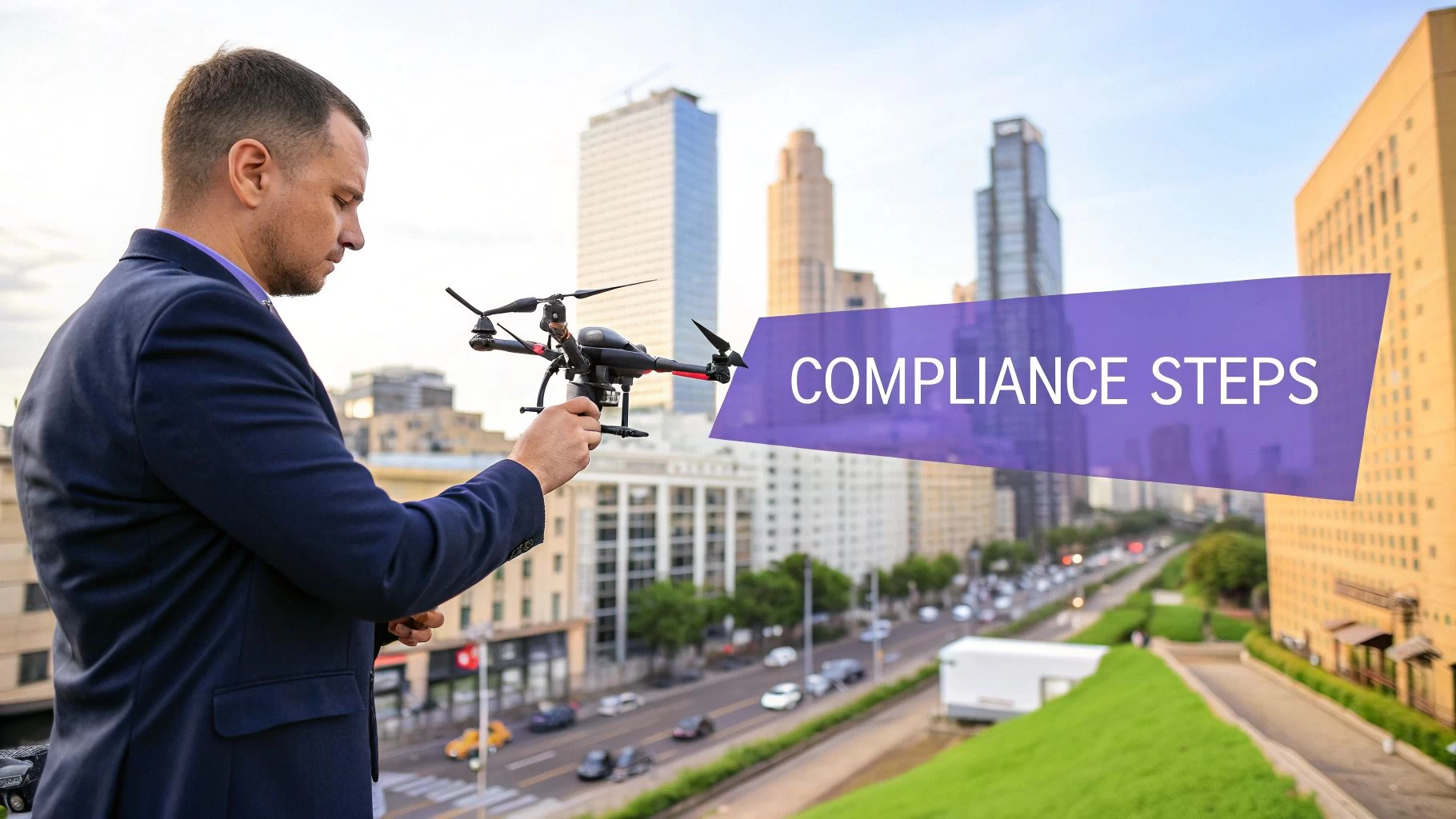 While the UK and EU are on the same page with a risk-based approach, the UK's version, handled by the Civil Aviation Authority (CAA), has its own unique character. Let's break down what this official framework actually means for you when you're out flying.
The entire system is built on one simple idea: the more risk, the more rules. Think of it like a driver's licence. A standard licence lets you drive a normal car on public roads without much fuss—that's the Open Category for drones. But if you want to drive a massive lorry, you need a special permit and have to follow a much stricter set of rules. That's the Specific Category.
For the vast majority of us, whether flying for fun or for work, the Open Category is our stomping ground. It's designed for low-risk flights, meaning you can fly without getting pre-flight permission from the CAA, as long as you play by the rules.
Decoding the Open Category
The Open Category is where the new regulations really come into their own, making life simpler. It’s split into three subcategories—A1, A2, and A3—which mainly determine how close you can fly to people, based on your drone's weight.
- A1 Subcategory: For the smallest drones, usually under 250g. This category gives you the most freedom, letting you fly over people who aren't involved in your flight (but never, ever over crowds).
- A2 Subcategory: For drones up to 4kg. This one lets you get closer to people than A3, but you'll need an extra qualification, the A2 Certificate of Competency (A2 CofC), to do so.
- A3 Subcategory: For heavier drones up to 25kg. These flights have to be kept well away from people and built-up areas.
This tiered system gives you clear, predictable boundaries. The lighter your drone, the fewer hoops you need to jump through. It's a smart response to the UK's booming drone market, which is on track to hit £1.2 billion by 2025. This explosive growth, along with a 125% jump in registered drones, demanded a more intelligent way to manage our skies.
Your Core Responsibilities in the Open Category
No matter which subcategory you're flying in, there are a few universal rules that always apply. These are the absolute non-negotiables for safe and legal flying in the UK.
To fly in the Open Category, you must always keep your drone within your direct Visual Line of Sight (VLOS). This means you have to be able to see it with your own eyes at all times, not just through a camera feed or binoculars.
This one rule is the bedrock of safe, low-risk flying. It ensures you’re always aware of your surroundings and can react instantly if something goes wrong.
On top of that, every pilot must stick to these fundamental safety rules:
- Altitude Limit: Never fly your drone higher than 400 feet (120 meters) from the ground.
- Operator ID: If your drone has a camera or weighs 250g or more, you have to register as an operator with the CAA and stick your Operator ID on your drone.
- Flyer ID: You must pass the CAA’s free online theory test to get your Flyer ID, proving you know the basics.
- Respect No-Fly Zones: Stay out of restricted airspace, like areas near airports or prisons.
These rules create a predictable and safe environment for everyone in the air. Getting these down is your first step to flying with confidence. For a deeper dive, check out our essential guide to 2025 drone license requirements, which breaks down exactly what qualifications you'll need.
The UK’s framework isn’t here to clip your wings; it’s designed to be an enabler. By understanding these clear, risk-based rules, you can operate with confidence, knowing you’re flying both safely and legally. It’s a structure that works just as well for the hobbyist out for a weekend flight as it does for the professional delivering high-value services.
Alright, let's hop across the channel and see what's happening in the skies above the European Union. Over there, a single unified framework from the European Union Aviation Safety Agency (EASA) governs the airspace, and frankly, their goal is refreshingly simple: create one set of rules that works everywhere. It's a move that has made flying a drone in Europe a whole lot more straightforward.
Think of it as having a "drone passport." Once you're certified in one EASA member state—let's say you get your qualification in Germany—that credential is good to go everywhere else. From the sunny coasts of Portugal to the dense forests of Poland, you're covered. This completely removes the headache of deciphering dozens of different national laws, creating a genuine single market for drone pilots.
Much like the UK's system, EASA's rules are all about risk, categorising flights into Open, Specific, and Certified. For most of us, the Open Category is where we'll be living, and EASA has come up with a brilliant tool to make life easier: the drone class identification label.
How Drone Class Labels Are Your Compliance Cheat Sheet
This is, hands down, the most helpful part of the EASA framework. Every new drone sold in the EU must now have a C-class identification label, ranging from C0 to C6. This label is much more than just a sticker; it's your built-in guide that instantly tells you what you can and can’t do with that drone.
It's a bit like the energy efficiency rating on a new fridge. A quick glance gives you the vital information you need. In the same way, a drone's C-class marking tells you exactly which subcategory of the Open Category it's cleared to fly in. It simplifies everything, from which drone you buy to how you plan your flights.
The EASA C-class label system is all about giving pilots immediate clarity. By looking at your drone's label—whether it's a C0, C1, or C2—you instantly understand the operational rules tied to it, like how close you're allowed to fly to people.
This system effectively removes the guesswork from compliance. No more digging through dense rulebooks, trying to match your drone's weight and specs to a specific flight plan. The C-class label does that heavy lifting for you.
Decoding the Most Common C-Class Labels
While there are several classes, most recreational and professional pilots will find themselves working with the first few. Getting your head around what each one means is the key to unlocking your operational freedom across the EU.
Here’s a quick rundown of what these labels mean in the real world:
- C0 (Under 250g): These are your ultralight, go-anywhere drones. They fall into the A1 subcategory, allowing flights over uninvolved people (though never over crowds). You don't need a pilot competency certificate, but you absolutely must read the user manual.
- C1 (Under 900g): Also for the A1 subcategory, these drones pack more punch while still letting you fly near people. For these, however, you will need to complete the A1/A3 online training.
- C2 (Under 4kg): These drones operate in the A2 subcategory. To fly them, you'll need to pass the A2 "Close to People" exam. This qualification allows you to fly closer to people than you could with heavier drones, but the drone itself must have more robust safety features.
What About Flying "Legacy" Drones in the EU?
So, what happens to the drones you already own that don't have a C-class label? These are what we call "legacy" drones. The good news is you can still fly them, but the rules are a bit more restrictive.
A legacy drone that weighs less than 250g can continue to fly in the A1 subcategory pretty much indefinitely. However, a heavier legacy drone (anything over 250g) gets bumped into the much more restrictive A3 subcategory. This means you have to keep it far away from people and well clear of any residential, commercial, or industrial areas.
This structure really incentivises pilots, especially those doing professional work, to move towards the newer, C-class rated drones because they offer so much more operational flexibility. It's a smart, forward-thinking approach that nudges the whole industry toward higher and more transparent safety standards. By harmonizing the rules and making compliance this intuitive, EASA has built a framework where pilots can spend less time on paperwork and more time flying.
What Really Changes for Pilots in 2025
Alright, let's cut through the noise. The new drone regulations coming in 2025 for the UK and EU aren't just about high-level principles you read in a manual once. These are concrete changes that will directly impact your day-to-day flying.
This is where the theory hits the tarmac, influencing everything from the drone you fly to the qualifications you need to carry. Let's break down the most significant shifts you're going to see.
One of the biggest changes you'll notice is the new requirement for Remote ID. The easiest way to think of it is like a digital number plate for your drone. It’s a system that broadcasts basic flight information—your drone's serial number, its current location, and your operator ID—in real-time. This isn’t about Big Brother watching you; it’s a massive step forward for air traffic safety.
With more drones taking to the skies every year, aviation authorities need a reliable way to tell the difference between compliant, professional pilots and those flying recklessly. Remote ID provides that clarity, making our airspace safer and holding rogue operators accountable. For professionals, it’s an added layer of legitimacy for your operations.
The Dawn of U-Space and BVLOS Flights
Another massive development is the introduction of U-space (you might also hear it called Unmanned Traffic Management or UTM). Picture dedicated superhighways in the sky, built just for drones. That's what U-space is—a network of automated services and digital air corridors designed to manage huge volumes of drone traffic safely.
The whole point is to prevent collisions, both with other drones and with traditional manned aircraft, especially in busy urban or commercial areas.
U-space is the key that finally unlocks complex, high-value drone operations. It's the framework that will make widespread Beyond Visual Line of Sight (BVLOS) flights a commercial reality, opening the door to everything from long-range infrastructure inspections to last-mile delivery services.
This is a fundamental leap from a world where we have to keep our drone in sight to one where technology manages safe separation for us. For operators, this means the very real possibility of longer, more ambitious, and more automated missions that were simply out of reach before. It's a genuine game-changer.
New Training and Certification Requirements
With new capabilities come new responsibilities. That's why the 2025 regulations are rolling out a much clearer, more structured approach to pilot training and certification across both the UK and the EU. Simply put, the qualifications you hold will directly dictate what, where, and how you can fly.
Here’s a quick rundown of the key certs you'll need to know about:
- UK A2 Certificate of Competency (A2 CofC): This is your ticket to operating in the A2 subcategory of the Open Category in the UK. It lets you fly drones up to 4kg much closer to people than would otherwise be allowed, making it pretty much essential for any commercial work in built-up areas.
- EU A1/A3 Proof of Online Training: Think of this as the foundation for most pilots flying in the EU. It’s a straightforward online course and test that covers the basic rules of the air and safety procedures. You'll need it to fly C1, C2, C3, and C4 class drones.
- EU A2 "Close to People" Certificate: This is the EU's equivalent of the UK's A2 CofC. You'll need this qualification to fly C2-rated drones in the A2 subcategory within the EU. It involves a more detailed theory exam and a declaration of practical self-training.
Getting qualified is probably simpler than you think. The whole process has been designed to be accessible, making sure every pilot has the core knowledge they need to fly safely.
Ready to get started? Here are the official portals:
- For UK pilots: Your journey begins at the CAA's drone registration and education service.
- For EU pilots: You'll need to register and train in one EASA member state. A great place to start is the national aviation authority of the country where you'll be flying the most.
These updates aren’t just about adding more rules for the sake of it. They're about building a safer, more mature, and more capable drone industry for all of us. By getting to grips with Remote ID, U-space, and the new certifications, you’ll be set to fly with confidence long into the future.
Compliance Beyond the Cockpit
Being a responsible pilot is about more than just knowing your flight rules and airspace. The moment your drone's camera starts recording, you step into a whole new world of legal responsibility: data privacy. The 2025 UK & EU drone regulations hammer this home—compliance isn't just about aviation safety, it's about data protection, too.
Let's say you're hired for a roof survey. While you're getting those perfect high-res shots, you might accidentally film a neighbour enjoying their garden, or catch a clear image of a car's number plate. That's not just aerial photography anymore. It's now classed as collecting personally identifiable information (PII), which puts you firmly under the gaze of data protection laws like GDPR.
Your Duties as a Data Collector
Once your drone captures images or video of people, even by accident, you become what the law calls a "data controller." This isn't just a fancy term; it comes with serious responsibilities. It means you are accountable for how that personal data is gathered, stored, used, and eventually, destroyed. Getting this wrong can lead to hefty fines and a trashed reputation, totally separate from any aviation penalties.
This is becoming a bigger deal every day as commercial drone use explodes. From last-mile deliveries to sustainability projects, drones are everywhere, and so are their cameras. UK operators in 2025 have to get to grips with both aviation rules and data protection laws. For some extra insight, there's some excellent practical advice and commentary on drone laws available that's well worth a read.
Creating a Privacy-First Workflow
Building a privacy-conscious workflow isn't some huge, complicated task, but it does mean you have to be proactive. You need to be thinking about privacy before you even launch. It’s a simple mindset shift that protects the public and, just as importantly, your business.
A professional drone operator's checklist for success must include a Data Protection Impact Assessment (DPIA). This is simply the process of thinking through the potential privacy risks of a flight and documenting how you plan to mitigate them. It’s your proof that you took privacy seriously.
Here's a straightforward checklist to help you build a privacy-first flight plan:
- Conduct a DPIA: Before you fly, think about what personal data you might capture and what the risks are. For instance, are you flying near homes, schools, or public parks?
- Provide Clear Notification: If you can, let people in the area know a drone will be operating. Simple signs or letting a site manager inform residents or employees works well.
- Fly Responsibly: Plan your flight path to avoid capturing irrelevant personal data. Don't fly directly over private gardens or point your camera into windows.
- Anonymize Your Data: Once you're back on the ground, review your footage. Use blurring or pixelation tools to obscure any faces or other identifying details that aren't critical to the job.
- Secure Data Storage: Keep your data stored securely and only for as long as you absolutely need it. When the project's done and the data is no longer required, delete it for good.
Adopting this approach shows you're not just a skilled pilot, but a trustworthy professional. While this covers data capture, don't forget the technical side of compliance, like drone identification. For a deeper dive, our essential guide to FAA Remote ID offers some great insights that echo where the UK and EU are heading. Getting these habits down pat ensures you’re covered on all fronts.
Answering Your 2025 Drone Regulation Questions
With new rules coming down the pike, it's completely normal to have questions. The 2025 shift in UK and EU drone regulations is a big one, but it doesn't have to be a headache. I'll walk you through the most common concerns I hear from both recreational and professional pilots, with direct, clear answers.
Think of each answer as a mini-guide, designed to reinforce the key takeaways and give you steps you can actually use. My goal is to make sure you feel confident and ready to fly legally and safely.
I Fly a Sub-250g Drone in the UK for Fun. What Changes for Me?
If you fly a lightweight drone like one of the DJI Mini series, the good news is the core principles of safe flying haven't changed. What has changed is the airspace you're flying in—it's now more formally managed, so your awareness is key.
You'll still need an Operator ID from the CAA displayed clearly on your drone, simply because it has a camera. And while a Flyer ID (the basic theory test) isn't technically required for drones under 250g, I strongly recommend getting one. It’s free, takes very little time, and is the best way to prove you understand the fundamental rules of the sky.
The main flight rules you already know are still in place:
- Always fly safely and responsibly.
- Respect people's privacy and don't fly over them.
- Stay below the 400ft (120m) altitude limit.
- Keep your drone within your direct line of sight at all times.
Essentially, your day-to-day flying won't feel much different. But being part of a more structured system means it's more important than ever to know the basics inside and out. To get a solid refresher, our guide on what every drone operator needs to know is a fantastic starting point.
How Do the EU's C-Class Labels Affect My Drone Purchases?
Think of the EASA C-class labels (C0-C6) as a new way of categorising drones that makes life much simpler. Each class is directly linked to a specific subcategory in the Open category, which dictates how close you can legally fly to people.
This has a massive impact on how you should think about buying new gear. A C1-rated drone (under 900g), for example, will give you far more freedom to operate near uninvolved people than a heavier C3 drone ever could. So, when looking at new drones for 2025 and beyond, it’s a smart move to choose one with a C-class label that matches the kind of work you do.
Investing in a C1 or C2 drone will unlock significant operational flexibility, especially if you plan to work in or near populated areas. Flying older, 'legacy' drones without a C-label will become much more restrictive, so aligning your fleet with this new system is the key to future-proofing your operations.
What Is Remote ID and Will It Make My Current Drone Obsolete?
Remote ID basically acts as a digital license plate for your drone. It's a system that broadcasts key information—like the drone's serial number, its real-time location, and your operator number—over a local signal like Wi-Fi or Bluetooth. For air safety, this is a game-changer, as it allows authorities to identify drones in the sky.
The good news is it probably won't make your current drone obsolete. Many manufacturers are rolling out simple firmware updates to enable Remote ID on existing models. Your first step should be to check with your drone's manufacturer to see if your model is covered.
If an update isn't available, there's another straightforward fix: an add-on broadcast module. This is a small, lightweight gadget you attach to your drone that transmits the required data, instantly making it compliant. So while compliance is mandatory, you've almost certainly got options that don't involve buying a whole new aircraft.
How Do I Operate Legally in Both the UK and EU?
This is a critical point for anyone planning to operate internationally. Since the UK is no longer part of EASA, you have to treat them as two completely separate regulatory worlds. Your UK qualification (like a GVC) is not valid for flying in the EU, and an EASA certificate is not valid for flying in the UK.
To operate legally in both, you'll need to achieve dual compliance. It’s not as daunting as it sounds.
- For EU Operations: You need to register as an operator with the national aviation authority in just one EASA member state (like Ireland, France, or Germany). Once you complete their online training and get your certificate, it's valid across the entire EU.
- For UK Operations: You must register as an operator with the UK's Civil Aviation Authority (CAA) and get the necessary UK-specific qualifications, such as the A2 CofC, depending on your planned flights.
The key is simply to plan ahead. It means holding two sets of paperwork and being diligent about following the specific rules of the airspace you're in. The challenge of keeping up with different digital rules isn't unique to drones; diving into expert insights on digital regulations and compliance offers valuable perspective on how different industries are tackling similar issues.
Managing dual certifications, different flight rules, and all the associated paperwork can be a major headache. That’s where Dronedesk steps in. Our platform is built to simplify complexity, helping you manage flight plans, risk assessments, and compliance documentation for both UK and EU operations, all in one place. Streamline your workflow and fly with confidence by visiting Dronedesk today.
 How to Prepare for the Drone Licence Test →
 How to Choose a Drone Mapping Service for Your Project →
 Drone Safety Rules That Every Commercial Team Needs →
 Airport Drone Rules: How to Plan Flights Without Surprises →
 FAA Part 107 Licence: Your Step-by-Step Application Guide →
 How to View DJI Flight Logs Online Safely →
 What Part 107 Covers Beyond the Pilot Certificate →
 How to Download and Read a DJI Flight Log →
 Drone Videography Planning Tips for Professional Crews →
 EU Drone Rules for Sub-250g Aircraft Explained →