
Pricing drone services: Master Costs, Models, and Profitable Rates
Setting the right price for your drone services is the make-or-break moment for your business. It's the difference between a thriving operation and a side hustle that barely pays for itself.
Pricing isn't just pulling a number out of thin air. It starts by figuring out your true operational costs, then adding a healthy profit margin that reflects your skill and what the market will bear. While rates can swing from $150 per hour for simple real estate photos to over $2,000 per day for specialized industrial inspections, your profitability always comes back to knowing your numbers.
Establishing Your Baseline for Profitable Drone Pricing
Before you even dream of sending a quote, you have to answer the most important question: what does it actually cost you to run your business? Simply guessing or matching what the other guy charges is a fast track to going broke. The only way to build a sustainable business is to base your prices on a rock-solid understanding of your actual expenses.
This goes way beyond the cost of your drone. So many operators fall into the trap of only thinking about their gear. The real profit-killers are the recurring, often hidden, costs that keep you flying legally and professionally. We're talking liability insurance, software subscriptions, marketing, and even the fuel to get to and from a job.
Uncovering Your True Operational Costs
To build a price list that actually makes you money, you have to get meticulous about tracking both your fixed and variable costs. Fixed costs are the bills you pay no matter what, like your annual insurance premium. Variable costs fluctuate with your workload, like fuel, battery replacements, or hiring a freelance editor for a big project.
Here's a quick rundown of the usual suspects you need to account for:
- Hardware Depreciation: Your drone, batteries, controller, and laptop all have a shelf life. You need to factor in their eventual replacement cost.
- Software Subscriptions: This is everything from flight management tools like Dronedesk to specialized photogrammetry or video editing software.
- Insurance: Commercial liability insurance isn't optional. It's a major annual expense for any serious operator.
- Marketing and Business Costs: Think website hosting, business cards, online ads, and accounting software. It all adds up.
- Training and Certification: Staying sharp and compliant is an ongoing investment in yourself and your business.
A deep dive into these expenses is non-negotiable before setting your rates. This isn't just about what you spend on a job; it's about the entire cost of being in business. Getting a handle on basic cost accounting principles will put you leagues ahead of the competition.
To give you a clearer picture, I've put together a sample breakdown of what a year's worth of expenses might look like for a solo operator.
Sample Annual Drone Business Cost Breakdown
This table outlines the typical fixed and variable costs you might encounter. Use it as a starting point to build your own detailed budget and figure out your baseline hourly rate.
| Cost Category | Example Item | Estimated Annual Cost | Notes |
|---|---|---|---|
| Hardware | Drone Depreciation (e.g., DJI Mavic 3 Pro over 3 years) | $700 | Assumes a $2,100 drone with a 3-year lifespan. |
| Computer/Laptop Depreciation (over 4 years) | $500 | A $2,000 machine is a reasonable estimate for processing data. | |
| Batteries & Accessories | $250 | Includes replacement batteries, filters, cases, etc. | |
| Software | Flight Management (e.g., Dronedesk) | $240 | Essential for compliance, planning, and admin. |
| Editing Software (e.g., Adobe Creative Cloud) | $600 | A must-have for photo and video work. | |
| Processing Software (e.g., Pix4D) | $3,500 | For specialized services like mapping and surveying. | |
| Insurance | Commercial Liability Insurance (1M coverage) | $800 | Non-negotiable. Rates can vary by location and coverage. |
| Business Overhead | Marketing (website, ads, networking) | $1,200 | You have to spend money to make money. |
| Training & Certification Renewal | $300 | Ongoing professional development. | |
| Office & Admin (phone, internet, accounting) | $900 | The "cost of doing business" expenses. | |
| Variable Costs | Travel/Fuel (based on average jobs) | $1,500 | Highly dependent on your service area and job frequency. |
| Outsourcing (editing, admin help) | $500 | For when you need an extra pair of hands. | |
| Total Annual Cost | $10,990 | This is your baseline operating cost for the year. |
Remember, these numbers are just examples. Your own costs will vary based on your gear, location, and the services you offer. The critical takeaway is the process: list every single expense, no matter how small.
Calculating Your Hourly Baseline
Once you’ve added up all your annual costs, you can figure out your minimum hourly rate. This is the absolute floor—the amount you have to charge just to break even. Think of it as your financial safety net.
To get this number, divide your total annual costs by the number of billable hours you realistically expect to work in a year. Be brutally honest with yourself. You won't be flying 40 hours a week. After you factor in admin, marketing, travel, and weather delays, a solo pilot might only log 10-15 billable hours a week.
Real-World Example Calculation Let's take our total annual cost from the table: $10,990. Now, let's say you realistically plan to work 800 billable hours a year (that’s about 15 hours a week).
Your break-even hourly rate would be: $10,990 / 800 hours = ~$13.75/hour.
This $13.75/hour is what it costs you just to exist as a business. Your actual rate that you charge clients needs to be significantly higher to cover your own salary and, you know, actually make a profit.
This exercise is absolutely vital. It grounds your pricing strategy in reality and gives you the confidence to quote prices that will keep you in business for the long haul. With the global drone service market projected to hit US$35.7 billion by 2026, there's a massive opportunity out there. Knowing your costs is the first step to claiming your piece of the pie.
For a deeper look at getting these expenses under control, check out our guide on how to reduce operational costs.
Selecting the Right Drone Pricing Model for the Job
Once you've got a solid handle on your operational costs, it's time to tackle the next big question: how are you actually going to charge for your work? Picking the right pricing model is just as crucial as knowing your numbers. Let's be honest, a one-size-fits-all approach is a recipe for disaster in this industry.
The model you choose has to make sense for the job, the client, and your own bottom line. The most successful drone pros I know are masters of adaptation. They understand that a quick residential real estate shoot is a completely different beast than a year-long construction monitoring contract. Knowing the pros and cons of each pricing structure is what allows you to quote confidently and stay competitive.
This decision tree gives you a good visual on how to start thinking through your pricing strategy. It all begins with a deep dive into your costs.
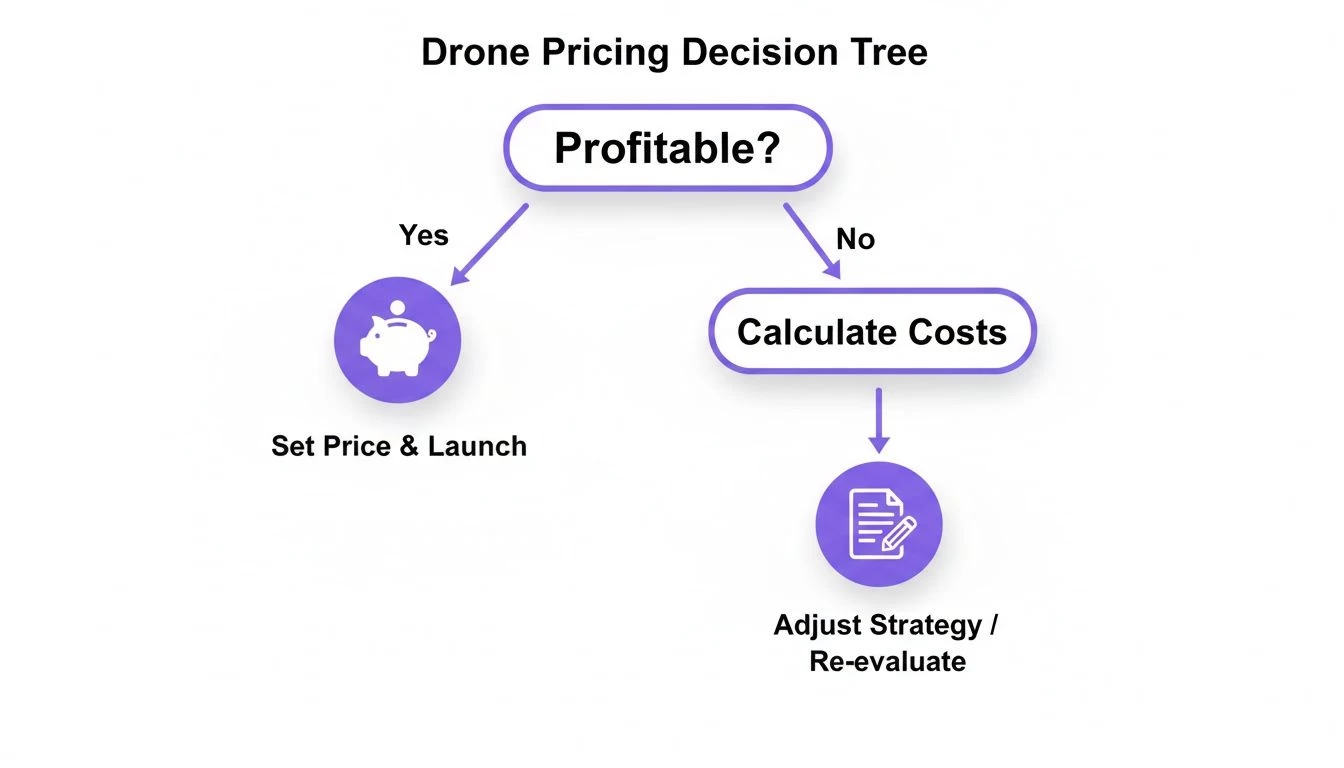
As you can see, everything flows from that initial cost calculation. Get that right, and you're well on your way to picking the right model and turning a healthy profit.
Charging by the Hour
The hourly rate is the old standby for a reason—it’s simple. You figure out a rate that covers your costs, your time, and a slice of profit, then you bill for the hours you're on the job, from setup to pack-up.
This model is a great fit for:
- Short, simple jobs: Think basic real estate photos or a quick roof inspection where the scope is crystal clear and unlikely to balloon.
- Projects with fuzzy scope: If a client isn't quite sure what they need or wants to direct the shoot on-site, charging by the hour protects you from scope creep and working for free.
But there's a catch. An hourly rate actually penalizes you for being good at your job. The faster and more efficient you become, the less you make for the same result. It can also make clients with a fixed budget a bit nervous.
Quoting Per Project
A fixed-fee, or per-project, price is exactly what it sounds like: one price for the entire job, no matter how many hours it takes. This is what most clients prefer because it gives them budget certainty right from the start.
This approach is perfect when you can confidently estimate the time and effort involved. For instance, you might offer a "Standard Real Estate Package" that includes 25 aerial photos and a 60-second video for a flat fee. To make this work, you have to be an expert at scoping everything—travel, flight planning, flight time, and all the post-processing work.
Pricing per project shifts the conversation from your time to the final product. Clients aren't just paying for the minutes your drone is airborne; they're paying for the stunning images, the detailed survey map, or the polished video. This is how you start moving toward value-based pricing.
The obvious risk here is underbidding. If a job hits a snag and takes way longer than you planned, that extra time eats directly into your profit.
The Value of Retainers and Subscriptions
For clients who need your services on a regular basis, a retainer or subscription model is a game-changer. The client pays a recurring fee, usually monthly, for a set amount of your time or a specific number of jobs. This is ideal for construction firms that need weekly progress updates or large farms that want monthly crop health reports.
A retainer gives you that predictable, recurring revenue that every small business dreams of. It smooths out your cash flow and frees you up from constantly chasing the next gig. For the client, it means they have a reliable, go-to drone expert on call. To get a better feel for the kinds of ongoing work you could offer, check out our guide on popular drone aerial services.
Value-Based and Per-Unit Pricing
This is where pricing becomes more of an art form. Here, your price is tied directly to the value you create for the client or a specific unit of measurement. It’s less about your hours and more about their ROI.
You might see this structured as:
- Per Acre: A go-to for agriculture and large-scale land surveying.
- Per Image/Video: Often used for real estate packages or event coverage.
- Per Megawatt: For specialized inspections of wind turbines or solar farms.
This model is really taking off with the growth of Drones as a Service (DaaS), a market projected to hit $8 billion by 2026. Companies are realizing it’s cheaper to subscribe to a drone service than to manage their own fleet. By tying pricing to concrete outputs like mapping data, operators using tools like Dronedesk can help clients slash their operational costs by 60-70% compared to running an in-house program.
Of course, it always helps to look outside our industry, too. Reviewing general pricing considerations can give you a broader perspective on how to structure your rates for maximum effect. Ultimately, choosing the right model comes down to practice and deeply understanding both your own business and your client's world.
How to Build Compelling Service Packages and Rate Sheets
Let's be honest, clients love simplicity. When they're shopping for a drone service, the last thing they want is a wall of technical jargon or a custom quote that feels like it was pulled out of thin air. This is where well-structured service packages become your secret weapon. They cut through the confusion, build instant trust, and make it incredibly easy for clients to say "yes."
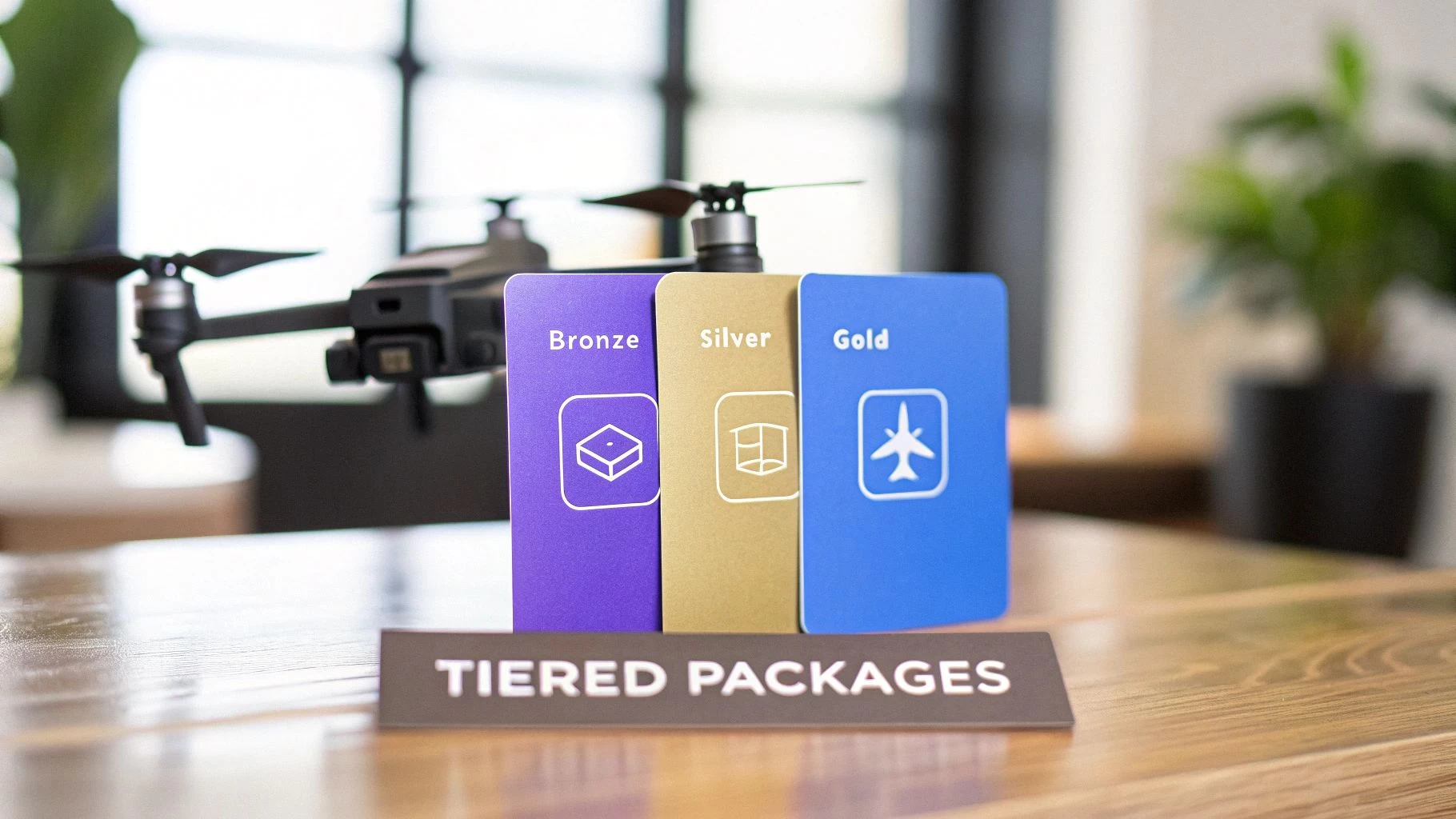
Instead of starting from scratch with every single inquiry, creating tiered packages streamlines your entire sales process. It's not about boxing clients in; it's about guiding them toward a decision, often encouraging them to choose a more complete—and profitable—option.
The Psychology of Tiered Packaging
The classic "Bronze, Silver, Gold" model works so well because it taps into a simple psychological principle known as choice architecture. By presenting three distinct options, you frame your services in a way that makes the value crystal clear.
- The Bronze Tier (The Anchor): Think of this as your entry-level option. It solves the client's core problem but leaves plenty of room for improvement. Its real job is to make your next tier look like a fantastic deal.
- The Silver Tier (The Sweet Spot): This is the package you want most clients to buy. Price it competitively and load it up with your most popular features. It should offer a big jump in value from the Bronze package for just a modest price increase.
- The Gold Tier (The Premium Option): This is your all-inclusive, high-ticket offering. While fewer clients might go for it, its presence makes the Silver tier seem even more reasonable. Plus, it's there to capture those high-value clients who simply want the best, period.
A well-priced middle option almost always becomes the bestseller. For most people, it feels like the safest, most logical choice—preventing them from feeling like they're either cheaping out or overspending.
Crafting Packages for Key Industries
Your packages need to speak directly to the needs of the industry you're targeting. Generic offerings just won't cut it. Your pricing for drone services has to reflect the specific deliverables and pain points each vertical has.
Real Estate Photography Packages
Real estate agents are all about speed and impact. They need high-quality visuals turned around quickly to get their listings on the market. A typical drone photography package often works great as an add-on to a standard ground photography shoot, usually costing an extra $100-$250.
- Basic Package: 10-15 high-resolution aerial photos. Simple and effective.
- Standard Package: Everything from the Basic tier, plus a slick 60-second, professionally edited fly-through video complete with agent branding.
- Premium Package: The works. Everything in the Standard package, plus a 3D virtual tour and dramatic twilight photos.
Construction Progress Monitoring Packages
For construction clients, it's all about consistency and data. They need regular updates to track progress, manage resources, and keep stakeholders in the loop. This makes them perfect candidates for monthly retainer agreements.
- Weekly Site Flyover: A basic package offering a set number of orthomosaic photos delivered like clockwork every week.
- Bi-Weekly Progress Report: A step up, adding volumetric stockpile measurements and a detailed PDF progress report.
- Full Project Documentation: A premium monthly retainer. This could include weekly flights, 3D models, and even integration with the client’s project management software.
The drone data services market is absolutely booming, and for good reason. Utility inspections, for example, can command $1,500-$4,000 per day—which is a massive 30-50% less than using a helicopter. This incredible growth highlights the demand for specialized data. And on the efficiency side, operators using platforms like Dronedesk have been shown to cut their administrative logging time by 70%. That time saved goes directly to billable hours, allowing for more competitive—yet still profitable—package pricing. You can read more about the drone data services market trends and see how you can apply these insights.
Creating a Professional Rate Sheet
Once you’ve designed your packages, you need to present them in a clean, professional rate sheet. This document isn't just a price list; it's a reflection of your brand. It should be easy to read, look sharp, and leave no room for confusion.
Below is a sample structure you can adapt for your own rate sheet. The goal is to provide total clarity and help clients easily compare their options.
Sample Drone Service Rate Sheet By Vertical
This table gives you a starting point for structuring your own rates. It makes your pricing transparent and helps potential clients quickly identify the best fit for their needs.
| Service Vertical | Package Tier | Deliverables | Example Price Range |
|---|---|---|---|
| Real Estate | Standard | - 20 Aerial Photos - 60-Sec Branded Video - 24-Hour Turnaround |
$350 - $500 |
| Construction | Monthly Progress | - 2 Site Visits/Month - Orthomosaic Map - Progress Report PDF |
$800 - $1,500/mo |
| Inspection | Basic Roof | - High-Res Ortho Image - 50 Detail Photos - Anomaly Report |
$400 - $650 |
| Agriculture | Crop Scouting | - NDVI/Health Map - Up to 100 Acres - Data Consultation |
$5 - $8 per Acre |
Ultimately, a great rate sheet is a powerful sales tool. It demonstrates your professionalism and shows clients that you have a structured, well-thought-out business. That builds confidence before the drone's propellers even start spinning.
Getting Savvy with Advanced Pricing and Client Talks
Once you've got your costs figured out and your service packages built, the next real step up in pricing is changing the conversation from what it costs you to what it's worth to your client. The basic pricing models get your foot in the door, sure. But the advanced strategies? That’s how you really start to grow your revenue and build a premium brand.
It's all about learning to price your expertise, not just your time in the air.
This means you have to get past just covering your bills with a little bit of profit on top. You need to really dig into the financial impact your work has for your clients and have the confidence to negotiate contracts that reflect that value. This is where the seasoned pros really pull away from the pack.
Start Thinking in Terms of Value-Based Pricing
Value-based pricing is a total game-changer. Seriously. Instead of tying your fee to your own expenses and hours, you anchor it to the financial value your client gets from what you do. It takes a bit more work to understand their business inside and out, but the payoff can be massive.
Think of it like this: a big construction company needs you to measure a massive gravel stockpile. Your flight might only take an hour, with another couple of hours for processing. If you're charging an hourly rate of, say, $200, you might walk away with $600-$800. Not bad.
But what if your super-accurate drone survey stops them from ordering $15,000 worth of gravel they don't actually need? Is your service still only worth a few hundred bucks? No way. With a value-based model, you could confidently charge $2,500 or more, because your fee is just a small slice of the money you just saved them. Suddenly, your service isn't an expense; it's an investment with a clear return.
To make this model work for you, you'll need to:
- Ask the Right Questions: When you first talk to a potential client, go deep. Ask them what their current methods cost, what risks they're dealing with, and what the financial fallout of bad data looks like for them.
- Spell Out the ROI: Frame your proposal around their return on investment. Use language like, "Our survey data will help you cut material ordering errors by up to 98%," or "Using our drone for this bridge inspection will save you about 40 man-hours and cut the need for expensive lift equipment."
- Focus on Niche Expertise: This approach is gold in specialized, high-stakes fields like industrial inspections, precision agriculture, or large-scale surveying. These are the jobs where the cost of not using a drone is huge.
How to Handle Price Objections Like a Pro
Eventually, you're going to hear it: "That's more than we were expecting to pay." Don't panic. And whatever you do, don't immediately offer a discount. A price objection is usually just a client's way of asking for more justification. It’s your cue to reinforce the value you bring, not to slash your rates.
When a potential client pushes back on your price, try this approach:
- Acknowledge and Ask: First, show them you hear their concern. Something like, "I understand that budget is always a big consideration. So we're on the same page, could you tell me a little more about what you had in mind?" This keeps it a conversation, not a standoff.
- Circle Back to Your Value: Gently remind them what's packed into that number. "Just to recap, our quote includes a fully licensed and insured operation, advanced LiDAR for top-tier accuracy, and a detailed report from a certified thermographer. We're focused on giving you data you can stake critical business decisions on."
- Offer Options, Not Just Discounts: If their budget is genuinely tight, don't just chop the price. Adjust the scope. You could say, "If the $2,000 premium package is a stretch, we could look at our standard package for $1,400. It delivers the orthomosaic map but doesn't include the 3D model. Would that be a better fit?" This protects the value of your work while still trying to win their business.
Remember, a client whose only concern is getting the lowest price is rarely going to be a good long-term partner. Standing by your rates confidently attracts the kind of clients who respect true professional expertise.
Shutting Down Scope Creep Before It Starts
Scope creep is the quiet killer of profits. It’s all those little "hey, while you're here, can you just..." requests that slowly turn a profitable job into a free-for-all. The absolute best way to handle it is to prevent it from ever happening with a rock-solid, crystal-clear proposal and contract.
Your statement of work needs to be ruthlessly specific. Don't just write "aerial video." Instead, get granular: "one 90-second, 4K edited video with branded graphics and one round of client revisions." When you clearly define the deliverables, revision limits, and project boundaries right from the start, you build a firm foundation to stand on.
Then, when a client inevitably asks for a little something extra, you can politely point back to the agreement and say, "That's a great idea! It falls outside the scope of our current agreement, but I'd be happy to put together a quick quote to add that for you." That one simple phrase completely changes the dynamic, turning what would have been a freebie into a paid upsell.
Using Dronedesk to Bring Sanity to Your Pricing and Operations
Smart pricing isn't just about picking the right numbers; it's fueled by good data. If you're trying to juggle job details, flight logs, client emails, and invoices with a messy combination of spreadsheets and notebooks, you're on a fast track to losing money and burning out.
This is exactly where a dedicated drone operations platform becomes the most valuable tool in your hangar.
Think of a platform like Dronedesk as the central nervous system for your business. It connects every single part of your workflow directly to your bottom line, making sure the prices you quote are not just competitive, but consistently profitable.
Connecting Job Management to Accurate Quotes
Every profitable quote starts with a crystal-clear understanding of the time and resources a job will actually take. Dronedesk is built to capture this data from the moment a client inquiry comes in, creating a single source of truth for every project.
This detailed tracking lets you see exactly how much time you're sinking into each phase—from the initial planning and risk assessments to on-site flight time and post-processing. When you can clearly see that a "simple" real estate shoot actually ate up an extra hour for airspace coordination, you can adjust your package pricing for the next one. It completely removes the guesswork from quoting.
By tracking every billable minute and operational task in one system, you build quotes based on what similar jobs actually cost you. This ensures your pricing for drone services reflects the true effort involved, protecting your profit margins on every single project.
Automating Invoicing for a Professional Experience
How you bill a client is just as important as how you fly the mission. A professional, timely invoice reinforces the value of your work and, more importantly, improves your cash flow. Let's be honest, manual invoicing is slow, easy to mess up, and can make your whole operation look amateurish.
Dronedesk automates this entire headache. Once you mark a job as complete, the system can generate and send a detailed, branded invoice with just a few clicks. This automation doesn't just save you hours of admin work; it ensures you get paid faster.
It's a professional touch that builds client trust and encourages repeat business, turning one-off jobs into long-term partners.
Using Fleet Management to Inform Your Costs
The true cost of your drone services has to include the wear and tear on your gear. Your drones, batteries, and sensors are all depreciating assets with real maintenance needs. Forgetting to factor these long-term costs into your pricing is a common—and very costly—mistake.
The fleet management tools inside Dronedesk help you track the lifecycle of every piece of equipment you own.
- Log Every Flight: Automatically track flight hours for each drone and component.
- Schedule Maintenance: Set reminders for routine checks and servicing based on actual usage.
- Monitor Asset Health: Keep a detailed history of repairs, battery cycles, and component swaps.
This information is gold. By knowing the precise operational history of your fleet, you can feed real depreciation and maintenance data back into your baseline cost calculations. This makes sure your hourly and project rates are high enough to cover the eventual replacement of your most critical assets. It's what keeps your business financially healthy and ready to grow.
For drone businesses looking to expand, getting a handle on these operational details is non-negotiable. You can learn more about how Dronedesk supports scaling your drone business in our detailed guide.
Common Questions About Pricing Drone Services
Even with the best calculations and slick service packages, questions are going to pop up. Let's be honest, pricing drone services isn't just about crunching numbers; it's about managing client expectations and dealing with the unique quirks of every single project.
Here are some of the most common questions I see operators wrestling with, along with some straightforward, real-world advice.
How Much Should I Charge for My First Drone Job?
For your very first paid gig, you have two main goals: cover your costs and get some killer experience under your belt.
A good starting point is to figure out your bare-minimum hourly rate. Just add up all your annual business costs—things like insurance, software subscriptions, and drone depreciation—and divide that by the number of hours you realistically expect to be billing clients in a year. Once you have that number, tack on a modest profit margin. Something like 15-20% is a safe bet.
Look, it's far better to price a bit lower on your first job and absolutely nail it to get a glowing testimonial than to overprice yourself and lose the opportunity. Be upfront with the client; let them know you're giving them a special introductory rate. But whatever you do, never work for free. It instantly devalues your skills and drags down the industry for everyone.
Should I Display My Drone Service Prices on My Website?
This is a classic "it depends" situation, and it really hinges on your business model and the kind of clients you're after.
If you offer standardized services like real estate photography, putting your package prices right on your website can be a massive time-saver. It automatically qualifies your leads and weeds out the tire-kickers whose budgets were never going to match your rates anyway.
On the other hand, for complex, custom jobs like large-scale surveying or industrial inspections, it’s much smarter to list a "Starting From" price or simply have a call to action like "Contact for a Custom Quote." This gives you the breathing room to properly assess the full scope of the project—we're talking risks, airspace complexity, specific deliverables—before you commit to a number. It stops you from getting locked into a price that doesn't even begin to cover the actual work involved.
How Do I Handle Clients Who Say My Prices Are Too High?
First off, take a breath and resist the knee-jerk reaction to offer a discount. A price objection is rarely a demand to slash your rates; it’s usually an invitation to prove your value.
Use it as a chance to dig a little deeper. Ask some clarifying questions to understand their budget and what they might be comparing your quote against. Then, you can politely walk them through what your price actually includes: your expertise, professional-grade gear, full insurance coverage, data processing, and a guarantee of quality.
You could try saying something like: "I understand that budget is a key consideration. Our rates reflect a fully insured, licensed, and professional operation that guarantees high-quality results. Could you tell me a bit more about what you're looking for? Perhaps a different package might be a better fit."
That simple script completely reframes the conversation. Suddenly, it’s not about price anymore—it’s about value and finding the right solution.
What Is the Best Way to Price Video Editing and Post-Production?
Post-production is a completely separate skill that takes a ton of time, so it should always be priced separately from your on-site flight time. Don't fall into the trap of lumping it all together.
There are two solid ways to tackle this:
-
Charge a Separate Hourly Rate: You can simply bill for editing at a specific hourly rate, say anywhere from $50-$150/hour, and give the client an estimated number of hours in the initial quote. Be sure to track your time meticulously.
-
Offer Fixed-Price Editing Packages: This is often the route clients prefer because it gives them cost certainty. For example, a 'Basic Edit' package might include simple cuts, color correction, and a 1-minute final video for a set fee. A 'Premium Edit' could go further with motion graphics, custom audio, and multiple revisions for a higher fixed price.
This package-based approach takes the guesswork out of it for the client and lets you price your creative work based on its actual value, not just the hours you clock.
Ready to stop guessing and start building profitable quotes that make sense? Dronedesk gives you the tools to track every job, manage your costs, and automate invoicing, connecting your field operations directly to your bottom line. Take control of your drone business management today by visiting https://dronedesk.io.
 FAA Small UAS Rule: Key Requirements for Operators →
 How to Build a Drone Pilot Flight Log That Is Audit Ready →
 FAA Drone Licence Requirements for Commercial Pilots →
 FAA BVLOS Waivers Granted: What Successful Cases Show →
 How to Export DJI Flight Logs for Incident Reviews →
 Drone Safety and Legal Duties for Business Operations →
 EASA Drone Regulations: Open, Specific and Certified Categories →
 What the BVLOS ARC Report Means for UAS Operators →
 Free Drone Pre-Flight Checklist for Commercial Missions →
 Contingency Volume and Flight Risk Buffer Explained →