
Your Guide to the FAA Part 107 Waiver
So, what exactly is a Part 107 waiver? Think of it as an official thumbs-up from the Federal Aviation Administration (FAA) that lets a certified drone pilot operate outside the standard Part 107 rulebook. It's a special permit for more advanced flights, but it’s only granted when you can prove your mission will be just as safe as one flown by the book.
What Is a Part 107 Waiver and Why You Need One
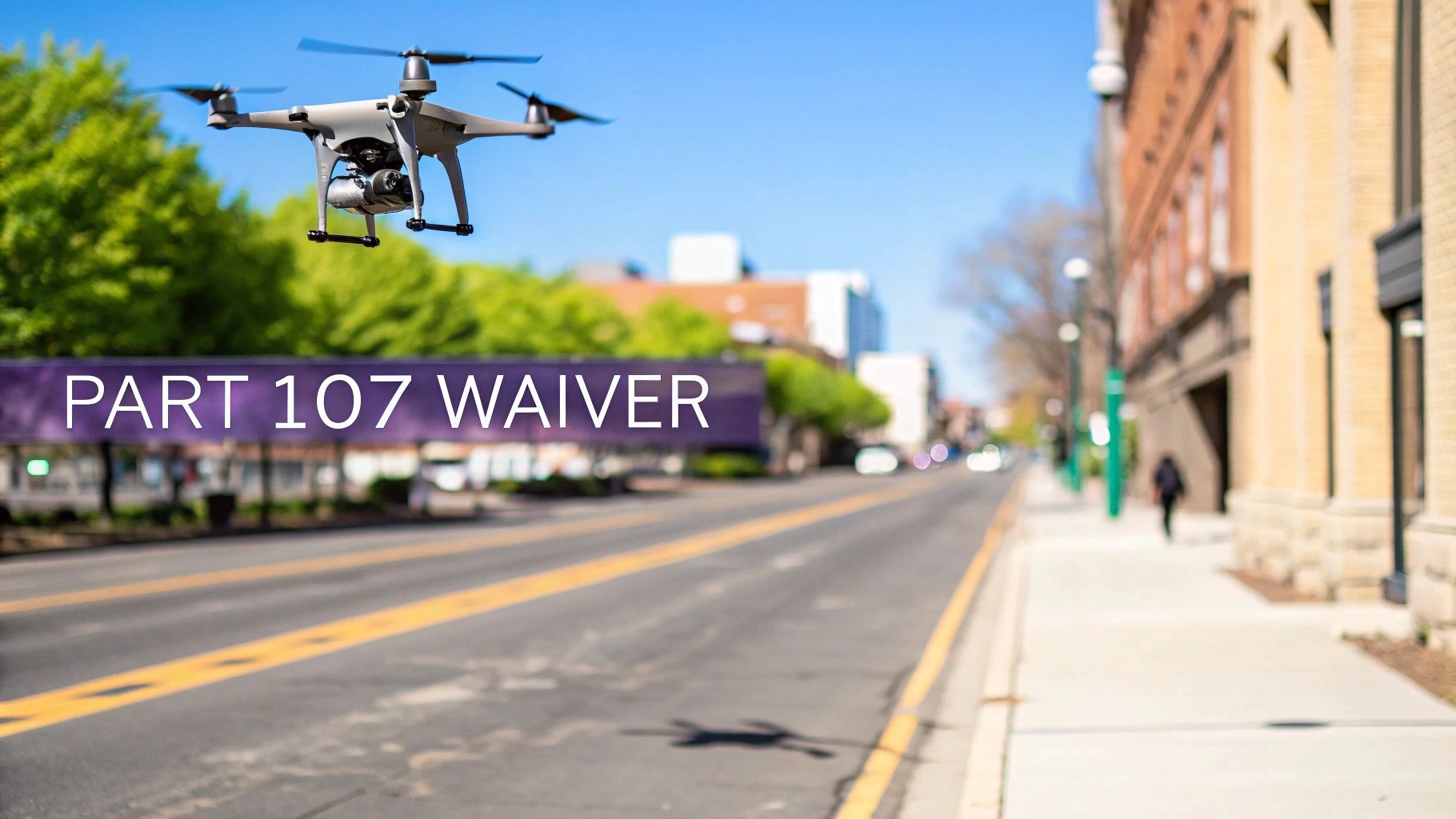
The standard drone rules are like the everyday traffic laws on a city street—they keep things orderly and safe for everyone. A Part 107 waiver is kind of like getting a special permit to close that street for a parade. You aren't breaking the law; you’ve just shown the authorities you have a solid safety plan to handle the unique risks.
This is the key to understanding waivers. They aren't loopholes for reckless flying. Instead, they represent a structured process for responsible innovation. When you get a waiver, you're essentially telling the FAA, "I need to operate beyond the usual limits, and here’s my detailed plan to maintain an equivalent level of safety."
The Evolution from Section 333 to Part 107
Before 2016, life for commercial drone pilots was a lot more complicated. Operators had to wrestle with a clunky process called Section 333 exemptions, which often demanded piles of legal and safety documents. When the FAA introduced the Part 107 rule in August 2016, it created a much clearer path for most commercial drone flights.
In that first year alone, the FAA issued 76 waivers, and a whopping 72 of them were for night operations. That showed a huge, immediate demand for flying outside standard daylight hours.
This shift opened up a new era. Instead of a blanket restriction, the waiver system gave pilots a clear way to request permission for specific, advanced missions. It was an acknowledgment that with the right tech and safety protocols, drones could do so much more.
A waiver is your ticket to unlocking the full commercial potential of your drone. It makes missions possible that are otherwise off-limits under standard rules, from cinematic night shots to large-scale infrastructure inspections.
Unlocking New Business Opportunities
For commercial drone operators, waivers are much more than just paperwork—they’re business enablers. Without them, a lot of high-value services would be completely out of reach. For commercial drone operations that require stunning visuals, like those in aerial photography for real estate, knowing your way around the waiver process is a must.
Just think about these common jobs that require a waiver:
- Night Operations: Capturing dramatic twilight cityscapes for a film or conducting thermal roof inspections after the sun goes down.
- Flying Over People: Providing aerial coverage of concerts, weddings, or public events where keeping a safe distance just isn't an option.
- Beyond Visual Line of Sight (BVLOS): Inspecting miles of pipeline or surveying massive agricultural fields in a single, efficient flight.
Each of these represents a major business opportunity that's only accessible through the Part 107 waiver process. As you move forward, you can dig deeper into the FAA Part 107 drone certification that serves as the foundation for any waiver application.
Exploring the Most Common Types of Waivers
While you can technically ask the FAA for a waiver on a whole slew of Part 107 rules, a few requests pop up way more often than others. These are the big ones—the waivers that unlock specific, high-value jobs that are otherwise completely off-limits. They run the gamut from relatively straightforward to seriously complex, and each comes with its own laundry list of safety hoops to jump through.
Getting a handle on these key waivers is the first step in connecting the dots between the FAA's rulebook and your actual business goals. Let's walk through the most common requests, starting with the easiest wins and working our way up to the holy grail of drone operations.
Flying After Dark with a Night Operations Waiver
One of the most popular waivers, by far, is for § 107.29 – Operation at night. The standard Part 107 rules pretty much ground you once the sun goes down. You can fly into twilight, but only if your drone has anti-collision lights. A night operations waiver throws that rule out the window, opening up a whole new world of evening and overnight missions.
This is a must-have for jobs like:
- Real Estate Photography: Getting those jaw-dropping twilight shots of a property.
- Security and Surveillance: Keeping an eye on large facilities or sites after hours.
- Thermal Inspections: Checking out rooftops or solar farms when temperature differences are most obvious.
To get this waiver, your safety case needs to prove you can maintain total situational awareness without daylight. This usually means slapping anti-collision lights on your drone that are visible for at least three statute miles and having rock-solid procedures for spotting and avoiding obstacles when it's pitch black.
Operating Over People and Moving Vehicles
Next up are two waivers that go hand-in-hand when you're working in populated areas: § 107.39 (Operation over human beings) and § 107.145 (Operations over moving vehicles). Standard rules say you have to keep your drone clear of people and cars that aren't part of your crew, which can be a massive headache for a lot of gigs.
These waivers are absolutely critical for news gathering, covering live events, or supporting public safety. The FAA's green light depends entirely on your ability to prove the risk to the public is acceptably low. This often means using a specific category of drone that the FAA has deemed safer—think drones with no exposed spinning props or a low kinetic energy impact. Your application has to spell out your risk mitigation plan in painstaking detail.
The bottom line for these waivers is simple: you have to convince the FAA your operation won't put the public in harm's way. Your safety case can't just be about how good of a pilot you are; it needs to lean heavily on your drone's built-in safety features and your detailed emergency plans.
To give you a clearer picture, here's a quick rundown of the most common waiver types and what the FAA is looking for.
Common Part 107 Waiver Types and Key Requirements
| Waiver Type | FAA Regulation | Primary Safety Consideration | Common Use Case |
|---|---|---|---|
| Night Operations | § 107.29 | Maintaining pilot situational awareness and aircraft visibility in the dark. | Twilight real estate photos, nighttime security patrols. |
| Over People | § 107.39 | Preventing injury to uninvolved people on the ground in case of failure. | News gathering, festival and event coverage. |
| Over Moving Vehicles | § 107.145 | Avoiding distraction to drivers and preventing accidents if the drone fails. | Filming traffic, inspecting infrastructure over roads. |
| BVLOS | § 107.31 | Deconflicting with other aircraft and managing emergencies without direct sight. | Long-range pipeline inspections, large-scale agriculture. |
As you can see, each waiver tackles a unique operational barrier, but they all share a common thread: a heavy focus on proving you can manage the increased risk.
The Ultimate Goal: Beyond Visual Line of Sight
The most challenging, and most valuable, Part 107 waiver is for § 107.31 – Visual line of sight aircraft operation. We all know it as Beyond Visual Line of Sight (BVLOS). This is the waiver that lets you fly your drone farther than you can physically see it. It's the key that unlocks massive, efficient operations that are just plain impossible under the standard rules.
BVLOS is a complete game-changer for industries managing huge stretches of infrastructure. Think about inspecting 50 miles of pipeline in one go, or surveying hundreds of acres of farmland without having to constantly pick up and move your ground station. These are the kinds of powerful missions BVLOS makes possible.
But, as you can imagine, the safety bar for a BVLOS waiver is set incredibly high. You need to present an absolutely bulletproof safety case showing how you'll avoid other aircraft and handle any emergency without being able to see the drone yourself. This almost always requires some serious tech.
- Detect-and-Avoid (DAA) Systems: Onboard tech like radar or cameras that can spot other aircraft.
- Reliable Command and Control Links: Redundant comms systems (like satellite or cellular) so you never lose the connection.
- Remote Operations Centers: Advanced ground stations where pilots monitor flight data and sensor feeds like they're in a mission control room.
Because it's so complex and has so much potential, BVLOS is where a ton of energy is being focused by both operators and regulators. To really get a sense of its impact, you can learn more about how BVLOS drone operations are shaping the future and what it takes to get there. Nailing this waiver is a sign that your operation has reached the big leagues, opening the door to the most advanced commercial drone work out there.
So, How Do You Actually Get a Waiver? A Look at the DroneZone Application Process
The FAA’s DroneZone portal is your one-stop shop for submitting a Part 107 waiver application. It might look a bit daunting at first, but if you break it down into manageable steps, it’s a pretty straightforward process. This is where you'll make your official case to the FAA, so it pays to get it right.
First things first, you'll need to set up an account. This part is easy, but make absolutely sure you register as a “Part 107” user. If you accidentally sign up as a recreational flyer, you won't see the right dashboards for submitting a waiver. Once you're in, you’ll kick off a new waiver application, and the system will walk you through a series of forms.
This screenshot shows the main login and registration page for the FAA DroneZone portal, the starting point for every waiver application. Having your FAA Tracking Number (FTN) handy will make registration a breeze and keep all your certifications tied to a single profile.
Defining Your Concept of Operations
Let's talk about the most important part of your application: the "Concept of Operations," or ConOps. This isn't just a quick note about what you want to do. It’s the full story—the who, what, where, when, and how of your proposed flight. You need to paint a crystal-clear picture for the FAA reviewer.
A vague or sloppy ConOps is one of the fastest routes to a denial. Saying something like, "I will fly safely at night," just won't cut it. That's a huge red flag for an FAA reviewer. You have to get specific. Really specific.
For instance, a solid ConOps for a night waiver should look something like this:
- Responsible Person: Jane Doe, Remote Pilot in Command, Certificate #1234567.
- Aircraft: DJI Mavic 3 Enterprise equipped with 3-statute-mile anti-collision strobes.
- Location: Operations are confined to the construction site at 123 Main Street, Anytown, USA.
- Timeframe: Flights will be conducted between 9 PM and 1 AM for thermal inspection purposes.
- Procedures: A dedicated Visual Observer will continuously scan the airspace, and all flights will follow a pre-planned grid pattern.
See the difference? That level of detail proves you've thought through the entire operation and understand the rules you're working within.
Building an Evidence-Backed Safety Case
Your ConOps tells the story, but your safety case provides the proof. This is where you meticulously connect every potential risk with a solid plan to mitigate it. The FAA needs to see that you’ve considered what could go wrong and have a concrete strategy to prevent it or deal with it if it happens.
An effective safety case is built on evidence, not just promises. It demonstrates that your proposed operation meets an equivalent level of safety to the rule you are asking to waive.
To really nail this, you should attach supporting documents directly within the DroneZone portal. Think of these as the exhibits that back up the claims you're making in your safety case.
Here are some of the most valuable documents to include:
- Flight Logs: These show your experience and prove you’re proficient with the specific drone you plan to use.
- Training Records: Document any specialized training you or your team have completed, especially for things like night flying or thermography.
- Equipment Specifications: Don't just mention your strobes or parachute; include the manufacturer's spec sheets.
- Custom Checklists: Provide copies of the pre-flight, in-flight, and emergency checklists you've tailored specifically for this type of waived operation.
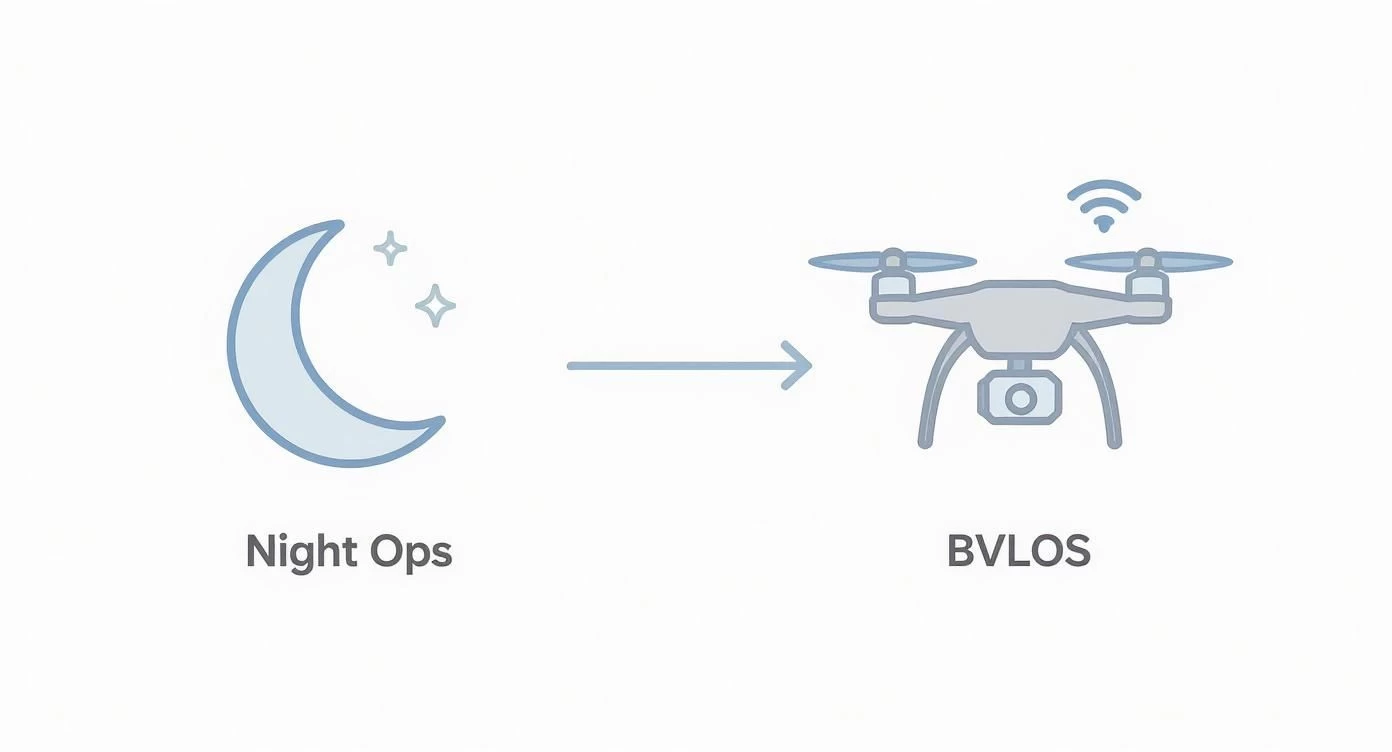
The image below gives you a sense of how waivers can build on each other, starting with more common requests and moving toward the complex stuff.
As you can see, a night operations waiver is often a foundational step. Mastering that process prepares you for more advanced permissions like BVLOS, which demand a far more comprehensive safety case. By structuring your application with a sharp ConOps and backing it up with hard evidence, you’re presenting a professional argument that massively increases your odds of getting that approval.
Crafting a Winning Safety Case for Your Waiver
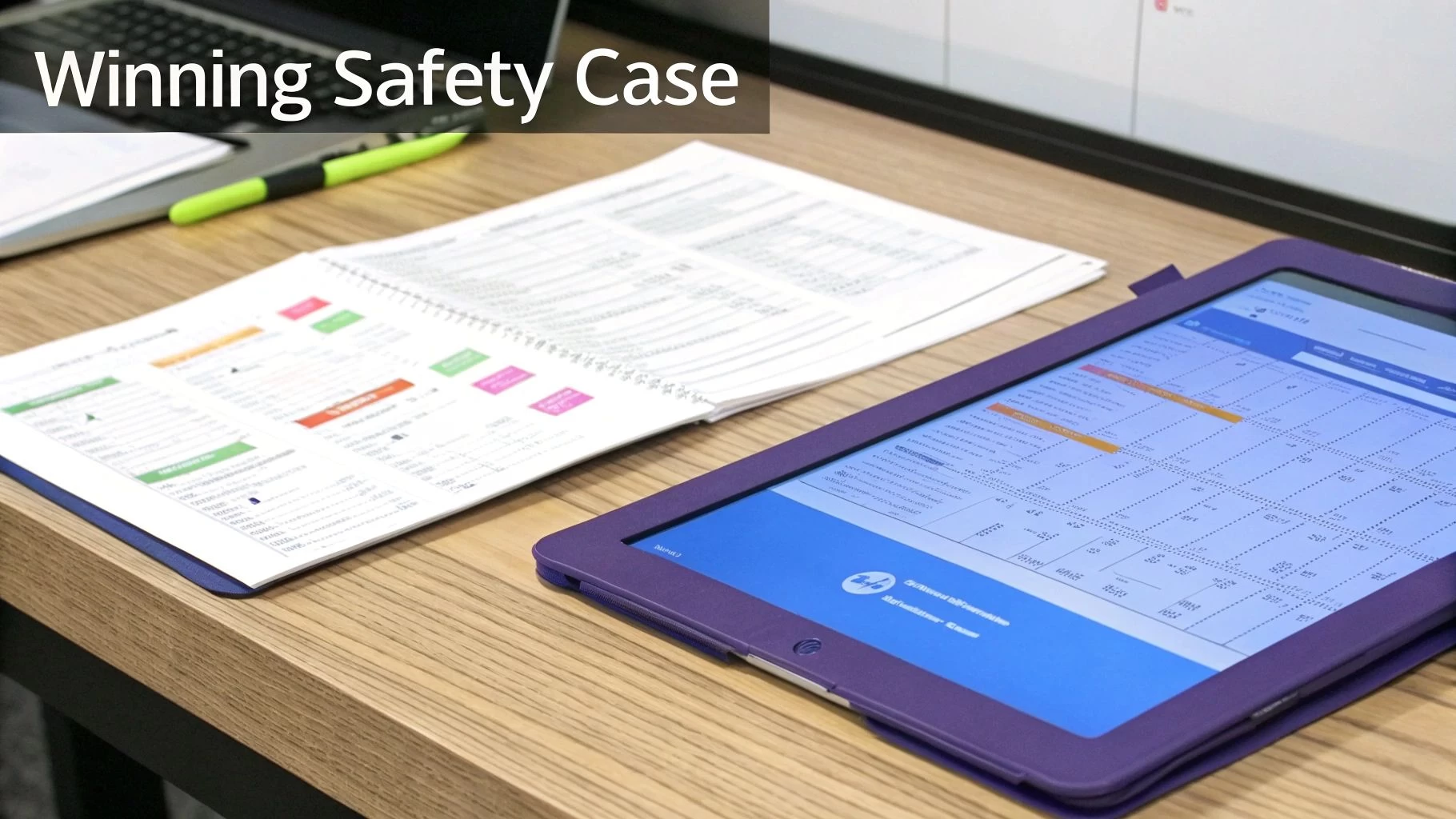 If your Concept of Operations is the "what" and "where" of your application, the safety case is the "why." As in, "why should the FAA trust you to pull this off safely?" This is the absolute heart of your Part 107 waiver request. It's your opportunity to prove you can handle the risks of your proposed flight with a concrete, evidence-backed plan.
Let's be blunt: a weak safety case is the fast track to a denial. Just promising you’ll “be careful” is an instant red flag for an FAA reviewer. They need to see that you've thought through every potential issue like a risk manager, not just a pilot.
The Three Pillars of a Bulletproof Safety Case
Building a solid argument comes down to a simple, three-step process: identify, assess, and mitigate. This framework is the gold standard in aviation because it forces you to dissect your operation, anticipate problems, and create real solutions before they ever have a chance to happen.
It’s not just busywork; it's the core logic that keeps the skies safe. The process looks like this:
- Hazard Identification: Pinpoint every single thing that could possibly go wrong.
- Risk Assessment: Figure out how likely each hazard is to occur and how bad the outcome would be.
- Risk Mitigation: Develop specific, actionable steps to either eliminate the risk or reduce it to an acceptable level.
This methodical approach tells the FAA that you're a professional who takes safety seriously.
A Practical Example: The Night Operations Waiver
Let's walk through this with a common request: a waiver for night operations under § 107.29. Imagine you need to shoot some twilight photos of a house in a quiet suburban neighborhood.
Step 1: Hazard Identification First, you brainstorm everything that becomes more dangerous in the dark.
- Losing Your Bearings: It's easy to lose sight of the drone's orientation against a black sky.
- Mid-Air Collision: Manned aircraft, especially something like a medical helicopter, won't see your small drone at night.
- Hidden Obstacles: Power lines, tree branches, and antennas are practically invisible after sunset.
- Emergency Landing: Trying to find a safe spot to land during a malfunction is a nightmare in the dark.
Step 2: Risk Assessment Next, you weigh the risks. A mid-air collision is extremely unlikely, but the severity is catastrophic. On the other hand, losing sight of the drone is a much more probable risk, with a moderate severity since it could lead to a flyaway.
Step 3: Risk Mitigation Now for the most important part: you detail the exact procedures and gear you'll use to counter each risk. This is where your safety case shines.
- For Loss of Bearings: "The DJI Mavic 3 Pro will be equipped with a Firehouse Arc V strobe, visible for 3 statute miles, ensuring the pilot and Visual Observer can maintain visual contact and determine the drone's position and attitude at all times."
- For Collision Risk: "A dedicated Visual Observer (VO) will continuously scan the airspace for any manned aircraft. The pilot and VO will use a pre-established communication protocol to immediately land the drone if an aircraft is detected."
- For Obstacle Avoidance: "A detailed site survey will be performed during daylight hours to map all potential obstacles. The flight path will be pre-programmed to maintain a minimum 50-foot buffer, both laterally and vertically, from all identified hazards."
A strong safety case replaces vague promises with specific actions, equipment, and procedures. It turns "I'll be careful" into a detailed, verifiable plan that an FAA reviewer can sign off on with confidence.
Data-Driven Arguments Win Approvals
The most compelling safety cases are backed by cold, hard data. The FAA wants proof, not just good intentions. This is your chance to use flight logs, checklists, and maintenance records to add serious weight to your application. If you ran practice flights in a controlled area to test your night procedures, include those logs as evidence.
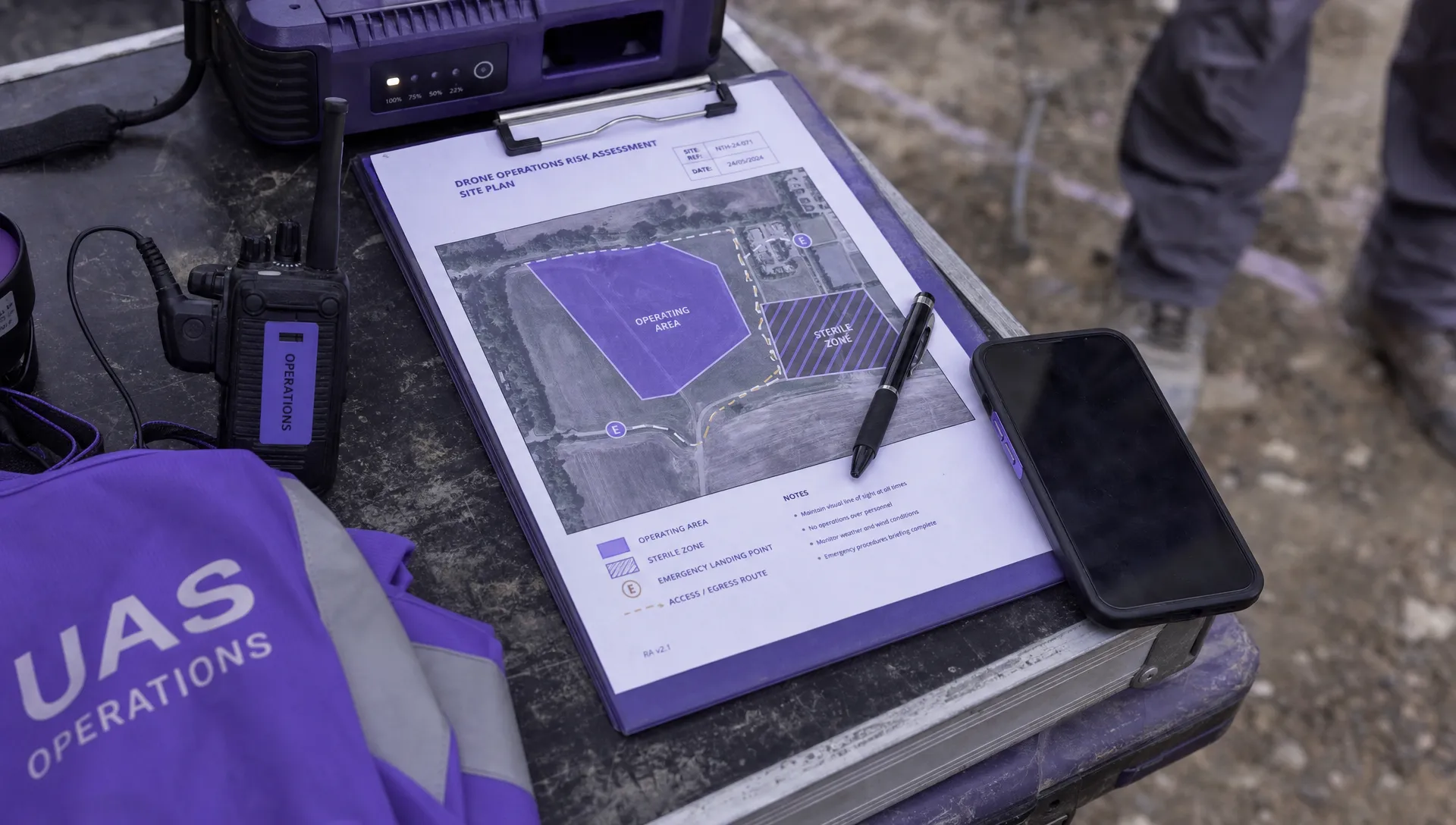
Building these safety protocols starts with a solid foundation. You can find excellent guidance in our article on drone operations risk assessment checklists, which includes templates you can adapt for your own waiver application. This documentation shows the FAA you're not just creating a plan to get a waiver—you're building safety into the DNA of your entire operation. When you present a case built on systematic risk management and supported by proof, you give them every reason to say yes.
Common Mistakes That Get Waiver Applications Denied
Want to get your Part 107 waiver approved on the first try? The fastest way is to learn from the mistakes others have made. The FAA doesn't deny applications on a whim; they have predictable reasons, and almost all of them boil down to one thing: a weak, incomplete, or unconvincing safety argument.
A lot of pilots make the critical error of thinking a simple promise to "fly safely" will cut it. That's probably the biggest red flag you can wave at an FAA reviewer. Your job is to replace those vague assurances with rock-solid, documented procedures. Saying you'll “be careful” when flying at night is a one-way ticket to rejection. Detailing your use of 3-statute-mile strobes and a specific pre-flight checklist for night conditions? Now that's what gets you an approval.
Vague Concepts and Weak Risk Mitigation
By far, the most common reason for denial is a fuzzy Concept of Operations (ConOps) combined with a flimsy risk mitigation plan. The FAA needs to see that you’ve thought through every possible hazard like a chess master and have a specific, actionable countermove for each one.
Where do pilots usually fall short?
- Generic Safety Plans: Submitting a cookie-cutter plan that isn’t tailored to the exact location, aircraft, and type of operation you’re proposing.
- Inadequate Hazard Analysis: Missing obvious risks. Think forgetting to account for local helicopter routes or failing to consider unseen power lines on a night flight.
- Unproven Mitigation: Making a claim without backing it up. For instance, saying a parachute makes the flight safe is useless without including the manufacturer's specs and testing data to prove it.
The FAA isn’t looking for a list of rules you promise to follow. They’re looking for a comprehensive safety management system. They need proof that you understand the why behind the regulations and can maintain an equivalent level of safety, even when you're asking to bend a rule.
Ignoring FAA Requests for Information
Here’s another surefire way to get your application tossed: ignoring a Request for Information (RFI) from the FAA. Getting an RFI isn't a bad sign; it just means a reviewer has questions or needs you to flesh out your safety case. Think of it as an opportunity to make your application even stronger.
Ghosting the FAA or giving a half-baked answer is a guaranteed denial. Be prompt, be thorough, and answer the specific questions they asked. It shows them you're a professional and responsive operator who takes this seriously. This is especially true for complex waivers like BVLOS, which have exploded in popularity. Back in 2020, only 6 BVLOS waivers were issued. By October 2024, that number had skyrocketed to 190. It just goes to show how critical a well-prepared, detailed application has become.
If you want to dive deeper into that trend, you can read the full report on FAA BVLOS operations.
Got Questions About Part 107 Waivers? We've Got Answers.
Even after you've mapped out the process, waivers can still feel a bit tricky. Let's tackle some of the most common questions pilots have, clearing up the confusion so you can get your application sorted with confidence.
How Long Does It Take to Get a Part 107 Waiver Approved?
Officially, the FAA says to expect up to a 90-day wait. But in reality, it’s a bit of a "how long is a piece of string?" situation. A really solid application for a common Part 107 waiver, like for night operations, might sail through much quicker.
On the flip side, if you're aiming for something more complex like BVLOS, you're in for a longer haul. Those applications get a much deeper look from a safety perspective. The single best way to speed things up? Nail your application on the first try—make it complete, detailed, and utterly convincing.
Can I Apply for Multiple Waivers at the Same Time?
Yes, you can fire off several applications at once through the DroneZone portal. But here’s the critical part: each application must target a single regulation.
Let's say your mission needs you to fly at night and over people. That’s two separate applications. You'll need a unique Concept of Operations for each, complete with a safety case built specifically for the risks of that one operation. The FAA won't let you bundle different requests into one submission.
It helps to think of it this way: each waiver addresses a unique safety problem. The FAA needs to see a dedicated, focused solution for each rule you're asking to bend, which is why they insist on separate applications.
Do I Need a Specific Drone Before Applying for a Waiver?
You don’t have to own the drone yet, but you absolutely must specify the exact make and model you plan to use. The drone's capabilities are the heart and soul of your safety case, and the FAA needs to know what they're evaluating.
For instance, if you want a waiver to fly over people, your application has to prove your drone meets certain criteria, like having no exposed spinning parts that could injure someone. The equipment you choose is central to proving you can operate just as safely as you would under the standard rules.
What Should I Do After My Waiver Is Approved?
First off, congratulations! Once the FAA gives you the green light, they'll issue a Certificate of Waiver (CoW). This is your official permission slip, and it will lay out the specific conditions and limits you must follow.
Read this document from top to bottom—seriously. You have to follow every single provision, no exceptions. Just like your Remote Pilot Certificate, you need to have your CoW on you (physically or digitally) during any flight you conduct under its authority. Most waivers are good for two to four years, after which you'll need to go through the process again.
Streamline your compliance and manage all your flight operations in one place. Dronedesk simplifies everything from flight logging and risk assessments to client management, helping you prepare stronger waiver applications with less effort. Discover how at https://dronedesk.io.
 Drone Risk Assessment Controls That Work in the Field →
 FAA Drone License Costs Beyond the Knowledge Test →
 Drone Part 107 Operations: When a Waiver May Be Needed →
 Drone Operating Rules for Managing Contractors and Employees →
 BVLOS Drone Requirements for Building a Safety Case →
 Drone Pilot Test Mistakes That Cost Candidates Marks →
 FAA 107 License vs Part 107 Certificate: What’s the Difference? →
 Drone Airport Rules: A Field Checklist for Site Assessments →
 FAA Part 107 Record-Keeping Rules for Commercial Teams →
 How to Review a DJI Flight Log After an Unexpected Event →