
The Commercial Drone Alliance: Your Pilot's Guide
You’re probably dealing with some version of the same problem most commercial operators face right now. Clients want more. They ask for faster turnaround, wider coverage, recurring inspections, and increasingly, operations that push beyond basic visual line of sight work. At the same time, hardware decisions got harder, procurement got political, and compliance has become a business system, not just a preflight checklist.
That’s where a commercial drone alliance stops being an abstract industry concept and starts becoming useful. If you fly for revenue, manage crews, maintain aircraft, or answer to procurement, legal, or insurers, an alliance gives you influence you can’t create alone. It gives you a seat near the conversations that decide what equipment stays viable, what reporting becomes normal, and what operations become practical.
Most pilots only notice industry groups when a rule changes or a public policy fight spills into trade press. By then, the strategic decisions are already underway. The operators who benefit most are usually the ones who treated alliance participation as part of business planning, the same way they treat maintenance records, client contracts, and flight risk reviews.
Why Every Professional Drone Pilot Needs an Alliance
A common scenario looks like this. A pilot has a solid workflow for mapping, roof inspections, utility work, or media capture. Jobs are coming in. Then a client asks for repeat corridor work, a larger operating area, or a proposal that assumes routine BVLOS will soon be feasible. At the same time, the pilot hears mixed signals about approved hardware, reporting expectations, and future airspace integration.

That operator can keep reacting one issue at a time. Many do. But reactive operators usually spend more time deciphering policy noise, rebuilding workflows after rule shifts, and trying to answer client questions with incomplete information. The stronger move is to plug into a group that tracks the policy and technical direction of the market before those changes hit daily operations.
A commercial drone alliance matters because drone businesses don’t operate in a stable environment. Airspace access, hardware sourcing, Remote ID implementation, procurement standards, and BVLOS frameworks all move together. When one changes, your flight operations, documentation, and client promises change with it.
For a working pilot, the value is practical:
- Earlier visibility into rule direction so you can plan equipment and service offerings with fewer surprises.
- A collective voice when regulators and policymakers hear from large manufacturers, public agencies, and enterprise buyers.
- Shared operating intelligence from people solving the same compliance and scaling problems you are.
Practical rule: If a regulatory or procurement shift could alter your fleet, service area, or contract model, it’s not “industry news.” It’s an operating risk.
If you’ve felt buried by shifting standards and jargon, Dronedesk’s guide to decoding the latest drone industry trends for busy pilots is a useful companion to this discussion.
Defining the Commercial Drone Alliance
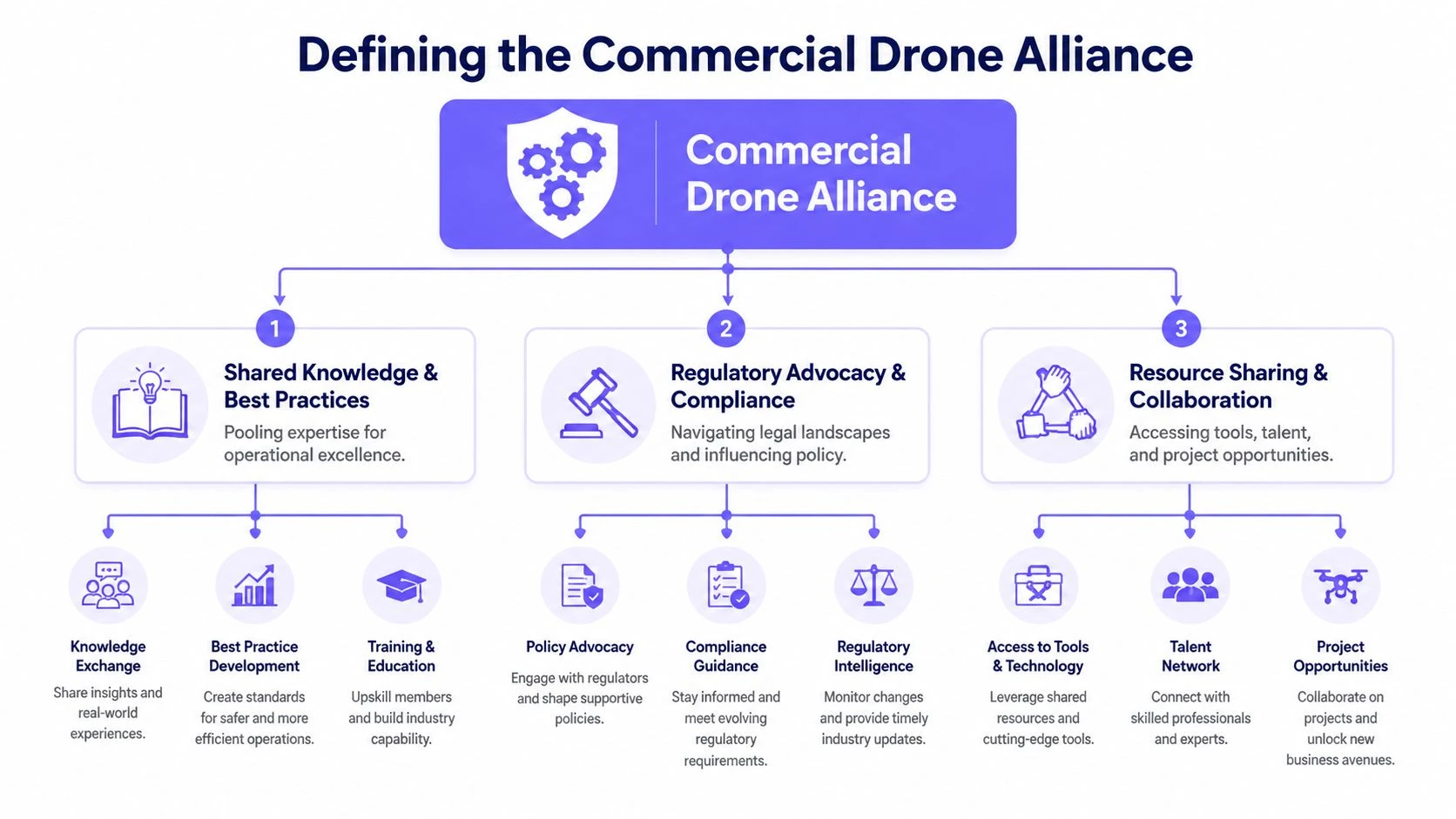
Think of a commercial drone alliance as a modern trade association for operators, manufacturers, software providers, and service firms that need the market to become more predictable. It isn’t just a networking club. It’s a formal organization built to represent industry interests, push for workable rules, and help shape the standards that determine how commercial UAS operations scale.
What makes an alliance different
A lot of drone operators confuse alliances with online communities, meetup groups, or vendor ecosystems. Those can be useful, but they serve a different purpose.
An alliance typically does three jobs at once:
| Function | What it looks like in practice | Why operators should care |
|---|---|---|
| Advocacy | Formal comments on rules, white papers, policy engagement | Your operating constraints get represented before rules are finalized |
| Standards input | Technical positions on UTM, DAA, reporting, interoperability | Your workflows become easier to scale when standards are practical |
| Industry coordination | Working groups, shared positions, member collaboration | You hear how peers are handling compliance and procurement |
The Commercial Drone Alliance (CDA) is a clear example. It is a 501(c)(6) non-profit, and according to ProPublica’s nonprofit profile for CDA, its revenue grew from $185,121 in its early years to over $1.3 million more recently. The same filing data shows tiered membership fees at $6,825 for smaller organizations, $9,500 for mid-sized organizations, and $21,000 for larger organizations. That matters because it shows two things. First, alliances need real funding to sustain policy work. Second, they’re structured to gather support across company sizes rather than only from the biggest firms.
What an alliance actually sells
It doesn’t sell flights, sensors, or software. It sells influence, coordination, and clarity.
That sounds abstract until you map it to operator pain points:
- If you’re struggling with procurement uncertainty, alliance advocacy can help push for clearer market rules.
- If your clients want advanced operations, alliance work on standards and regulation helps move those operations from exception to normal.
- If your team keeps rebuilding compliance processes, alliance input can push agencies toward repeatable frameworks instead of one-off approvals.
A good alliance doesn’t eliminate friction. It reduces avoidable friction and makes the remaining friction easier to plan for.
Why membership structure matters
Not every operator joins for the same reason. A small service provider may want representation and market visibility. A manufacturer may care about certification and procurement. An enterprise flight department may care about standards harmonization and large-scale operational certainty.
That mix is the point. A commercial drone alliance works because it combines different parts of the ecosystem into one policy voice. When that coalition is credible, agencies take it seriously.
For a useful comparison with another professional trade body model, see Dronedesk’s article on Unmanned Support and a new UK trade body for professional drone operators.
How Alliances Influence Drone Regulation and Standards
A rule change rarely starts with the rule itself. It usually starts months earlier, when an operator hits the same bottleneck for the tenth time, a manufacturer sees sales blocked by uncertainty, and a trade group turns those complaints into language a regulator can act on.
That is the practical job of an alliance. It gathers field problems, translates them into policy and standards input, and keeps showing up until agencies, standards bodies, and lawmakers have to address them. For operators, the value is simple. Better rules reduce avoidable delays, make approvals more predictable, and lower the cost of scaling a program.
Policy influence is slow, technical work
The Commercial Drone Alliance has been active on both market access and advanced operations. In its March 31, 2026 white paper and related announcement, the group set out six policy priorities after FCC restrictions on foreign drones, including stronger domestic demand, financing support for U.S. manufacturers, improved business certainty, and fewer regulatory barriers. That same announcement references the alliance's earlier comments on FAA Docket FAA-2025-1908 in support of a more workable path for BVLOS operations.
That matters because regulators respond better to specific, documented proposals than to general industry frustration. A serious alliance does not just ask for "innovation." It submits language, explains implementation, and ties requests to safety, economics, and operational reality.
From an operator's perspective, the pattern is usually predictable:
- A recurring bottleneck shows up in the field, such as slow approvals, inconsistent procurement rules, or incompatible technical requirements.
- The alliance turns that bottleneck into formal input, through comments, white papers, working groups, and meetings with agencies.
- Regulators and standards bodies use that input, especially when it reflects multiple parts of the market instead of one company's agenda.
- Operators get clearer operating conditions, even if the final rule is still a compromise.
That last point deserves honesty. Alliances do not get everything they ask for. The benefit is that they improve the quality of the fight and increase the odds that final rules can be used in day-to-day operations.
Standards work decides whether scale is practical
Operators often watch FAA headlines and ignore standards meetings. That is a mistake.
Standards determine whether a rule can be repeated across crews, aircraft, clients, and regions without rebuilding the compliance package every time. UTM, Remote ID implementation, data exchange, maintenance expectations, crew responsibilities, and detect-and-avoid frameworks all sit in that category. If those pieces stay inconsistent, growth gets expensive fast.
For a solo pilot, that may mean buying into systems that do not match future client requirements. For an SMB, it often means writing custom procedures for each contract and spending too much management time on approval prep. For an enterprise team, fragmentation creates procurement risk, cross-site inconsistency, and painful integration work between flight ops, safety, and IT.
Alliance participation offers real business value. During standards discussions, operators can push for requirements that fit field conditions instead of lab assumptions. Mixed fleets, subcontractor oversight, rural connectivity gaps, and client reporting needs all need a voice there.
What helps operators, and what wastes time
Alliance work produces results when it stays grounded in operations.
What usually helps
- Performance-based proposals that let operators meet a safety outcome through more than one technical path
- Detailed implementation comments that explain staffing, training, equipment, and recordkeeping consequences
- Cross-industry positions that align operators, software providers, manufacturers, and enterprise users around practical requirements
What usually wastes everyone's time
- Political messaging without technical detail
- Standards proposals built around one narrow business model
- Recommendations that ignore smaller operators, especially those running mixed fleets, contract crews, or regional service areas
I have seen the difference firsthand. The useful comments are the ones written by people who understand how flights are planned, briefed, logged, audited, and billed. The weaker ones sound persuasive until you try to run them through an actual operation.
That is also why policy work should connect back to your internal systems. If your team tracks approvals, aircraft status, pilot currency, site risk, and client requirements in one place, it is much easier to spot which proposed rules will add friction and which will remove it. Dronedesk's article on regulatory compliance, market readiness, and opportunity is a useful reference point for that operational view.
The short version is straightforward. Alliances influence regulation by turning operator experience into formal input. They influence standards by pushing for technical rules that can survive real field use. If you care about faster approvals, repeatable workflows, and services you can scale, that work affects your business long before a new rule reaches your operations manual.
Alliance Benefits for Solo Pilots SMBs and Enterprises
A solo pilot finishing a roof inspection, a five-person mapping team trying to standardize client deliverables, and an enterprise UAS manager dealing with procurement, legal, and regional operating rules do not buy alliance membership for the same reason.
That is the point.

The value of an alliance depends on the constraint in front of you. If you want industry prestige, membership may disappoint you. If you want earlier warning on policy changes, better operating precedent, stronger client confidence, and a channel into the standards work that affects your margins, it can pay for itself.
Solo pilots
Solo operators usually need time back and fewer bad surprises.
If you handle real estate, roofing, content capture, local inspections, or subcontract survey work, you probably do not have spare hours to track every policy discussion, client requirement shift, or equipment question. A good alliance reduces that monitoring load. It gives you a practical read on what may change and what matters to a small business this quarter.
Representation matters too. Solo pilots rarely have direct access to the rooms where standards language, operating assumptions, and procurement expectations start to form. Alliance membership gives you indirect reach. That matters when larger operators and manufacturers dominate the discussion.
For a solo operator, the useful benefits are usually concrete:
- Policy updates translated into operating impact
- Access to peers who have already dealt with waiver documents, client risk questions, or insurer requests
- A stronger professional signal when a client asks how you stay current
There is a trade-off. Passive membership does very little. If you never read the updates, join a call, or respond to a member survey, you are paying for access you are not using.
Small and medium drone teams
SMBs usually get the clearest operational return.
They feel compliance pressure early. They need repeatable workflows before they can afford dedicated compliance staff. They also run into the same client questions as larger operators, but with less internal support to answer them.
That makes alliance membership practical, not symbolic.
A regional inspection company, survey firm, or media team can use an alliance to shorten the learning curve on risk documentation, customer qualification standards, and fleet planning. The primary gain is process reuse. Instead of solving every problem from scratch, SMBs can borrow language, compare approaches, and spot which standards are likely to affect upcoming bids.
I have seen SMB teams get the most value when they connect alliance participation to their operating system. If your team uses Dronedesk to track aircraft records, pilot currency, site paperwork, and repeat job workflows, alliance updates become easier to apply. You can map a policy change to a checklist, update a client template, or adjust an approval workflow before it becomes a field problem.
That is where membership starts to affect revenue. Faster internal adoption means fewer avoidable delays, cleaner client responses, and less rework across the team.
A simple comparison helps:
| Operator type | Main risk | Most useful alliance value | Common mistake |
|---|---|---|---|
| Solo | Regulatory surprise and admin overload | Early guidance, peer insight, professional credibility | Paying dues and staying inactive |
| SMB | Scaling inconsistency across crews and clients | Templates, standards visibility, shared operating precedent | Treating alliance work as abstract policy |
| Enterprise | Fragmented governance across business units | Influence on standards, procurement alignment, cross-functional visibility | Assuming membership replaces internal decision-making |
Enterprise operations
Enterprise teams join for operating consistency at scale.
If you manage a utility, telecom, rail, energy, construction, or large inspection program, alliance membership gives your team a seat near the standards and policy work that can later affect procurement, software integration, training requirements, and audit expectations. That matters long before a final rule reaches the field.
The return is usually indirect at first. It shows up in better purchasing decisions, fewer dead-end integrations, and less friction between operations, compliance, legal, and procurement. Large organizations benefit when they can compare internal plans against where industry standards are actually heading, not where a vendor says they are heading.
Useful enterprise applications include:
- Participating in working groups tied to safety, reporting, and operational frameworks
- Comparing roadmap assumptions with manufacturers, service providers, and other large operators
- Spotting standards conflicts before they create internal rework across regions or departments
Enterprise teams still need to do their own homework. An alliance can inform strategy and strengthen your position. It does not replace your safety case, legal review, security requirements, or internal governance.
What each operator should ask
The practical test is simple. Will this membership save time, reduce uncertainty, improve client confidence, or help your business make better operational decisions?
For solo pilots, that often means better awareness and stronger credibility.
For SMBs, it usually means turning one-off effort into repeatable process.
For enterprises, it means influencing the conditions your program will have to operate under later.
If none of that applies, skip the membership. If it does, join with a clear use case and treat the alliance like an operating input, not a logo on your website.
How to Join and Actively Engage with a Drone Alliance
Most operators evaluate an alliance the wrong way. They look at the homepage, skim the member list, check the fee, and decide based on brand familiarity. That tells you very little about whether the group will help your business.
Start with your operating problem
Join based on the constraint you need help with.
If your biggest issue is BVLOS readiness, look for evidence that the alliance submits detailed comments, hosts technical discussions, and engages with standards questions. If your problem is procurement uncertainty or fleet transition planning, look for groups that speak credibly on domestic manufacturing, hardware policy, and operator transition impacts. If your issue is business development, peer access and industry credibility may matter more than policy depth.
Use a short vetting list:
- Membership fit. Are the members operators like you, or only manufacturers and large enterprises?
- Work product. Does the group publish real submissions, papers, or guidance?
- Access level. Can members join committees, working groups, or policy discussions?
- Operational relevance. Are they talking about problems you face?
Ask better questions before joining
Don’t ask, “What are the member benefits?” Ask sharper questions.
Try these instead:
- Where has this alliance materially engaged on regulation or standards?
- What member input channels exist?
- How often do operators get to shape the organization’s positions?
- Will this membership help me make better fleet, compliance, or service decisions this year?
Those questions quickly separate active alliances from logo collections.
Don’t buy access to a mailing list and call it strategy.
Make the membership produce value
The operators who get the most from alliances do simple things consistently. They show up. They answer surveys. They read draft positions. They contribute examples from real operations. That matters because regulators and standards bodies respond to concrete operational evidence, not vague complaints.
A practical engagement pattern looks like this:
- Attend briefings regularly so you hear the direction of travel early.
- Join at least one working group connected to your service line or operating model.
- Submit field feedback when the alliance asks for examples of friction, cost, or implementation issues.
- Build peer relationships with members facing similar client and compliance pressures.
A short operator checklist
Before you commit, run through this checklist:
- Define your reason for joining in one sentence.
- Name one person internally who will own the membership.
- Block time monthly for events, reading, and feedback.
- Track decisions influenced by membership, such as fleet planning, risk policy, or service expansion.
- Review annually whether the alliance is helping you reduce uncertainty or open opportunity.
That last point matters. Membership should affect how you operate, not just how you describe yourself.
Integrating Alliance Workflows into Dronedesk
A common failure point shows up right after an alliance briefing. The operations lead understands where standards are heading, the chief pilot agrees the team needs tighter records, and then nothing changes in the daily workflow. Flights still get logged three different ways. Maintenance notes sit in separate folders. Compliance evidence has to be rebuilt every time a client or regulator asks for it.
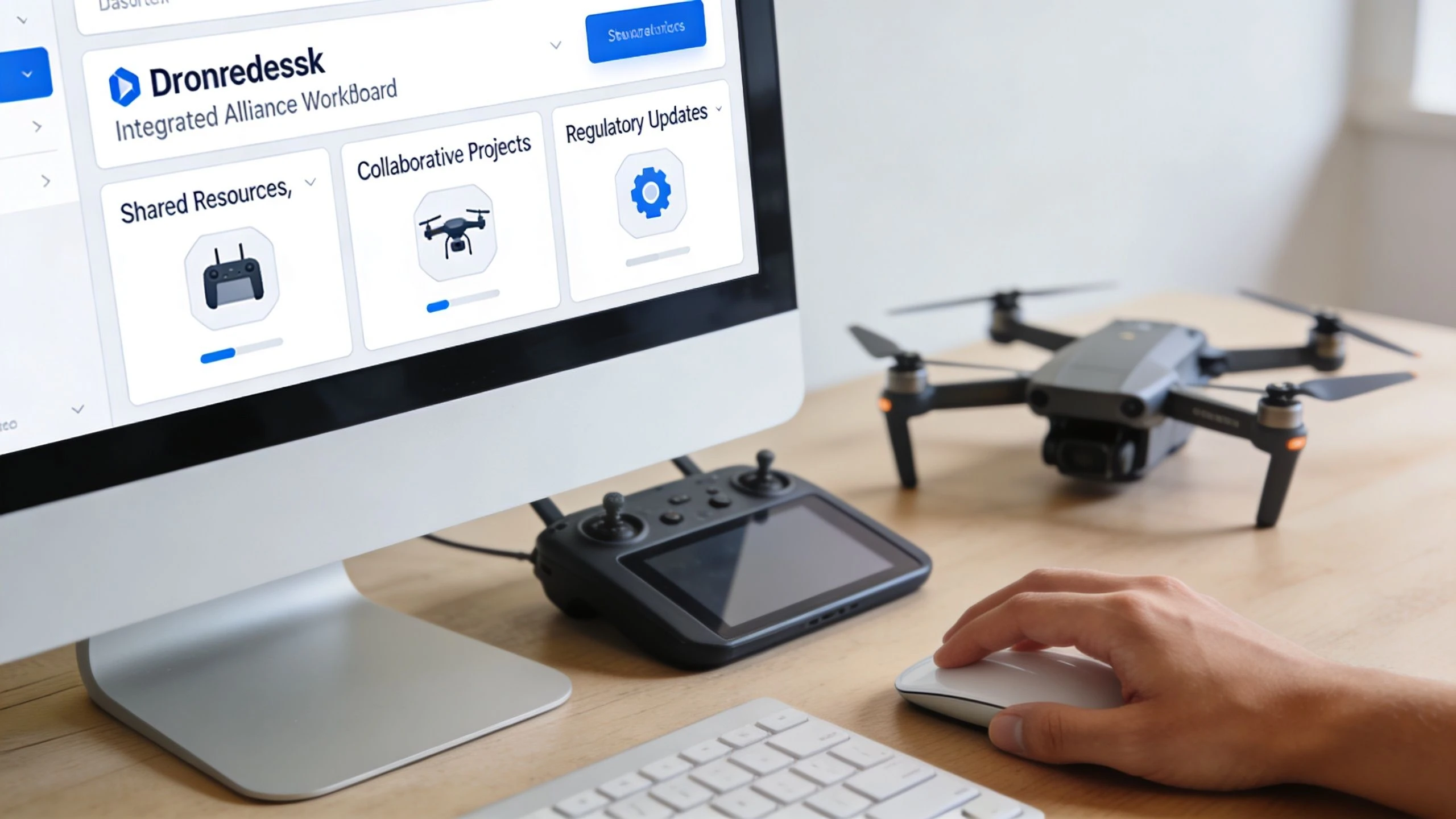
Turn alliance priorities into operating discipline
Alliance work has practical value only when it changes how missions are planned, logged, reviewed, and retained. For operators preparing for more advanced approvals, that usually means cleaner flight records, clearer maintenance history, and a standard way to show who flew what, where, and under which conditions.
Dronedesk fits that job well because it brings planning, pilot records, asset tracking, job management, and reporting into one operating system. That matters for a solo pilot trying to stay inspection-ready, for a small team dividing work across crews, and for an enterprise operation that needs consistent records across regions.
The trade-off is straightforward. Standardised workflows take effort to set up. They save time later when a client questionnaire lands, an auditor asks for evidence, or a new operating approval requires historical documentation.
Build workflows around the records you will actually need
Alliance discussions often point to the direction of regulation. Your management platform should translate that direction into repeatable admin. In practice, that means setting up workflows that produce usable records by default instead of relying on pilots to remember extra steps after the flight.
A workable setup usually includes:
- Fleet tags for aircraft class, sensor payload, approval status, and mission fit
- Mission records linked to pilot, aircraft, site, client, and risk documentation
- Maintenance history attached to each asset, with faults, inspections, and service actions in one place
- Operational notes captured in a consistent format across every pilot and crew
- Reporting outputs that can be exported quickly for internal review, clients, or regulators
That structure looks simple. It is also where many teams fall short.
I have seen operators invest time in industry groups, attend the right calls, and still struggle to produce a clean evidence pack for one contract review because their records were built for convenience, not for scrutiny.
Different operator types need different setups
A solo operator usually needs speed and consistency. The goal is to avoid rebuilding paperwork at night or before an audit. In Dronedesk, that means using standard job templates, keeping aircraft records current, and making every mission entry complete enough to support future approvals and insurance questions.
An SMB needs coordination. Once multiple pilots and aircraft are in play, inconsistency becomes expensive. The practical fix is shared templates, required fields, centralised maintenance tracking, and a review process that catches weak records before they spread across the operation.
An enterprise team needs control across scale. That means role-based oversight, standard operating records across offices, and reporting that stands up to procurement, legal, safety, and client review. The software matters, but governance matters just as much. Someone has to own the data standard.
Where alliance participation and software meet
The useful connection is simple. Alliances help shape what good operational evidence looks like. Dronedesk helps teams collect that evidence in a form they can effectively use.
That connection pays off in several ways:
- Faster response to compliance requests
- Cleaner support for procurement and fleet transition decisions
- Less reliance on tribal knowledge from one pilot or manager
- Better continuity when staff, aircraft, or client requirements change
Strong advocacy with weak records creates exposure. Strong records let you act on the opportunities that advocacy creates.
For operators who want a real return from alliance membership, this is the practical standard. Treat every policy shift, draft standard, and member briefing as a prompt to tighten the workflow inside the platform your team already uses.
Case Studies Alliance Victories and Operator Wins
A rule changes on Tuesday. By Wednesday, a solo pilot is asking whether the aircraft in the van is still the right one to bid with. An enterprise team is asking a different question. Will the program they budgeted for still clear procurement, legal, and safety review six months from now?
That is where alliance work proves its value. The benefit is not abstract access or industry visibility. It is better operating decisions under pressure.
A small provider dealing with fleet transition pressure
For a regional provider, fleet transition risk shows up fast. One change in sourcing policy or equipment eligibility can affect quoting, maintenance planning, client commitments, and insurance conversations in the same week.
The practical win from alliance advocacy is time and clarity. A smaller operator gets earlier signals about where restrictions may tighten, where industry is pushing for workable transition periods, and which use cases are most likely to stay commercially viable during the shift. That does not remove the cost. It helps the business avoid rushed purchases, poor replacement choices, and unnecessary disruption to active contracts.
For a solo pilot or small team, that usually translates into three concrete advantages:
- better timing on aircraft replacement decisions
- stronger justification for phased fleet changes instead of reactive swaps
- clearer client communication when equipment questions start affecting scopes of work
I have seen smaller operators absorb policy changes well when they treat alliance updates as an input to weekly operational planning, not as background reading. The useful question is simple: what decision do we need to make now, and what can wait until the next procurement cycle?
An enterprise team planning urban operations
Enterprise programs face a different problem. They are rarely blocked by a single flight. They are blocked by inconsistency across departments.
Urban inspection, infrastructure, and public-facing operations often depend on standards that procurement, legal, safety, and flight teams can all accept. Alliance work around BVLOS frameworks, traffic management, and operating standards helps enterprises plan against a more stable target. That matters because large teams spend real money long before the first mission launches. They buy aircraft, set training requirements, draft safety cases, and build internal approval paths.
The operator win is a better planning horizon. Instead of building a program around one-off approvals and temporary assumptions, the enterprise can align its operating model with the direction the field is heading.
That also affects software and recordkeeping. If an alliance pushes for clearer safety expectations or more consistent documentation standards, enterprise teams can reflect that inside Dronedesk through required fields, standardized mission records, maintenance logs, and review workflows. The policy work happens outside the platform. The operational response needs to happen inside it.
A good alliance does not fly the mission for you. It improves the conditions around the mission, so your team can commit capital, write procedures, and sell services with less guesswork.
The real operator win is not winning every policy argument. It is making better fleet, compliance, and growth decisions before uncertainty turns into cost.
Your Next Steps and the Future of Drone Advocacy
A commercial drone alliance isn’t an optional accessory for serious operators anymore. It’s part of how you protect your business from avoidable uncertainty and position it for the next phase of commercial drone work. The operators who benefit most are the ones who treat alliance participation like any other operational system. They define why they’re joining, they engage consistently, and they translate policy movement into fleet, reporting, and service decisions.
The future pressure points are already visible. Advanced operations will keep raising questions about airspace integration, hardware sourcing, safety frameworks, and cross-agency consistency. No individual operator can shape those alone. Organized industry voices can.
If you fly solo, an alliance can give you representation and better foresight. If you run an SMB, it can reduce scaling friction. If you manage an enterprise program, it can help you influence the rules your operation will eventually live under.
Join with a purpose. Participate with evidence. Use what you learn to tighten your workflows, sharpen procurement decisions, and protect your margins.
If you want to turn industry guidance into day-to-day operational discipline, Dronedesk gives professional drone teams one place to manage jobs, fleets, team activity, flight records, and reporting so compliance work is easier to maintain as regulations and standards evolve.
 BVLOS Drone Requirements for Building a Safety Case →
 Drone Pilot Test Mistakes That Cost Candidates Marks →
 FAA 107 License vs Part 107 Certificate: What’s the Difference? →
 Drone Airport Rules: A Field Checklist for Site Assessments →
 FAA Part 107 Record-Keeping Rules for Commercial Teams →
 How to Review a DJI Flight Log After an Unexpected Event →
 Drone Laws Around the World: A Pre-Flight Research Framework →
 How to Compare Drone Survey Services for Complex Sites →
 How to Start a Drone Mapping Business With a Clear Workflow →
 Class C Airspace Drone Rules for Commercial Flights →