
Reliable Jet Maintenance: Drone Fleet Guide
A drone fleet rarely fails at a convenient time. It fails on the morning of a client survey, halfway through a facade inspection, or just after a team has driven two hours to a remote site. The immediate problem looks technical. A motor runs hot, a battery sags under load, a gimbal starts hunting, or a connector works loose. Ultimately, the issue is operational. One fault can wipe out the day’s schedule, strain client confidence, and force rushed decisions that create even more risk.
That’s why reliable jet maintenance matters to drone operators.
Not because your aircraft looks anything like a Gulfstream or Challenger. It doesn’t. But the maintenance logic that keeps business jets airworthy translates surprisingly well to unmanned fleets. Manned aviation has already spent decades refining how to reduce surprises, document work, standardize inspections, and use data to catch weak components before they fail in service. Drone teams can borrow that discipline without copying the entire regulatory structure of crewed aviation.
Why Drone Operators Should Study Jet Maintenance

A preventable drone failure usually starts long before the aircraft comes down. The warning signs are small. A battery that lands warmer than its matched set. A motor that sounds rough only at spool-up. A prop that passed a quick visual check but has a nick at the root. Teams that operate under pressure often keep flying because the aircraft still “works.” That’s exactly how minor defects turn into field failures.
Jet operators learned long ago that reactive maintenance is expensive in all the wrong ways. It creates downtime you didn’t schedule, repairs you didn’t budget, and operational disruptions that ripple outward. Drone businesses face the same pattern, even if the scale is smaller. Lost site access, delayed deliverables, repeat mobilization, and avoidable safety events can do real damage.
The drone sector also has a knowledge gap. There’s no clear guidance on how traditional aircraft maintenance principles apply to unmanned systems, even as commercial drone activity expands, and the industry is projected to grow at an estimated 13.8% CAGR from 2023 to 2030 according to Reliable Jet Maintenance’s maintenance market discussion. That leaves many operators building their maintenance process from scratch.
The parts differ, the principles don’t
Jet maintenance and drone maintenance diverge at the hardware level. Jets track engines, landing gear, pressurization, and avionics in a very different operating environment. Drones deal with batteries, ESCs, compact motors, payload connections, firmware interactions, and repeated transport abuse. But the core questions are the same:
- What can fail
- How early can you detect it
- What inspection interval makes sense
- Who signs off the work
- Where is the record
Those questions matter whether you’re maintaining a cabin-class business jet or a mapping quadrotor.
Reliability is a systems problem
Most drone failures aren’t caused by a single bad part alone. They come from weak systems. Poor recordkeeping, inconsistent preflight checks, mixed batteries, undocumented repairs, and no feedback loop from flight data. Teams that work on architecting complex fleet systems already understand this at the operational level. Maintenance needs the same mindset. The fleet is a system. The data, people, parts, and procedures have to support each other.
Good maintenance isn’t about fixing broken aircraft. It’s about making sure the same preventable fault doesn’t return next week on a different airframe.
Reliable jet maintenance gives drone operators a mature blueprint. Not for copying every rule, but for adopting the habits that make aircraft dependable.
The Three Pillars of Aircraft Maintenance Programs
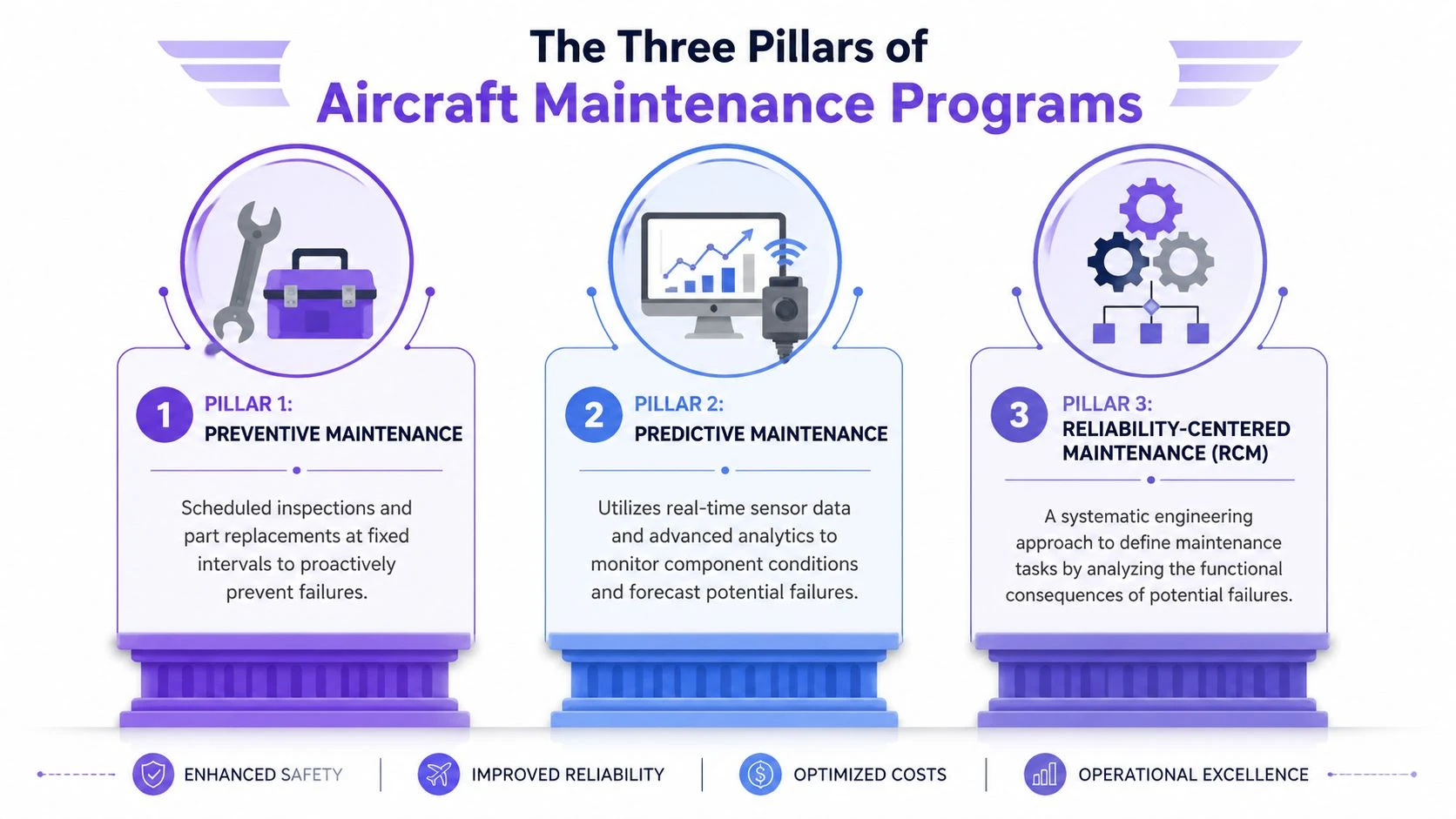
A drone returns from a routine mapping job with no writeups. The next flight ends early because one motor runs hotter than its mate, a payload connector backs out in transit, and the battery set used for dispatch had already shown imbalance on the previous two jobs. None of those problems appeared out of nowhere. They were maintenance signals that went unmanaged.
That is why mature aircraft programs do not rely on one maintenance method. They combine three. Preventive maintenance, predictive maintenance, and reliability-centered maintenance each address a different type of failure risk. Jet operators use all three because dispatch reliability depends on it. Drone operators with revenue aircraft, repeat customers, and field crews need the same discipline.
Preventive maintenance
Preventive maintenance is scheduled action. Inspect, service, or replace an item before failure because the wear pattern is understood and the consequence of waiting is unacceptable.
For drone fleets, this approach fits components that are inexpensive to inspect, quick to change, and known to degrade through normal use or repeated handling. It is the maintenance equivalent of standardizing preflight. You remove guesswork by setting intervals in advance and sticking to them.
Typical preventive items include:
- Propellers: Remove and inspect at recurring intervals, not only after visible strikes or chips.
- Landing gear and frame fasteners: Re-torque and inspect after transport-heavy operations or repeated rough site setups.
- Payload mounts and connectors: Check fit, pin condition, and retention before vibration-prone work.
- Batteries: Retire, downgrade, or segregate packs when they show repeated imbalance, swelling, or abnormal temperature behavior.
Preventive maintenance is simple to train and easy to audit. Its weakness is bluntness. Some parts get replaced early. Others deteriorate between intervals.
Predictive maintenance
Predictive maintenance uses condition and trend data to catch a problem before it becomes a field failure. In jet operations, this often means monitoring drift in temperatures, pressures, vibration, or recurring faults across many flights. The drone version is smaller in scale but follows the same principle.
Useful signals include repeated voltage sag under a familiar payload, one motor drawing more current than the others, startup GPS acquisition getting slower over time, or vibration increasing after a hard landing that did not appear serious at the time. A single event may not ground the aircraft. A pattern should trigger inspection.
Practical rule: If performance is drifting, maintenance should evaluate it before pilots are forced to manage it in the air.
This only works if the team records trends in a form that can be reviewed across aircraft, batteries, and missions. A spreadsheet can carry a small operation for a while. A growing fleet usually needs a dedicated aircraft maintenance tracking system for drone operations so recurring defects are visible before they become dispatch surprises.
Reliability-centered maintenance
Reliability-centered maintenance, or RCM, decides where to apply the first two methods. It starts with consequence, not habit. Which failures threaten flight safety? Which ones stop the mission? Which ones are expensive to recover in the field? Which defects can wait until scheduled downtime?
That prioritization is standard practice in manned aviation because every discrepancy does not deserve the same response. Drone teams benefit from the same logic. A cosmetic shell scuff and an intermittent compass fault are both defects. They do not belong in the same risk category, and they should not trigger the same maintenance action.
For a drone fleet, an RCM view might classify issues like this:
| Failure area | Likely impact | Best maintenance approach |
|---|---|---|
| Prop damage | Immediate flight safety risk | Preventive plus preflight inspection |
| Battery degradation | Mission reliability and safety risk | Predictive trend monitoring |
| Cosmetic shell wear | Low operational impact | Deferred repair if structural checks pass |
| Payload connector looseness | Data loss and mission failure risk | Preventive inspection with sign-off |
| Recurrent compass or GPS anomalies | High dispatch risk | Root-cause analysis and controlled return to service |
What works in practice
Many teams start with only preventive maintenance because it is easy to explain and easier to enforce. That is a reasonable first step. It stops being enough once aircraft utilization rises, payloads become revenue-critical, or several pilots share the same fleet.
What works:
- Fixed inspections for common wear items
- Condition monitoring for batteries, motors, and avionics behavior
- Clear failure ranking so crews know what grounds an aircraft and what can wait
What fails under pressure:
- Relying on pilot memory instead of recorded history
- Using one inspection standard for every airframe regardless of mission profile
- Treating all defects as either urgent or trivial
The best jet maintenance programs combine these three pillars because reliability comes from matching the method to the failure mode. Drone operators should do the same. The payoff is fewer aborted missions, more predictable aircraft availability, and fewer maintenance decisions made at the launch site when the job clock is already running.
Designing Your Maintenance Schedule and Tracking System
Jet maintenance runs on usage and time. Drones should too.
In private jet maintenance, engine oil changes are required every 25 to 50 flight hours, depending on engine type, because lubrication, cooling, and contamination control can’t be left to guesswork, as noted in this private jet maintenance guide. Drone fleets don’t have turbine oil systems, but the lesson is transferable. High-stress components need recurring service intervals tied to actual operation, not vague intention.
Track three clocks
A practical drone maintenance schedule should monitor more than total airtime. One metric alone misses too much. Track these three clocks for every aircraft and major component:
- Flight hours: Total operating time for airframes, motors, payloads, and batteries in service.
- Cycles: Battery charge cycles, takeoff and landing cycles, payload deployment cycles, or winch cycles where relevant.
- Calendar time: Storage exposure, seasonal checks, firmware review intervals, and periodic deep inspections even when aircraft fly infrequently.
An aircraft that flies often accumulates wear through use. An aircraft that sits can still degrade through storage conditions, connector oxidation, battery aging, or unnoticed transport damage.
Build inspection layers
A reliable schedule isn’t one long checklist. It’s layered.
Turnaround checks happen between jobs or batteries. These are quick condition checks: props, motor spin feel, landing gear, payload security, lens condition, and battery seating.
Routine service checks happen at planned intervals. During these, you inspect fasteners, arm joints, cooling paths, harness strain relief, gimbal dampers, antenna condition, and battery health trends.
Deep condition reviews happen less often but matter more. This is when you remove covers, inspect internal wiring paths, check for hidden cracking, review flight anomalies, and verify that previous repairs were done correctly.
A simple scheduling model
A small team can use a structure like this:
- After every flight day: Record defects, battery anomalies, hard landings, and environmental exposure.
- At recurring usage intervals: Inspect wear items and confirm torque, alignment, and connector integrity.
- At recurring calendar intervals: Review stored aircraft, rotate stock, re-check dormant batteries, and audit records.
- After abnormal events: Trigger unscheduled inspection after impact, water exposure, excessive dust, or firmware irregularities.
That last category is where many teams get into trouble. A drone that “flew fine afterward” still needs inspection if the event was abnormal.
Treat hard landings and transport shocks as maintenance events, not just operational notes.
Use one source of truth
Paper notes, messaging apps, and memory don’t scale. Even a two-aircraft team benefits from a centralized tracking record. Every asset should have a history showing flight use, battery cycles, defects, repairs, parts replaced, and return-to-service status.
Teams that want a model for digital recordkeeping can look at aircraft maintenance tracking software to see how structured scheduling reduces missed tasks. The key isn’t the software label. It’s the discipline of recording maintenance by asset, component, date, reason, and outcome.
The schedule should tell you what is due next. The tracking system should tell you why a recurring issue keeps returning.
Upholding Quality Assurance and Regulatory Compliance
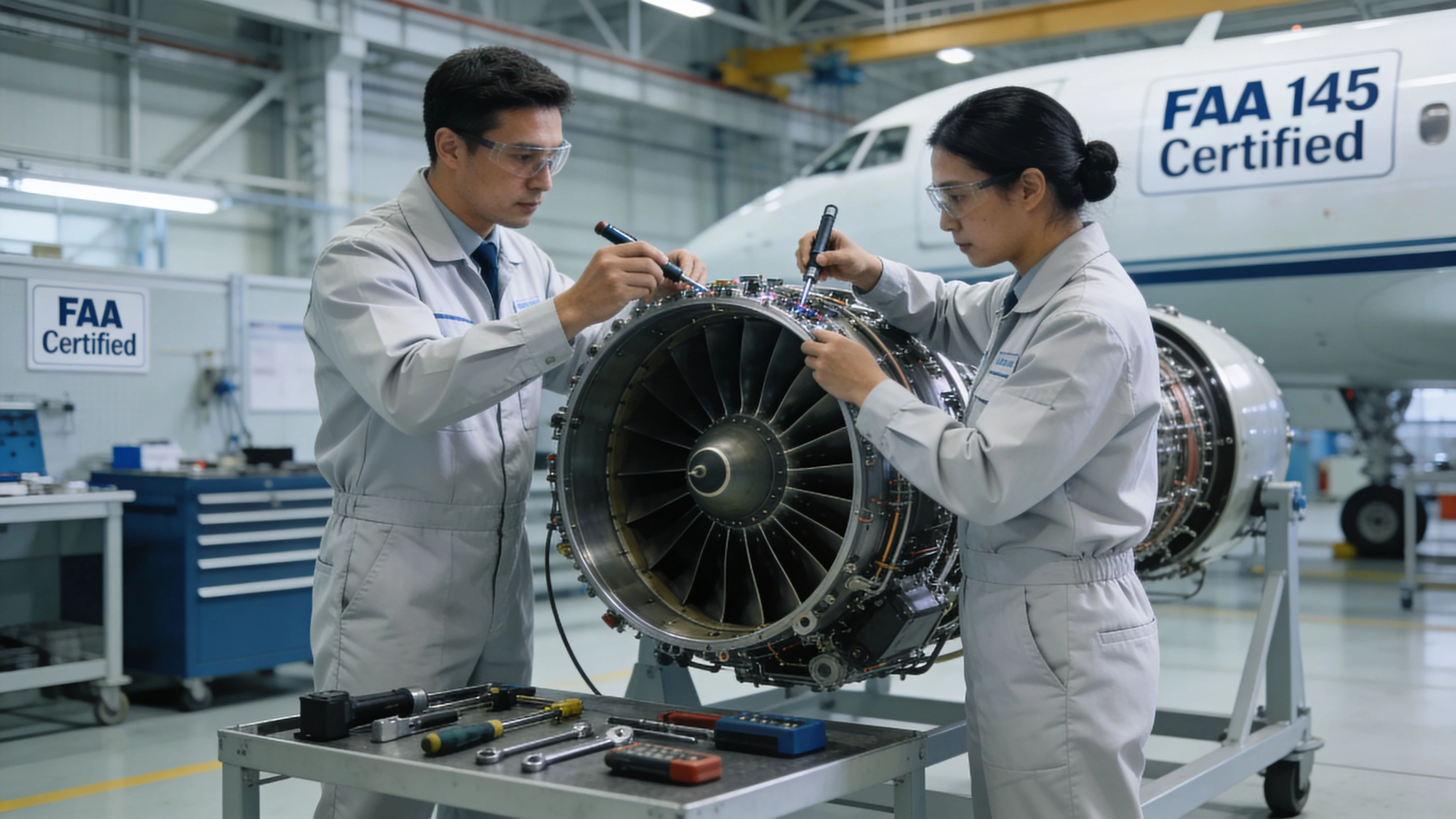
When people hear FAA 145 certified repair station, they often think the certificate itself is the value. It isn’t. The value is the operating discipline behind it. Standardized procedures. Controlled tooling. Documented work. Trained personnel. Traceable parts. Independent quality checks.
That’s why serious jet operators pay attention to where maintenance is performed.
Reliable Jet Maintenance, an FAA 145 certified repair station, was founded in 2005 and has grown to 21 to 50 technicians with estimated annual revenue of $20.6 million, according to ZoomInfo’s company profile for Reliable Jet Maintenance. The specific numbers matter less than what they imply. A maintenance organization doesn’t reach that scale by running on informal habits and undocumented fixes.
What drone operators should borrow
Most drone teams won’t operate under a Part 145 framework. That’s fine. You can still apply the principles.
Start with standard job cards for recurring tasks. If your team replaces motors, arms, ESCs, antennas, prop hubs, or payload dampers, each task should follow a repeatable procedure. Same inspection points. Same torque references if applicable. Same test flight or bench verification. Same sign-off.
Add controlled records. Every maintenance action should answer five questions:
- What was wrong
- What work was done
- Which parts were used
- Who performed the work
- How the aircraft was cleared for service
If your records can’t answer those, your process isn’t protecting you.
Compliance is also a liability shield
Clients increasingly ask operational questions that sound commercial but are really maintenance questions. How do you know the aircraft is fit for work? How do you manage recurring defects? What happens after an impact? Can you prove a repair was completed properly?
Those answers live in your quality system.
A practical quality framework for a drone team usually includes:
- Document control: Keep one current version of procedures and retire old ones.
- Maintenance release practice: Don’t return aircraft to service without a named sign-off.
- Parts traceability: Record where replacement parts came from and what aircraft received them.
- Defect escalation: Define which faults ground the aircraft automatically.
- Audit habit: Periodically review whether the team is following its own procedures.
A maintenance log is not paperwork for its own sake. It is evidence that a known process was followed by a named person on a specific aircraft.
What usually breaks quality first
Small teams often assume quality assurance is only for large organizations. In practice, small teams need it more because one rushed decision affects a larger share of the fleet.
The first failure usually isn’t technical. It’s procedural. Someone swaps a part without documenting it. A battery gets moved between aircraft with no trend history. A technician signs off a repair without a post-maintenance test. Weeks later, nobody knows what changed.
Operators who want to tighten that side of the business can review quality assurance best practices and adapt them into their own maintenance control process. Good QA doesn’t slow operations down. It stops preventable rework and gives your team a defensible standard.
Using Data to Predict Failures and Boost Reliability

A drone returns from a routine job. The pilot reports no handling issues, the battery still shows acceptable health, and the aircraft is released for the next mission. Two flights later, a motor fault forces an abort. That pattern is familiar in aviation. The failure rarely appears without warning. The warning was in the trend, not the last flight.
That is one of the clearest lessons drone operators can borrow from jet maintenance. Airlines and business jet operators do not wait for a hard failure if condition data has been drifting in the wrong direction. Drone fleets can apply the same discipline on a smaller scale. The sensors differ. The maintenance logic does not.
The drone equivalent of engine trend monitoring
Predictive maintenance starts with baseline behavior. If you do not know what normal looks like for a given aircraft, pack, or payload, you cannot spot deterioration early enough to act on it.
For drone fleets, the most useful trend signals usually include:
- Battery voltage sag under consistent load: A weak pack often shows itself under demand before it fails a basic static check.
- Motor temperature spread across arms: One motor running hotter than its peers can point to bearing wear, cooling blockage, winding problems, or mechanical drag.
- Hover current changes: If one aircraft starts drawing more power in similar conditions, inspect props, motors, frame alignment, and payload drag.
- IMU, compass, or GPS startup irregularities: Longer lock times or repeated calibration issues can indicate mounting problems, interference, or hardware degradation.
- Vibration growth: Small increases over time often point to bent shafts, damaged props, loosened mounts, or airframe fatigue.
- Payload communication faults: Intermittent disconnects are early warnings for connector wear, cable strain, or contamination.
Jet operators trend exhaust gas temperature margin, vibration, oil debris, and other condition indicators because those values move before the aircraft becomes unavailable. A drone maintenance lead should treat battery, motor, navigation, and vibration data the same way. It is the unmanned version of engine health monitoring.
Read trends, not isolated events
One hot battery after a high-wind mission may not mean much. The same battery landing hot across several comparable flights is a maintenance problem until proven otherwise.
A common mistake is to treat telemetry only as a flight review tool. Maintenance control should use it to decide what to inspect, what to remove from service, and what to watch more closely after repair.
A simple comparison model helps:
| Signal | One-time anomaly | Repeated trend | Maintenance response |
|---|---|---|---|
| Voltage sag | Maybe environmental or mission-related | Likely pack degradation | Isolate, test, and reclassify or retire |
| Motor heat | Could be airflow or workload | Likely component or alignment issue | Inspect motor, ESC, prop, and mount |
| GPS lock delay | Could be local interference | Possible hardware or installation issue | Check antennas, mounting, shielding, logs |
| Vibration increase | Could be after a prop strike | Structural or rotating-part concern | Inspect prop set, shaft, arm, payload mount |
The key trade-off is simple. Pulling an aircraft early costs utilization. Leaving it in service too long risks an abort, damaged hardware, a lost workday, or a safety event. Mature operators bias toward planned intervention because planned downtime is cheaper than field failure.
Remove aircraft on evidence of deterioration, not on proof of failure.
Build thresholds your team can actually use
Most drone teams will not have formal probabilistic models, and they do not need them to improve reliability. What they need is a repeatable trigger for action.
Set alert thresholds around changes that matter operationally. That might mean a battery whose voltage sag has worsened flight after flight, a motor that consistently runs hotter than its opposite arm, or an aircraft whose vibration signature has climbed since a hard landing. The threshold does not need to be perfect on day one. It needs to be documented, reviewed, and tied to an inspection step.
This is how jet maintenance programs mature. They start with observed patterns, compare them against outcomes, and tighten the standard over time.
Protect what repeated failures tend to attack
Condition data also shows where the environment is wearing the aircraft fastest. Dust intrusion, salt exposure, chemical residue, and repeated washdown cycles leave their mark on connectors, fasteners, cooling paths, and exposed surfaces. If a fleet works in harsh operating conditions, some preventive measures make inspections easier and slow surface deterioration.
Teams evaluating environmental protection methods may find this guide to advanced graphene coatings useful as background on protective coating concepts. It does not replace inspection or scheduled maintenance, but it can inform decisions about cleanability, corrosion resistance, and contamination control on ground equipment and exposed hardware.
Make telemetry review part of maintenance control
Flight logs should feed maintenance decisions, not sit in storage after compliance is satisfied. A workable routine looks like this:
- Flag repeated outliers by aircraft, battery, and payload.
- Compare each aircraft against its own history before relying on fleet averages.
- Inspect the most likely fault path first instead of swapping parts by guesswork.
- Record the finding and post-maintenance result so the team can confirm whether the trend stopped.
Operators who want a practical starting point can use flight data analysis for drone operations to build a review process that supports maintenance decisions, not just post-flight reporting.
Collecting data is easy. Building reliability from it takes discipline. That is the same lesson jets taught the rest of aviation years ago, and it applies just as well to a six-aircraft drone fleet as it does to a corporate flight department.
Managing Your Tooling, Parts, and Personnel
Reliable jet maintenance depends on logistics as much as technical skill. The same applies to drones. A good maintenance plan falls apart quickly if the team uses poor tools, installs uncertain parts, or assigns critical work to whoever happens to be available.
Tooling that protects the aircraft
Wrong tools damage aircraft. Over-tightening small fasteners can crack mounts or strip threads. Poor-quality drivers round hardware and create unnecessary teardown time. Uncontrolled soldering tools can damage adjacent electronics. Even something as simple as an improvised prop tool can scar hubs and introduce new problems.
A professional drone maintenance bench should have:
- Correct hand tools: Precision drivers, torque-capable tools where needed, ESD-safe tools for electronics work, and proper extraction tools for connectors and clips.
- Inspection tools: Good lighting, magnification, and a way to inspect hidden areas without forcing access.
- Electrical test gear: Reliable meters and basic diagnostic tools suitable for batteries, continuity checks, and connector verification.
- Bench discipline: Separate clean assembly space from dirty teardown space, especially after dust, moisture, or agricultural exposure.
If a tool can’t produce repeatable work, remove it from the process.
Parts that can be trusted
A cheap replacement part is rarely cheap once it causes a repeat defect. The issue isn’t only quality. It’s traceability. If a batch of arms, props, dampers, harnesses, or batteries shows irregular behavior, you need to know what was installed where.
Three habits matter here:
- Buy from known channels: Use sources that give you confidence in authenticity and specification.
- Record installation by serial or batch where practical: Especially for batteries, motors, ESCs, payload cables, and safety-critical structural items.
- Separate serviceable from unserviceable stock: Don’t let removed parts drift back into usable inventory by accident.
Gray-market buying creates two risks at once. The part may be wrong, and if it fails, your records may not be good enough to identify the affected aircraft quickly.
Personnel and authorization
Not everyone on a drone team should perform every maintenance task. That doesn’t mean building a bureaucracy. It means defining who is authorized for what.
A useful model is role-based maintenance authority:
| Role | Suitable tasks | Not suitable without escalation |
|---|---|---|
| Pilot-operator | Preflight checks, basic cleaning, defect reporting | Structural repair, electrical rework, return-to-service sign-off |
| Field technician | Module swaps, approved inspections, post-event checks | Nonstandard repairs, undocumented parts substitution |
| Lead maintainer | Root-cause diagnosis, controlled repairs, service release | Work outside procedure without engineering review |
| Operations manager | Scheduling and record oversight | Technical sign-off without evidence |
Assigning maintenance authority is one of the fastest ways to reduce rushed, undocumented fixes.
Small teams often blur operations and maintenance because they need flexibility. That’s understandable. But flexibility works only when everyone knows the boundary between inspection, repair, and release to service.
Conclusion: Building a Culture of Reliability in Your Operations
A crew launches at first light for a utility inspection. One aircraft shows an intermittent payload fault that was mentioned after the last job but never written up. A battery with a hard landing history is back in rotation because no one quarantined it. The mission still might fly. The operation is already less reliable than it looks.
That gap between appearing ready and being ready is familiar in manned aviation. Airlines and business jet operators closed it years ago with disciplined maintenance culture, not with luck or heroic technicians. Drone operators can use the same principle. Smaller aircraft change the scale. They do not change the consequences of poor records, deferred defects, or inconsistent release decisions.
Reliable maintenance protects three things at once: aircraft availability, safety margin, and margin on the job. For a drone business, that can mean fewer cancelled site visits, less wasted travel, stronger client confidence, and longer service life from batteries, payloads, and airframes.
Reliability starts before the defect
Good operations do not wait for a failure message on the controller.
They build repeatable habits that catch wear early and make field decisions easier under pressure. In jet maintenance, that discipline shows up in inspection intervals, logbook accuracy, parts control, and clear sign-off authority. In a drone fleet, the equivalent is simpler, but the logic is the same.
A reliable operation usually has a few visible traits:
- Inspections triggered by time, cycles, events, and mission type
- Individual tracking for aircraft, batteries, payloads, and high-failure components
- Standard work cards or checklists for recurring tasks
- Defect reporting that captures symptoms clearly enough for the next person to act
- Return-to-service records that explain what was inspected, replaced, tested, and approved
None of this is complicated. It does require consistency.
Proactive maintenance improves cost control
Reactive maintenance always looks cheaper until it disrupts revenue.
The direct repair bill is only part of the cost. A missed client slot, a second site visit, an extra pilot day, or a rushed parts order often does more damage to the job than the failed component itself. Jet operators learned to treat maintenance planning as an operating control, not just a technical function. Drone companies benefit from the same approach because planned downtime is easier to schedule, staff, and explain than avoidable failures in the field.
Some faults will still arrive without warning. The goal is not perfect prediction. The goal is to reduce preventable surprises and stop small defects from turning into operational delays.
Run the fleet like a small air service operation
If you manage several aircraft, battery sets, payload configurations, and crews, you are already dealing with airline-style reliability problems in a smaller package. Configuration control matters. Accurate histories matter. Deferred defects need visibility. Maintenance release needs evidence.
At this stage, many drone businesses split into two groups. One group keeps flying through minor friction until the pattern becomes downtime, lost confidence, or an incident. The other group builds a system that makes defects visible early, routes work to the right person, and keeps maintenance decisions tied to records instead of memory.
The second model scales better. It also tends to win better work, because serious clients notice when an operator can explain aircraft status, maintenance history, and go or no-go decisions with the same discipline used in manned aviation.
What reliable maintenance looks like day to day
You can usually spot a healthy maintenance culture in a few minutes.
Aircraft histories are complete. Batteries are identified and matched to records. Hard landings trigger inspection instead of informal reassurance. Recurring faults get root-cause attention instead of repeated resets. Removed parts do not drift back into serviceable stock. The person approving release to service can explain the basis for that decision without guessing.
That is the bridge between jet maintenance and drone operations. The hardware differs. The discipline does not.
If you want fewer disruptions and more predictable fleet performance, adopt the habits proven in higher-stakes aviation and scale them to your operation. The operators who do this well stop treating maintenance as back-office admin. They use it as a reliability system.
Dronedesk helps professional drone operators turn that reliability mindset into a repeatable system. With Dronedesk, you can manage fleet records, track assets, organize operational data, and reduce the admin burden that causes maintenance details to slip through the cracks. If you’re ready to run your fleet with the discipline of a small airline instead of a loose collection of aircraft, it’s a strong place to start.
 Drone Pilot Test Mistakes That Cost Candidates Marks →
 FAA 107 License vs Part 107 Certificate: What’s the Difference? →
 Drone Airport Rules: A Field Checklist for Site Assessments →
 FAA Part 107 Record-Keeping Rules for Commercial Teams →
 How to Review a DJI Flight Log After an Unexpected Event →
 Drone Laws Around the World: A Pre-Flight Research Framework →
 How to Compare Drone Survey Services for Complex Sites →
 How to Start a Drone Mapping Business With a Clear Workflow →
 Class C Airspace Drone Rules for Commercial Flights →
 How to Create a Drone Job Pack for Every Mission →