
Understanding the True Drone Licence Cost in 2026
Thinking the base fee for a drone licence is all you’ll pay is a common mistake. It’s really just the tip of the iceberg, and your total startup costs will swing wildly depending on where you plan to fly. For example, a commercial pilot in the US might pay around $175 for their initial exam, but once you factor in mandatory training, insurance, and equipment, that total can easily sail past $1,000.
Your Guide to the Global Drone Licence Cost
Trying to figure out the total cost of getting your drone licence is a bit like planning a road trip. The fee for the driver's test is a small, known cost, but it tells you nothing about the price of driving lessons, getting the car, or insuring it. It's the same with drones. That official licence fee is just your entry ticket; the real investment comes from everything else you need to operate safely and professionally.
We'll break down the complete financial picture for you. First, let's get to know the key regulatory bodies that set the rules and, by extension, the costs you'll face.
Key Regulatory Bodies at a Glance
Every major region has its own authority, and knowing who's in charge is the first step to understanding what you’ll have to pay.
- Federal Aviation Administration (FAA): This is the governing body in the United States. They issue the Part 107 certificate you'll need for any commercial work.
- European Union Aviation Safety Agency (EASA): EASA creates a single set of drone regulations for all EU member states, using a system based on risk categories.
- Civil Aviation Authority (CAA): The regulator for the United Kingdom. The CAA's system is similar to EASA's but has its own specific requirements and certifications.
The thread connecting all these agencies is simple: the riskier your planned flight, the more you'll have to invest. Flying over crowds or in restricted airspace demands more in-depth training and tougher exams, which naturally comes with a higher price tag. This makes sure pilots have the skills to match the mission.
To give you a bird's-eye view right from the start, here’s a quick comparison of the estimated all-in costs for a new commercial pilot in these key markets.
Estimated Drone Pilot Startup Costs by Region in 2026
| Region | Regulatory Body | Base Exam/License Fee (Approx.) | Estimated Training Costs | Total Estimated Startup Cost |
|---|---|---|---|---|
| United States | FAA | $175 | $150 - $300 | $325 - $475 |
| United Kingdom | CAA | £20 - £250+ | £300 - £800 | £320 - £1,050+ |
| European Union | EASA | €0 - €100+ | €150 - £600 | €150 - €700+ |
Use this as a rough starting point for your budget. As you can see, the numbers vary quite a bit, so let's dig into the details to see what's behind them.
Breaking Down the US Part 107 Licence Investment
If you're looking to fly a drone for money in the United States, the FAA's Part 107 certificate is your ticket to the game. The approach in the US is quite different from Europe or the UK. It all hinges on a single, comprehensive knowledge test designed to make sure you know the rules of the sky from day one.
The one mandatory, unavoidable cost is the Part 107 Aeronautical Knowledge Test, which is a flat $175 every time you take it. You'll sit this exam at an FAA-approved testing centre. It covers a ton of ground, from airspace charts and weather reports to flight rules and what to do in an emergency. It’s basically your final exam to become a professional drone pilot.
The Real Cost Is in the Preparation
Now, it’s tempting to just look at that $175 and think you’re done. But that’s like thinking the price of a marathon entry fee covers your running shoes and all the training. The real investment isn't the exam itself; it's the prep work that makes sure you pass the first time around.
Failing the test means forking out another $175 to retake it, so getting your preparation right from the start is just smart money management. This is where the other costs sneak in. Most people who are serious about passing the Part 107 exam will invest in some sort of training material.
Here’s what that usually looks like:
- Online Prep Courses: These are by far the most popular route. You get structured video lessons, practice quizzes, and full-blown mock exams. You can expect to pay anywhere from $150 to $300.
- Study Guides and Books: If you're more of a self-starter, you can grab a printed or digital study guide. This is a cheaper option, typically running between $20 and $50.
- Practice Exam Software: Some companies offer access to a huge bank of practice questions, which is great for drilling down on any topics you're struggling with.
In the United States, obtaining a drone pilot license under FAA Part 107 certification has become a critical entry point for commercial drone operators, with over 400,000 pilots certified as of 2025, reflecting a 28% year-over-year increase in commercial registrations. The direct cost for this license is remarkably affordable at just $175 for the knowledge test administered at approved testing centers, making it accessible for solo operators and small teams looking to launch businesses.
Maintaining Your Part 107 Certification
Once you pass your exam and get that certificate in hand, the initial spending is over. To keep your certification valid, though, the FAA requires you to complete a recurrent online training course every 24 months.
And here's the good news. This recurrent training is completely free. You just do it through the official FAA Safety Team (FAASTeam) website. It's an open-book course that brings you up to speed on any new regulations, so your knowledge stays fresh without costing you a penny. For a closer look at this whole process, check out our complete guide on the FAA Part 107 drone certification.
So, when you add it all up, your total investment to get certified in the US realistically lands somewhere between $325 and $475. That might sound like a decent chunk of change, but the return can be incredibly fast. Just one or two paid jobs—a real estate shoot, a roof inspection, or a farm survey—can often cover your entire startup cost, quickly turning that initial expense into a profitable career move.
Navigating European and UK Drone Licence Expenses
Hop across the Atlantic, and you'll find the world of drone licence costs looks completely different. In Europe and the UK, there isn't a single, catch-all exam like the US Part 107. Instead, both the European Union Aviation Safety Agency (EASA) and the UK's Civil Aviation Authority (CAA) have adopted a risk-based system.
It’s a bit like getting a driver's licence. You don't need a special permit toodle around your neighbourhood in a small hatchback. But if you want to drive a massive articulated lorry down the M1, you’d better believe you need advanced training and a commercial licence. The drone rules here are built on that exact same logic—the riskier your flight, the more training and certification you’ll need, and that’s what really shapes your total cost.
The Open Category: Your Low-Cost Entry Point
For most hobbyists, and even a lot of pros just starting out, your first stop will be the Open Category. This is designed for low-risk flying, like putting a small drone up in an empty field well away from people.
The most basic ticket you can get here is for the A1/A3 subcategories. Getting this certificate is refreshingly simple and, in many cases, completely free. You’ll just need to:
- Register as a drone operator in your country. This usually comes with a small annual fee, which in the UK is £10.33.
- Run through an online training course provided by your national aviation authority.
- Pass an online multiple-choice test, which is typically around 40 questions.
Pass the test, and you’ll get a certificate that's good for five years. It's the cheapest and quickest way to get flying legally in low-risk situations, but it does come with some pretty firm rules, like not being able to fly near people.
The A2 CofC and GVC: Higher Costs for Greater Freedom
If you want to open up the door to more professional work, you’ll need to aim for a more advanced certification. This is where getting your drone licence starts to feel like a proper investment.
Across Europe, drone licensing costs under EASA regulations emphasize a tiered, risk-based system that scales with operation complexity, typically ranging from €0 for the basic A1/A3 'Open' category to €200–€500 for the more advanced A2 or Specific category exams and training. Since the EU Drone Regulation entered force on January 31, 2020, over 500,000 remote pilot certificates have been issued, a testament to the growing industry. Discover more insights about the global drone market on IDTEChex.com.
In EASA member countries, that next step is the A2 Certificate of Competency (A2 CofC). In the UK, the ticket for most commercial jobs is the General VLOS Certificate (GVC). These qualifications let you fly closer to people and tackle more complex projects, making them a must-have for things like urban surveying or wedding photography.
Getting one of these is a much bigger deal, and the costs reflect that:
- Formal Training: You’ll have to complete a proper course with a Recognised Assessment Entity (RAE) in the UK or a similar body in the EU. These courses can set you back anywhere from £300 to £800 (€350 - €950).
- Theory Exam: You'll need to pass a supervised, in-person theory exam that goes into far more detail than the basic A1/A3 test.
- Practical Flight Test: For the GVC in the UK, you also have to pass a practical flight assessment with an examiner to prove you know how to handle the sticks.
The harmonised EASA rules have been a massive plus, meaning a pilot who gets certified in Germany can work commercially in France with very little fuss. It’s made cross-border jobs so much easier for professional operators. If you want to get your head around these evolving rules, you might want to read our deep dive into what new drone regulations mean for UK and EU operators. While the UK's GVC isn't automatically recognised in the EU anymore, it's still the gold standard for UK-based pros and your key to unlocking a huge range of drone work.
Uncovering the Hidden Costs of Drone Operations
Getting your drone licence sorted is a great first step, but it’s crucial to see it for what it is: the starting line, not the finish. Think of it like buying a ticket to a big concert. That ticket gets you in the door, but it doesn't cover the merch, the expensive drinks, or the cab ride home. A professional drone operation is no different.
That initial certification fee is just one slice of a much bigger financial pie. To build a business that actually lasts and turns a profit, you have to look at the whole picture. If you don't account for these "hidden" costs, you'll hit some nasty financial surprises that could ground your business before it ever really gets flying.
One-Time Investments Versus Recurring Expenses
The best way to get a handle on your budget is to split your costs into two buckets: one-time investments and recurring expenses. The one-time costs are the big, upfront purchases you need to get off the ground. The recurring ones are the bills that keep coming in to keep the lights on and the props spinning.
Getting a solid grip on both is vital for any kind of sensible financial planning. It helps you figure out how much cash you need to start and what it'll cost you just to keep the business running each month.
Your Initial One-Time Investments
These are the big-ticket items that form the foundation of your drone business. They'll sting the wallet upfront, but they're investments that should serve you for years.
- Drone Hardware: This is the most obvious and usually the biggest hit to your bank account. A professional drone can set you back anywhere from $1,000 to over $10,000, depending on the camera, flight time, and any fancy features it has.
- Essential Accessories: Your drone isn't much good without a stack of extra batteries. You’ll also need a decent carrying case, fast memory cards, and maybe some ND filters for better camera work. This can easily tack on another $300 to $1,000.
- Specialised Training: Your basic licence is one thing, but you might need more advanced training for specific gigs like thermography, surveying, or 3D mapping. These courses can run from $500 to $2,500 but open the door to much higher-paying jobs.
Looking at what other professional services charge, like drone inspection services, can also help you frame the value of your own investment and potential earnings.
This chart gives you a good visual on the certification costs for different drone licence levels in the EU and UK.
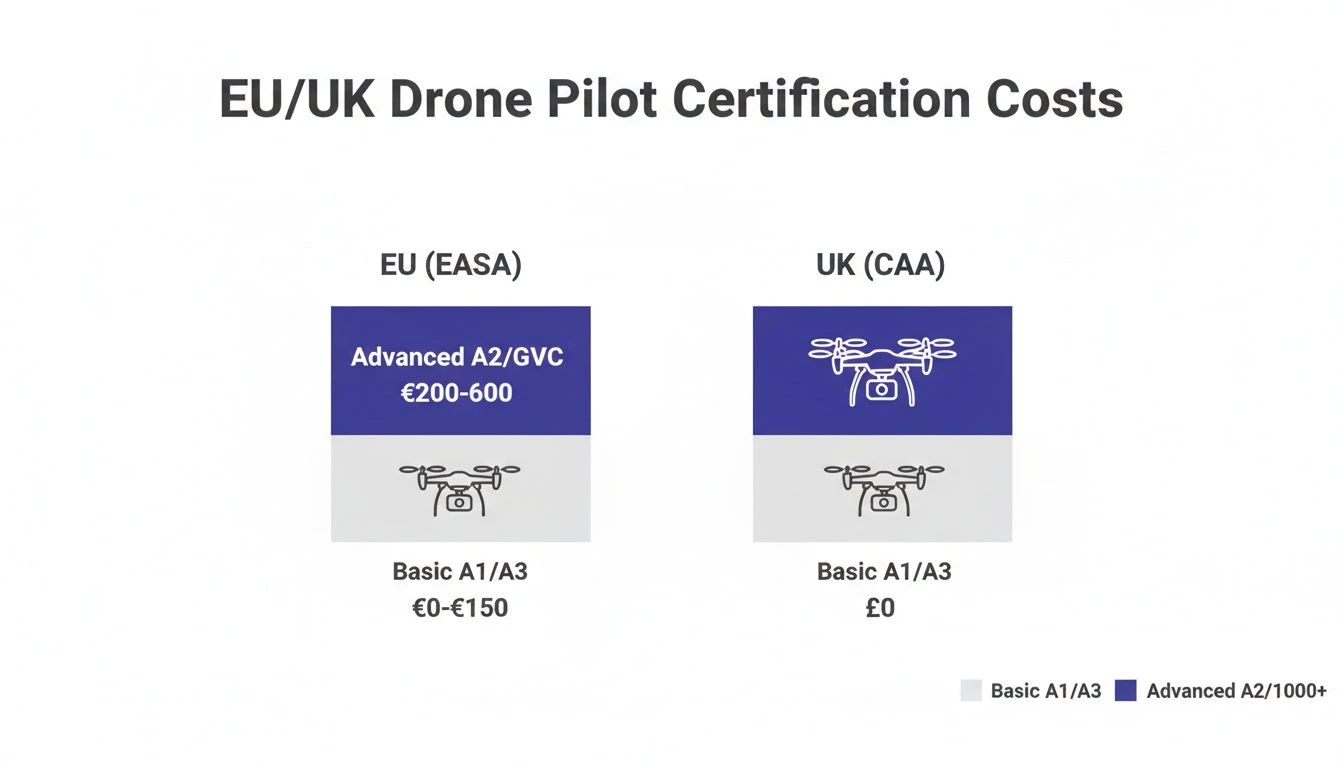
As you can see, there's a real jump in cost when you move from basic flying to the more advanced commercial operations that give you more freedom and better earning potential.
To give you a clearer idea, here’s a breakdown of the ancillary costs you can expect when setting up a professional drone business, whether you're flying solo or running a small team.
| Expense Category | Cost Type (One-Time/Recurring) | Estimated Cost Range (Solo Operator) | Estimated Cost Range (Small Team) |
|---|---|---|---|
| Drone & Equipment | One-Time | $1,500 - $12,000 | $5,000 - $30,000+ |
| Specialised Training | One-Time | $500 - $2,500 | $2,000 - $10,000 |
| Commercial Insurance | Recurring | $500 - $1,500 / year | $1,500 - $5,000+ / year |
| Software Subscriptions | Recurring | $20 - $100 / month | $100 - $400+ / month |
| Maintenance & Repairs | Recurring | $20 - $50 / month | $100 - $300+ / month |
| Licence/Certificate Renewals | Recurring | $10 - $100 / year | $50 - $500 / year |
| Marketing & Website | Recurring | $50 - $200 / month | $200 - $1,000+ / month |
This table doesn't cover every possibility, but it highlights the key areas you absolutely need to budget for. Underestimating these figures is a common mistake that can really hurt a new business.
Budgeting for Recurring Operational Costs
These are the ongoing bills that keep your business legal, insured, and running efficiently. They are every bit as important as your initial startup costs.
The biggest recurring cost, and one you absolutely cannot skip, is insurance. Commercial drone insurance is not just a good idea; it's often a legal or contractual requirement. It protects you from liability in case of an accident, which could otherwise be financially catastrophic.
Other recurring costs include:
- Software Subscriptions: An operations management platform like Dronedesk is an essential tool for streamlining flight planning, ensuring compliance, and managing your business. These subscriptions are a small monthly cost that saves immense time and reduces risk.
- Maintenance and Repairs: Drones are not maintenance-free. It's smart to budget for things like new propellers, battery care, and unexpected repairs. Putting aside $20 to $50 a month is a good rule of thumb for a solo pilot.
- Medical Certificates: For some advanced operations, particularly in the Specific Category in the EU/UK, a medical certificate might be necessary. This adds another recurring expense to the list.
- Licence Renewals: Don’t forget that your operator ID and certain pilot certificates have an expiry date. They need to be renewed periodically, and that comes with a fee.
Getting your head around these numbers is key. For a deeper dive, you might find our guide on how drone insurance costs are calculated useful. By planning for both the big one-off costs and the steady drip of recurring expenses, you can build your drone business on solid financial ground and avoid any nasty turbulence later on.
Comparing How Global Licence Costs Shape the Market
The price you pay for a drone licence isn't just an arbitrary number. It’s a powerful signal about a country's entire approach to the drone industry, shaping everything from the number of active pilots to its dominance in manufacturing.
Why is the barrier to entry so low in some parts of the world, yet so high in others? It all comes down to a fundamental choice between two philosophies: do you prioritise mass accessibility or demand initial proficiency? Some nations want to get as many pilots certified as possible to turbocharge their drone economy. Others prefer rigorous, front-loaded testing to make sure every pilot meets a high standard right out of the gate.
China's Low-Cost, High-Volume Strategy
China is the textbook example of the accessibility model. In what is now the world’s largest drone market, the cost to get licensed is kept remarkably low.
The basic AOPA China pilot certificate exam, brought in back in 2013 by the Civil Aviation Administration of China (CAAC), costs a mere CNY 160. That's about $22 USD. This rock-bottom price has been a massive driver behind the nation's $1.394 billion revenue in 2024 and its staggering control of 70-80% of global drone production. You can read more about these striking drone statistics and what they really mean for the industry.
This approach has created a huge talent pipeline. With a certificate required for any drone over 250g, China is on a path to have more than 1 million registered pilots by 2025. By making it cheap and simple to get certified, the country has built an enormous, skilled workforce ready to fuel its manufacturing and service sectors.
The strategy is plain to see: drop the financial barrier, encourage massive adoption, build a giant pool of operators, and secure your place as the world leader in both making and using drones. It's all about accelerating innovation and achieving economies of scale.
The Western Focus on Upfront Proficiency
Now, contrast that with the approach in the US, UK, and EU. Here, the game isn't about the sheer volume of pilots but the depth of their knowledge from day one. The cost of a licence isn't just a fee; it's an investment in a pilot's solid understanding of safety and regulations before they even think about flying commercially.
Take the FAA’s Part 107 in the United States. It hinges on passing a single, notoriously tough aeronautical knowledge test. While the exam itself is $175, the real cost often includes hundreds of dollars for prep courses. These are designed to make sure pilots have mastered complex topics like airspace classes, weather charts, and risk management from the get-go.
It's a similar story in Europe. The UK’s GVC and EASA’s A2 CofC both require formal training and proctored exams, which can easily run into hundreds of pounds or euros. This system acts as a filter. It ensures that only those who are serious about learning the rules of the sky are allowed to take on more complex commercial jobs.
This philosophy puts safety and pilot competence above all else. The higher cost and tougher requirements are seen as a necessary price to pay for a safe and orderly airspace. For businesses using platforms like Dronedesk to stay compliant, knowing these different regulatory mindsets is key to navigating the global market and understanding the talent you'll find in different regions.
Smart Ways to Manage Your Drone Business Budget
Keeping a tight rein on your drone licence cost and overall business spending is all about making smart choices, not just blindly cutting corners. Getting certified doesn't have to empty your bank account if you go in with a solid plan. It's a bit like packing for a long hike; you have to be realistic about what’s essential and what’s just dead weight.
One of the first places you can save some cash is on study materials. For example, if you're an aspiring pilot in the US, you can find a ton of free study guides and practice questions straight from the FAA. Paid courses can give you more structure, sure, but these free resources are often more than enough to get you over the line if you're a disciplined self-starter.
Invest Where It Counts
When you do open your wallet, put your money into things that will pay you back in the long run. It’s tempting to grab the cheapest drone on the market, but think about a well-maintained refurbished model instead. You can get professional-grade features for a fraction of the cost, much like buying a certified pre-owned car instead of a brand-new one.
By the same token, don't splash out on advanced training you don't need right now. If your immediate plan is to shoot some simple real estate photos, you really don't need that expensive thermography course just yet. Make your training investment match your immediate business goals, and then level up your skills as your client work starts to demand it.
One of the most important areas where spending smarter really pays off is your day-to-day workflow. This is where putting some money into a drone operations management platform like Dronedesk stops being an expense and starts being a powerful cost-saving tool.
Think of an operations platform less as software and more as a financial safety net. By automating your compliance checks and flight planning, you massively reduce the risk of eye-watering fines from accidental rule-breaking. A single fine can easily cost you more than the annual price of the software.
Here are a few key ways Dronedesk helps you look after your budget:
- Cuts Down on Admin Time: It automates the boring, repetitive stuff like filling out risk assessments and logging flight hours. This gives you back dozens of hours you can spend on billable client work instead of getting lost in paperwork.
- Minimises Compliance Risks: With built-in airspace intelligence and automated safety checks, you're far less likely to make a mistake that hits your wallet.
- Keeps Your Fleet Healthy: Tracking maintenance schedules and battery health helps you dodge unexpected repair bills and makes your expensive gear last longer.
It’s crucial to see this as an investment in your own efficiency. It's a tool that quietly works in the background to protect your bottom line, making sure the cost of your drone licence is the beginning of a profitable business, not a financial headache. Save wisely on the initial setup, invest smartly in your operational tools, and you’ll be on the right track to building a drone business that lasts.
Frequently Asked Questions About Drone Licence Costs
So, you've got a handle on the main costs to get certified, but a few nagging questions are probably still bouncing around your head. It's completely normal. The world of drone regulations has plenty of long-term details and international quirks. Let's tackle some of the most common ones I hear from pilots.
How Often Do I Need To Renew My Drone Licence?
This is a big one, and the answer completely depends on where you're flying. It’s definitely not a "one-and-done" deal, and keeping track of renewals is crucial for staying legal.
In the US, for example, your Part 107 certificate technically doesn't expire. But, you have to complete a free online recurrent training course every 24 months to keep your privileges. Across the pond in Europe, EASA certificates are generally valid for five years. Then there's the UK, where your Operator ID needs an annual renewal – a small but regular expense to factor in.
Does The Drone Licence Cost Include Insurance?
Nope. Your drone licence and insurance are two totally separate things, and it's vital to budget for both. Think of your licence as your "permission to fly," while insurance is your financial safety net if things go pear-shaped.
For any commercial pilot, insurance is a non-negotiable, recurring cost. It covers your liability if you have an accident or damage someone's property. Depending on your coverage, operational risk, and flight record, annual premiums can run anywhere from a few hundred to several thousand pounds.
A classic rookie mistake is under-budgeting for insurance. It's a critical expense that protects your business from financial ruin. Never, ever fly a commercial job without it.
Can I Fly Commercially In Other Countries With My Licence?
Generally, the answer is no. Drone certifications aren't like a driving licence that's recognised internationally. Your home country's qualification probably won't be valid once you cross a border.
A US Part 107 certificate, for instance, is only good for flights within the United States. While EASA rules cover most of Europe and let you fly between member states, that same certificate won't let you work in the UK or the US. To operate commercially in another country, you'll have to go through their specific certification process.
Trying to juggle all these moving parts—flight planning, risk assessments, compliance checks, and fleet maintenance—can feel like a full-time job in itself. That's exactly where Dronedesk steps in. Our platform is built to slash your admin time, cut the risk of expensive fines, and free you up to focus on what you actually love doing: flying. Find out how Dronedesk can make your drone operations safer and more profitable.
 BVLOS Drone Requirements for Building a Safety Case →
 Drone Pilot Test Mistakes That Cost Candidates Marks →
 FAA 107 License vs Part 107 Certificate: What’s the Difference? →
 Drone Airport Rules: A Field Checklist for Site Assessments →
 FAA Part 107 Record-Keeping Rules for Commercial Teams →
 How to Review a DJI Flight Log After an Unexpected Event →
 Drone Laws Around the World: A Pre-Flight Research Framework →
 How to Compare Drone Survey Services for Complex Sites →
 How to Start a Drone Mapping Business With a Clear Workflow →
 Class C Airspace Drone Rules for Commercial Flights →