
How to Become a Commercial Drone Pilot in 2026
The drone industry is absolutely buzzing with opportunity right now. If you're looking to turn a passion for flight and tech into a real career, becoming a commercial drone pilot is more achievable than ever. Forget the generic advice—let's walk through the actual journey: getting your FAA Part 107 certification, sharpening your flight skills, and then building a business that lands you paying clients.
Your Path to a Career in the Sky
Think of this as your roadmap. The demand for skilled pilots is surging in huge industries like real estate, construction, and agriculture, which means there's a clear path for anyone ready to get started. It really boils down to three key stages.
This visual breaks down the entire process into three simple, essential steps.
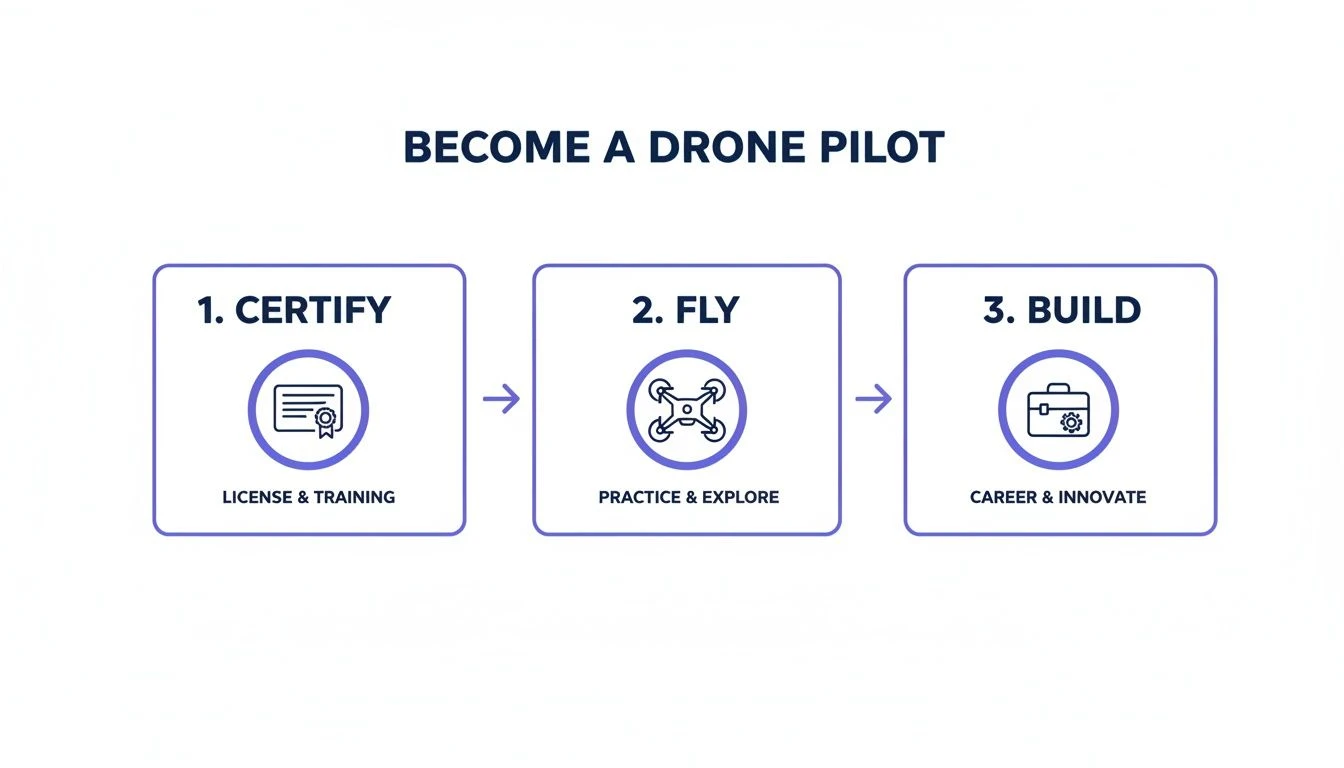
The Three Pillars of a Successful Drone Career
Your journey breaks down into three distinct, but connected, phases. Each one builds on the last, turning your initial interest into a professional service that clients will actually pay for.
-
Master the Rules: First things first, and this part is non-negotiable. You have to earn your FAA Part 107 Remote Pilot Certificate. This is your license to fly commercially, proving you understand the critical regulations from airspace rules to safety protocols.
-
Gain Hands-On Skills: A certificate proves you know the theory, but exceptional flight skill is what gets you hired. This means practicing precise maneuvers, flying confidently in different weather, and mastering the specific types of shots your clients need.
-
Build Your Operation: This is where you turn your skills into a real business. It involves picking the right gear, getting liability insurance, building a portfolio that shows off your work, and learning how to find and manage clients effectively.
Your success as a commercial drone pilot won't come from just one of these areas. It’s the combination of legal knowledge, practical skill, and business savvy that separates a hobbyist from a pro who commands top rates and wins high-value contracts.
This guide is built to take you through each pillar, one step at a time. We'll cover everything from how to study for the Part 107 exam to setting your prices and managing your jobs. Let's get you off the ground.
Mastering Your Part 107 Certification
 Before you can legally charge a single dollar for your drone work, you need the FAA’s Part 107 Remote Pilot Certificate. Think of it as your official passport into the world of professional drone operations. It’s the one credential that proves you understand the rules of the sky.
The industry has exploded, and the numbers don't lie. As of October 2026, the FAA had a whopping 855,860 drones registered in the US. A full 37% of those—that's 316,075 drones—are classified for commercial use.
To join these ranks, you’ll need to be at least 16 years old, be physically and mentally fit, and pass a 60-question aeronautical knowledge test. You'll need a score of 70% or better to pass. The exam costs around $175, and your certificate is good for 24 months before you need to renew it.
What to Expect from the Part 107 Exam
Don't mistake the Part 107 exam for a simple quiz on drone models. It's a serious test of your aeronautical knowledge. The FAA needs to know you can operate safely within the same airspace as crewed aircraft.
You’ll get two hours to answer 60 multiple-choice questions. While that sounds generous, some questions will have you digging into complex charts and interpreting data, which can eat up the clock.
The exam really drills down on a few key areas:
- Regulations: Knowing the nitty-gritty of 14 CFR Part 107, from flight limitations to reporting requirements.
- Airspace: This is a big one. You'll need to identify airspace classifications (Class B, C, D, E, G) on sectional charts and know the rules for flying in each.
- Weather: You must be able to read and interpret METARs (current weather reports) and TAFs (terminal aerodrome forecasts) to make smart go/no-go decisions.
- Drone Performance: Understanding how things like weight, balance, temperature, and altitude affect your drone's performance is crucial.
- Operations: This covers everything from best practices around airports and emergency procedures to Aeronautical Decision-Making (ADM).
I've seen many aspiring pilots get tripped up by the airspace and weather sections. You won't just be memorizing definitions; you'll get a real sectional chart or weather report and be expected to make a judgment call, just like a real pilot.
Creating Your Study Plan and Finding Resources
Passing the Part 107 exam all comes down to structured prep. Trust me, you can't just skim the rulebook once and expect to pass. You need a solid plan and the right resources.
A good study plan always involves two things: learning the material and then testing yourself under pressure. It's a formula I've seen work for hundreds of pilots.
Pro Tip: Don't just aim for that 70% passing score on practice tests. When you're consistently scoring 85% or higher on full-length, timed practice exams, that's when you know you're truly ready for the real thing.
Here are a few resources that have proven to be incredibly effective:
- Official FAA Materials: Always start here. The FAA provides free study guides and resources that are the source of truth for every question on the test.
- Online Training Courses: Paid courses from providers like Pilot Institute or King Schools offer a great structured path with video lessons, quizzes, and often a community to lean on.
- Practice Exams: This is non-negotiable. Use a platform that gives you realistic, timed tests. It builds your confidence and quickly shows you where your weak spots are.
For a great overview of the topics and question styles, our own comprehensive Part 107 study guide is a fantastic place to start your deep dive.
Scheduling and Taking Your Exam
Once you're hitting that 85% benchmark on your practice tests, it’s go-time. You can’t take the exam online; it has to be done in person at an FAA-approved testing center.
Here's how to get it on the calendar:
- Get an FTN: First, you’ll need to create an FAA Tracking Number (FTN) using the FAA's IACRA system.
- Find a Testing Center: All exams are handled by a company called PSI. Head over to their website to find an approved testing location near you.
- Schedule Your Date: Pick your day, select a time, and pay the exam fee.
On the big day, you'll show up at the center, present your ID, and they'll hand you a supplement book with all the charts and figures needed for the exam. Once you pass, you'll complete your official application through IACRA, undergo a quick TSA background check, and then you're set. You'll get a temporary certificate by email, with the permanent card arriving in the mail a few weeks later.
Gaining Real-World Flight Experience
 Passing your Part 107 exam proves you know the rules, but it's your skill on the sticks that actually gets you hired. Think of your certificate as the key to the door; your hands-on ability is what clients are ultimately paying for. This is where theory gets real, and where you start the journey from a certified operator to a confident, professional pilot.
There’s a massive gap between knowing the regulations and executing a perfect orbit shot with a client looking over your shoulder. This is why logging your first 100 flight hours after getting certified is such a critical milestone. It’s in those hours that you build the muscle memory and situational awareness you'll need to tackle complex jobs without breaking a sweat.
From Open Fields to Tricky Locations
Your first few flights should be in a wide-open field, far away from people, trees, and buildings. The goal here isn't to capture incredible footage; it’s to get a truly intuitive feel for the controls without any pressure. Just focus on the basic movements until they become second nature.
Once you’re comfortable, it's time to up the difficulty. Start practicing takeoffs and landings in progressively tighter spaces. Fly in different wind conditions to see firsthand how it affects your drone's performance and battery life. A strong headwind on your return flight can drain your battery much faster than you’d think—a lesson you definitely want to learn in practice, not on a paid job.
The difference between an amateur and a professional isn't just about getting the shot. It's about getting the shot safely, efficiently, and repeatably, even when conditions are far from perfect. Precision and consistency are your greatest assets.
Essential Flight Maneuvers to Master
To be the kind of commercial drone pilot who gets called back for more work, you need to have a solid command of a few key maneuvers. These are the building blocks for pretty much any job you'll take on.
Make yourself a practice checklist and get these skills down cold:
- Smooth Takeoffs and Landings: Practice ascending and descending with buttery smoothness. A jerky takeoff or a hard landing screams "amateur" and can be unsafe in tight spots.
- Box Patterns: Fly your drone in a large, square pattern while keeping a consistent altitude and speed. This drill is fantastic for honing your control over orientation.
- Orbits (Point of Interest): Pick an object—a tree, a cone, anything—and practice flying a perfect circle around it while keeping the camera locked on. This is a must-have shot for real estate and cinematic gigs.
- Grid Patterns for Mapping: For survey and mapping jobs, you'll need to fly precise, overlapping grid patterns. Use a flight planning app to practice running these automated missions and, just as importantly, learn to take over manually if something goes wrong.
- Precision Flying: Practice flying along straight lines, like a fence or a curb, at low altitudes. This skill is vital for inspection work where you have to follow a power line or a roof edge closely.
To take your practice to the next level, our guide on drone flight training techniques offers more advanced exercises and drills.
Self-Training vs Formal Flight School
So, how do you actually gain these skills? You have two main paths: self-training or enrolling in a hands-on flight school. Each has its pros and cons.
Self-training is the most budget-friendly route. You learn at your own pace and can focus on the skills that feel most relevant to you. The downside is that it requires immense discipline, and you run the risk of picking up bad habits without an expert there to correct you.
A formal flight school offers a structured curriculum and direct feedback from experienced instructors. In the drone industry, sectors like agriculture are seeing 40% annual growth, and inspections are up 30%. For these advanced roles, formal training can be invaluable. Accredited schools can cost anywhere from $500 to $2,000 for 20-40 hours of instruction, covering everything from emergency procedures to complex flight maneuvers that help pilots command rates of $50 to $150 per hour.
This table breaks down the decision:
| Factor | Self-Training | Formal Flight School |
|---|---|---|
| Cost | Low (cost of drone only) | Moderate to High ($500+) |
| Structure | Unstructured, self-directed | Structured curriculum |
| Feedback | Limited to self-assessment | Direct from expert instructors |
| Pacing | Flexible, learn at your own speed | Fixed schedule and pace |
| Best For | Disciplined self-starters on a budget | Pilots seeking advanced skills quickly |
Ultimately, the best path really depends on your budget, learning style, and career goals. A lot of successful pilots I know use a hybrid approach: they start with self-training to nail the basics and then invest in specialized workshops for advanced techniques like thermal imaging or LiDAR operations.
Building Your Professional Drone Kit
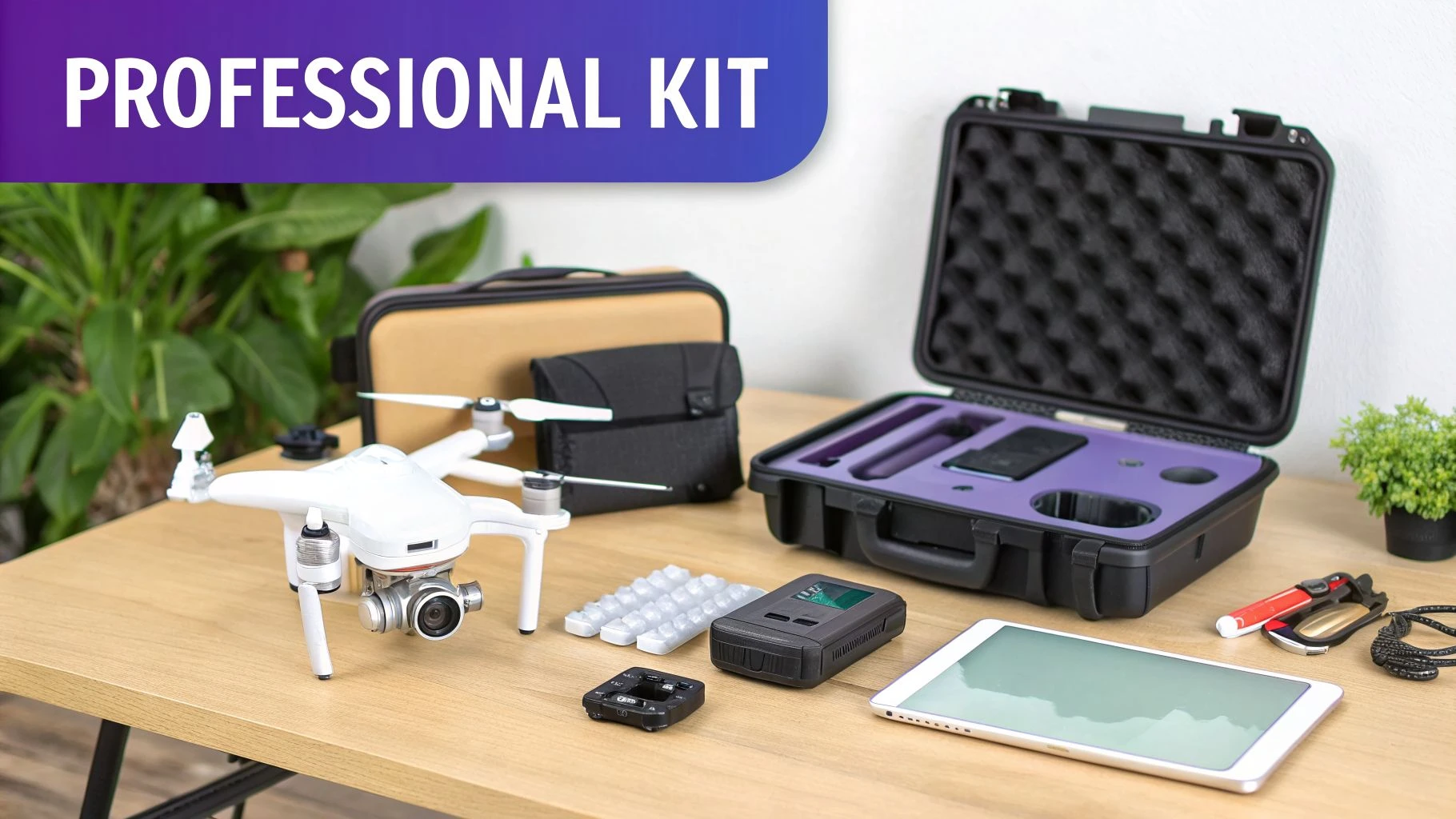
Let's get one thing straight: your equipment is your business. As a commercial pilot, the gear you carry directly impacts the quality of your work, your efficiency on-site, and ultimately, your ability to land those bigger, better-paying contracts. Assembling a proper toolkit is about much more than just buying a drone; you're building an entire ecosystem to support your operations.
The aircraft is the star of the show, of course. But the right choice depends entirely on what services you plan to offer. You absolutely don't need a $10,000 cinema drone if your bread and butter is real estate photos. On the flip side, a basic consumer model just won't cut it for detailed industrial inspections that require thermal imaging.
So, think about your ideal client. Are you targeting real estate agents? A versatile and portable model like a DJI Air 3 or Mavic 3 Pro will give you fantastic image quality without breaking the bank. If you're aiming for high-end cinematic work, you might eventually set your sights on a beast like the DJI Inspire 3. For more specialized jobs like mapping or inspections, an enterprise-grade drone like the Mavic 3 Enterprise becomes a must-have.
Your Gear Goes Way Beyond the Drone
The drone is just where it starts. Your day-to-day success hinges on a collection of key accessories that prepare you for whatever a job throws at you. Flying without them is like a wedding photographer showing up with one battery—it’s unprofessional and a huge risk to the job.
Here are the absolute must-haves for any serious operator's kit:
- A Fleet of Batteries: Never, ever show up to a job with just one or two batteries. Four to six is the bare minimum. This lets you cycle them on a multi-charger and fly almost continuously without frustrating downtime.
- Quality ND Filters: Think of Neutral Density (ND) filters as sunglasses for your drone's camera. They are critical for getting that smooth, cinematic motion blur in bright daylight by letting you use a proper shutter speed.
- A Proper Travel Case: The box your drone came in is not a professional case. Invest in a rugged, weatherproof hard case (like a Pelican or similar) to protect your expensive gear from getting banged up in transit.
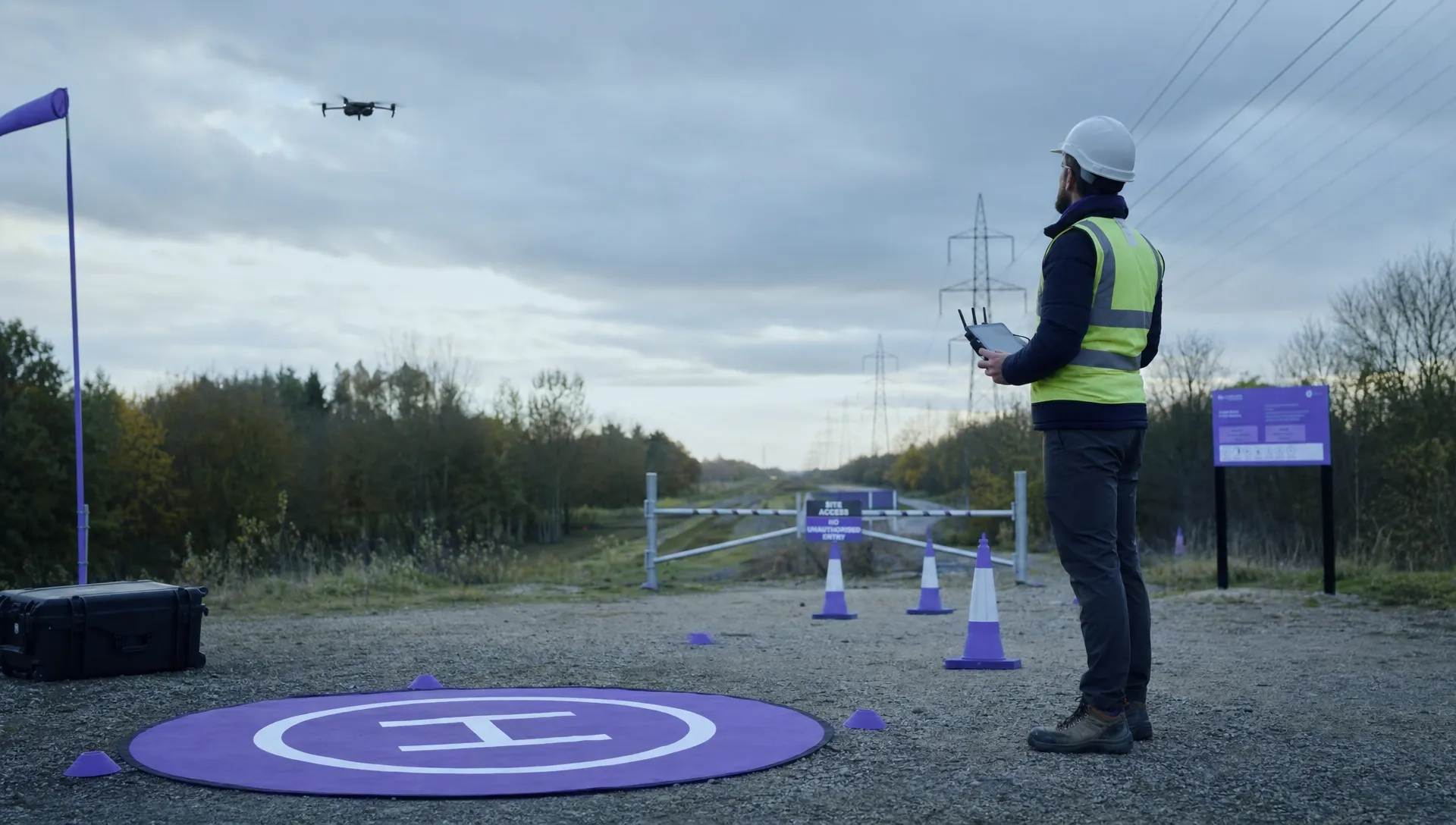
- Safety and Landing Gear: A simple collapsible landing pad is a lifesaver. It keeps dust and debris from kicking up into your camera and gimbal on takeoff and landing. And always, always have a set of safety cones and a high-visibility vest in your kit to mark out your flight area.
Essential Drone Pilot Gear Comparison
Choosing your first set of gear can feel overwhelming. To help you prioritize, here’s a look at how you might build out your kit based on different budget levels. This isn't about having the most expensive stuff, but the right stuff for the job.
| Gear Category | Entry-Level Operator (Under $2,500) | Mid-Tier Professional ($2,500 - $7,000) | Advanced Specialist ($7,000+) |
|---|---|---|---|
| Primary Drone | DJI Air 3 or Mini 4 Pro | DJI Mavic 3 Pro or Mavic 3 Classic | DJI Inspire 3, Matrice 30T, or Mavic 3 Enterprise |
| Batteries | 4-6 Intelligent Flight Batteries | 6-8 Batteries + Multi-Charger | 8+ Batteries, multiple charging hubs, power station |
| Camera Filters | Basic ND/PL Filter Set | High-quality variable NDs (e.g., PolarPro) | Full set of cinematic filters (ND, PL, CPL, Mist) |
| Transport | Padded soft case or manufacturer's combo bag | Weatherproof hard case (e.g., Pelican, Nanuk) | Custom-fitted hard cases for all primary gear |
| Insurance | On-demand liability policy (e.g., hourly) | $1M annual liability + hull insurance | $2M+ liability, hull, and specialized equipment coverage |
| Software | Basic flight logging app | Professional ops management (e.g., Dronedesk) | Full enterprise suite for ops, processing, and analytics |
This table should give you a solid starting point. As you land more jobs and specialize, you'll naturally reinvest in gear that meets your clients' specific demands.
The most overlooked piece of kit isn't hardware—it's protection. Flying without proper liability insurance is a catastrophic business risk. A single accident could wipe out your entire business and then some.
Getting Your Business Insured
Let me be blunt: liability insurance is non-negotiable. Most commercial clients worth their salt will flat-out refuse to hire you without proof of at least a $1 million liability policy. It protects you, your client, and their property if the worst happens.
But don't just grab the first policy you see. Find one that fits where you are in your business journey. Plenty of providers offer on-demand insurance you can activate by the hour, which is perfect when you're just starting out. As you get busier, an annual policy usually makes more financial sense. Look for policies that include not just liability but also "hull insurance"—that's what covers damage to your actual drone.
The Software That Pulls It All Together
Your professional kit isn't complete without the software to run your operations. Flying professionally isn't just about stick skills; it's about meticulous planning, logging, and compliance. Using a dedicated platform like Dronedesk is just as critical as having extra batteries.
This is the kind of software that helps you manage a job from A to Z: generating risk assessments, checking airspace for restrictions, building flight plans, logging flight times for compliance, and keeping track of client details. More importantly, it signals to clients that you are a serious, organized professional, which is a huge factor in winning bigger contracts and running a business that doesn't drown in admin.
Alright, you've got your certifications, honed your flying skills, and assembled your gear. That's the foundation. Now for the exciting part: turning your passion into a real, money-making business. This is where you graduate from being just a pilot to becoming a business owner.
Flying for mates is one thing, but as soon as you start charging for your services, you're running a business. That means you need to make it official. This isn't just about paperwork; it affects your personal liability and how you handle your taxes.
Choosing Your Business Structure
Kicking off your commercial drone business means getting the legal stuff right from the start. It’s a good idea to consult a complete legal guide to setting up a business to make sure you've covered all your bases, but most solo pilots start with one of two options: a sole proprietorship or a Limited Liability Company (LLC).
A sole proprietorship is the simplest path forward. Legally, you and the business are the same entity. It’s dead simple to set up with minimal fuss, which is why it's a popular choice for pilots just getting their wings.
The big catch, though, is liability. If a job goes sideways and a client sues, there's no legal wall between your business and your personal life. That means your house, your car—it could all be on the line. In an industry where accidents can be expensive, that's a huge risk to take on.
An LLC, on the other hand, builds that legal wall. It separates your personal assets from the business. So, if the business faces a lawsuit or racks up debt, your personal finances are generally safe. It takes a bit more effort and a registration fee to set up, but that protection is priceless once you start landing bigger jobs.
My Advice: If you're on a shoestring budget and need to start fast, a sole proprietorship will get you off the ground. But I strongly recommend forming an LLC as soon as you start taking on regular commercial clients. The professional image and peace of mind are absolutely worth it.
Building Your Winning Portfolio
Your portfolio is your most powerful sales tool, full stop. It's the visual proof that you can deliver the goods. A killer portfolio shows clients what you can do, which is far more convincing than just telling them.
Don't wait around for paid work to start building it. Get out there and shoot the kind of projects you want to get hired for.
- Pick a Niche: Want to get into real estate? Get permission to shoot a couple of impressive local properties. Create a full package with polished photos and a slick video tour.
- Show Your Range: Don't just show one type of shot. Mix it up with sweeping aerial landscapes, detailed inspection-style close-ups, and smooth, cinematic orbits around a key subject.
- Highlight Before-and-Afters: For industries like construction or agriculture, this is gold. Showing progress on a job site over a month provides undeniable proof of the value you bring.
Think of your portfolio as a targeted marketing piece, not just a highlight reel. A real estate agent wants to see stunning, aspirational shots that sell a lifestyle. A construction manager, on the other hand, is looking for precision, clarity, and data. Tailor it to who you're trying to attract.
How to Price Your Drone Services
Pricing is one of the biggest headaches for new pilots. Go too low, and you undervalue yourself and the entire industry. Go too high, and you risk scaring off those crucial first clients. In the drone world, it usually boils down to three models.
| Pricing Model | How It Works | Best For |
|---|---|---|
| By the Hour | Charge a fixed rate for every hour you are physically on-site. | Quick, simple jobs with a well-defined scope, like a few aerial photos or a basic site check. |
| By the Project | Quote a single, flat fee for the whole job, from planning to flying to post-production. | Most professional projects, including real estate packages, marketing videos, or progress reports. |
| On Retainer | The client pays a recurring monthly fee for a pre-agreed amount of work. | Clients needing regular flights, like construction firms that want weekly site updates. |
When you're starting out, project-based pricing is usually your best bet. It gives the client a clear, upfront cost and makes sure you're paid for all your work—not just the time you spend in the air. Remember to factor everything into your rate: insurance, software, travel, equipment depreciation, and your time for editing and client chats. Our in-depth guide on pricing drone services breaks this down even further to help you build a profitable model.
Finding Your First Paying Clients
Okay, you're legal, your portfolio is sharp, and you know what to charge. Time to find some work. The "build it and they will come" fantasy doesn't apply here; you need to be proactive.
- Network in Your Niche: You have to go where your clients are. Attend local real estate meetups, construction trade shows, or agricultural events. Introduce yourself, show off your portfolio on a tablet, and be ready to explain exactly how you can solve their problems.
- Use Online Pilot Networks: Sites like DroneUp and Skyward can connect you with companies looking for certified pilots. These platforms are a great way to get your first few jobs under your belt, but be aware that the pay can be less than what you’d earn with direct clients.
- Master Local SEO and Social Media: Get a simple website online and set up a Google Business Profile. Post your best shots on Instagram and LinkedIn, tagging local businesses and using hashtags relevant to your area and industry. A local roofer is more likely to find you through a "drone pilot near me" search than a national directory.
To win bigger, more professional contracts, it's all about how you present yourself. When you submit a proposal, include a risk assessment, a basic flight plan, and a copy of your insurance certificate. This shows you're a serious, compliant operator, not just a hobbyist with a new toy. That level of professionalism will instantly put you ahead of the competition.
Frequently Asked Questions
Alright, you've put in the work, studied the regs, and you're getting ready to turn this passion into a profession. It's completely normal for a few lingering questions to pop up as you get closer to your first paid gig.
Let's clear up some of the most common ones I hear from new pilots.
How Much Can I Realistically Earn as a Commercial Drone Pilot?
This is the big one, isn't it? The honest answer is: it really depends on where you live, what you do, and how good you are at it. Your income will grow right alongside your skills and your reputation.
When you're just starting out, focusing on straightforward jobs like basic real estate photos, you might find yourself charging between $50 and $100 per hour. This is a great way to get your foot in the door, build a portfolio, and get comfortable working with clients.
The real money comes with specialization. Once you build up experience and carve out a niche, your rates can jump significantly. Pilots who are experts in things like industrial inspection, 3D mapping, or high-end cinematic work can comfortably charge $150 to over $300 per hour.
The fastest way to increase your earnings is to specialize. Generalists often end up competing on price. Specialists, on the other hand, compete on value. Find a niche—whether that's thermal roof inspections or FPV tours of luxury homes—and become the go-to expert.
Do I Need to Renew My Part 107 Certificate?
Yes, you absolutely do. Think of your Part 107 certificate less like a diploma and more like a driver's license that needs renewing. It's valid for 24 calendar months from the month it was issued.
To stay current, you have to complete a free recurrent online training course on the FAA's safety website. This isn't just a box-ticking exercise; it ensures you're up-to-date on any rule changes, which is vital for keeping your operations safe and legal.
What Is the Best Drone for a Beginner Commercial Pilot?
The "best" drone for a new commercial pilot is one that hits the sweet spot between capability, ease of use, and price. You need a reliable tool that delivers professional results without an enterprise-level price tag or a massive learning curve.
For most new pilots doing jobs like real estate or creating content, drones in the DJI Air or Mavic series are fantastic starting points.
- DJI Air 3: This is a brilliant all-rounder. It has dual cameras for wide and telephoto shots, fantastic image quality, and excellent flight time.
- DJI Mavic 3 Pro: This is a step up and a true workhorse for many pros. Its larger sensor delivers superior image quality, making it a favorite for serious photographers and videographers.
Both of these drones come packed with safety features like obstacle avoidance, which is a huge confidence booster when you're starting out. They're powerful enough to impress paying clients but still user-friendly.
Can I Fly Commercially at Night or Over People?
The short answer is yes, but it’s not as simple as just taking off. Both are considered advanced operations under Part 107 and come with very specific rules. Your basic certificate doesn't automatically grant you these privileges.
For night flights, you have to meet two conditions:
- You must have completed the recurrent online training, which now covers night operations.
- Your drone needs to be equipped with anti-collision lights that are visible for at least three statute miles.
Flying over people is much more complicated. The FAA has four operational categories (Category 1-4) that are mostly based on the drone's weight and whether it has exposed propellers. Most common drones you'd buy off the shelf, like a DJI Mavic, do not meet the requirements to fly over people without a special FAA Declaration of Compliance from the manufacturer or a specific operational waiver.
The golden rule here is to assume you cannot fly directly over people unless you have done your homework and can prove your specific drone and operation meet the FAA's strict criteria.
Juggling jobs, staying compliant, and impressing clients is about more than just your flying skills—it requires serious organization. Dronedesk is the all-in-one platform built to manage your flight plans, risk assessments, client details, and compliance logs. It frees you up to do what you love. Streamline your workflow and look like a pro from day one. Learn more and start your free trial with Dronedesk today.
 FAA Small UAS Rule: Key Requirements for Operators →
 How to Build a Drone Pilot Flight Log That Is Audit Ready →
 FAA Drone Licence Requirements for Commercial Pilots →
 FAA BVLOS Waivers Granted: What Successful Cases Show →
 How to Export DJI Flight Logs for Incident Reviews →
 Drone Safety and Legal Duties for Business Operations →
 EASA Drone Regulations: Open, Specific and Certified Categories →
 What the BVLOS ARC Report Means for UAS Operators →
 Free Drone Pre-Flight Checklist for Commercial Missions →
 Contingency Volume and Flight Risk Buffer Explained →