
A Guide to Enterprise Fleet Maintenance Locations for Drones
Think about it this way: could a professional racing team ever hope to win a championship if their mechanics were scattered randomly across the country, working out of their garages? Of course not. It's the same for a growing enterprise drone program. You just can't afford a reactive, disorganized approach to maintenance.
Dedicated enterprise fleet maintenance locations aren't just workshops; they're strategic assets. They have a direct impact on your reliability, your compliance, and your mission readiness.
Why You Need a Strategy for Drone Maintenance Locations
Once you move past a handful of drones, maintenance can't be an afterthought handled in a spare room or the back of a truck. As your fleet grows into the dozens or even hundreds, the logistics of servicing, repairs, and compliance checks get complicated—fast.
This is where dedicated maintenance locations come in. They turn what could be a chaotic cost centre into a real competitive advantage.
These hubs are the nerve centre for your fleet's health. They’re where your skilled technicians do the critical work, from routine battery checks and propeller swaps to complex sensor calibrations and post-crash diagnostics. Without them, drone downtime goes through the roof, mission schedules become a guessing game, and the risk of falling foul of aviation authorities like the FAA or EASA gets very real.
For a quick overview, let's break down the core components of a solid maintenance location strategy.
Quick Answer: What Is a Drone Maintenance Location Strategy?
At its heart, a drone maintenance location strategy is your plan for setting up and running the physical hubs where all the essential service, repair, and compliance work on your drone fleet happens. As your UAV operations get bigger, having this plan is non-negotiable for keeping your drones in the air, running efficiently, and staying on the right side of the law.
| Strategic Pillar | Purpose |
|---|---|
| Location Model | Deciding between a single, centralized hub or multiple, distributed locations to best serve your operational area. |
| Site Selection | Choosing the right physical spots based on accessibility, security, and proximity to where your drones are flying. |
| Staffing & Tooling | Ensuring each location has the right people with the right skills and all the necessary tools and spare parts. |
| Workflow & Compliance | Standardizing the maintenance processes and record-keeping to ensure quality, safety, and a solid audit trail. |
Ultimately, this strategy provides the backbone for a professional and scalable drone operation, ensuring every aircraft is maintained to the same high standard.
The Benefits Are Non-Negotiable
Putting a formal strategy in place for your maintenance locations gives you the structure you need to keep a large-scale drone fleet airborne and earning its keep. The benefits show up almost immediately:
- More Uptime: When you centralize parts, tools, and expert technicians, repairs get done faster. Instead of waiting days for a replacement part to arrive, your team has what it needs on hand, getting drones back into service in hours, not days.
- Better Reliability: Standardized procedures mean every drone gets the same high-quality service, no matter which technician is on the job. That consistency is the key to preventing unexpected in-flight failures.
- Watertight Compliance: Dedicated locations make record-keeping almost effortless. Every repair, part replacement, and service check is logged meticulously, creating an unassailable audit trail for any regulatory body that comes knocking.
- Lower Operational Costs: A well-run maintenance hub cuts down on wasted time and money. It reduces the need for expensive overnight shipping and stops technicians from having to drive long distances for simple fixes.
A good fleet management platform like Dronedesk gives you that crucial bird's-eye view of every drone's status right from your dashboard.
This kind of visibility is what makes it all work. Managers can see which drones are active, which are down for maintenance, and which are overdue for a service, all from one screen. A network of well-managed enterprise fleet maintenance locations is the true backbone of any professional, scalable, and profitable drone program.
You can learn much more about building this foundation in our detailed guide on enterprise fleet maintenance.
In that guide, we’ll walk you through all the essential steps, from picking the right maintenance model and selecting the best sites to using powerful software like Dronedesk to manage your entire maintenance network for peak performance. You'll get the insights you need to make sure your drone operations are built to last.
Choosing Your Hub Model: Centralized vs. Distributed
So, how do you actually set up your network of enterprise fleet maintenance locations? This is one of the biggest calls you'll make, and it all boils down to a classic trade-off: cost versus speed and specialization. You're looking at two main playbooks—centralized and distributed—and each one shines in different operational scenarios.
Picking the right structure isn't just a logistics problem. It's a strategic move that will define how agile and resilient your fleet can be. This decision affects everything from how you train your techs and stock parts to your mission uptime and the bottom line of your budget.
The Centralized Model: A Center of Excellence
Picture the centralized model as a single, super-powered "center of excellence." It's one primary base, kitted out to tackle the most difficult repairs, deep-level diagnostics, and advanced training for your technicians. This is where your most specialized tools and top-tier talent live.
This setup is spot-on for jobs that need serious expertise or expensive equipment you don't use every day, like complex sensor recalibration or fiddly composite airframe repairs. By pooling these resources in one place, you're not paying to duplicate high-cost gear across multiple sites. The major drawback, though, is the logistical headache.
A centralized hub is brilliant for complex, high-value repairs, but it can create serious downtime. When a drone flying hundreds of miles away needs work, it has to be shipped back, repaired, and then shipped back out to the field—all while it's out of commission.
This model usually makes the most sense for companies whose operations are packed into a smaller geographic area or whose missions aren't super time-sensitive. It keeps management simple, makes quality control consistent, and is often cheaper to get off the ground.
The Distributed Model: Forward Operating Bases
The distributed model, on the other hand, is more like a network of nimble "forward operating bases." Instead of one main hub, you set up several smaller enterprise fleet maintenance locations closer to where your drones are actually flying. These sites are equipped to handle the common, day-to-day stuff.
These smaller depots are all about speed and easy access. The goal is to knock out routine services, component swaps, and minor fixes as efficiently as possible to get your assets back in the air. This is perfect for fleets that are spread out over a wide area, like those doing nationwide infrastructure inspections or supporting projects at multiple construction sites.
Of course, this approach has its own set of challenges. It drives up overhead with multiple rent payments and duplicate toolsets, makes inventory management a real puzzle, and can make it tough to keep service quality consistent across every location.
Making the Right Choice for Your Fleet
There’s rarely a one-size-fits-all answer here. Your decision has to be based on a cold, hard look at what your fleet really needs—its size, how spread out it is, and the type of missions it flies.
The flowchart below gives you a simple decision tree to start figuring out which model, or maybe a mix of the two, is the right fit for your drone program.
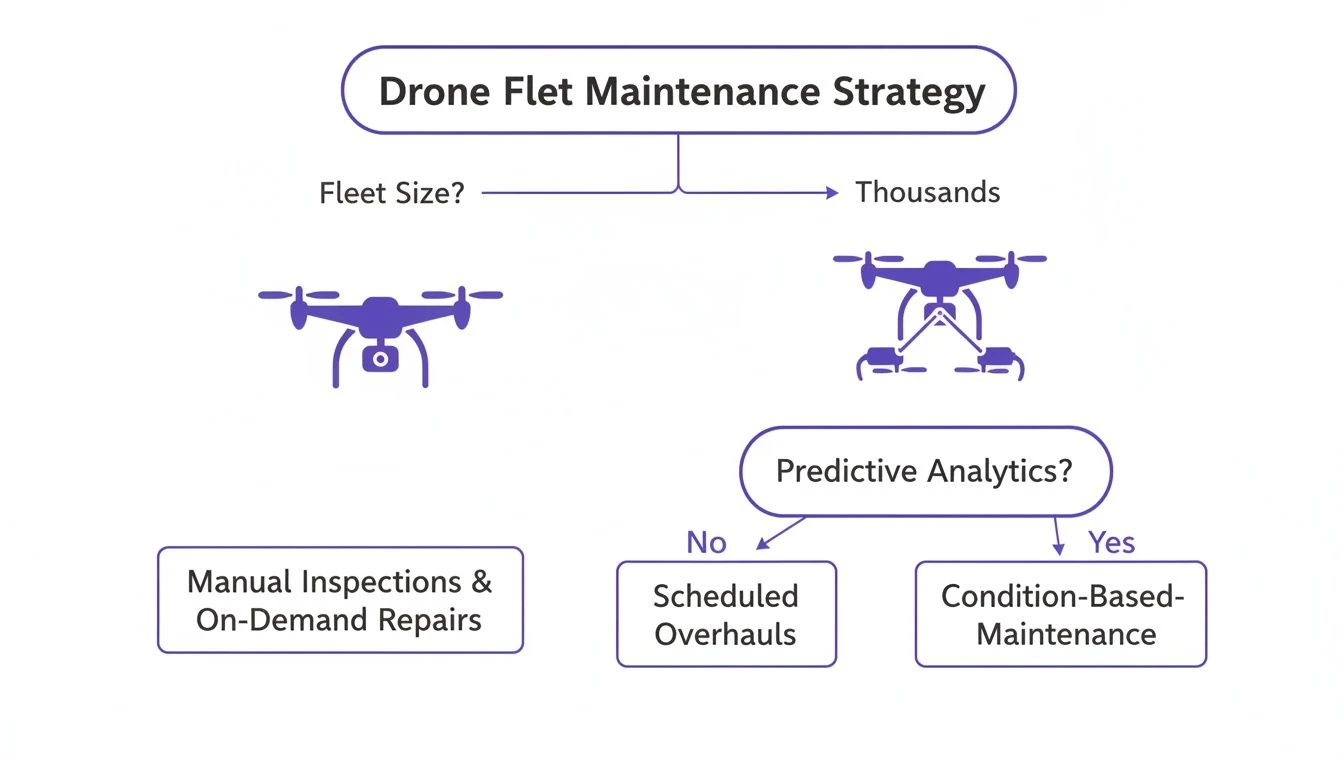
As you can see, smaller fleets typically get more bang for their buck with a centralized setup. Larger, more spread-out operations, however, naturally lean toward a distributed or hybrid network to stay quick on their feet.
For many large-scale operations, a hybrid model is the best of both worlds. This means having a central "Tier 3" hub for the heavy-duty repairs, backed by several distributed "Tier 1" satellite spots for routine maintenance. It’s a structure that gives you deep-level capability when you need it and a rapid response out in the field.
How to Select and Equip Your Maintenance Sites

Figuring out the physical home for your maintenance operation is a bit like choosing a spot for a new house. If you get the foundation wrong, everything you build on top of it is going to have problems. It doesn't matter if you’re setting up one big centralized hub or a whole network of smaller depots—picking the right spot needs careful, strategic thinking.
This isn't just about finding a room with four walls and a roof. It’s about creating a space that’s built for technical work, keeps your valuable assets secure, and helps your team work efficiently. A good location can give your whole operation a massive boost, while a bad one will just become a constant headache and a drag on your uptime.
Core Criteria for Site Selection
When you're out scouting for potential enterprise fleet maintenance locations, you need to look past the simple square footage. The sweet spot is a place that’s easy to get to, secure, and has the right kind of infrastructure for all your high-tech gear.
Here’s a quick checklist to run through when you’re evaluating potential sites.
Location and Accessibility:
- Near Your Flight Zones: Your maintenance site should be close enough to your main operational areas to cut down on travel time. The less time technicians and drones spend on the road, the faster those assets get back in the air.
- Easy Access: Think about the practicalities. Are the roads good for transporting equipment? Is it a nightmare for your staff to commute to? A hidden-away spot in a confusing industrial park can quickly become a daily frustration.
Security and Environment:
- Serious Security: Drones, batteries, and sensors are not cheap. You need a facility with solid access control, good surveillance cameras, and ideally a fenced perimeter to keep thieves and unauthorized people out.
- Climate Control: This one’s a deal-breaker. Sensitive electronics and especially LiPo batteries hate extreme temperatures and humidity. A climate-controlled space is absolutely essential for safe battery storage and keeping your sensors properly calibrated.
Space and Layout:
- Enough Room to Work: You'll need dedicated bays for repairs, a secure area for inventory, a super-clean space for delicate sensor work, and some office space for the team. Don't forget you'll also need some open floor space for quick test hovers and system checks.
- Room to Grow: Pick a place that can grow with you. If your fleet doubles in size next year, can you easily expand your workshop or add more storage? Don't box yourself in.
Essential Tools and Equipment for Your Hub
Once you've found the perfect spot, it's time to kit it out. A well-stocked maintenance hub gives your technicians everything they need for jobs big and small, from routine servicing to complex repairs. Getting this right is a direct investment in the quality and speed of your work.
It helps to think about your equipment in a few different tiers.
- Basic Bench Tools: This is your bread and butter. We’re talking about soldering stations, multimeters, hex driver sets, wire strippers, and those tiny precision screwdrivers. No electronics workshop can function without them.
- Diagnostic and Calibration Gear: This is what keeps your drones flying safely and your data accurate. Think propeller balancers, thrust stands, and specific calibration rigs for things like IMUs and camera gimbals.
- Battery Management Systems: You'll need smart chargers, battery analyzers, and fire-resistant storage like LiPo bags or proper battery bunkers. Managing your battery stock safely is a top priority.
- Software and IT Infrastructure: A fast, reliable internet connection is non-negotiable. You’ll also need good workstations running diagnostic software, tools for flight log analysis, and of course, your fleet management platform like Dronedesk.
For an extra edge in operational readiness, you might even look into bringing in technologies like UAV 3D printing. This can be a game-changer, allowing you to print custom mounts, non-critical replacement parts, and specialised jigs on-demand, which means you’re less dependent on suppliers.
Building Your Expert Maintenance Team
The most kitted-out workshop in the world is completely useless without the right people. Your team is what turns that room full of expensive tools into a well-oiled machine that keeps your fleet flying.
A maintenance bottleneck isn't always about a missing part; a lot of the time, it's about not having the right person to figure out the problem or manage the workflow. A skilled team is your best insurance against long periods of downtime.
This isn’t just a drone industry problem; lessons from the wider vehicle fleet world prove it. A recent report showed that two of the biggest causes of maintenance delays were technician shortages (27.4%) and poor communication (31.5%). It just goes to show that investing in good people and clear processes is every bit as important as buying the right equipment.
Your dream team should include:
- Certified Drone Technicians: These are the heart of your operation. Look for people with solid experience in electronics, soldering, and ideally, the specific drone models you fly.
- Inventory Manager: This person is your supply chain guru. They track all the spare parts, manage stock levels, and make sure your technicians have the components they need, when they need them.
- Compliance Specialist: This role is all about the paperwork. They ensure every single maintenance action is documented perfectly to meet regulatory standards, keeping you audit-ready at all times. Properly managing your hardware is a huge part of this, which you can learn more about in our guide on equipment lifecycle management.
Standardizing Workflows to Maximize Drone Uptime
A top-of-the-line workshop is a great start, but it’s only half the battle. Your enterprise fleet maintenance locations will only run as smoothly as the processes you build for them. Without standardized workflows, you’re just creating well-organized chaos. It’s the repeatable, efficient procedures that turn a maintenance hub from a cost center into a machine that drives uptime.
This means you need to map out the entire journey a drone takes through your maintenance system. Every step, from routine pre-flight checks and scheduled servicing to urgent field repairs and post-fix test flights, has to be defined, documented, and followed to the letter, every single time, at every single location.
Defining Your Maintenance Lifecycle
Don't mistake standardization for red tape. It’s about building a playbook that guarantees quality, safety, and compliance across the board. When a drone in Texas gets the exact same quality of service as one in Florida, you've built a fleet you can truly rely on. That consistency is your best defense against surprise failures and a sharp eye from regulators.
A solid workflow is like a GPS for your technicians, guiding them through each job. It should cover the full trip a drone takes through your shop:
- Intake and Triage: The drone lands in the workshop. A technician logs its arrival, notes the issue or scheduled service, and does a quick once-over to figure out what needs to be done.
- Repair and Service: The tech follows a standard checklist for the task, whether it's a simple prop swap or a tricky sensor calibration. Every part used is scanned and logged against that drone’s specific ID.
- Quality Control: Another person—maybe a senior tech or a different team member—reviews the work. This simple cross-check confirms everything was done by the book and stops shoddy repairs from ever leaving the bench.
- Post-Maintenance Validation: The drone goes for a test flight in a safe, designated area to prove it's fully operational. The logs from this flight are checked to make sure all systems are performing as they should.
- Return to Service: Once it passes validation, the drone’s status is updated, and it’s officially cleared to get back to work.
The Digital Twin for Maintenance Operations
In any modern operation, you're not tracking this on a whiteboard or a messy spreadsheet. A platform like Dronedesk becomes a 'digital twin' for your maintenance activities, creating a permanent, searchable history for every single drone in your fleet.
This is non-negotiable. It lets you track every service event, every part that’s been swapped, and every note a technician has made in one place. Managers get a complete, real-time picture of the fleet's health, no matter where the drones or the maintenance teams are physically located.
A digital maintenance log is more than just a record; it's a powerful analytical tool. By tracking trends in repairs and component failures across your enterprise fleet maintenance locations, you can move from a reactive to a proactive service model.
Making this shift is fundamental to keeping your drones in the air. When you’re standardizing your workflows, you need to decide on your core maintenance strategy, weighing the pros and cons of predictive maintenance vs. preventive maintenance strategies. A digital platform gives you the hard data you need to make that call effectively.
Smart Scheduling and Predictive Analytics
Once you have a solid workflow and digital tracking, you can start getting really smart. One of the easiest wins is scheduling routine maintenance during off-peak hours or planned downtime. That way, servicing never has to compete with paying jobs.
But the real magic happens when you start using the data you’re collecting. By analyzing service histories, you can spot patterns. You might find that a certain motor model tends to give up the ghost after 300 flight hours. With that insight, you can schedule a replacement at 280 hours, stopping an in-flight failure before it has a chance to happen.
This data-driven approach lets you:
- Forecast Parts Demand: Know exactly which spares you’ll need and when, so you can keep inventory at each location just right.
- Optimize Technician Time: Line up complex repairs for when your most skilled techs are on shift, nailing the fix the first time around.
- Improve Fleet Reliability: Get ahead of known failure points and boost the Mean Time Between Failures (MTBF) for your entire fleet.
By bringing together standardized workflows, a powerful management platform, and data-driven insights, your enterprise fleet maintenance locations transform from simple repair shops. They become strategic hubs of excellence, dedicated to keeping your drones flying and your business moving forward.
7. Tracking KPIs and Compliance Across Your Network
Trying to manage a network of enterprise fleet maintenance locations without solid data is like flying blind. Without clear metrics and airtight compliance, you can't spot weaknesses, prove your strategy is working, or show the real value your maintenance program delivers. It's simple: to get every location operating at its best, you have to let the data lead the way.
The first step is getting your record-keeping in order. For regulatory bodies like the FAA or EASA, this is non-negotiable. Sloppy paperwork isn’t just a minor headache; it can ground your aircraft, land you with hefty fines, and even cost you the authority to operate.
Mastering Compliance and Record-Keeping
A solid compliance process ensures every single maintenance action is documented, traceable, and ready for an audit at a moment's notice. This isn't just about ticking boxes for the authorities. It’s about building an unshakeable foundation of safety and accountability across your entire network.
Your compliance records need to be flawless and easy to pull up. This means tracking:
- Detailed Maintenance Logs: Every repair, inspection, and component swap has to be logged against a specific drone's serial number. This gives you a complete, chronological service history for each aircraft.
- Technician Certifications: You need a live record of which technicians are certified for which tasks on which drone models, and you have to make sure those qualifications never lapse.
- Complete Parts Traceability: The history of every single part, from a propeller to a high-end sensor, must be tracked. This is absolutely critical for handling recalls or understanding why certain components fail.
Honestly, the only sane way to manage this level of detail is with a central system. Using dedicated aircraft maintenance tracking software ensures you have consistency and control across all your maintenance sites.
Identifying Your Most Important KPIs
If compliance is about following the rules, then Key Performance Indicators (KPIs) are about winning the game. These are the specific, measurable numbers that tell you just how effective your maintenance operation really is.
You can't improve what you don't measure. Think of KPIs as the vital signs of your fleet's health. They tell you exactly where your maintenance strategy is working and where it needs urgent attention.
To avoid getting lost in a sea of data, just focus on a few high-impact metrics. These core indicators will give you a clear, honest picture of your operational efficiency and financial performance.
Core Maintenance KPIs to Track
| KPI | What It Measures | Why It's Important |
|---|---|---|
| Mean Time Between Failures (MTBF) | The average time a drone operates before something goes wrong. | A high MTBF is a great sign. It points to reliable aircraft and a preventive maintenance plan that’s actually working. |
| Mean Time To Repair (MTTR) | The average time it takes to fix a drone and get it back in the air. | A low MTTR shows you have efficient technicians and smooth workflows, which is key to minimizing downtime. |
| Maintenance Cost Per Flight Hour | Your total maintenance spend divided by the total number of flight hours. | This metric ties your maintenance budget directly to operational output, helping you see the true cost of keeping your fleet flying. |
| Fleet Availability Rate | The percentage of time your fleet is ready for a mission. | This is the bottom line. It’s the ultimate measure of how well your maintenance program is supporting your core operations. |
Using Data to Drive Decisions
Tracking these KPIs is just the start. The real magic happens when you use this data to make smarter decisions across all your enterprise fleet maintenance locations. By benchmarking performance, you can quickly see which sites are knocking it out of the park and which are falling behind.
For example, if one location has a much higher MTTR, that could be a red flag for a lack of technician training or poor parts inventory management. If a specific drone model consistently has a low MTBF across the board, you’ve likely found a recurring hardware issue that needs a fleet-wide fix.
The broader fleet maintenance software market, valued at USD 3.98 billion in 2025, is set to skyrocket to USD 15.49 billion by 2034, fueled by a powerful 16.3% CAGR. For enterprise drone managers, this explosion in growth highlights one thing: software-driven optimization is no longer optional. Real-time tracking and analytics are becoming essential tools to slash downtime and get ahead of rising operational costs with predictive maintenance.
This data-first approach lets you move from a reactive "break-fix" model to a much smarter, proactive one. By analysing trends, you can start to anticipate failures, fine-tune your supply chain, and confidently prove the ROI of your entire maintenance operation.
How Dronedesk Manages Your Maintenance Locations
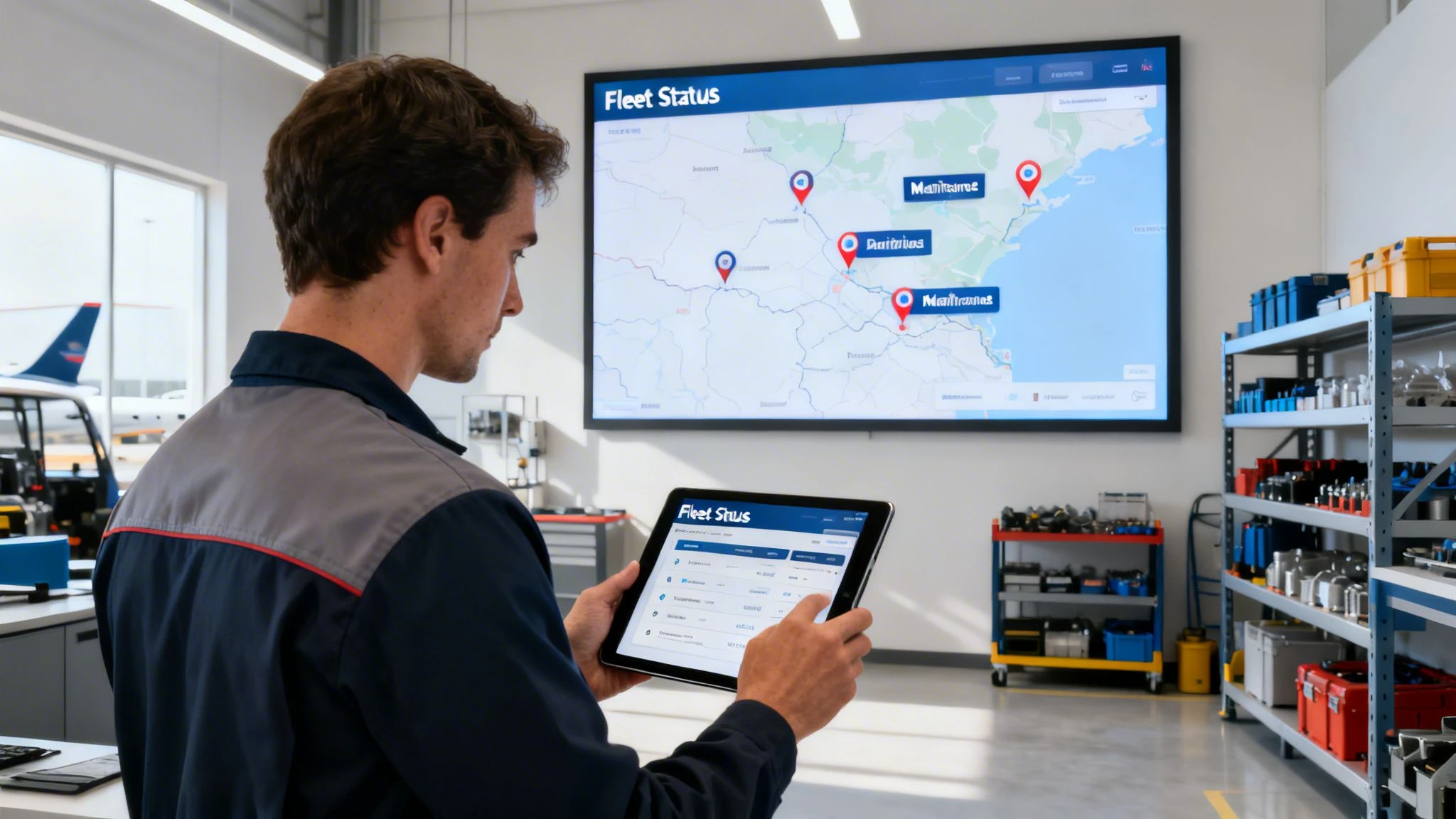
All the theory and strategy in the world won't keep your drones in the air. A great plan is only as good as its execution, and that’s where a dedicated platform like Dronedesk really shines. It's the bridge between your vision for enterprise fleet maintenance locations and the day-to-day reality of keeping your aircraft mission-ready.
Think of it as the command centre for your entire maintenance network. Instead of juggling a mess of spreadsheets, chaotic email threads, and paper logbooks, Dronedesk gives you one place to see everything. It takes your chosen model—centralized, distributed, or a hybrid—and turns it into a living, digital environment where every action is tracked.
Building Your Digital Maintenance Network
The first step is to create a digital twin of your physical maintenance footprint inside the platform. With Dronedesk, you can set up each of your maintenance locations as its own distinct hub, giving you a crystal-clear map of your operations. This isn't just about plugging in addresses; it's about building a smart, connected system from the ground up.
Once your locations are mapped out, you can start assigning assets and people with real precision:
- Assign Drones to Hubs: Link specific drones and their batteries to a designated "home" maintenance location. No more confusion about where an asset belongs.
- Manage Technician Access: You can grant specific permissions to your technicians, making sure they only see and manage the aircraft and tasks for their assigned hub.
- Organize Parts Inventory: Track your spare parts inventory not just for the whole company, but by individual location. This stops a tech in one city from accidentally using a critical part that's desperately needed at another site.
From Task Scheduling to Total Oversight
With your digital network in place, Dronedesk becomes the engine for all your maintenance activities. You can schedule a recurring service for a drone at its home base, log an emergency repair at a forward operating site, and attach all the notes, photos, and parts used directly to that drone’s permanent digital record.
Dronedesk transforms maintenance from a messy logistical puzzle into a clean, predictable workflow. By pulling in data from all your enterprise fleet maintenance locations, it gives you a live, 360-degree view of your entire fleet's health and readiness.
This means that from a single dashboard, you can see instantly which drones are in the air, which are in for service, and which are overdue for critical checks. This level of oversight kills the guesswork, closes communication gaps, and gives you the confidence to manage your fleet with total clarity.
Frequently Asked Questions
Setting up a drone maintenance network for a large enterprise always brings up a few key questions. I've heard them all over the years, so let's get straight to the answers you'll need as you build out your strategy for enterprise fleet maintenance locations.
How Do I Calculate the ROI of a New Maintenance Location?
Thinking about the Return on Investment (ROI) is smart. The trick is to look beyond the obvious costs. On one side of the ledger, you'll have your setup expenses — things like lease payments, salaries for your techs, and the initial tooling. That's the easy part.
The real value, the "return" part of the equation, comes from the gains. This is where a new location truly starts to pay for itself.
You'll want to quantify benefits like:
- Less money spent on fuel and a massive reduction in technician travel time.
- The complete elimination of shipping costs for sending drones back and forth to a central hub.
- More revenue generated simply because your fleet has higher availability and less downtime.
When you look at it that way, a location that keeps your drones mission-ready isn't just a cost center. It's a direct contributor to your bottom line.
What Are the Biggest Compliance Mistakes to Avoid?
The most expensive mistakes almost always boil down to two things: inconsistency and a lack of central oversight. I've seen operators get tripped up by inconsistent record-keeping across different sites, using technicians who aren't certified for specific repairs, and—a big one—failing to track the lifecycle of critical parts like batteries and props.
A single compliance gap can put your entire operation at risk. Your best defense is a unified system that standardizes every bit of documentation. You need to ensure every location, no matter how small, plays by the exact same rulebook. That way, there's just no room for error when an auditor comes knocking.
Frankly, centralizing all this data in a platform like Dronedesk is the only practical way to sidestep these errors and stay permanently audit-ready.
Can I Start with a Mobile Maintenance Van?
Absolutely. A mobile maintenance van is a fantastic way to dip your toes into a distributed model without a huge upfront commitment. Think of it as a roving service hub, bringing the workshop directly to your drones out in the field.
It's a flexible, lower-cost method for testing the waters in different service areas. You can figure out demand and what your teams actually need before you commit to signing a lease on a physical building. It's a savvy way to prove the concept works while keeping your initial investment down and your uptime high.
Ready to take full control of your enterprise fleet maintenance locations and ensure every drone is mission-ready? Dronedesk provides a single, powerful platform to manage your maintenance schedules, track parts, and maintain flawless compliance records across your entire network. Start your free trial today and see the difference.
 FAA Unmanned Aircraft Regulations Made Simple →
 Part 107 Test Tips to Pass With Confidence →
 How to Pass the FAA Drone Written Test First Time →
 What a BVLOS Flight Means for Risk and Compliance →
 Drone VLOS Rules Explained for Commercial Teams →
 FAA Remote ID Rule Explained for Commercial Pilots →
 Drone Legal Requirements for Commercial Operations →
 Drone Near Airport Rules Explained for Safer Planning →
 International Drone Regulations Every Global Team Should Know →
 Drone Flight Risk Assessment Example for Safer Missions →