
What Part 107 Covers Beyond the Pilot Certificate
For many commercial drone operators, Part 107 begins with a simple goal: pass the FAA knowledge test and obtain the Remote Pilot Certificate. That certificate matters, but it is only one part of the rule. The wider Part 107 framework governs how small UAS operations are planned, authorised, flown, supervised and reported in United States airspace.
That distinction is important for survey firms, utility inspection teams, emergency services and any operator managing repeatable commercial missions. A pilot certificate can prove competence at an individual level. It does not, by itself, make a flight legal, safe or defensible.
The official rule is found in 14 CFR Part 107, which covers small unmanned aircraft systems used for civil, non-recreational operations. In practical terms, Part 107 is less like a driving licence and more like an operating framework for the whole job.
Part 107 is an operating framework, not just a licence
The Remote Pilot Certificate sits inside Part 107, but the rule reaches far beyond pilot qualification. It defines the type of aircraft covered, the role of the remote pilot in command, operational limits, airspace access, operations over people, night operations, accident reporting and waiver pathways.
For a commercial team, this means Part 107 compliance is a workflow. It starts when a job is scoped, continues through airspace checks and risk assessment, and does not end until the flight is logged and any required reports are complete.
A useful way to think about it is this: the certificate answers “who is allowed to act as remote pilot in command?” The rest of Part 107 answers “under what conditions can this mission be flown?”
| Area Part 107 touches | What it means in practice | Why it matters |
|---|---|---|
| Pilot qualification | The remote pilot in command must hold the appropriate FAA certificate and maintain recurrent training | Individual competence must be current, not assumed |
| Aircraft and mission limits | Small UAS operations are limited by weight, altitude, speed, visibility and other operating conditions | The aircraft and task must fit the rule before the job is accepted |
| Airspace access | Controlled airspace generally requires FAA authorisation before flight | A qualified pilot still cannot simply launch in controlled airspace |
| People and vehicles | Flights over people or moving vehicles are restricted unless specific conditions are met | Urban surveys, public safety work and infrastructure inspections need careful planning |
| Waivers | Some rules may be waived if the FAA accepts the safety case | Advanced missions require documented mitigations, not informal judgement |
| Reporting and compliance | Certain accidents must be reported, and records may need to be shown to the FAA | Operational evidence matters after the flight as much as before it |
It defines the aircraft and operation Part 107 applies to
Part 107 is designed for small unmanned aircraft systems. In general, that means drones weighing less than 55 lb, including everything attached or carried. This matters because payloads, sensors, batteries and attachments all count toward the operating weight.
For survey companies, that can affect whether a heavier mapping payload still fits within the small UAS framework. For utility operators, it can determine whether a drone carrying specialist inspection equipment remains eligible for the same operational pathway. For emergency services, it helps clarify which aircraft can be deployed quickly under normal Part 107 rules and which may require a different authorisation route.
Part 107 also sets the basic operating environment. The rule includes limits such as maximum altitude, maximum groundspeed, minimum flight visibility and cloud clearance. It also prohibits careless or reckless operation. Those limits are not academic details. They shape whether a job can be flown on the requested day, in the requested location, at the requested height and in the requested weather.
The standard altitude limit is 400 ft above ground level, with an allowance to fly higher when operating within 400 ft of a structure. That distinction is especially relevant for tower inspections, wind turbine work, bridge inspections and other infrastructure missions. The job may be possible, but the operator must understand the rule and document the plan clearly.
It makes the remote pilot in command accountable
Part 107 assigns responsibility to the remote pilot in command, often shortened to remote PIC. This person is not just the person holding the controller. The remote PIC is responsible for the safe conduct of the operation, even when other people support the flight.
That responsibility includes ensuring the aircraft is in a condition for safe operation, understanding the operating environment, checking for hazards, and making sure the flight complies with the applicable rules. If another person manipulates the controls, they must be under the direct supervision of the remote PIC unless they are also qualified to act in that role.
This is where commercial operations often become more complex than solo flying. A utility inspection may involve a pilot, payload operator, visual observer, site safety lead and client representative. A public safety deployment may involve an incident commander and multiple aircraft teams. Part 107 does not remove the need for command structure. It makes the accountable aviation role clear.
For larger teams, that means it is not enough to know that “someone has a Part 107”. Each operation should identify who is acting as remote PIC, who is supporting the flight, what each person is responsible for, and how decisions will be made if conditions change.
It controls where you can fly, especially in controlled airspace
A pilot certificate does not grant automatic access to controlled airspace. Under Part 107, operations in Class B, C, D and certain Class E airspace require FAA authorisation. In many cases, operators use LAANC, the FAA’s Low Altitude Authorization and Notification Capability, to request near real-time access where available.
This is one of the most common gaps between certificate knowledge and operational compliance. A pilot may be fully certificated, the aircraft may be capable, and the client may be ready, but the flight still cannot proceed in controlled airspace without the right authorisation.
Airspace planning should also account for temporary flight restrictions, restricted areas, nearby airports, heliports, emergency response activity and local site constraints. Some of those constraints sit outside Part 107 itself, but they still affect whether the mission can lawfully and safely take place.
For emergency services, this is especially important. A drone deployed near an incident may be close to helicopters, temporary restrictions or other response aircraft. For survey and utility firms, repeatable inspections near airports or urban corridors need a consistent authorisation process, not one-off guesswork.
It covers night operations, people and moving vehicles
Modern commercial drone work often happens in environments that Part 107 treats with extra care. Night flights, operations near people and operations around vehicles can all introduce risk that goes beyond basic pilot certification.
Night operations are allowed under Part 107 when the pilot has completed the applicable FAA training or testing requirements and the drone has anti-collision lighting visible for at least 3 statute miles, subject to safety considerations. That opens the door for useful work such as thermal inspections, emergency response support and low-light infrastructure surveys, but it does not remove the need for planning.
Operations over people and moving vehicles are more restricted. The FAA created categories for certain operations over people, but operators need to understand whether their aircraft qualifies, whether exposed rotating parts are protected, and whether the operation meets the relevant conditions. In many commercial settings, the safest and simplest plan is still to control the area, brief participants and avoid unnecessary overflight.
The same applies to moving vehicles. A road closure, utility corridor, construction site or public event may look straightforward from the air, but Part 107 requires careful analysis of who is participating, who is protected, and whether the flight path creates exposure to uninvolved people.
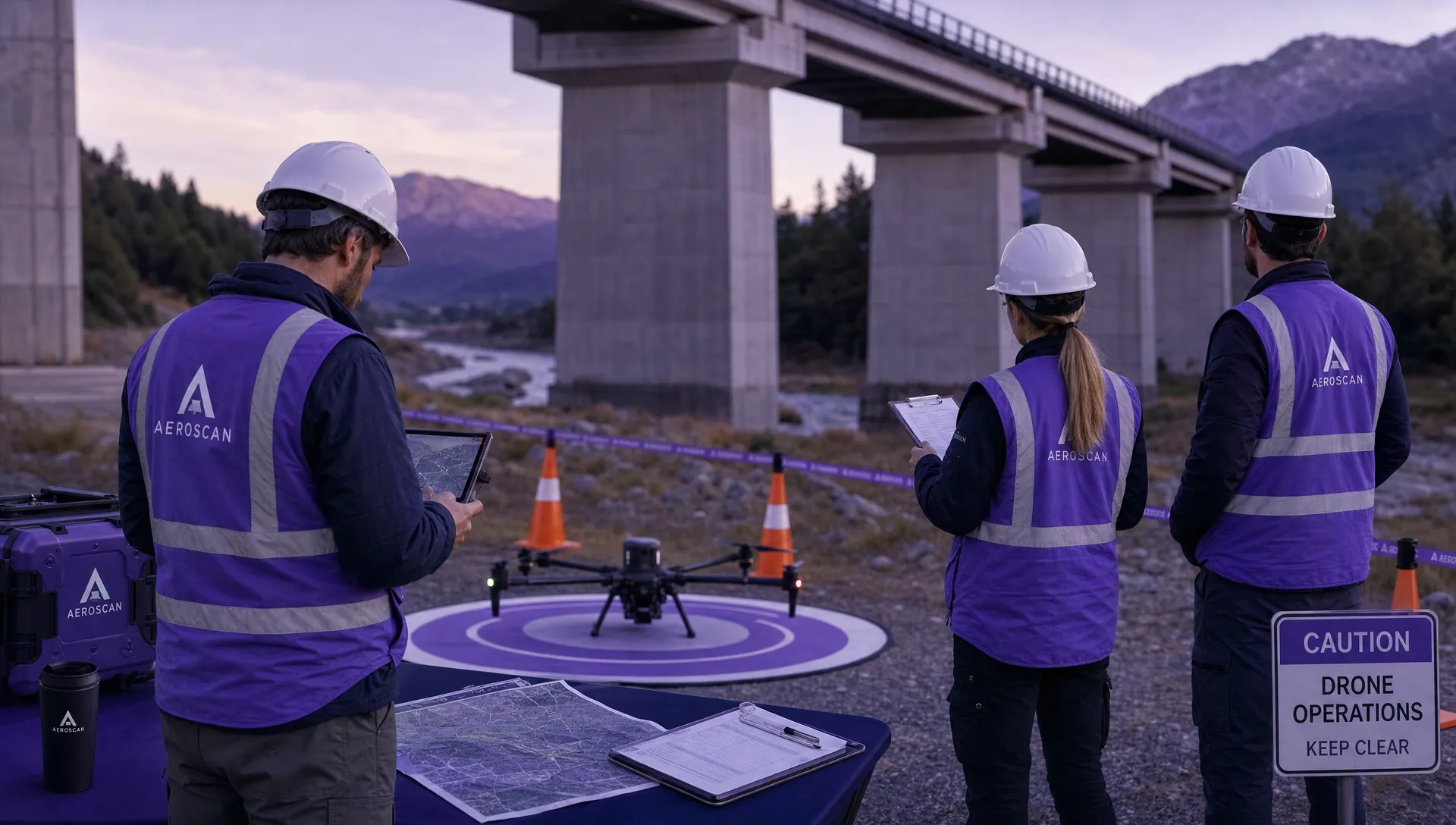
It expects pre-flight assessment and practical risk management
Part 107 does not prescribe one universal risk assessment template. It does, however, require the remote PIC to assess the operating environment and ensure the aircraft is safe before flight. In real-world commercial operations, that quickly becomes a need for structured risk management.
A sound Part 107 workflow should consider the airspace, weather, ground hazards, nearby people, emergency landing options, crew roles, communication methods, aircraft condition and mission-specific risks. The goal is not to create paperwork for its own sake. The goal is to make defensible decisions before the aircraft leaves the ground.
This is particularly important for repeat operators. A single low-risk photography job may be manageable with a simple process. A programme of utility inspections, emergency response deployments or survey flights across multiple sites needs a consistent method that can be followed by different pilots and reviewed later.
If you are strengthening your operational process, Dronedesk has a detailed guide on building a drone flight risk assessment that works, which is a useful companion to the regulatory requirements.
It includes waivers for operations outside the standard rule
Part 107 is not only a list of restrictions. It also includes a waiver mechanism. If an operation cannot be conducted under the standard rules, the operator may be able to request a waiver by showing the FAA how the mission can be conducted safely.
Waivers are commonly associated with more advanced operations, such as beyond visual line of sight, operations over people that do not otherwise qualify, operating multiple drones, certain altitude needs, and other deviations from the standard limitations. The key point is that a waiver is not a shortcut. It is a safety case.
The FAA will expect the operator to explain the proposed operation, identify hazards, define mitigations, and demonstrate that the residual risk is acceptable. That often means documenting crew training, technology, communication procedures, contingency planning, detect and avoid methods, and emergency actions.
For organisations exploring advanced operations, it helps to understand the operational concept before focusing on the paperwork. Dronedesk’s overview of how beyond visual line of sight drone operations work can help teams frame the practical issues that sit behind a waiver request.
It intersects with registration, Remote ID and other FAA rules
Not everything a commercial drone operator must do is contained inside Part 107. That is another reason the certificate-only view can be misleading.
Drone registration, for example, is handled under separate FAA requirements, but it is part of the compliance picture for commercial operations. Remote ID is also governed separately, mainly under 14 CFR Part 89, but most drones that require registration must comply unless an exception applies, such as flying at an FAA-recognised identification area. The FAA’s Remote ID guidance explains the current framework.
There may also be state, local, tribal, privacy, data protection, land access, critical infrastructure or client-specific requirements. Part 107 compliance does not automatically authorise take-off from private land, override privacy obligations or satisfy every contract requirement.
For operators working internationally, the distinction is even more important. Part 107 is an FAA rule for US operations. A UK-based company operating in the United States, or supporting a US client, may need to understand Part 107. But flights in the UK are governed by the UK Civil Aviation Authority, not the FAA.
It creates post-flight obligations too
Part 107 compliance does not end when the aircraft lands. The rule includes accident reporting obligations and gives the FAA authority to inspect or test certain documents, records and equipment related to compliance.
Under Part 107, the remote pilot in command must report certain accidents to the FAA within 10 calendar days. This applies when an operation results in serious injury, loss of consciousness, or qualifying property damage above the regulatory threshold. Operators should not wait until an incident happens to decide how reporting will be handled.
Post-flight discipline is also valuable even when no report is required. Flight logs, battery records, maintenance notes, crew observations, client deliverables and lessons learned can all support safer future operations. They also help managers spot patterns, such as recurring site hazards, aircraft reliability issues or training needs.
A mature Part 107 operation should therefore include both pre-flight and post-flight administration. If a job is worth planning, it is worth recording accurately.
A practical Part 107 compliance workflow
The easiest way to move beyond a certificate-only mindset is to treat each mission as a lifecycle. The details will vary by organisation, but the core stages are consistent.
| Stage | Compliance focus | Typical questions to answer |
|---|---|---|
| Job intake | Mission fit | Is this a Part 107 operation, and does the aircraft, payload and location fit the standard rule? |
| Planning | Airspace and permissions | Is controlled airspace involved, and are authorisations, site permissions or waivers needed? |
| Risk assessment | Operating environment | What hazards affect the flight, and what mitigations will be used? |
| Crew briefing | Roles and responsibilities | Who is the remote PIC, who is observing, and how will the team communicate? |
| Pre-flight | Aircraft and site readiness | Is the drone airworthy, is Remote ID functioning where required, and are weather conditions acceptable? |
| Flight | Rule compliance | Is the operation staying within visual line of sight, altitude, airspace and people-related limits? |
| Post-flight | Records and reporting | Are logs complete, defects noted, and any reportable events escalated? |
This workflow is especially useful for organisations with multiple pilots. It gives managers a repeatable structure and helps prevent compliance from depending solely on individual memory.
How operations software fits into Part 107 compliance
Software cannot make a flight legal on its own, and it cannot replace the judgement of a competent remote pilot in command. What it can do is help teams keep the operational pieces organised.
Dronedesk is built as an all-in-one web platform for drone operations management. Its published feature set includes client management, fleet management, team management, airspace intelligence, proximity intelligence, flight planning, flight logging, data reporting, configurable checklists and risk assessments. You can review the current capability set on the Dronedesk features page.
For Part 107 operators, those categories map naturally to the compliance lifecycle. Client and site details support job intake. Fleet and team records support readiness. Airspace and proximity intelligence support planning. Checklists and risk assessments support pre-flight decision-making. Flight logging and reporting support the post-flight record.
The important point is not to create more administration. It is to make the right administration easier to complete consistently, especially when your operation involves multiple sites, pilots, aircraft or clients.
Frequently Asked Questions
Is a Part 107 certificate enough to fly commercially in the United States? No. The certificate allows a qualified person to act as remote pilot in command, but the operation must still comply with Part 107 operating rules, airspace authorisations, aircraft requirements, Remote ID where applicable, and any other relevant legal or site requirements.
Does Part 107 apply outside the United States? Part 107 is an FAA rule for operations in US airspace. Operators flying in other countries must follow the rules of the relevant aviation authority, such as the UK Civil Aviation Authority for UK operations.
Can a Part 107 pilot fly at night? Yes, provided the pilot has completed the applicable FAA training or testing requirements and the drone has suitable anti-collision lighting visible for at least 3 statute miles, unless a reduction in intensity is necessary for safety.
Does Part 107 allow beyond visual line of sight operations? Standard Part 107 operations generally require the drone to remain within visual line of sight of the remote pilot in command or visual observer. BVLOS operations usually require a waiver, exemption or other FAA approval pathway.
What should operators document for Part 107 compliance? At a minimum, operators should be able to evidence pilot qualification, aircraft readiness, airspace authorisation where needed, risk assessment, crew briefing, flight details, maintenance issues and any incident reporting decisions.
The takeaway for commercial operators
Part 107 is much more than the Remote Pilot Certificate. It is the rulebook that shapes the aircraft you use, the airspace you enter, the people you fly near, the conditions you fly in, the waivers you may need and the records you should keep.
For professional drone teams, the certificate is the starting point. The real compliance work is building a repeatable operation around it, one that is safe, documented and practical enough to use on every mission.
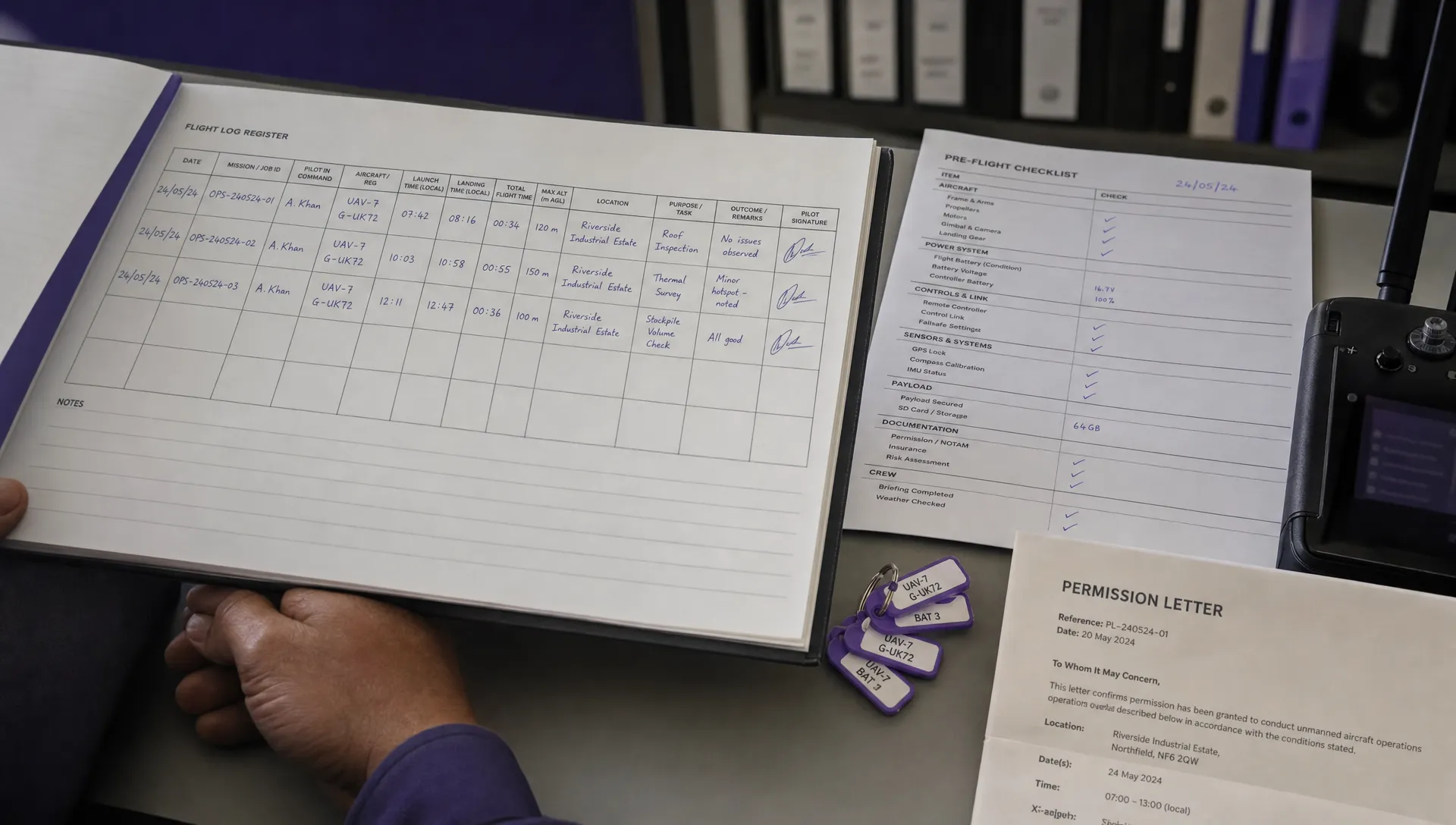 How to Build a Drone Pilot Flight Log That Is Audit Ready →
 FAA Drone Licence Requirements for Commercial Pilots →
 FAA BVLOS Waivers Granted: What Successful Cases Show →
 How to Export DJI Flight Logs for Incident Reviews →
 Drone Safety and Legal Duties for Business Operations →
 EASA Drone Regulations: Open, Specific and Certified Categories →
 What the BVLOS ARC Report Means for UAS Operators →
 Free Drone Pre-Flight Checklist for Commercial Missions →
 Contingency Volume and Flight Risk Buffer Explained →
 FAA Policy Changes That Commercial Drone Teams Should Track →