
Mastering State Drone Laws A Pilot's Guide
You've unboxed your shiny new drone, you're staring up at the sky, and you're thinking FAA registration is the only real hurdle to clear. If only it were that simple. That federal registration is just the base layer of a pretty complex legal cake, and each state adds its own unique flavor of rules. It's a confusing patchwork that can easily trip up even the most seasoned pilots.
Getting your head around this distinction between federal and state law is the absolute first step toward flying safely and, just as importantly, legally.
Why FAA Rules Are Only Half The Battle
Think of the Federal Aviation Administration (FAA) regulations as the foundation for all drone laws in the United States. They’re the big, overarching rules that apply everywhere. But they are far from the complete picture.
A good analogy is the national speed limit on a highway—it applies universally. But as soon as you pull off onto a city street or cruise through a school zone, a whole new set of local rules kicks in. State and local drone laws work in exactly the same way.
These state-specific rules are there to tackle the stuff that federal regulations don't really get into. While the FAA is focused on keeping the airspace safe, states step in to manage issues happening much closer to the ground. This creates a multi-layered legal landscape that every single drone pilot has to navigate.
It helps to visualize how these regulations stack on top of each other.

As you can see, federal rules form the base, but then you've got state and local ordinances piling on, each adding another layer of compliance you need to be aware of.
The Critical Role Of State Legislation
States tend to focus their drone laws on a few key areas that have a direct impact on local communities. If you ignore these, you could land yourself in serious legal trouble, even if you’ve ticked every single FAA box. You’ll often find state laws that cover:
- Privacy Concerns: Many states have put their own spin on "Peeping Tom" laws to include drones. This makes it illegal to use your drone to spy on or record people on private property without their permission.
- Critical Infrastructure Protection: States often designate no-fly zones around sensitive sites like prisons, power plants, and major government buildings to head off any potential security threats.
- Law Enforcement Use: You'll find specific legislation that lays out exactly how and when police or fire departments can use drones, whether for surveillance, search and rescue, or accident scene reconstruction.
- Public Lands and Parks: While national parks have a blanket ban on drones, states get to make their own rules for state and local parks, beaches, and wildlife conservation areas.
Navigating this legal maze means accepting one fundamental truth: compliance isn't a one-and-done FAA registration. It’s an ongoing process of checking federal, state, and local rules before every single flight you make.
This guide is your map through that maze. We’re going to break down the critical differences between these legal layers to help you fly with confidence. If you want to take a deeper dive into recent regulatory changes, you can explore the latest updates on new drone laws and see how they're affecting pilots.
Getting this right is the key to avoiding costly fines and legal headaches, ensuring every flight is safe, compliant, and completely stress-free.
Building Your Foundation with Federal Drone Law
Before you even think about digging into the patchwork of state drone laws, every single pilot needs to get a solid handle on the universal rules of the road. The Federal Aviation Administration (FAA) is the top dog, governing all airspace across the US. Their regulations are the non-negotiable bedrock that all other state and local rules are built on.
This isn't just for the pros. The federal framework applies to everyone, whether you're a hobbyist flying for fun in the local park or a commercial operator doing a detailed roof inspection. If you don't master these core rules, you're flying blind. State laws can add extra requirements, but they can never, ever replace these essential federal mandates.
These federal rules create a standardized system that keeps our skies safe and holds everyone accountable. That's becoming more critical by the day, especially when you see how many drones are actually up there.
As of October 2025, an incredible 855,860 drones were registered with the FAA in the United States. That number alone shows just how fast this industry is growing and why oversight is so important. Breaking it down, about 63% are flown for recreational fun, with the other 37% earning their keep in commercial work. It’s clear drones are a huge part of both business and pleasure now.
The Recreational Pilot Rulebook
If you're just flying for the sheer joy of it, the FAA has a straightforward set of guidelines just for you. The idea is to keep it simple while making sure everyone knows the basic safety principles. You won't need a formal pilot's license, but there are a couple of must-do tasks before you take off.
The main thing for any recreational pilot is passing The Recreational UAS Safety Test (TRUST). It’s a free, pretty simple online test that walks you through the fundamentals of safe flying. Once you pass, you have to have that proof of completion on you anytime you fly.
On top of that, any drone that weighs more than 250 grams (that’s about 0.55 lbs) has to be registered with the FAA. It’s a quick online process, costs just $5, and is good for three years. Just make sure your registration number is marked clearly on the outside of your drone.
The Commercial Pilot Pathway: Part 107
The moment your drone flights are tied to any kind of business—even indirectly—you’ve stepped into commercial territory. That means you fall under the FAA's Part 107 rules. This covers the obvious stuff like selling aerial photos, but also things like using a drone to check out the roof of your own business.
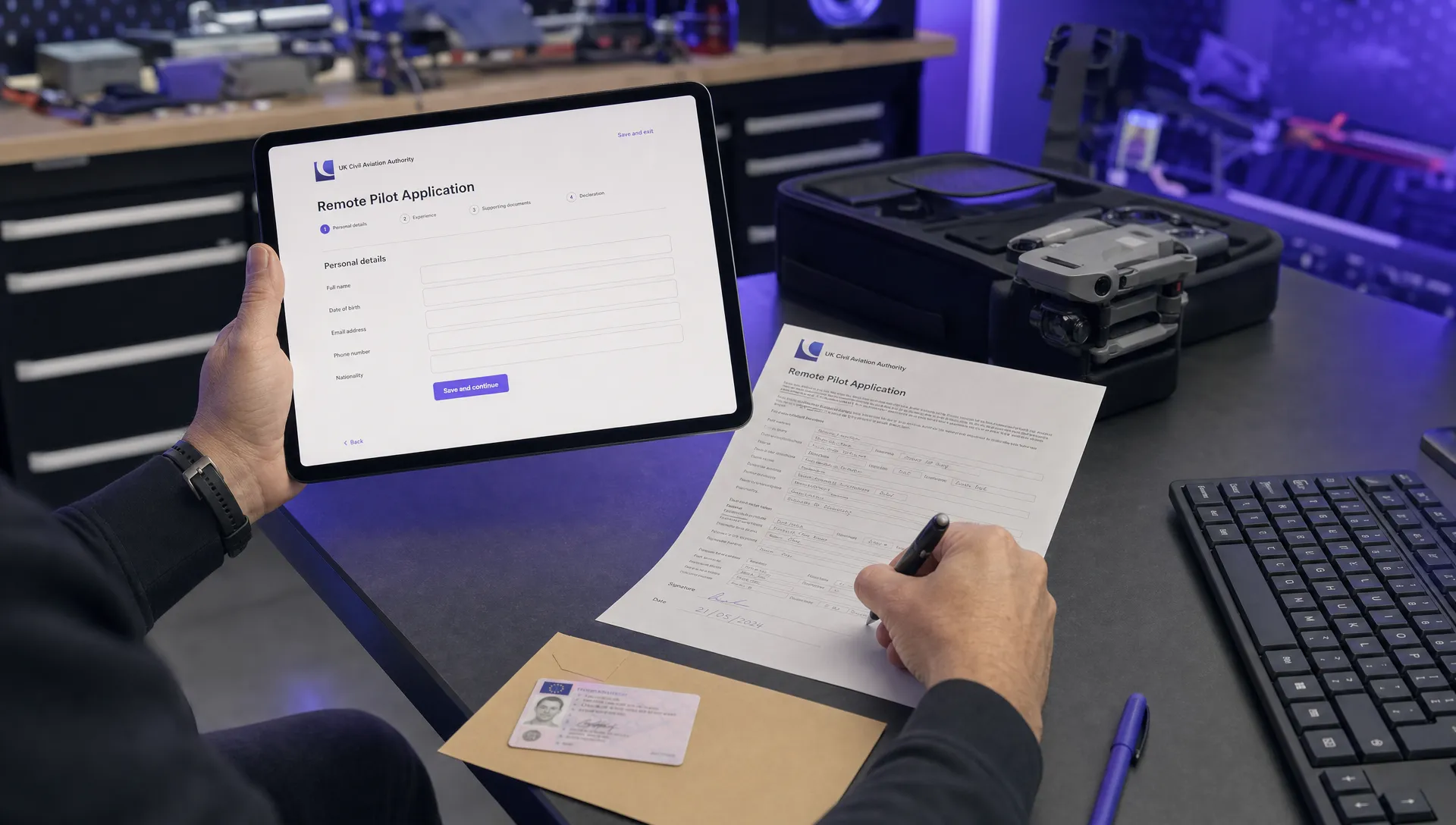
To fly commercially, you need to earn a Remote Pilot Certificate, which most of us just call a Part 107 license. Getting it involves passing an initial aeronautical knowledge exam covering everything from airspace classifications and weather to flight restrictions. You also need to be at least 16 years old and be able to read, write, and speak English.
The big difference-maker here is your intent. If the flight has any commercial purpose, you're a Part 107 pilot. If it's purely for kicks, you're recreational. When you're not sure which category you fall into, sticking to the stricter Part 107 rules is always the safest move.
For a complete breakdown of the requirements, check out our guide on how to get your FAA Part 107 drone certificate.
Remote ID: The Digital License Plate
There's one more massive federal rule that affects pretty much everyone: Remote ID. The easiest way to think about it is like a digital license plate for your drone. While in the air, it broadcasts identification and location info, which helps law enforcement and other officials know who is flying in their area.
This rule is a must for almost any drone that needs to be registered. You’ve got three ways to play by the rules:
- Standard Remote ID: Fly a drone that has Remote ID technology built right in from the factory.
- Broadcast Module: If your drone is older and doesn't have it, you can attach a separate Remote ID module to it.
- FRIA: The only exception is flying without Remote ID, but you can only do this within an FAA-Recognized Identification Area.
Getting your head around these federal pillars—TRUST for hobbyists, Part 107 for pros, and Remote ID for just about everyone—is step one. Once you have this foundation solid, then you’re ready to start looking at the unique state drone laws in your area.
Decoding the Patterns in State Drone Legislation
Trying to get a handle on state drone laws can feel like you're trying to solve 50 different puzzles at the same time. While the FAA gives us a solid national baseline for airspace safety, almost every state has piled its own specific rules on top. This patchwork of regulations means the game can change completely just by hopping over a state line.
But it’s not as chaotic as it looks.
When you take a step back, you start to see that most state laws circle around a handful of key themes. Instead of drowning in the legal jargon of each individual state, you can get ahead by understanding these common patterns. It helps you anticipate the kind of rules you'll run into, no matter where you fly.
Most of these state-level rules are focused on ground-level concerns—things the FAA's airspace mandate doesn't really cover.

To make sense of it all, I've broken down the most common types of state drone laws into a few key categories. Think of this as your cheat sheet for predicting what local regulations you'll need to look for.
Key Categories of State Drone Regulations
This table gives you a quick overview of the usual suspects in state drone legislation. It's a great starting point for knowing what to look out for before you launch.
| Category of Law | Common Restrictions | Example State Actions |
|---|---|---|
| Personal Privacy | Prohibits recording individuals on private property where they have a reasonable expectation of privacy. | California's strict laws criminalize using a drone to record someone in their backyard without consent. |
| Critical Infrastructure | Establishes no-fly zones around sensitive sites like prisons, power plants, and military bases. | Arizona and Delaware have enacted strong flight restrictions around these facilities. |
| Law Enforcement Use | Defines when and how government agencies can use drones, often requiring warrants for surveillance. | Florida has comprehensive laws that limit police use of drones for evidence gathering. |
| Public Lands & Parks | Restricts or bans drone flights in state parks and wildlife areas to protect nature and visitors. | Colorado requires special permits to fly in designated areas of its state parks. |
These four buckets cover the vast majority of state-level drone rules you'll encounter. Let's dig a little deeper into each one.
Protecting Personal Privacy
Let's be honest: nobody wants a drone with a camera peeking into their backyard BBQ. Public concern over privacy is one of the biggest reasons states create their own drone laws. It’s a completely understandable reaction.
To tackle this, states have taken old-school "Peeping Tom" laws and given them a 21st-century update to specifically include drones. These rules often make it flat-out illegal to use a drone to photograph or record people where they have a reasonable expectation of privacy—think fenced-in yards, through a bedroom window, you get the idea.
California is a perfect example, with tough laws that make unauthorized recording on private property a serious offense. The big takeaway here is simple: just because the FAA says you can fly in the airspace doesn't give you a free pass to film whatever is happening on the ground.
Securing Critical Infrastructure
Another major theme you'll see in state drone laws is the drive to protect sensitive locations. States have a huge interest in keeping sites that are essential to public safety and security safe from any potential threats. This has led to a whole new layer of no-fly zones on top of the FAA's.
These "critical infrastructure" sites usually include places like:
- Correctional Facilities: Flying a drone near a prison is a big no-no in most states, mainly to stop people from trying to smuggle in contraband.
- Power Plants and Utilities: To head off any security risks, states often ban flights around power stations, water treatment plants, and oil refineries.
- Military Installations: While federal law already covers these, many states have tacked on their own extra penalties for buzzing a military base.
States like Arizona and Delaware, for instance, have very clear no-fly zones around this type of infrastructure. It's also become common for states to explicitly ban weaponized drones. You can find more details on how different states are handling these rules and other fascinating drone statistics on hiredronepilot.uk. Always double-check for these local no-fly zones before you take off.
Regulating Law Enforcement Use
Drones are an incredible tool for police and first responders, but their use also brings up valid questions about surveillance and civil liberties. To strike a balance, many states have passed laws spelling out exactly how, when, and why government agencies can fly drones.
These regulations typically force law enforcement to get a warrant before using a drone for surveillance during an investigation. Of course, there are exceptions for real emergencies, like a search and rescue mission or mapping an accident scene. Florida, for example, has put extensive laws in place that set clear boundaries on how police can use drones to collect evidence.
This whole category of law is about creating a transparent system that allows public safety to benefit from drone tech without trampling on individual rights.
Managing Public Lands and Parks
While the National Park Service has a blanket ban on drones, the rules for state and local parks are a completely different story. This is where things get really messy, as regulations can change from one park to the next, even if they're in the same state.
Some states let individual park districts call the shots, while others try to set a statewide policy. Colorado, for example, generally prohibits drone flights in its state parks unless a pilot gets a specific permit for a designated flying area. It’s a common-sense approach designed to protect wildlife, keep the peace, and ensure visitors are safe.
The most important lesson here is to never assume you can fly in a public park. Always check the specific rules for that park, city, or state before launching. Ignoring these rules is one of the easiest ways for a pilot to receive a hefty fine.
How Drone Laws Vary From State to State
Getting a handle on the common themes in state drone laws is a great starting point, but the real test is seeing how wildly different those ideas play out on the ground. A rule that’s a minor detail in one state could get you in hot water just one border crossing away. This is where the abstract idea of "state drone laws" becomes a very concrete reality for every single pilot.
To really wrap your head around this legal patchwork, let's put a few states with totally different priorities side-by-side. Seeing their rules on the same page drives home the most critical lesson for any drone operator: you can never, ever assume the rules are the same.
A Head-to-Head Comparison
The differences aren't always subtle. Some states are laser-focused on privacy, while others care more about public land access or how law enforcement can use drones. This creates a messy legal quilt that demands you do your homework for a specific location before every single flight.
This regulatory maze is a direct response to the explosion in drone use. As more drones take to the sky, local and state governments are scrambling to add their own layers of rules. For instance, Florida has broad privacy laws that put tight limits on police drone use, while Colorado bans drone flights in its state parks unless you get a specific permit. Every major market is wrestling with how to balance innovation with safety and public comfort. You can get a broader view of these global drone industry trends on commercialuavnews.com.
Let's see how four completely different states—California, Florida, Colorado, and Texas—tackle some of the most common issues.
State Drone Law Comparison
This table gives you a snapshot of just how much drone regulations can differ, highlighting the key variations across four states.
| Legal Aspect | California | Florida | Colorado | Texas |
|---|---|---|---|---|
| Privacy Laws | Very strict. It's illegal to use a drone to record someone in a private place without their consent. | Strong focus on preventing "surreptitious surveillance" by both individuals and the government. | General trespass laws apply, but there's no specific drone privacy law at the state level. | Makes it a misdemeanor to use a drone to capture images of a person or private property with the intent to spy. |
| Law Enforcement Use | A warrant is required for drone surveillance in most scenarios. | Requires a warrant for surveillance, with clear exceptions for immediate threats or search and rescue. | No specific statewide law; it's governed by broader Fourth Amendment principles and local department policies. | A warrant is needed for surveillance in most cases, but there's a long list of exceptions for specific police activities. |
| Public Lands/Parks | Varies by city and park district; there isn't a single statewide law covering all state parks. | Local governments are allowed to regulate drone takeoffs and landings on property they own. | Banned in state parks and wildlife areas unless you have a specific permit from park management. | Gives cities the power to restrict drone operations over their parks and public facilities. |
| Critical Infrastructure | Flying over correctional facilities is prohibited. | Flying over or near designated critical infrastructure facilities is illegal. | No specific statewide drone law for critical infrastructure, so federal rules are the primary guide. | Has a very detailed list of "critical infrastructure facilities" where drone flights are strictly forbidden. |
As you can see plain as day, a flight that's perfectly fine in Colorado could get you into serious trouble in California or Texas.
The bottom line is this: checking local and state laws before you fly isn't just a good idea—it's an absolute must. Your FAA certificate is your ticket to the national airspace, but state and local laws tell you how you have to behave once you're there.
This side-by-side comparison proves that a one-size-fits-all approach to compliance is a recipe for disaster. Let's dig a little deeper into these differences to see what they actually mean for you as a pilot.
Deep Dive Into State Differences
It’s the little details in state laws where pilots often get snagged. It’s not just about what the law says, but how it’s interpreted and enforced on the ground.
Take California, for example. Its privacy law is famously broad. It holds you liable if you use a drone to fly into the "airspace above the land of another person without permission... in a manner that is offensive to a reasonable person." That fuzzy language puts all the pressure on you, the pilot, to avoid even the slightest appearance of snooping.
Colorado, on the other hand, takes a more hands-off approach to privacy at the state level but is incredibly protective of its public lands. The state's main goal is to protect the natural beauty and visitor experience in its parks, which led to a permit system that gives park rangers total control over drone flights.
Then there’s Texas, which is all about securing its critical infrastructure. The Texas law gives you a long, specific list of no-fly zones, from oil pipelines to massive sports stadiums. This creates a complex map of restricted airspace that every pilot in the state needs to navigate carefully.
This just goes to show that even if your mission is identical—say, shooting real estate photos—the rules you have to follow can change dramatically from one state to the next. What's a simple job in one place could require special permits or be completely illegal just down the road. This makes pre-flight research less of a "best practice" and more of an essential, non-negotiable step for every flight.
Your Pre-Flight Checklist for Legal Compliance

Knowing the tangled web of federal, state, and local drone laws is one thing. Actually putting that knowledge into practice before every flight is what keeps you safe, professional, and out of trouble. Theory without action is useless.
Think of this section as your practical, step-by-step workflow. It's not just a list of things to do; it’s a repeatable process for responsible piloting. By making these checks a habit, you move from simply knowing the rules to actively applying them—protecting yourself from hefty fines, legal headaches, and potential accidents.
1. Clear Your Federal Airspace
First things first: always confirm you're clear at the federal level. This means checking the specific airspace you plan to fly in for any and all restrictions. Thankfully, a couple of essential apps make this part pretty straightforward.
The FAA's official B4UFLY app should be your initial go-to. It gives you a real-time status of the airspace, immediately flagging if you're near airports, national parks, or Temporary Flight Restrictions (TFRs) for things like sporting events or wildfires. It’s the quickest way to get a "go/no-go" decision based on FAA rules.
If you're flying in controlled airspace (often near airports), you’ll need to use the Low Altitude Authorization and Notification Capability (LAANC) system. This is the official pipeline for getting automated, near-instant approval for flights at low altitudes in these sensitive areas.
2. Investigate State-Level Laws
Once you've got the green light from the FAA, it's time to zoom in on the state you're in. This is a step where a lot of pilots, even experienced ones, can trip up. They assume FAA approval is the only hurdle.
Remember, states often add their own layer of rules on top of federal regulations. These laws typically focus on issues like privacy, flying over critical infrastructure, or how law enforcement can use drones.
Your best bet for accurate info is always an official source:
- State Legislature Websites: Do a quick search for statutes using terms like "unmanned aircraft," "drones," or "UAS."
- State Department of Transportation (DOT) Websites: Many DOTs have dedicated aviation pages that helpfully summarize drone regulations in one place.
Never rely solely on a forum post or an old article for legal advice. Laws change constantly, and going directly to the source is the only way to be sure you have the most current information.
3. Dig for Local Ordinances
This is the layer that gets missed most often. After you've cleared federal and state rules, you have to dig even deeper for city or county ordinances. These local rules can be surprisingly strict and are often buried in municipal codes.
For example, a city might ban drone takeoffs from all public parks. A county could have specific no-fly zones around its government buildings. A quick search for "[City Name] drone ordinance" or "[County Name] municipal code" is a crucial final step. Ignoring this can get you a local citation, even if you’re perfectly compliant with FAA and state laws.
4. Confirm Location-Specific Rules
Finally, check the rules for the exact spot you're launching from. Are you on private land? You'll need the landowner's permission, period. Are you at a state park? You need to check that specific park's regulations, which can be different from the general state policy.
Your pre-flight legal check should be a simple, four-step habit:
- Federal: Use B4UFLY and LAANC.
- State: Check legislature and DOT websites.
- Local: Search for city and county ordinances.
- Venue: Get permission for the specific property (e.g., park, private land).
Building this process into your routine is essential for any serious pilot. For a more detailed look at everything you should check, our comprehensive drone pre-flight checklist covers it all, from legal checks to equipment safety. And for those running larger operations, it's worth noting that some are now leveraging AI for legal compliance to manage this complexity. A systematic approach turns what feels like a chore into a simple, professional habit.
Answering Your Top Questions on Drone Laws
Let's be honest, trying to make sense of drone regulations can feel like you need a law degree. Even when you think you've got the federal, state, and local rules figured out, you're left scratching your head when it comes to real-world situations. This section is all about tackling those common, nagging questions that every pilot has.
My goal here is to cut through the dense legal jargon and give you practical advice you can actually use when you're out in the field. Let's clear up those gray areas between FAA authority, state drone laws, and the rights of property owners.
Can I Legally Fly My Drone Over Private Property?
This is, without a doubt, one of the most heated debates in the drone community. The short answer? It's complicated. The FAA owns the sky, but state and local laws on trespass and privacy dictate what you can do in that sky, especially when you're flying low.
Technically, just zipping over a house high up might not break any FAA rules. But the moment you start hovering low, taking pictures, or recording video of someone’s backyard without their okay, you're wandering into a legal minefield. People have a reasonable expectation of privacy, and a buzzing drone can feel like a major violation of that.
The best practice is simple and universal: always avoid flying directly over private property without explicit permission from the owner. It’s the professional, respectful thing to do, and it’s the surest way to steer clear of messy legal fights over trespass or privacy claims.
This very issue is why public perception of drones can be so rocky. In the United States, support is still surprisingly low—only 11% of Americans are comfortable with drones flying near their homes, even though about 8% of the population owns one. To get a better sense of how public opinion is shaping the industry, you can explore the latest global drone report findings.
What Are the Penalties for Violating a State Drone Law?
The consequences for breaking a state drone law are all over the map. There’s no single, one-size-fits-all penalty; it really depends on the state and how serious the violation is.
Think of it like speeding.
- Minor Infractions: A simple mistake, like accidentally flying into a restricted local park, might just get you a warning or a small fine—basically, a parking ticket.
- Serious Offenses: But if you're caught doing something like using a drone for illegal surveillance, getting in the way of emergency responders, or flying over critical infrastructure, you're in hot water. We're talking thousands of dollars in fines, having your drone confiscated, and even facing misdemeanor or felony criminal charges.
The bottom line is that states take these violations seriously, especially when they touch on privacy, safety, or security. Pleading ignorance won't get you off the hook, which is why doing your homework before you fly is absolutely essential.
Do I Also Need to Check City or County Drone Rules?
Yes, a thousand times yes. This is a crucial step that a surprising number of pilots skip, and it's a huge mistake. Don't assume you're in the clear just because you've checked the FAA and state regulations.
Local governments—cities, counties, even park districts—often have their own rules that are much stricter than state law.
- Example 1: A state might be fine with you flying in public parks, but a city like Chicago could have a blanket ban on flying in any park within its limits.
- Example 2: A county might create its own no-fly zones around local government buildings, courthouses, or schools that you won't see on any federal chart.
Always check the municipal code for your exact flight location. A quick Google search for "[City Name] drone ordinance" should be a mandatory part of every single pre-flight check. No excuses.
Where Can I Find the Most Current Laws for My State?
When you're dealing with legal compliance, where you get your information is everything. Regulations change fast, and relying on some outdated blog post or a random forum comment is a recipe for disaster.
Stick to the official sources. They're the only ones you can truly trust.
- State Legislature Websites: This is where the actual laws (the statutes) live. It can be dry reading, but it's the primary source.
- State Department of Transportation (DOT) Websites: Many state DOTs have aviation sections with pages or PDFs that summarize drone rules in plain English.
- State Attorney General Websites: Occasionally, these sites will have updates or opinions on new tech laws, drones included.
Always go straight to the source to make sure you have the most current information before you launch. Of course, once you nail down the legal side, you might wonder how to apply this in a professional setting. For more on that, you can explore the business potential of drones.
Juggling legal compliance, client emails, and flight logs for every job can be a massive headache. Dronedesk pulls everything into one place, from pre-flight checks and airspace analysis to post-flight reports. Make your workflow simpler and fly with more confidence by visiting https://dronedesk.io to see how it can make your operations safer and more efficient.
 How to Evaluate a Free Drone Logbook Before Using It →
 FAA Part 107 Test: How to Master Airspace Questions →
 Drone Risk Assessment Controls That Work in the Field →
 FAA Drone License Costs Beyond the Knowledge Test →
 Drone Part 107 Operations: When a Waiver May Be Needed →
 Drone Operating Rules for Managing Contractors and Employees →
 BVLOS Drone Requirements for Building a Safety Case →
 Drone Pilot Test Mistakes That Cost Candidates Marks →
 FAA 107 License vs Part 107 Certificate: What’s the Difference? →
 Drone Airport Rules: A Field Checklist for Site Assessments →