
Mastering Drone Operations Manuals Templates for Every Pilot
Operations manual templates are the bedrock of a professional drone business. Think of them as pre-built frameworks that lay out all your procedures, ensuring every pilot and team member follows the exact same playbook for safety, flight operations, and emergency responses. They are an absolute must-have for safety, compliance, and scalability.
Why a Solid Operations Manual Is a Strategic Asset

Too many drone operators see their operations manual as a box-ticking exercise—a regulatory pain you deal with once and then shove in a drawer. Honestly, that view is holding your business back. A well-thought-out manual, built from a solid template, is the strategic backbone of your entire operation. It turns tedious procedures into a real competitive edge. It's not just a document; it's your playbook for excellence.
Picture this: one of your survey teams has a minor incident on site. With a detailed manual, they can instantly pull up records of their pre-flight checks, risk assessments, and emergency protocols. This demonstrates total due diligence and protects your business. Without it, they're left scrambling, wide open to liability claims and a serious hit to client trust.
From Compliance to Confidence
A standardized manual helps you shift from a mindset of just "meeting the rules" to actively building a culture of safety and professionalism. It becomes the single source of truth that guarantees every pilot—from the 10-year veteran to the new hire—operates to the same high standard. That's the kind of consistency that builds a rock-solid reputation and lets you grow your operations without chaos.
For instance, when a small videography crew expands into a new city, their operations manual ensures the new team works with the same precision as the original one. There's no guesswork involved, which cuts down on risk and protects the brand you've worked so hard to build.
Take a look at the clear benefits you can expect when you implement operations manual templates.
Key Benefits of Using Operations Manual Templates
A quick summary of the tangible advantages operators gain from implementing standardized templates in their workflow, from safety improvements to time savings.
| Benefit Area | Impact for Drone Operators |
|---|---|
| Operational Efficiency | Standardized procedures eliminate indecision and wasted time, letting pilots focus on flying the mission successfully. |
| Role Clarity | Everyone knows their exact responsibilities, from pre-flight planning and risk assessments to post-flight data logging. |
| Team Scalability | A strong manual provides the foundation needed to add new pilots, aircraft, and services without introducing chaos. |
| Enhanced Safety Culture | Consistent safety protocols and emergency responses are embedded in every operation, reducing the likelihood of incidents. |
| Compliance & Liability | Provides clear, documented evidence of due diligence, protecting the business from legal and financial risks. |
| Client Confidence | Signals to clients that you are a serious, professional operator, which can be a deciding factor in winning contracts. |
Ultimately, a well-defined manual isn't just a requirement; it's a strategic tool that empowers your entire operation to perform at its best.
The Unsung Hero of a Booming Industry
In the commercial drone world, which hit a global market value of USD 30.02 billion in 2024 and is rocketing towards USD 54.64 billion by 2030, the operations manual is the unsung hero keeping everything on track. Standardized templates are vital, providing checklists and protocols that can slash accident rates by as much as 40%. You can explore more data on the commercial drone market to see just how fast this industry is growing.
A great operations manual isn't about restriction; it's about freedom. It frees your team from ambiguity, allowing them to execute complex missions with confidence and precision because the foundational rules are already clear.
At the end of the day, this document is so much more than a regulatory hurdle. It’s a powerful asset that protects your business, empowers your team, and shows clients you mean business. Putting in the time to create a high-quality operations manual template is a direct investment in your company's growth and long-term success.
Building Your Core Operations Manual From Scratch

Staring at a blank page and trying to write an operations manual can feel like a mountain to climb. The secret? Stop thinking about it as one giant, dusty binder and start seeing it as a living collection of connected procedures. We're going to break down the essential building blocks every professional drone operator needs, no matter the size of their business.
This isn't about downloading a generic PDF and calling it a day. It's about building a master template that actually reflects how you work. Let’s get practical and craft the core components that will make your manual genuinely useful.
The Three Pillars of a Robust Manual
Every solid operations manual stands on three core pillars. Think of these as the main chapters in your company's operational playbook.
- Safety Management System (SMS): This is your high-level game plan for safety. It spells out your safety policy, your process for managing risk, and how you build a real safety-first culture.
- Normal Operating Procedures (NOPs): These are your day-to-day, bread-and-butter instructions. NOPs cover everything from planning a mission and running pre-flight checks to what happens in the air and how you handle data afterward.
- Emergency Response Plan (ERP): This part is all about what to do when things go sideways. It gives your team clear, step-by-step actions for emergencies like a flyaway, a sudden battery failure, or an unexpected aircraft in your airspace.
Put them together, and these three sections form a comprehensive guide that protects your crew, your gear, and your clients. It’s the framework that ensures every single mission is flown with consistency and professionalism.
Crafting Your Safety Management System
Your SMS is more than a document; it’s the foundation of your entire safety culture. It’s your public declaration that safety isn't just a box-ticking exercise—it’s baked into every decision. A good SMS section needs to clearly lay out how you identify and handle hazards.
Imagine a drone team inspecting high-voltage power lines. Their risk assessment has to be specific. Their SMS would detail exactly how they identify risks from electromagnetic interference and the control measures they’ll use, like maintaining a minimum safe distance or flying drones with shielded components.
Your SMS is your commitment to safety, both for your team and your clients. It needs to define roles, responsibilities, and the process for constantly improving safety. This is how you prove to regulators and customers that you're a serious, responsible operator.
This section also needs to cover your safety reporting procedures. How can a pilot report a near-miss or a potential hazard without worrying about getting blamed? A non-punitive reporting system is absolutely crucial if you want to learn from mistakes and stop them from happening again.
Detailing Normal Operating Procedures
The NOPs are the real heart of your manual. This is the section your pilots will turn to again and again. It’s where you spell out the "how-to" for every standard task. As you build your operations manual, you'll need to know how to create standard operating procedures that actually make your team more consistent and efficient.
Effective NOPs are all about the details. A generic checklist just won't cut it. For a much deeper look at this, check out our complete guide on how to create standard operating procedures. The key is tailoring every procedure to your specific kind of work.
Think about these two different jobs:
- Real Estate Photographer: Their pre-flight NOP would stress checking for privacy issues, maybe notifying residents, and finding the best light for the shoot. The mission is all about keeping clients happy and respecting privacy.
- Agricultural Surveyor: Their NOP is laser-focused on data. It will cover calibrating multispectral sensors, planning precise flight grids for accuracy, and hitting the right Ground Sample Distance (GSD).
Your NOPs should be broken down into the logical phases of any flight:
- Pre-Flight: All the prep work—mission planning, airspace checks, weather analysis, risk assessments, and equipment inspections.
- In-Flight: How you communicate, navigate, and react to changing conditions while the drone is in the air.
- Post-Flight: The wrap-up, including data offloading, battery care, equipment maintenance, and logging the flight.
Preparing Your Emergency Response Plan
An Emergency Response Plan (ERP) is your lifeline when a mission goes wrong. This section needs to have clear, calm, and sequential instructions for all sorts of potential emergencies. The whole point is to eliminate guesswork when stress levels are high.
A well-designed ERP will have specific sections for different types of emergencies. Each one should be a mini-playbook that any pilot can grab and follow instantly.
| Emergency Scenario | Key Actions | Communication Protocol |
|---|---|---|
| Loss of Control Link | Immediately state "Lost Link." Activate drone's Return-to-Home (RTH). Visually track the aircraft and clear the landing zone. | Inform Visual Observer (VO). If near controlled airspace, prepare to notify Air Traffic Control (ATC) per pre-agreed procedures. |
| Sudden Battery Failure | Announce "Emergency Landing." Identify the safest immediate landing spot, prioritizing avoidance of people and property. Execute a controlled descent. | Alert team members and any ground personnel of the immediate landing. No external communication is needed unless an accident occurs. |
| Unexpected Obstacle | Immediately halt forward flight and increase altitude to clear the obstacle. Re-assess the flight path before proceeding. | Announce "Obstacle, climbing" to the VO. Confirm visually that the drone has cleared the hazard. |
Your ERP has to be practical, which means you need to drill it regularly. A plan that only exists on paper is useless. Your team needs to practice these responses until they become muscle memory, ensuring everyone knows exactly what to do when it counts.
Adapting Your Manual for Different Team Sizes
One of the biggest mistakes I see drone operators make is grabbing a template and calling it a day. They treat their operations manual like a static, one-size-fits-all document. But the reality is, the operational needs of a solo pilot are a world away from those of a multi-state enterprise fleet. A solid template is your starting point, but its real value comes from how you shape it to fit the scale and complexity of your own team.
Your manual has to grow with you. A doc that’s perfect for a lone wolf will quickly become a liability the moment you hire your first pilot. On the flip side, an enterprise-level manual would needlessly bog down a solo operator with irrelevant procedures. The key is to create a living document that scales intelligently, adding layers of complexity only when you actually need them.
Let’s break down how to customize your operations manuals templates for three very different types of drone businesses.
The Lean Manual for the Solo Operator
As a solo pilot, your biggest advantage is agility. You don't need a 100-page binder filled with team communication protocols and fleet management rules you'll never use. Your focus should be on building a lean, efficient manual that keeps you compliant and safe without drowning you in administrative drag.
The solo operator’s manual is all about personal accountability. Think of it as your professional playbook—a tool to keep yourself consistent, safe, and ready for any ramp check or client inspection.
Here’s what to zero in on for a solo operator’s template:
- Simplified Procedures: Your Normal Operating Procedures (NOPs) should be direct and tailored to your specific gear and mission types, whether that's real estate photography or local surveying jobs.
- Personalized Emergency Plan: Your Emergency Response Plan (ERP) has to focus on scenarios you can handle alone. What are your exact steps for a flyaway when there’s no visual observer to help?
- Efficient Record-Keeping: Clearly document your maintenance schedules, battery health cycles, and flight logs. This isn't just for you; it demonstrates a high level of professionalism to clients and regulators.
For the solo pilot, the operations manual isn't about managing others; it's about managing yourself. It’s your documented commitment to professionalism, proving that even as a one-person show, you operate with the discipline of a much larger organization.
Scaling Up for the Small Team
The moment you bring on a second pilot—let alone a team of three or five—your manual needs a serious overhaul. It's no longer just about your personal workflow; it’s about creating consistency across multiple operators. This is where many growing drone businesses stumble, as informal habits clash and create unnecessary risk.
Now, your manual needs to introduce concepts like shared responsibility and standardized communication. Who is the Pilot in Command (PIC) on a given job? How does the team communicate during a tricky flight near obstacles? Your ops manual has to provide clear, unambiguous answers.
Key additions for a small team manual should include:
- Defined Roles and Responsibilities: Clearly outline the duties of the PIC, Visual Observer (VO), and any other ground crew. This eliminates confusion and assumptions on site.
- Standardized Communication Protocols: Specify the exact phrases to be used for critical in-flight events (e.g., "Obstacle right," "Returning to home," "Battery at 25%").
- Multi-Pilot Logging: Establish a consistent method for logging flights, maintenance, and incidents that can be accessed and understood by everyone.
- Equipment Handovers: Create a checklist for when one pilot hands off a drone to another. This ensures a formal check of the aircraft's condition is completed and documented every single time.
The Comprehensive Manual for the Enterprise Fleet
At the enterprise level, the operations manual completely transforms. It becomes a cornerstone of corporate governance and risk management. With dozens of pilots, a diverse fleet of aircraft, and operations potentially spanning multiple regions, consistency and control are everything. The manual is no longer just a field guide; it's an auditable system that must plug into broader company safety policies.
Fleet-wide version control is now absolutely critical. You have to implement a robust system to ensure every single pilot is flying with the latest approved procedures. An outdated manual in the hands of just one pilot can expose the entire organization to significant liability.
Advanced topics for an enterprise-level manual include:
- Fleet-Wide Version Control: You need a system to track, approve, and distribute updates. This has to include a process for pilots to formally acknowledge they have read and understood the latest version.
- Specialized Addendums: Create aircraft-specific addendums. The procedures for a heavy-lift survey drone will be vastly different from those for a small FPV drone used for indoor inspections.
- Integration with Corporate SMS: Your manual’s Safety Management System (SMS) should align perfectly with the parent company's overall safety framework, ensuring consistent reporting and risk analysis across the board.
- Tiered Training Requirements: Define different levels of pilot certification and the specific training required to operate certain aircraft or conduct high-risk missions (like BVLOS or night operations).
As the drone services market is projected to surge from USD 29.90 billion in 2025 to USD 109.25 billion by 2030, the reliance on robust operational structures will only grow. Piloting and operations, which held a 52.35% market share in 2024, depend heavily on well-structured operations manuals templates to manage regulatory demands. For operators of all sizes, platforms like Dronedesk provide the plug-and-play templates needed to reduce paperwork and focus on flying. You can read the full report on the drone services market to get a better sense of the industry's trajectory.
Integrating Checklists and Safety Protocols for Daily Use
An operations manual is brilliant on paper, but it’s completely useless if it just collects dust on a shelf or gets lost in a cloud folder. The whole point is to make it a living, breathing part of your daily workflow. This is where the rules on a page become real-world habits that genuinely improve safety and cut down on human error for every single mission.
The bridge between your manual and what actually happens in the field is built with practical checklists. These aren't just bureaucratic boxes to tick; they are your pilot's best friend, turning complex procedures into simple, repeatable actions. When you get them right, they make sure nothing gets missed.
Crafting Checklists Pilots Will Actually Use
For a checklist to be effective, it has to be clear, concise, and tied directly to each phase of a flight. A vague list is just as bad as having no list at all. Your goal is to create actionable prompts that guide a pilot’s focus at those critical moments.
It helps to break them down into three distinct categories:
- Pre-Flight Procedures: This is your most detailed list. It should cover everything from verifying airspace authorisations and checking the latest weather reports to physically inspecting the aircraft for damage. Get specific here—things like confirming battery health (voltage and cell balance), checking propeller integrity, and making sure all firmware is up to date.
- In-Flight Actions: These are often mental checks, but they absolutely need to be documented for training. Key points include monitoring telemetry data, keeping the drone within visual line of sight (unless you're authorised otherwise), and staying alert for unexpected changes in weather or airspace activity.
- Post-Flight Protocols: This list ensures the mission is wrapped up correctly and professionally. It should include steps like safely powering down the aircraft, inspecting it for any new damage, logging flight times and battery cycles, and securely offloading and backing up mission data.
The scale of your operation—from a solo pilot to a full-blown enterprise fleet—directly impacts how you manage these daily procedures, as the infographic below shows.
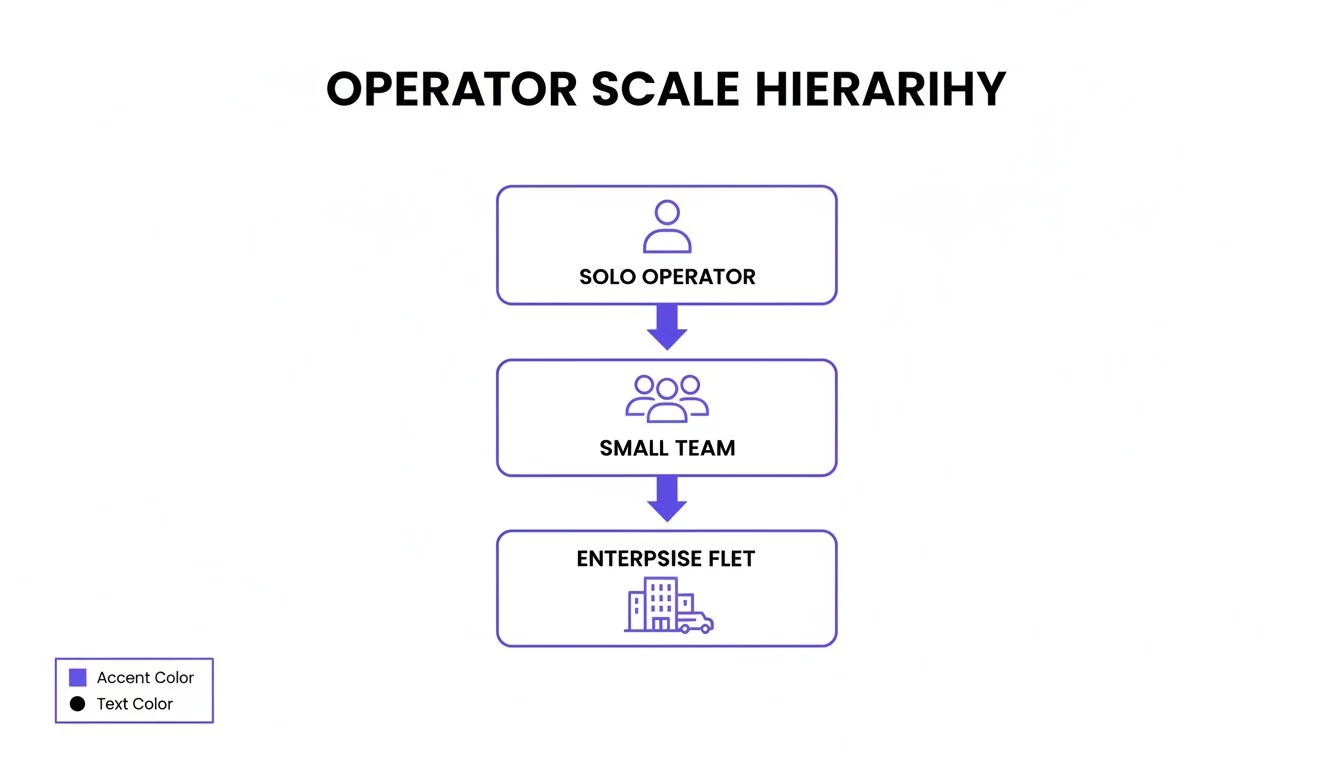
This just goes to show that while the core safety principles never change, the systems you use for managing checklists and protocols have to evolve as your team gets bigger.
A Practical, Copy-Ready Checklist
Here’s a sample pre-flight safety checklist you can adapt. It's designed to be a solid starting point, covering the essential checks that should happen before any drone leaves the ground. Feel free to modify it to fit your specific aircraft and mission types.
Sample Pre-Flight Safety Checklist
| Check Category | Inspection Point | Status (OK/Not OK) |
|---|---|---|
| Site & Environment | Weather forecast confirmed (wind, rain, temp) | |
| Airspace checked for restrictions (NOTAMs, TFRs) | ||
| Takeoff/landing zones clear of obstacles & people | ||
| First aid kit and fire extinguisher accessible | ||
| Aircraft | Visual inspection for damage (frame, arms, props) | |
| Propellers secure and free of nicks/cracks | ||
| Gimbal & camera check (clear lens, moves freely) | ||
| Battery securely latched, contacts clean | ||
| Systems & Payload | Battery charged to mission-appropriate level | |
| Controller battery level sufficient | ||
| Firmware updated on drone, controller & batteries | ||
| SD card formatted and has enough space | ||
| "Return-to-Home" altitude set correctly for site | ||
| IMU & Compass calibrated (if required by location) |
Remember, this isn't just paperwork. Running through a consistent checklist instills a professional discipline that prevents simple oversights from turning into costly accidents.
Building an Actionable Emergency Response Plan
An Emergency Response Plan (ERP) is the one part of your manual you hope you never have to use, but you absolutely must know by heart. Its value is measured in seconds. Clear, pre-defined actions can stop a minor issue from snowballing into a major incident.
Your ERP should be a series of simple, direct flowcharts or checklists for specific "what-if" scenarios.
Think about these common situations:
- Signal Loss (Flyaway): The immediate action is to trigger the Return-to-Home (RTH) function. The pilot should announce "Flyaway" to the crew and try to maintain visual contact. The next step is to inform the Visual Observer of the drone's last known direction and altitude, preparing to notify ATC if you're near controlled airspace.
- Unexpected Weather: The pilot should announce "Weather Abort" and land immediately at the primary or alternate landing zone. This is a simple, internal communication to the crew.
- Bird Strike or Mid-Air Collision: First, announce "Emergency Landing." Then, assess the aircraft's control. If it's still controllable, land it at the nearest safe spot. The ground crew needs to be alerted, and the drone must be thoroughly inspected before its next flight.
A well-practiced ERP is your ultimate safety net. It takes panic and indecision out of high-stress situations, replacing them with muscle memory and calm, decisive action. Regularly drilling these scenarios is just as important as writing them down.
The drone inspection and monitoring market is projected to skyrocket from USD 15.2 billion in 2025 to USD 61.5 billion by 2035. This massive growth only magnifies the need for safe, scalable workflows driven by solid operations manual templates. Platforms like Dronedesk are built for this, with reporting tools that can auto-generate logs compliant with your manual, which massively simplifies asset tracking and financial oversight.
Integrating these daily habits is what brings your operations manual to life. To really dive deep into this, check out our dedicated article on the importance of using checklists in drone operations. It’s a great reminder that the consistent use of these tools is what separates the amateurs from the true professionals.
Managing Revisions and Document Control Like a Pro
Your operations manual is a living document. It’s not some file you create once, tick a box, and forget about. Regulations change constantly, you'll inevitably add new drones to your fleet, and your team will figure out better, safer ways to do things on the job.
If you don't have a solid system for managing these updates, your manual becomes useless—or worse, a huge compliance risk. This is where professional document control comes into play, and it’s about way more than just hitting "save as" and adding a new date.
Real version control is a system. It’s a process that guarantees every pilot is working from the most current, approved playbook. Imagine a pilot using an old emergency procedure during a real incident. It could have catastrophic consequences and completely undermine your entire safety culture.
Establishing a Clear Versioning System
First things first, you need a logical versioning system. Don't overcomplicate it. For an operations manual, a simple numerical system usually works best.
- Minor Revisions (v1.1, v1.2): Use these for the small stuff. Correcting a typo, clarifying a sentence, or adding a minor item to a checklist. These are tweaks that don't fundamentally change a procedure.
- Major Revisions (v2.0, v3.0): Keep these for the big updates. This is for things like adding procedures for a brand-new aircraft, overhauling your emergency plan after a near-miss, or rewriting sections to comply with new CAA or FAA regulations.
Every single version needs a changelog. This is just a short, bulleted list right at the start of the manual that spells out what changed, who approved it, and when it took effect. This creates an instant, auditable paper trail of the document's life.
An operations manual without a clear revision history is an operational liability. It makes it impossible to prove to regulators—or even your own team—which set of rules was in effect at any given time.
The Approval and Distribution Workflow
Once you've drafted an update, the next stage is getting it approved and into the hands of your team. If you’re a solo operator, this might just be you giving it a final read-through. But for any kind of team, a formal workflow is non-negotiable. It’s what stops untested or unapproved changes from creeping into your official manual.
A reliable workflow looks something like this:
- Drafting: A designated person (maybe the Head of Operations or the Chief Pilot) drafts the proposed changes.
- Review: A few key people, like the Safety Manager or another senior pilot, review the draft. They're checking for accuracy, clarity, and any potential operational impacts.
- Approval: The final authority—whoever that is in your company—officially signs off on the new version.
- Distribution: The updated manual gets pushed out to every single pilot and relevant team member.
- Acknowledgement: Each pilot must formally confirm they've read and understood the changes. This is the most critical step for creating an audit trail.
To keep this process tight and consistent, it's worth looking into a content governance framework. This helps you nail down the rules, roles, and processes for managing your critical documents from creation all the way to archival.
Confirming Team-Wide Acknowledgement and Training
Just sending out the new manual isn't enough. You have to be able to prove that every pilot has received it, read it, and understood the changes. Honestly, this is where a lot of companies fall down. An email blast with a PDF attached is just too easy to miss or ignore.
This is where platforms like Dronedesk can be a lifesaver, centralising your documents and tracking who has acknowledged what. For major changes, like a completely new emergency procedure, don't just rely on a read receipt. Consider holding a quick training session or even requiring a short quiz to confirm everyone is genuinely up to speed.
This level of diligence is what separates the pros from the amateurs. It’s essential for your audit trail and for ensuring your entire operation is always on the same page. Staying on top of document control is a massive part of your overall compliance strategy, which you can explore further in our guide to the top regulatory compliance solutions.
Common Questions About Drone Manuals
Even with the best template in hand, you’ll probably have a few questions as you get into the nitty-gritty of creating your drone operations manual. Let's tackle some of the most common ones we hear from pilots and ops managers.
Getting these details right is what separates a truly professional, compliant operation from one that's just winging it.
How often should I be updating my operations manual?
You should be giving your manual a thorough review at least once a year. But here’s the critical part: you must update it immediately whenever there’s a significant change in your operations. This isn't just good practice; it's a core safety and compliance task.
So, what counts as a "significant change"?
- Adding a new model of drone to your fleet, especially if it has different capabilities.
- A shuffle in key personnel, like bringing on a new Chief Pilot or Safety Manager.
- An incident or near-miss that highlights a gap in your procedures.
- New regulations dropped by your local aviation authority (like the FAA or EASA).
Think of your manual as a living document. An outdated one isn't just useless—it's a serious liability waiting to cause problems.
Can I just use a generic template I found online?
Using online operations manual templates is a fantastic way to get your structure sorted, but you absolutely cannot use one straight out of the box. Regulators can spot a generic, copy-pasted manual from a mile away, and it simply won’t reflect the realities of your specific operation.
Your manual needs to cover your aircraft, your typical mission types, and your local airspace challenges.
A regulator expects your manual to be a mirror of how you actually work, not a generic document you downloaded. Use templates as a foundation, but the real meat of the content has to be 100% yours.
What's the single most important section in the manual?
Honestly, every section is vital for full compliance, but if you twisted my arm, I'd say the Emergency Response Plan (ERP) is the most critical for safety in the field. This is the section that lays out, step-by-step, how your team handles high-stress situations like a flyaway, a sudden battery failure, or losing the control link.
A well-rehearsed ERP can be the difference between a minor hiccup and a major accident. It’s a true test of your operational readiness and something any auditor will look at very closely.
Does my manual need to be officially approved by the aviation authorities?
This really depends on where you are and what kind of flying you're doing.
In the U.S. under Part 107, for instance, the FAA doesn't pre-approve your manual for standard flights, but they can ask to see it anytime, especially during an inspection.
However, if you're getting into advanced operations that require waivers or special permissions—think BVLOS or flying over people—your manual becomes a central piece of your application. In those scenarios, you can bet it will be thoroughly scrutinised by the aviation authority. Always double-check the specific rules for your country and the type of flights you plan to conduct.
Ready to stop wrestling with documents and start managing your drone operations with clarity and control? Dronedesk provides the tools you need to create, manage, and distribute your operations manual seamlessly, ensuring your entire team is always on the same page. See how you can streamline your workflow at https://dronedesk.io.
 Drone Airspace Rules: How to Document Your Site Checks →
 How to Evaluate a Free Drone Logbook Before Using It →
 FAA Part 107 Test: How to Master Airspace Questions →
 Drone Risk Assessment Controls That Work in the Field →
 FAA Drone License Costs Beyond the Knowledge Test →
 Drone Part 107 Operations: When a Waiver May Be Needed →
 Drone Operating Rules for Managing Contractors and Employees →
 BVLOS Drone Requirements for Building a Safety Case →
 Drone Pilot Test Mistakes That Cost Candidates Marks →
 FAA 107 License vs Part 107 Certificate: What’s the Difference? →