
How to Pass the FAA Drone Written Test First Time
Most people who fail the Part 107 exam do not fail because aviation is impossible to learn. They fail because they memorised isolated answers, used outdated study material, or underestimated how much of the test is about applying information to a chart, weather report, or real operating scenario.
If you want to pass the FAA drone written test first time, treat it like preparation for commercial drone operations, not just a box-ticking exercise. The same knowledge you need for the exam, airspace, weather, regulations, performance, human factors and emergency procedures, is the knowledge that keeps a survey job, utility inspection or public safety flight safe and compliant.
This guide focuses on the initial FAA Remote Pilot Certificate exam under Part 107, officially called the Unmanned Aircraft General, Small aeronautical knowledge test, often shortened to UAG.
First, confirm you are preparing for the right FAA drone test
The phrase FAA drone written test usually refers to the Part 107 initial aeronautical knowledge test. It is not the same as TRUST, which is the safety test for recreational flyers. If you intend to fly a drone for work, payment, business purposes, inspections, mapping, media, emergency support or any non-recreational operation in the United States, Part 107 is usually the route you need unless your organisation is operating under a different FAA approval such as a public aircraft operation or Certificate of Waiver or Authorization.
The FAA’s Become a Drone Pilot page explains the basic eligibility route. For most new applicants, you must be at least 16, be able to read, speak, write and understand English, be in a physical and mental condition to safely operate a drone, obtain an FAA Tracking Number through IACRA, and pass the initial aeronautical knowledge test at an FAA-approved knowledge testing centre.
The initial Part 107 test is computer based. It has 60 multiple-choice questions, a two-hour time limit, and a minimum passing score of 70 percent. That sounds manageable, but the exam is designed to check whether you can make safe aeronautical decisions, not whether you can repeat flashcards.
Start with the FAA standards, not random answer banks
Your most important study document is the FAA Unmanned Aircraft Systems Airman Certification Standards. The ACS tells you the areas of knowledge the FAA can test, the risks it expects remote pilots to understand, and the skills connected to each subject area.
Pair that with the FAA Remote Pilot Study Guide. A good paid course can be useful, but it should help you understand the official material, not replace it.
Be especially careful with old Part 107 content. Rules and test emphasis have changed over time, particularly around night operations, operations over people, Remote ID and recurrent training. If your notes still say night operations always require a waiver, your material is out of date.
What the FAA drone written test actually covers
The exam is broad, but it is not random. Most questions fall into a few predictable categories. Build your preparation around these areas and you will avoid the common mistake of spending too much time on trivia while missing high-value topics.
| Exam area | What you need to be able to do | Common first-time mistake |
|---|---|---|
| Part 107 regulations | Apply operating limits, pilot responsibilities, waiver rules and reporting requirements | Memorising numbers without knowing when they apply |
| Airspace | Identify controlled airspace, special use airspace, airport data and authorisation needs | Confusing Class E surface airspace with Class G |
| Sectional charts | Read symbols, obstacles, airport information, coordinates and airspace boundaries | Looking only at colour instead of reading all chart details |
| Weather | Interpret METARs, TAFs, visibility, cloud clearance, wind and hazardous conditions | Decoding the report but missing the operational decision |
| Loading and performance | Understand weight, balance, density altitude, payload and battery effects | Assuming small drones are unaffected by performance limits |
| Operations and human factors | Apply crew coordination, preflight checks, maintenance, emergencies and risk management | Treating the exam as theory instead of operational judgement |
Think of the exam as scenario based. A question might not ask you to recite a rule directly. It may describe a flight near an airport, under a cloud layer, with a visual observer and a nearby obstacle, then ask what the remote PIC should do.
Learn the Part 107 rules as operating decisions
You need to know the key numbers in 14 CFR Part 107, but numbers alone are not enough. The test often checks whether you know which number matters in context.
For example, small unmanned aircraft under Part 107 must weigh less than 55 pounds, including payload. Standard operations are limited to a maximum groundspeed of 87 knots, or 100 mph. The usual altitude limit is 400 feet above ground level, unless operating within 400 feet of a structure and not more than 400 feet above its immediate uppermost limit. Minimum flight visibility is 3 statute miles, with cloud clearance of 500 feet below, 1,000 feet above and 2,000 feet horizontally.
You should also understand the remote pilot in command role. The remote PIC is directly responsible for the operation and has final authority. That means exam questions often come down to judgement: pause the flight, move the launch point, brief the visual observer, seek authorisation, or do not fly.
Other rules worth knowing well include visual line of sight, right of way, careless or reckless operations, alcohol and drug restrictions, preflight inspection, accident reporting, Remote ID, operations over people, operations over moving vehicles, and the difference between an airspace authorisation and a waiver.
A useful test is this: for every rule you memorise, ask yourself what a compliant remote pilot would actually do on a job site.
Airspace and sectional charts are where many candidates lose marks
If you only have time to get very good at one practical skill, make it sectional chart reading. Many first-time candidates can recite the names of airspace classes but struggle when the test gives them a chart excerpt and a set of coordinates.
You should be able to identify Class B, C, D, E and G airspace, including where controlled airspace begins at the surface and where it starts at a higher floor. You should know how to spot airports, heliports, seaplane bases, control towers, obstacle heights, military training routes, restricted areas, prohibited areas, alert areas, MOAs, parachute activity, national security areas, TFR relevance and airport data blocks.
Do not rely on colour alone. Sectional charts contain compact information, and the FAA test expects you to use it. Read the airspace boundary, the airport information, the altitude figures and any nearby hazards together. The FAA Chart Users’ Guide is a valuable reference because it explains the symbology used on aeronautical charts.
When practising, use a simple three-question routine for every chart problem. First, what airspace is the drone in at the proposed altitude? Second, what nearby hazards or restrictions could affect the flight? Third, what permission, authorisation or operational change is required before launch?
Weather questions test judgement, not just decoding
METARs and TAFs look intimidating at first, but they become predictable with practice. You need to know how to read wind direction and speed, gusts, visibility, cloud layers, temperature, dew point, altimeter setting, forecast validity periods and common weather codes.
The bigger skill is interpreting what the weather means for a small unmanned aircraft. A METAR might technically meet the minimum visibility requirement, but gusty winds, low ceilings, nearby thunderstorms or rapidly changing conditions could still make the operation unsafe.
Focus on the concepts that affect drone performance and decision making: density altitude, temperature, pressure, humidity, stable and unstable air, fog, fronts, thunderstorms, wind shear and microbursts. The Aviation Weather Center is a useful place to become familiar with real aviation weather products, although your exam prep should still be anchored to the FAA materials.
For commercial operators, this is not abstract. A mapping flight can fail if wind affects overlap and battery endurance. A utility inspection can become unsafe if gusts funnel around structures. An emergency response flight can be compromised by poor visibility, pressure to launch quickly, and multiple crew members working under stress.
Use a 14-day study plan that builds confidence
A first-time pass is realistic with a focused plan. Some candidates need more time, especially if they are new to aviation, but the structure below works well if you can study for 1 to 2 focused hours a day.
| Day | Focus | Output by the end of the session |
|---|---|---|
| 1 | Exam overview and ACS | Create a checklist of every ACS topic you need to cover |
| 2 to 3 | Part 107 regulations | Know the main operating limits and when authorisations or waivers are needed |
| 4 to 5 | Airspace basics | Identify the major airspace classes and controlled airspace triggers |
| 6 to 7 | Sectional charts | Answer chart questions using symbols, coordinates and airport data |
| 8 | Weather theory | Understand wind, visibility, cloud clearance and hazardous weather |
| 9 | METARs and TAFs | Decode reports and decide whether a drone flight is safe and legal |
| 10 | Loading and performance | Explain how weight, density altitude, payload and batteries affect flight |
| 11 | Operations and human factors | Review crew coordination, maintenance, emergencies and ADM |
| 12 | Timed practice test | Complete 60 questions in exam conditions and log every weak area |
| 13 | Targeted revision | Re-study only your weakest topics, especially charts and weather |
| 14 | Final mock and test-day review | Score consistently above your comfort threshold before sitting the exam |
Aim to score at least 85 to 90 percent on reputable practice tests before your real exam. That buffer matters because the real questions may be worded differently from the examples you have seen.
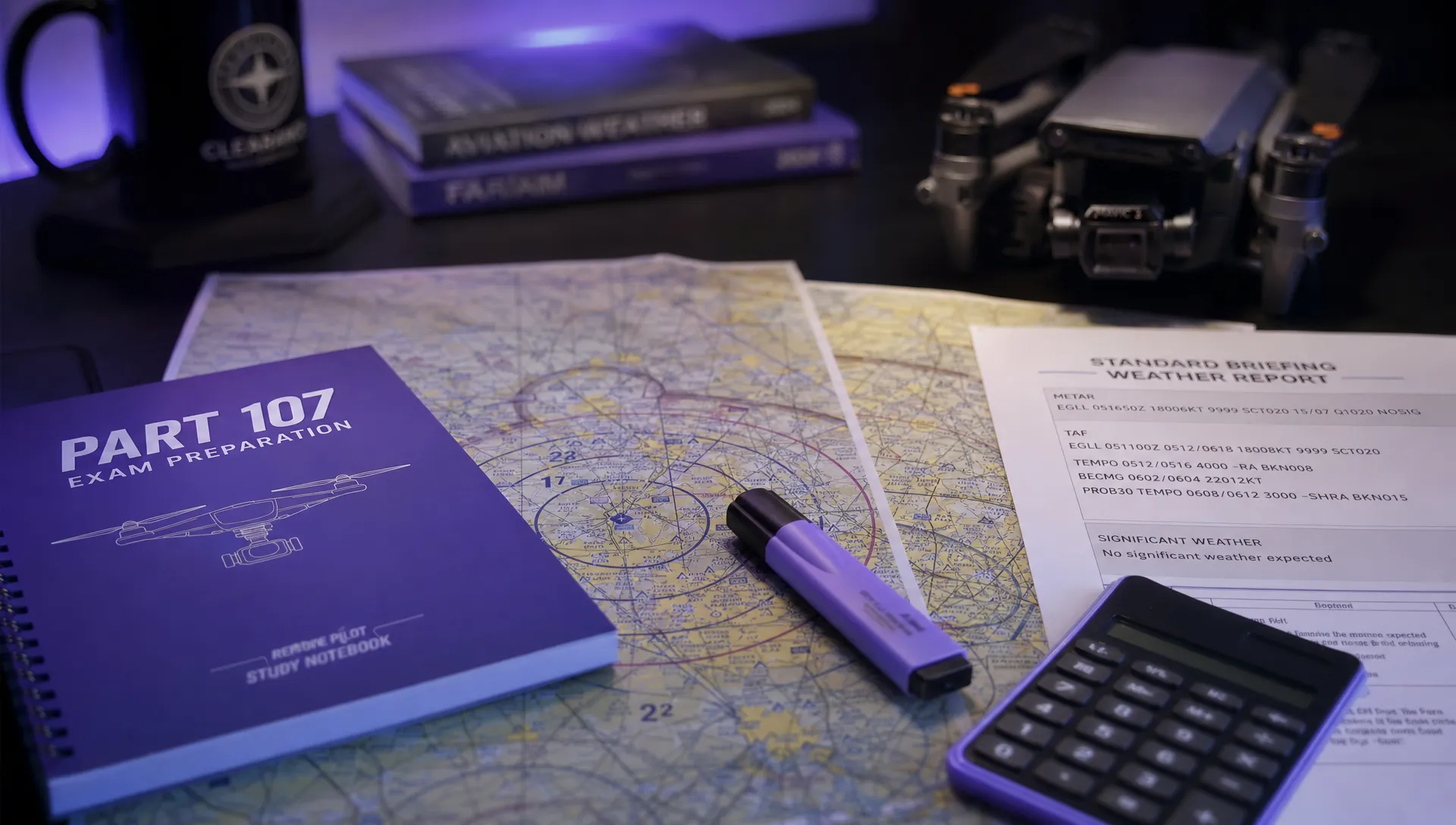
Practise like the real exam
Practice tests are helpful only if you use them correctly. If you repeat the same free question bank until you recognise the answers, you may feel ready while still being weak on the underlying concepts.
A better approach is to review every wrong answer and every guessed right answer. Write down the reason you missed it. Was it a chart symbol, an altitude unit, a regulation exception, a weather code, or simply rushing the question? Patterns will appear quickly.
Use timed practice blocks as you get closer to test day. The real exam allows two hours for 60 questions, which is enough time if you stay calm. During practice, learn to answer straightforward questions quickly and flag chart or calculation questions for a second look.
Also practise with the FAA testing supplement style of question. The exam may refer to a figure, chart excerpt or airport data. Many mistakes happen because candidates use the wrong figure, miss a note in the question, or confuse MSL and AGL.
Test-day tactics that protect your score
By test day, your job is not to learn new material. Your job is to avoid preventable errors.
- Confirm your testing centre appointment, identification requirements and the exact name format used during registration.
- Arrive early enough to avoid rushing, especially if the test centre has parking or check-in procedures.
- Read each question twice before looking at the answers, then identify exactly what the FAA is asking.
- Watch units carefully, especially feet MSL, feet AGL, statute miles, knots, local time and UTC.
- Flag longer chart or weather questions and return to them after collecting easier marks.
- Do not change an answer unless you can identify a clear reason your first answer was wrong.
- Use any permitted scratch paper to note key figures, coordinates, altitudes or weather details.
If you fail, it is not the end of your drone career, but you will lose time and money. You will need to follow FAA retesting rules and use your knowledge test report to guide revision. The better goal is to pass once by preparing properly.
After you pass: turn exam knowledge into operational discipline
Passing the FAA drone written test is a milestone, not the finish line. After a passing result, you still need to complete the FAA application process through IACRA and wait for the required checks before receiving your Remote Pilot Certificate. Once certificated, you must keep your knowledge current through the FAA’s recurrent training requirements.
You also need to operate within Part 107 on every job. That means checking airspace, assessing site hazards, briefing crew members, confirming aircraft condition, managing batteries, logging flights, and documenting decisions. For professional teams, the paperwork and audit trail can matter as much as the flight itself.
This is where exam preparation should connect with real-world processes. If you learned that the remote PIC must assess conditions before flight, build a preflight checklist. If you learned that airspace and obstacles affect legality and safety, build them into your planning workflow. If you learned that weather changes risk quickly, create a clear go or no-go process before the aircraft is powered on.
For a deeper operational approach, Dronedesk’s guide to building a drone flight risk assessment that works is a useful next step after exam prep. And if your organisation is moving from one pilot and one aircraft to a larger operation, the drone fleet management guide explains the systems and records that become important as you scale.
Common mistakes that stop candidates passing first time
The most common mistake is studying passively. Watching videos can help, but you need to solve questions, read charts, decode weather and explain decisions out loud. If you cannot explain why an answer is correct, you have not really learned it.
The second mistake is ignoring weak areas because they feel uncomfortable. Chart reading and weather are often the difference between a marginal score and a confident pass. Spend more time on the topics you avoid.
The third mistake is using outdated rules. Part 107 has evolved, and the drone industry continues to mature. Make sure your course, flashcards and practice tests reflect current FAA requirements.
The fourth mistake is treating the test as separate from operations. A survey company, utility team or emergency service unit does not need a pilot who can merely pass an exam. It needs a remote pilot who can plan, decide, document and adapt safely.
Frequently Asked Questions
Is the FAA drone written test hard? It is manageable if you study the official FAA topics and practise applying them. Most difficulty comes from sectional charts, weather interpretation and regulation scenarios rather than from obscure facts.
How many questions are on the Part 107 test? The initial Part 107 aeronautical knowledge test has 60 multiple-choice questions, and you have two hours to complete it.
What score do I need to pass the FAA drone written test? You need at least 70 percent to pass. For practice tests, aim higher, ideally around 85 to 90 percent, so you have a comfortable margin on exam day.
Can I take the initial Part 107 test online? The initial aeronautical knowledge test is taken at an FAA-approved knowledge testing centre. Recurrent training for certificated remote pilots is handled differently, so check the FAA’s current process for your situation.
How long should I study for the FAA drone written test? Many candidates can prepare in two to four weeks with consistent study. If you are completely new to aviation charts and weather, give yourself more time rather than relying on memorisation.
Do emergency services need Part 107? It depends on how the agency operates. Some public safety organisations use Part 107, some use a Certificate of Waiver or Authorization, and some use both. Agencies should confirm their operating model with the FAA and their internal legal or aviation authority.
What should I study most if I am short on time? Prioritise Part 107 regulations, sectional charts, airspace and weather. These areas appear often and are also essential for safe real-world drone operations.
Build professional drone operations after the test
A first-time pass gives you the certificate pathway. The next challenge is running drone operations consistently, safely and with the right records behind every flight.
Dronedesk is built for drone operators who need to manage the operational side of flying, including client management, fleet and team management, airspace and proximity intelligence, flight planning, flight logging, data reporting, configurable checklists and risk assessments. You can explore the platform’s current capabilities on the Dronedesk features page.
If you are preparing for Part 107 because your organisation is expanding drone work, use the exam as the start of a stronger operating system, not the end of your training journey.
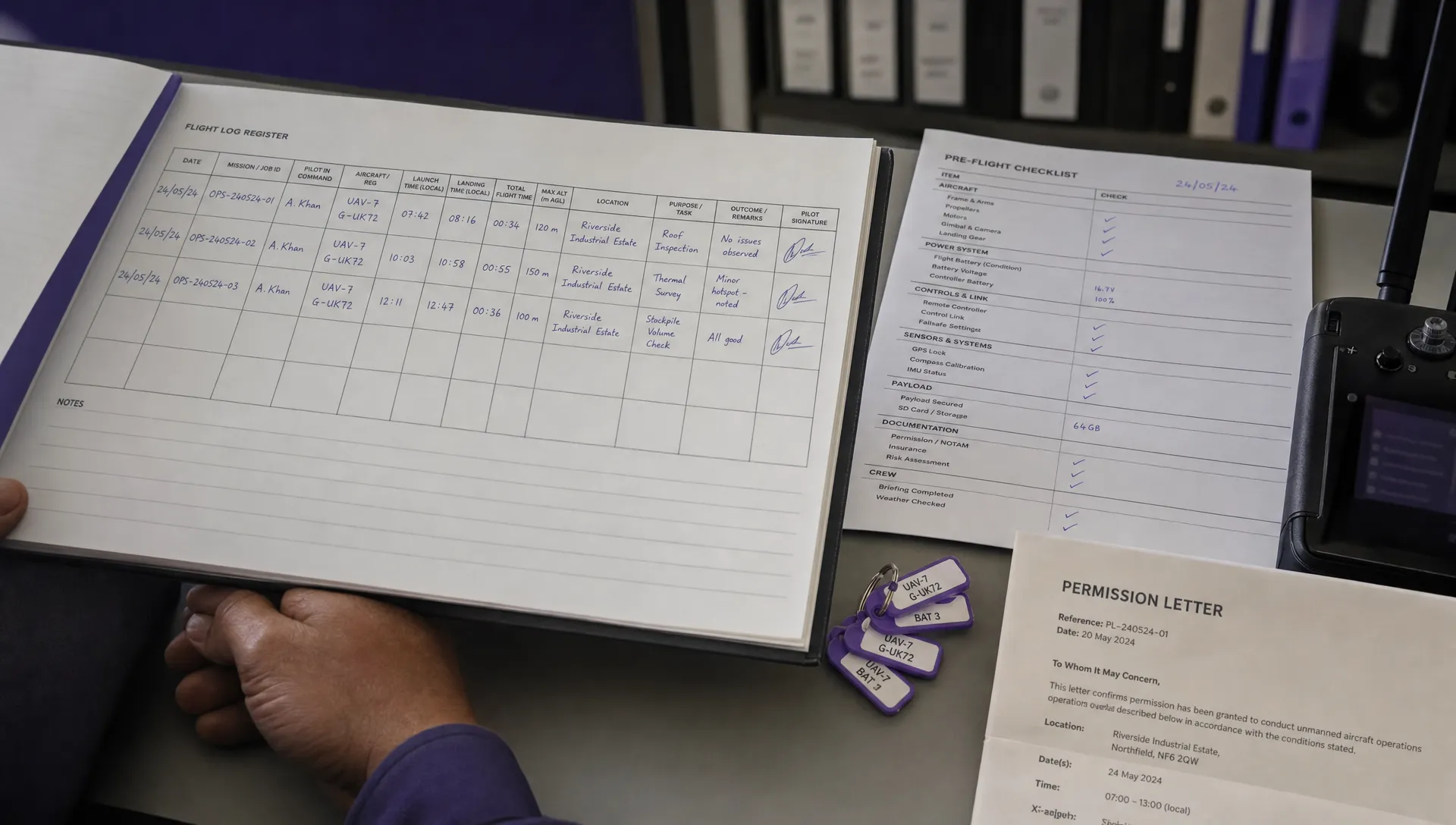 How to Build a Drone Pilot Flight Log That Is Audit Ready →
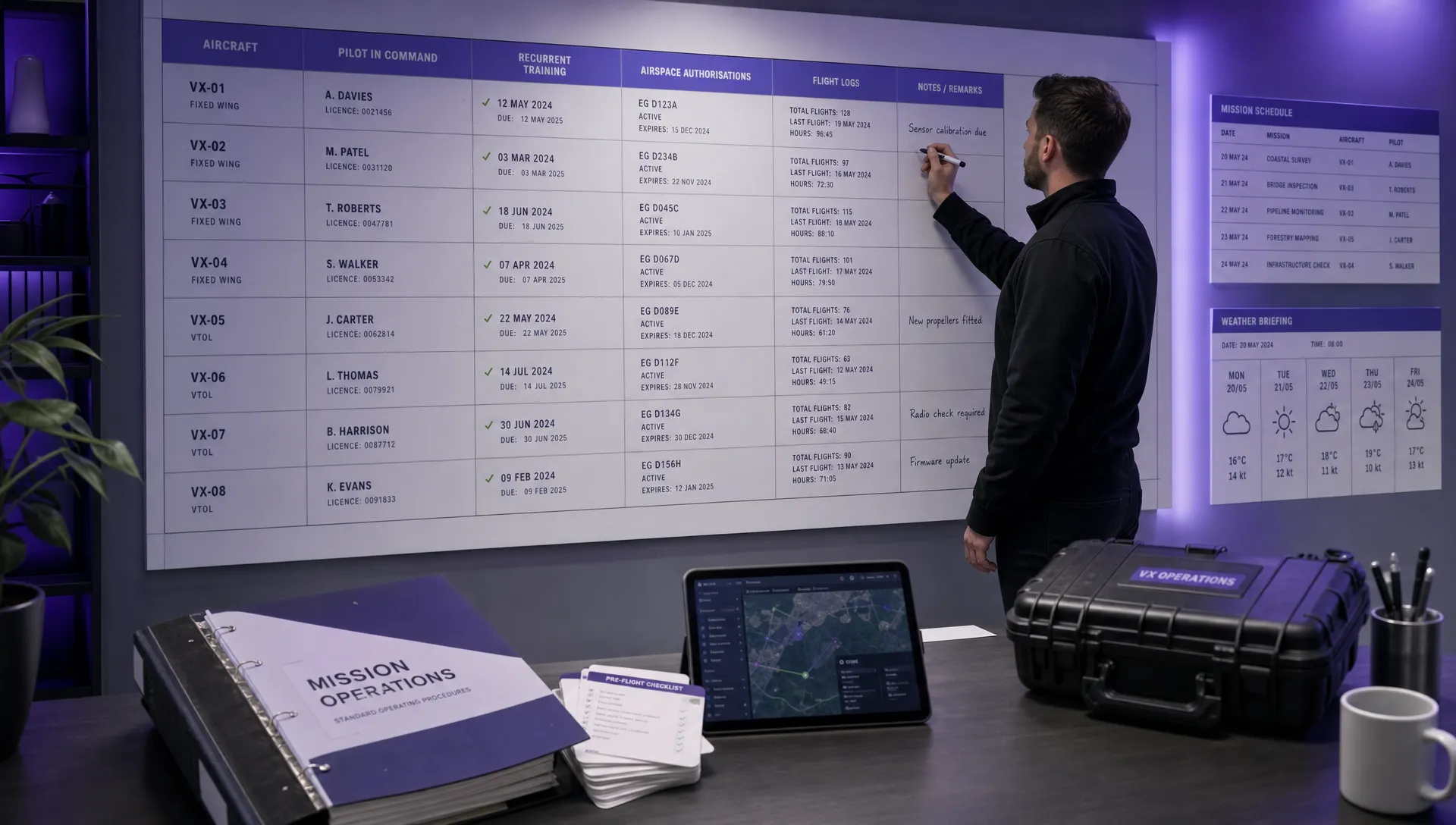 FAA Drone Licence Requirements for Commercial Pilots →
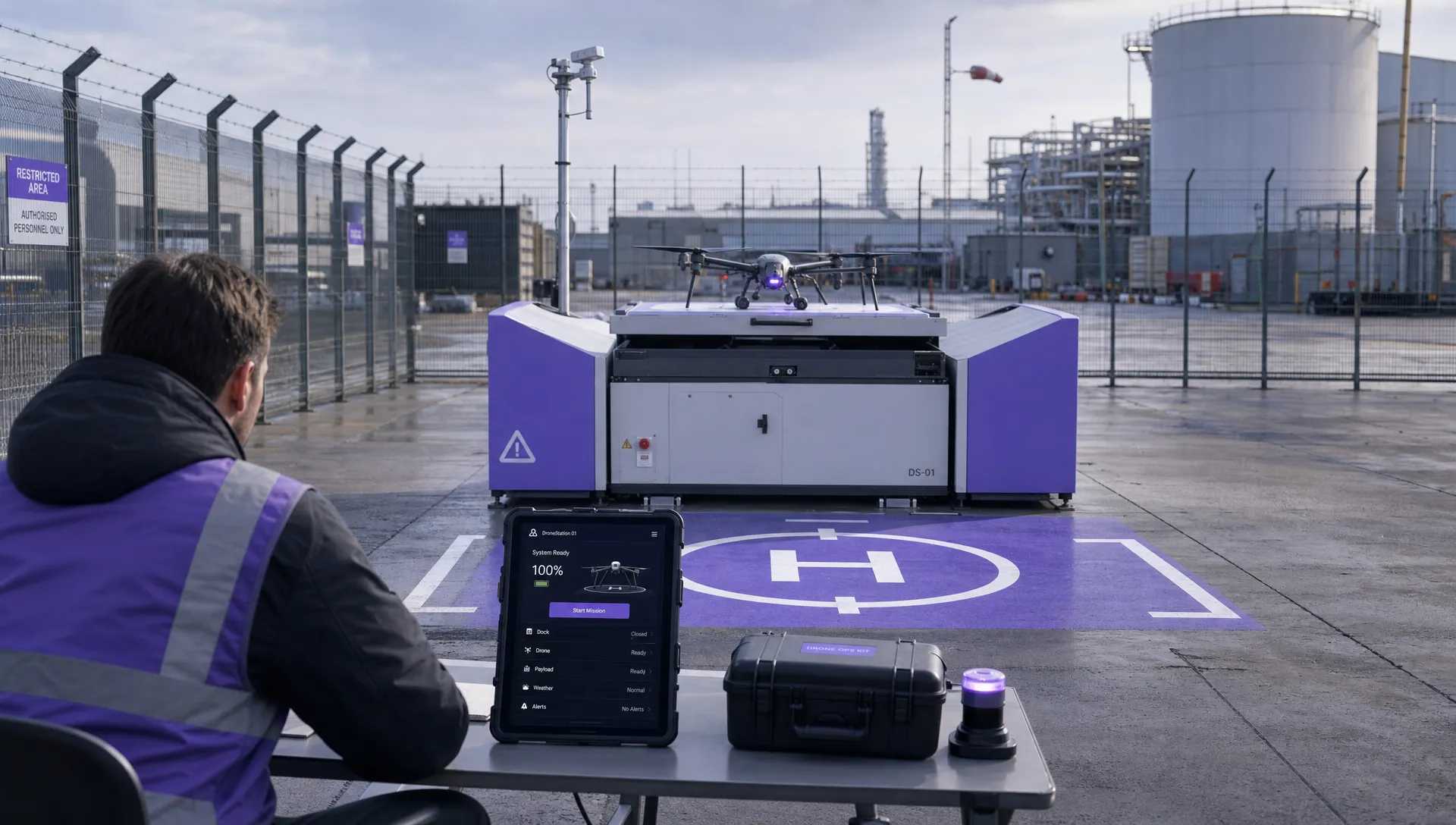 FAA BVLOS Waivers Granted: What Successful Cases Show →
 How to Export DJI Flight Logs for Incident Reviews →
 Drone Safety and Legal Duties for Business Operations →
 EASA Drone Regulations: Open, Specific and Certified Categories →
 What the BVLOS ARC Report Means for UAS Operators →
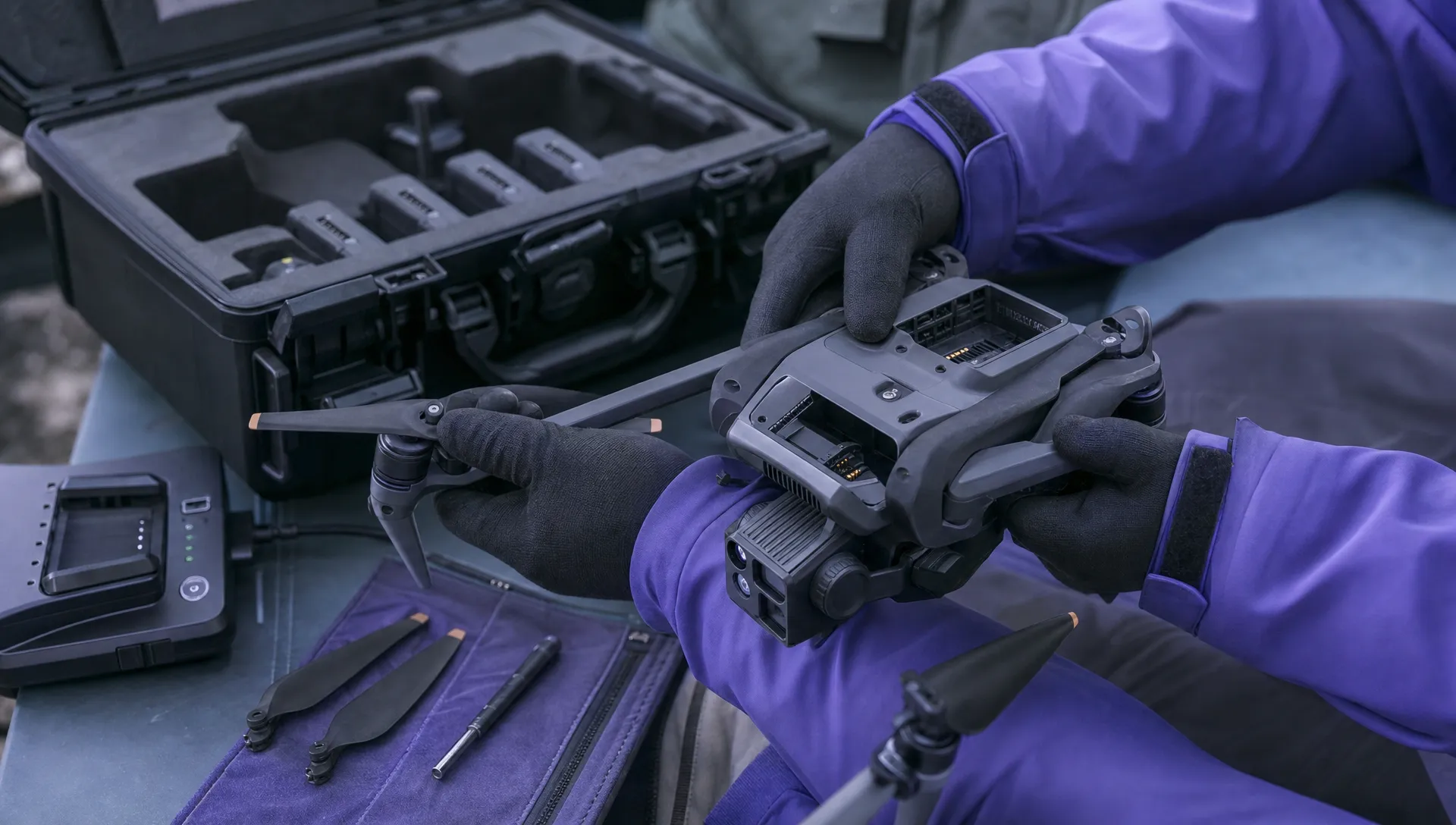 Free Drone Pre-Flight Checklist for Commercial Missions →
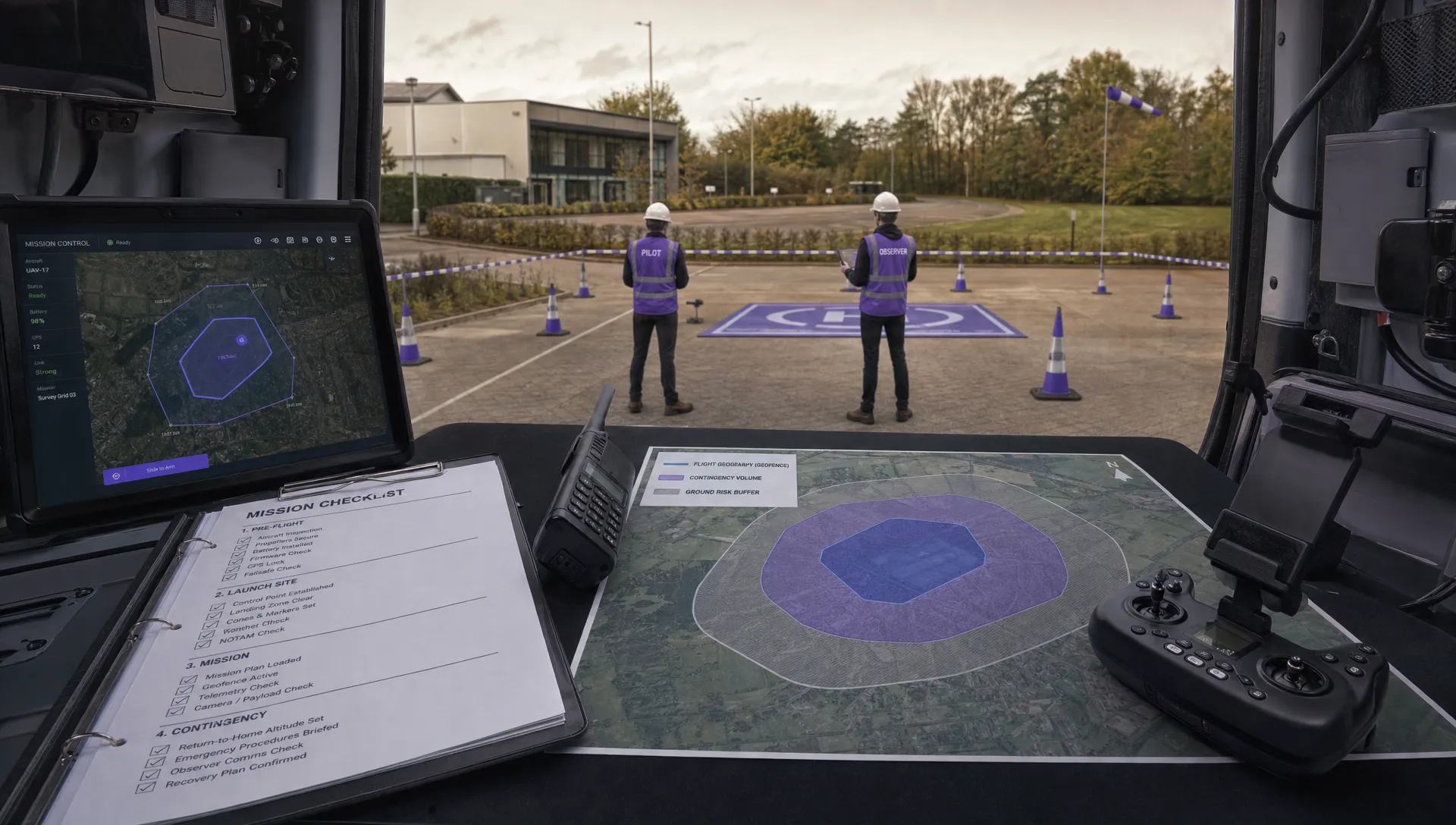 Contingency Volume and Flight Risk Buffer Explained →
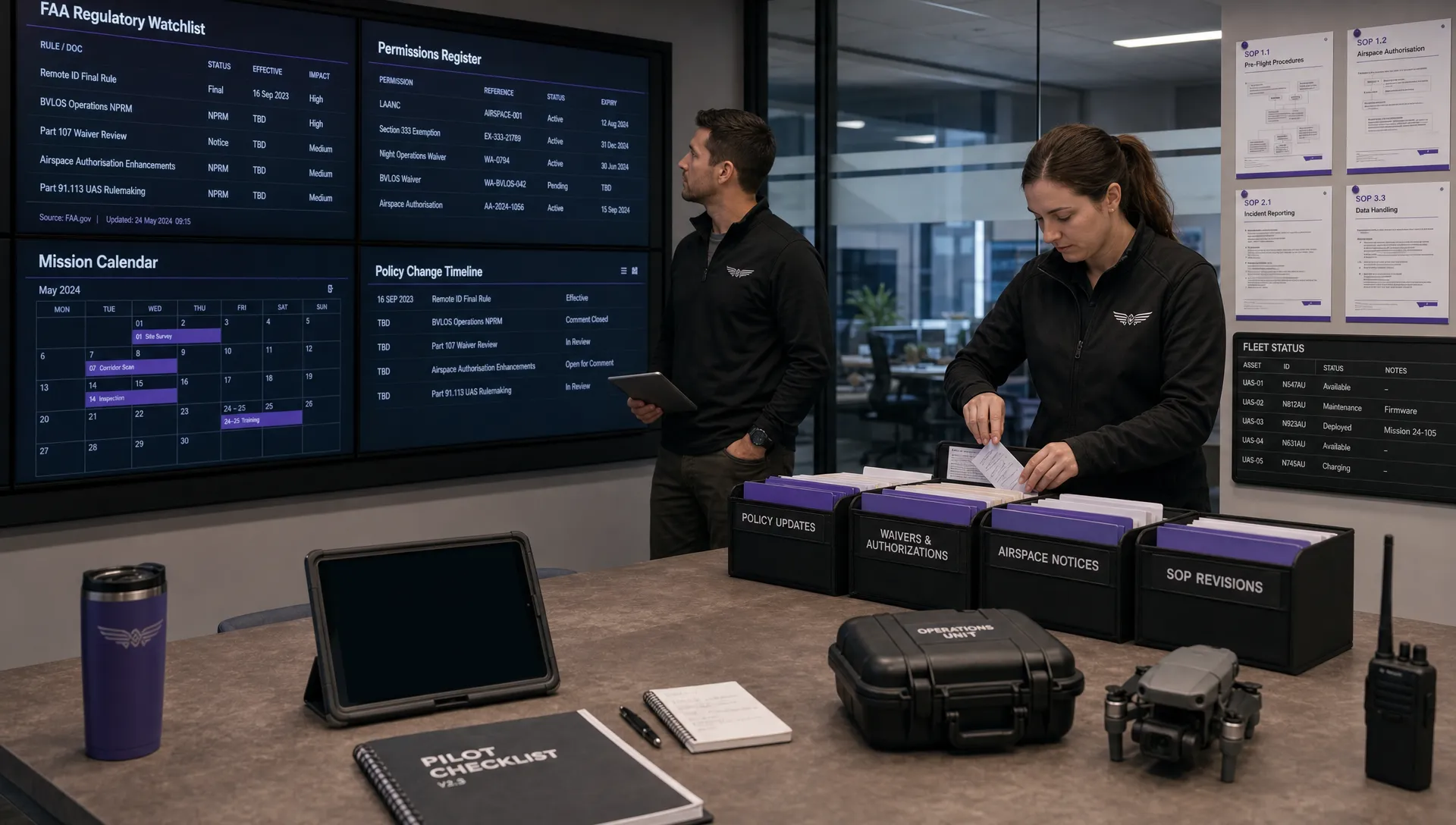 FAA Policy Changes That Commercial Drone Teams Should Track →