
Drone Safety Rules That Every Commercial Team Needs
Commercial drone safety is not a single checklist completed five minutes before take-off. For survey companies, utilities, emergency services and growing drone operators, it is a working system that covers people, aircraft, airspace, clients, data and the site itself.
That system matters because commercial teams rarely fly in perfect conditions. They work near roads, assets, construction sites, infrastructure, members of the public and other airspace users. The practical goal of drone safety rules is to make safe behaviour repeatable, even when a job is urgent, the site is complex or the client is pushing for a fast turnaround.
This guide focuses on the operational rules every commercial drone team should embed into day-to-day work. It is written with UK operations in mind, but the principles apply broadly. Always verify the current requirements for the country, airspace and sector you are operating in.
Start with the legal baseline
In the UK, drone operations are regulated by the Civil Aviation Authority. The CAA drone guidance and the Drone and Model Aircraft Code are the starting points for registration, pilot competency, airspace restrictions and safe flying conduct.
One point is worth stating clearly: commercial use alone does not automatically decide the category of a flight. UK drone rules are risk based. A paid roof survey may be possible in the Open category if it meets the relevant limits, but a utility inspection close to people, controlled airspace or critical infrastructure may need a Specific category approach and an operational authorisation.
| Safety area | What the team must confirm | Typical evidence to keep |
|---|---|---|
| Operator responsibility | Who is legally accountable for the operation | Operator registration, operating procedures, insurance checks |
| Pilot competency | Who is flying and whether they are qualified for the task | Flyer ID where required, competency certificates, training records |
| Operational category | Whether the flight fits Open, Specific or another framework | Category decision, authorisation details, operating limitations |
| Airspace access | Whether the area is restricted, controlled or affected by temporary activity | Airspace screenshots, NOTAM checks, permissions, coordination notes |
| Site risk | What hazards exist on the ground and around the operating area | Site survey, risk assessment, emergency plan, client brief |
| Flight record | What was planned, flown and learned | Flight log, maintenance notes, incident or near miss report |
A good safety culture turns those legal requirements into practical habits. The following rules help do that.
1. Make one person accountable for each operation
Every job needs a named operational lead. In a small team, that person may also be the remote pilot. In a larger team, they may coordinate the client, pilots, observers, security staff, emergency services liaison and site manager.
The accountable person should have the authority to delay, change or cancel the flight. That authority matters on commercial jobs because the safest decision is sometimes commercially inconvenient. If a pilot feels unable to stop a job because the client is waiting, your safety system is too weak.
For higher-risk work, separate responsibilities where possible. One person can manage client liaison and site access, while the remote pilot focuses on aviation decisions. Visual observers, payload operators and ground marshals should know exactly what they are responsible for before the aircraft is powered on.
2. Classify the operation before accepting the brief
The safest teams decide whether a job is viable before they price it or promise a delivery date. A quick classification step prevents the classic problem of discovering too late that the flight needs extra permissions, additional crew or a different method.
At minimum, assess the aircraft, location, proximity to uninvolved people, airspace, altitude, line of sight, site sensitivity and client requirements. If the flight cannot be completed within the limits of your standard procedures, escalate it before the booking is confirmed.
This rule is especially important for emergency services and utility companies. A mission may be urgent, but urgency does not remove the need to understand airspace, people risk, radio communications, incident command structures and other aircraft activity.
3. Check airspace early, then check it again on the day
Airspace is not a one-time check. A site that looked straightforward during quoting can change because of NOTAMs, temporary restrictions, emergency activity, nearby heliports, cranes, events or changes to airport operations.
For commercial teams, the airspace check should happen at three points: during initial feasibility, during detailed planning and immediately before flight. The final check should be part of the pre-flight briefing, not something one pilot does silently in a car park.
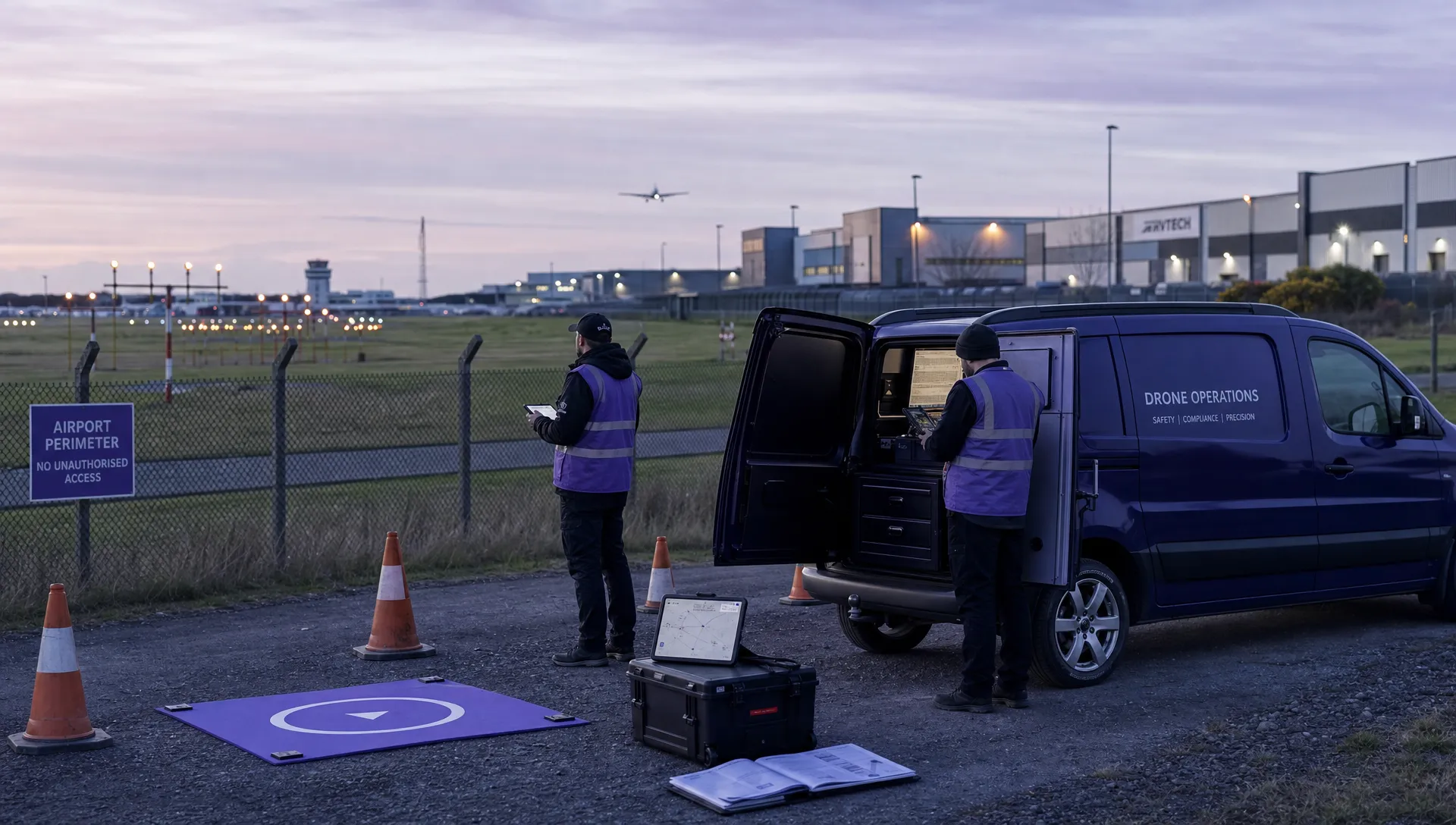
Airport flight restriction zones need particular care. If your work involves operations near aerodromes, it is worth reviewing Dronedesk’s guide to planning flights around airport drone rules so your team can build permission timelines into the job, instead of treating them as a last-minute hurdle.
4. Treat the site survey as operational intelligence
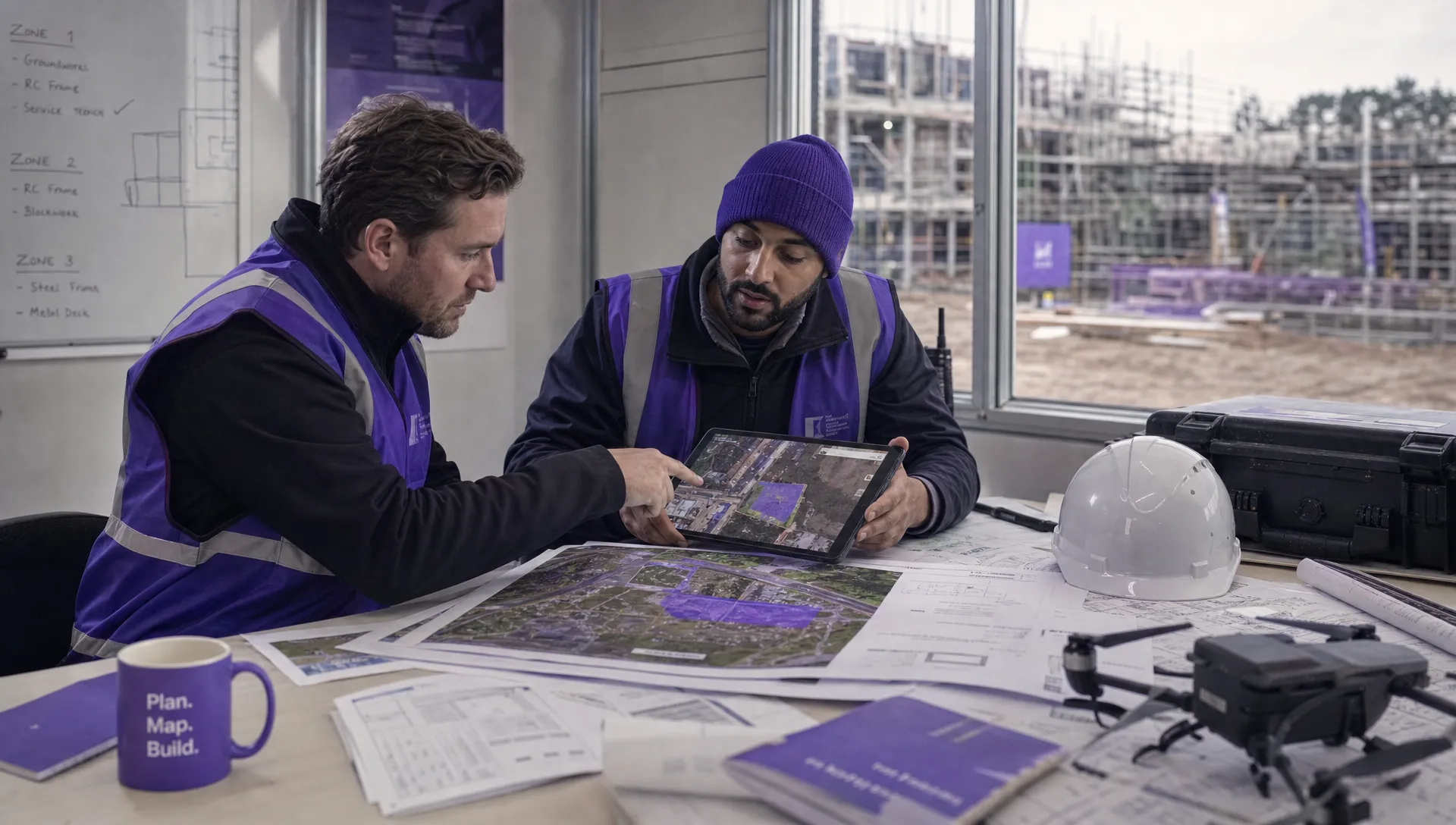
A site survey is not admin for admin’s sake. It is how a drone team discovers what will actually affect the flight: access routes, take-off and landing areas, public movement, power lines, trees, reflective surfaces, livestock, security restrictions, road traffic, railways and emergency access points.
Desk research is useful, but it has limits. Satellite imagery may be out of date. A quiet industrial estate on a map may have shift-change traffic. A rural inspection corridor may have temporary works, walkers or seasonal vegetation. Where possible, combine desk planning with information from the client or a physical site visit.
The output should be practical. Your crew should know where to park, where to brief, where to launch, where to stand, where to keep the public away and where to move if the primary landing area becomes unsafe.
5. Write risk assessments that crews can use
A risk assessment should help a pilot make better decisions, not sit untouched in a folder. The best assessments describe the specific hazards of the job, the controls in place and the trigger points for stopping or changing the operation.
Avoid generic wording such as “maintain situational awareness” unless it is backed by a real control. A better control might be “visual observer positioned at the eastern gate to monitor public access, with radio call ‘hold’ if pedestrians enter the cordon”. That tells the crew what to do.
For a deeper approach, Dronedesk has a useful guide on building a drone flight risk assessment that works. Use it to strengthen the connection between hazard identification, crew briefing and operational decision-making.
6. Set weather and light limits before the day of flight
Weather decisions are harder when the client is already on site. Set limits in your procedures before the job starts, including maximum wind, gust spread, visibility, precipitation, temperature, cloud base where relevant and light level.
Do not rely only on the manufacturer’s published wind tolerance. A drone may technically fly in strong wind, but the job may still be unsafe if it affects battery performance, image quality, return-to-home accuracy, manual control margins or landing area safety.
Commercial teams should also define who has the final weather call. If a central operations manager, chief pilot or incident commander can override the remote pilot without being on site, that arrangement needs careful governance. The person with the best real-time aviation picture must be heard.
7. Protect uninvolved people with separation and clear controls
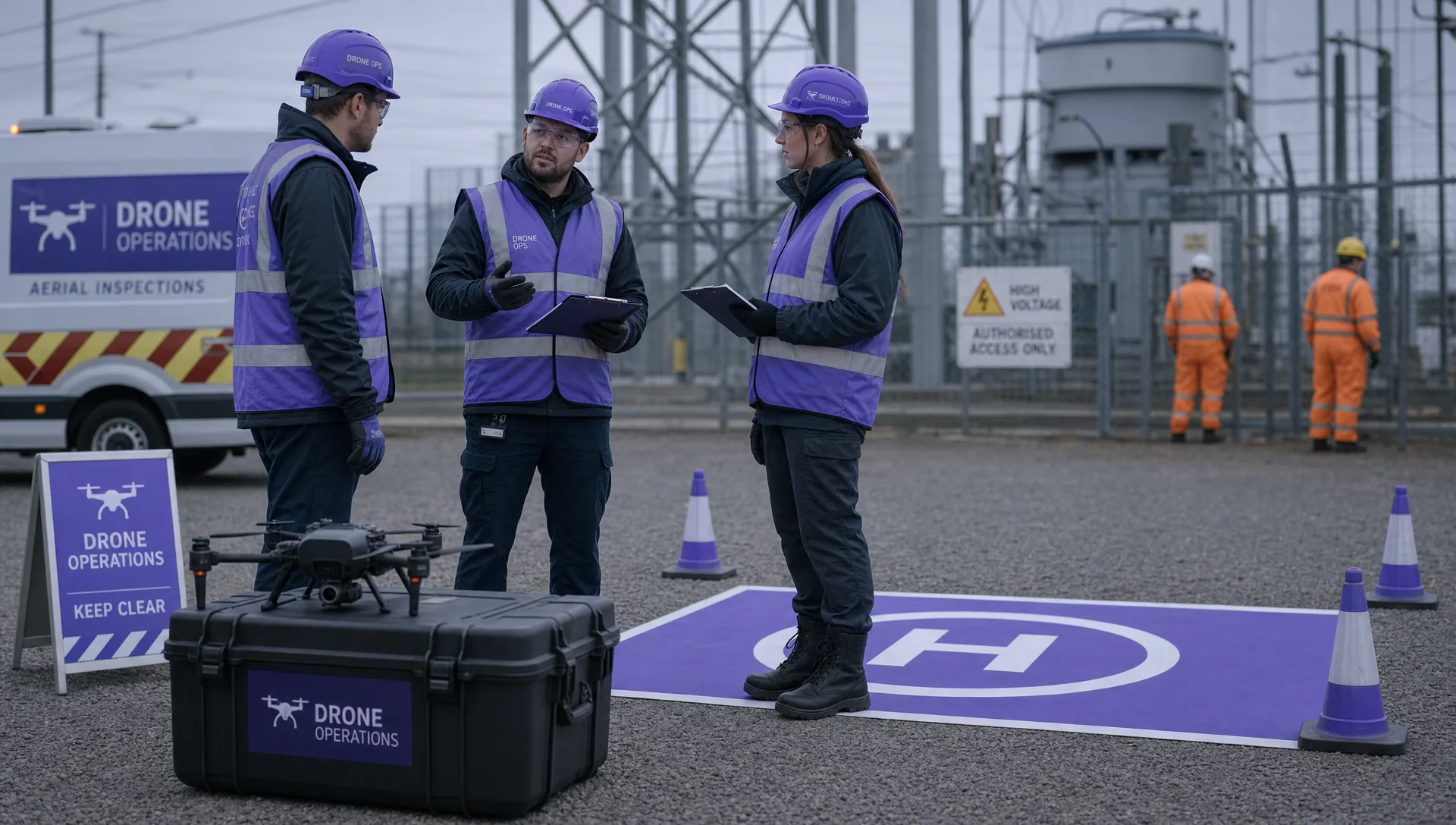
People risk is one of the biggest differences between a hobby flight in an empty field and a commercial operation in the real world. Teams need a clear method for keeping uninvolved people out of the operating area and for responding if someone enters unexpectedly.
Controls can include physical barriers, cones, signage, marshals, client security support, timed operations, exclusion areas, alternative launch points and a planned hold position. For urban surveys or public sector work, communication with site stakeholders can be as important as the flight plan.
Emergency services face a particular challenge because scenes are dynamic. Members of the public, media, blue-light vehicles and other aircraft can appear quickly. A drone safety rule for emergency operations should specify how the UAS crew integrates with incident command, who approves launch and how aviation conflicts are reported.
8. Keep crew communication short, clear and rehearsed
A crew that has not agreed its language before flight will improvise under pressure. That is risky. Use simple, standard calls for launch, land, hold, abort, lost link, public incursion, aircraft sighted and battery state.
Short phrases work best because they reduce ambiguity. If a visual observer sees a helicopter, “aircraft north, hold position” is better than a long explanation. The remote pilot can then take immediate action and ask for more detail if needed.
For multi-crew operations, test radios or communication devices before the aircraft takes off. Also agree what happens if communications fail. If the observer cannot speak to the pilot, the aircraft should not continue as though nothing has changed.
9. Make aircraft readiness a hard stop
Aircraft checks should be treated as go or no-go decisions. If a drone, controller, battery, propeller, payload, firmware state or navigation system is not fit for the task, the flight should stop until the issue is resolved.
Fleet management becomes harder as teams grow. Multiple pilots may share aircraft. Batteries may rotate between sites. Payloads may be swapped for different jobs. Without accurate records, teams can lose track of maintenance status, defects, firmware, insurance information and aircraft allocation.
This is where a structured approach to drone fleet management helps. Whether you use software or a tightly controlled internal system, the goal is the same: no aircraft should arrive on site with an unclear status.
10. Manage batteries as a safety-critical system
Battery management is not just about endurance. It affects aircraft performance, fire safety, emergency margins, transport and mission completion. A commercial crew should know the charge state, health, temperature and role of every battery before a job starts.
Set minimum take-off battery levels and return-to-land thresholds for different mission types. A mapping flight over open land may have different margins from an inspection near structures or a search operation in difficult terrain.
Teams should also have procedures for damaged, swollen, overheated or suspect batteries. Do not leave that decision to individual preference. If a battery is unsafe, it should be isolated, labelled and removed from service according to your procedures and manufacturer guidance.
11. Build privacy, security and data handling into the mission
Commercial drones collect valuable and sometimes sensitive data. Survey images, inspection footage, emergency scene imagery and utility asset data can all create privacy, security or contractual obligations.
Before the flight, agree what data will be captured, where it will be stored, who can access it and how long it will be retained. If your drone will capture people, homes, vehicles or sensitive sites, privacy controls should be part of the risk assessment and client brief.
For UK organisations, the Information Commissioner’s Office provides guidance on data protection and surveillance technologies. Drone teams should align operational workflows with their organisation’s data protection policies, especially when flying for public authorities, utilities or security-sensitive clients.
12. Log the flight and review what happened
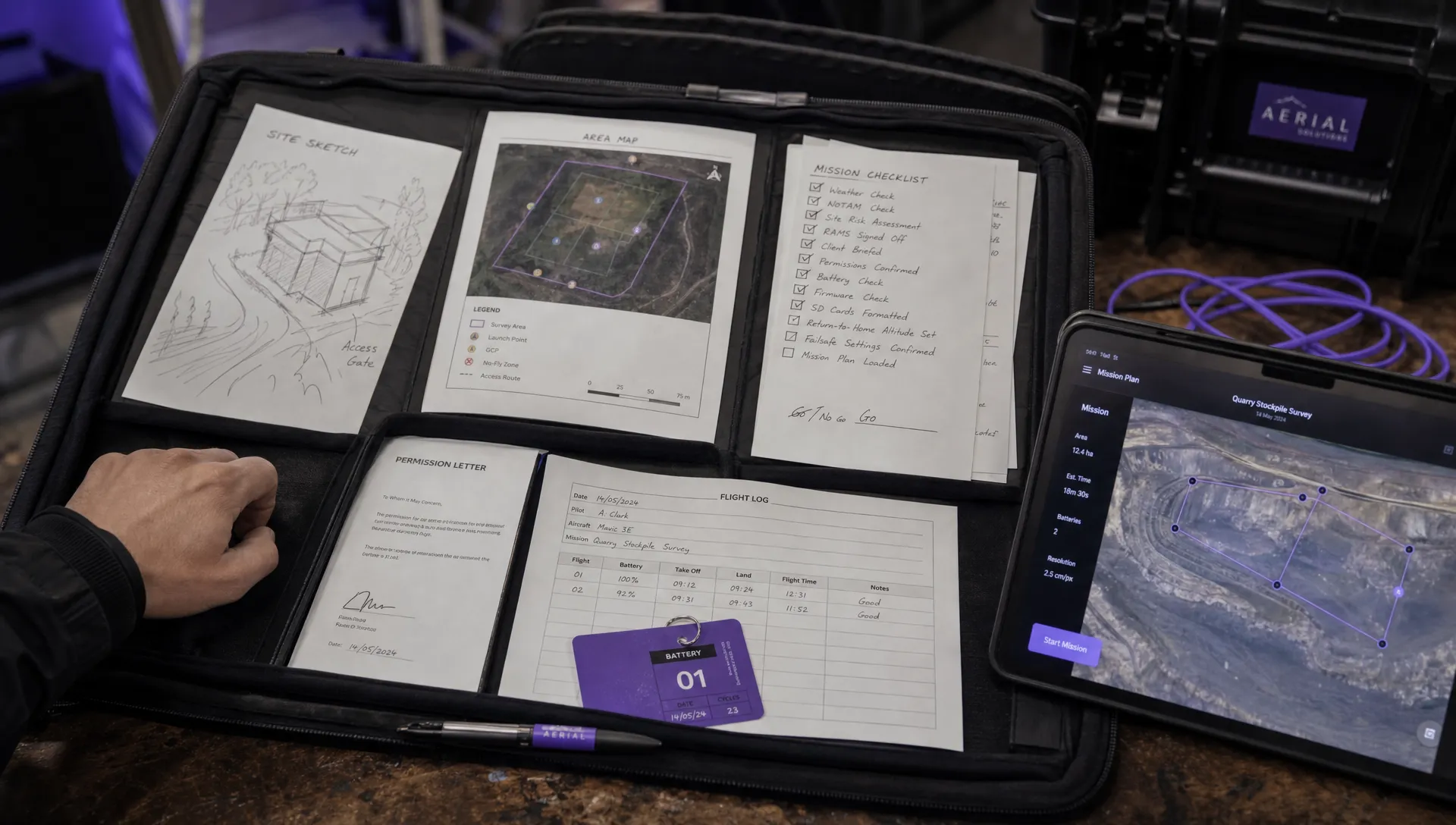
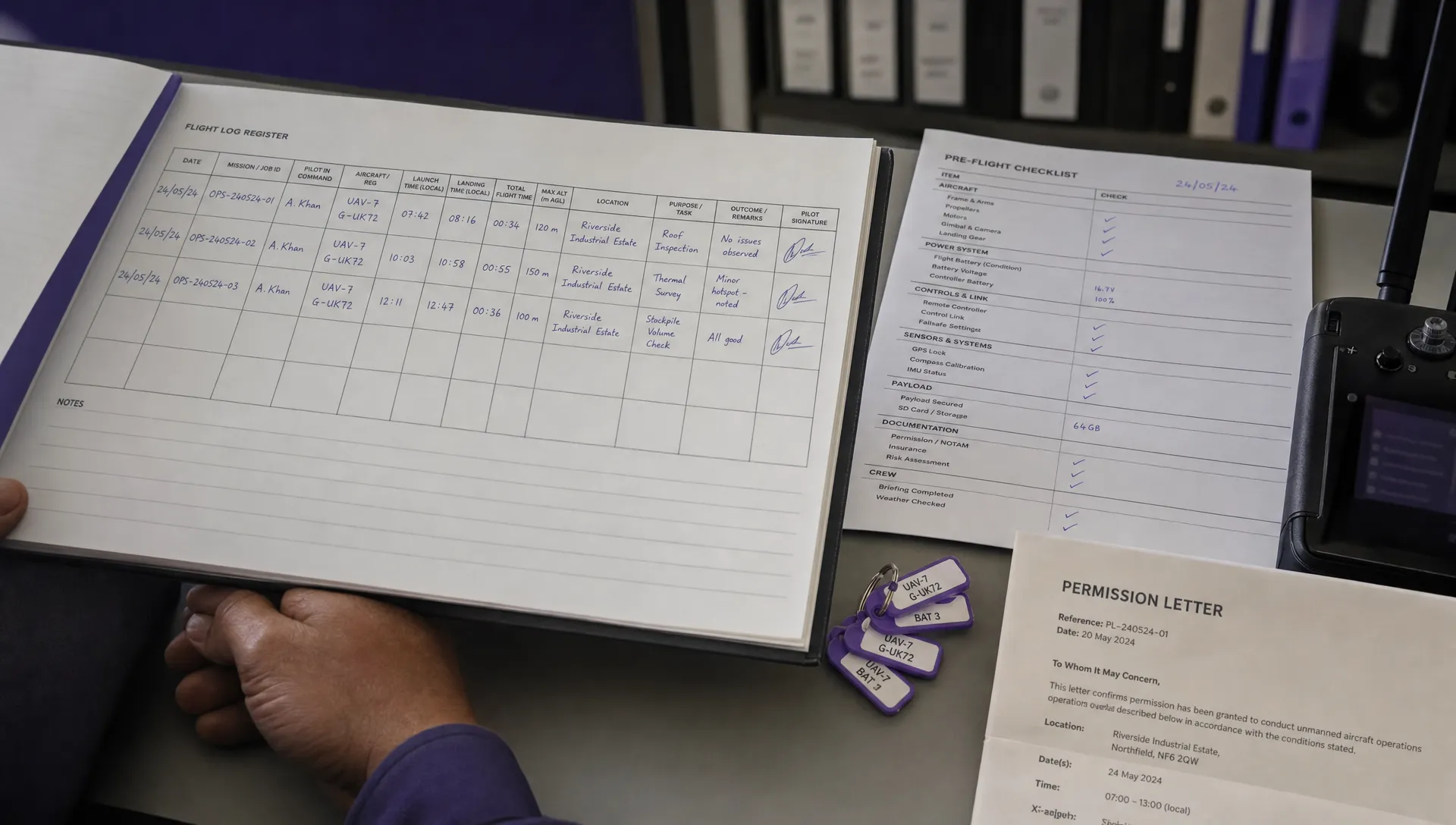
A flight log is evidence, but it is also a learning tool. Record the planned flight, actual flight, crew, aircraft, batteries, location, conditions, defects, incidents, near misses and any changes made on site.
The review does not need to be complicated. Ask whether the planning was accurate, whether the controls worked, whether the crew had the right equipment and whether anything should change before the next job. Near misses deserve attention because they reveal weaknesses before an accident does.
For recurring work, such as monthly asset inspections or repeated site progress surveys, post-flight review can improve future planning. The team can refine launch points, timing, cordons, stakeholder communication and battery planning based on real operational experience.
How different commercial teams apply the rules
The same drone safety rules apply across sectors, but the emphasis changes depending on the mission. A survey company may focus on public interface and data quality. A utility operator may focus on infrastructure hazards and access control. Emergency services may focus on speed, command integration and deconfliction with other aircraft.
| Team type | Main safety pressure | Controls that matter most |
|---|---|---|
| Survey companies | Public access, repeatable image quality, client deadlines | Site surveys, cordons, weather limits, data handling, post-flight review |
| Utility companies | Critical assets, restricted sites, electromagnetic and access hazards | Client coordination, asset-specific risk controls, aircraft readiness, security procedures |
| Emergency services | Dynamic scenes, urgency, other responders, public attention | Command integration, clear launch authority, observer roles, airspace deconfliction |
| Multi-pilot operators | Consistency across crews and locations | Standard procedures, shared checklists, fleet records, competency tracking |
This is why safety rules should be written as a team system, not as a personal checklist for one careful pilot. The larger the operation, the more important consistency becomes.
Turning safety rules into daily practice
The gap between a good operations manual and a safe flight is execution. Commercial drone teams need a way to bring client details, aircraft status, pilot competency, airspace checks, risk assessments, checklists and logs into the same operational workflow.
Dronedesk is designed around that end-to-end operational workflow. Its features page lists client management, fleet management, team management, airspace intelligence, proximity intelligence, flight planning, flight logging, data reporting, configurable checklists and risk assessments. Used well, those capabilities can help a team keep the evidence behind its safety decisions in one place rather than scattering it across emails, spreadsheets and paper forms.
Technology does not replace judgement. A platform cannot decide whether a gusty landing area feels wrong or whether a member of the public is about to enter the cordon. It can, however, make it easier for teams to plan consistently, brief clearly and retain the records that prove the work was controlled.
Frequently Asked Questions
What are the most important drone safety rules for commercial teams? The most important rules are to assign clear accountability, classify the operation correctly, check airspace, complete a practical site survey, use job-specific risk assessments, set weather limits, protect uninvolved people, manage crew communication, confirm aircraft readiness, control batteries, handle data responsibly and log every flight.
Do commercial drone flights always need special permission in the UK? No. UK drone regulation is risk based, so the category depends on the aircraft, location and operating conditions rather than payment alone. Some commercial flights may fit within the Open category, while others need Specific category authorisation. Always check the current CAA requirements for the operation.
How often should airspace be checked before a commercial drone job? Airspace should be checked during feasibility, again during detailed planning and once more on the day of flight. Temporary restrictions, NOTAMs, emergency activity and local conditions can change between booking and launch.
Who should have the authority to cancel a drone flight? The remote pilot must be able to stop or refuse a flight if safety is compromised. Commercial pressure, client expectations or operational urgency should not override the person responsible for the safe conduct of the flight.
What records should a commercial drone team keep? Keep records of planning decisions, airspace checks, permissions, risk assessments, crew roles, aircraft and battery status, checklists, flight logs, defects, incidents, near misses and post-flight reviews. These records support compliance, learning and client assurance.
Make your drone safety rules repeatable
Strong safety performance comes from consistent preparation, clear crew roles and reliable records. If your team is still relying on disconnected spreadsheets, duplicated forms or memory-based processes, it becomes harder to prove that every job followed the same standard.
Dronedesk gives commercial drone teams an all-in-one platform for managing drone operations, from planning and risk assessments to checklists, fleet records and flight logging. Build your safety rules into the way your team works every day, so safer decisions become easier to make and easier to evidence.
 How to Start a Drone Mapping Business With a Clear Workflow →
 Class C Airspace Drone Rules for Commercial Flights →
 How to Create a Drone Job Pack for Every Mission →
 FAA Small UAS Rule: Key Requirements for Operators →
 How to Build a Drone Pilot Flight Log That Is Audit Ready →
 FAA Drone Licence Requirements for Commercial Pilots →
 FAA BVLOS Waivers Granted: What Successful Cases Show →
 How to Export DJI Flight Logs for Incident Reviews →
 Drone Safety and Legal Duties for Business Operations →
 EASA Drone Regulations: Open, Specific and Certified Categories →