
What CAP 3217 Means for Drone Operators: The CAA's Electronic Conspicuity Consultation Response Explained
What CAP 3217 Means for Drone Operators: The CAA's Electronic Conspicuity Consultation Response Explained
The CAA has published its response to the electronic conspicuity consultation, and if you're planning BVLOS operations in UK airspace, this document matters. CAP 3217 landed on 2 March 2026, summarising the feedback from 808 respondents to last year's EC Technical Concept of Operations CAP 3140. It sets the direction for how electronic conspicuity will shape the rules you'll be flying under.
The headline? Broad agreement that EC is needed. Real disagreement on who has to carry it, and who gets to opt out. Here's the breakdown.
What CAP 3217 actually is
Some quick context. In July 2025, the CAA published CAP 3140, its Initial Technical Concept of Operations for Electronic Conspicuity. That document proposed nine positions on how EC technology should be deployed across UK airspace, covering everything from frequency standards to who needs to equip what. The consultation ran until 6 October 2025.
CAP 3217 is the response to that consultation. It doesn't change the rules overnight. What it does is summarise what 808 people and organisations told the CAA, identify where consensus exists and where it doesn't, and signal what comes next.
Three policy drivers sit behind all of this: the ICAO Global Air Navigation Plan, the UK Airspace Modernisation Strategy, and the UK Future of Flight Action Plan. EC is where those agendas converge, connecting manned and unmanned aviation through shared electronic visibility.
One thing worth knowing about those 808 responses: 91.9% came from the general aviation community. And of those GA respondents, 59.48% were hang glider, paraglider, or paramotor pilots. That demographic skew is significant, and it shows up clearly in the results.
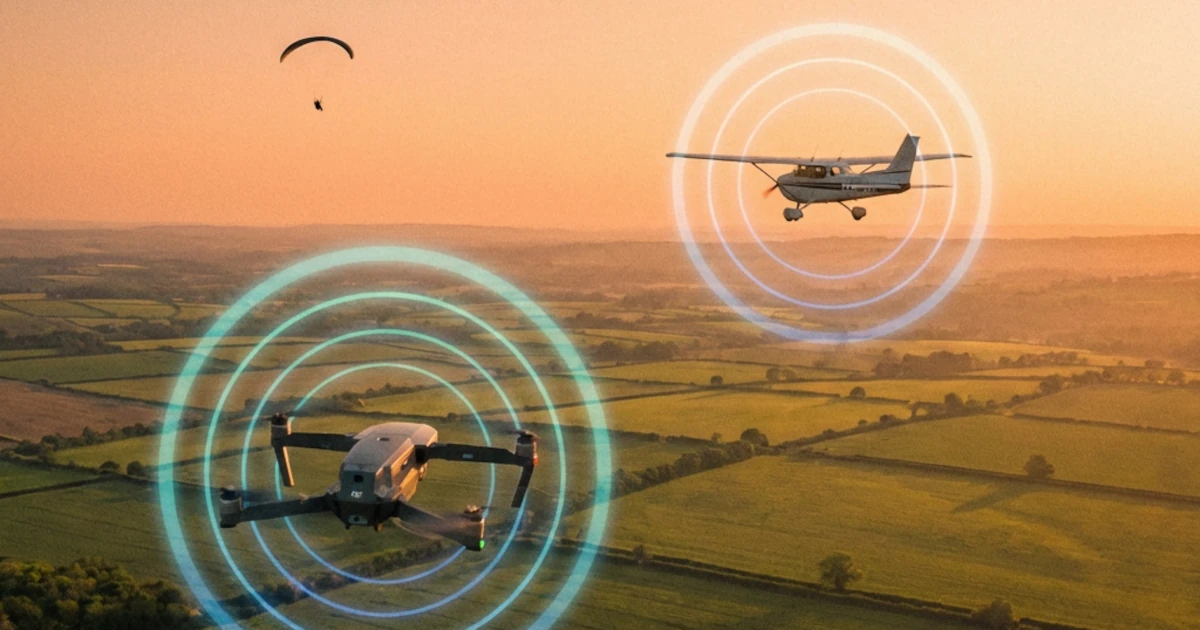
The nine positions at a glance
Rather than reproduce the CAA's full technical language, here's what each position means in practice for UAS operators.
EC's role and system design (Positions 1, 2, 3)
Position 1 confirms that EC will serve as an enabler for both tactical deconfliction (real-time avoidance) and strategic deconfliction (pre-flight planning and airspace management). No surprises here.
Position 2 says the EC system won't rely on airborne equipment alone. Ground-based infrastructure will play a role too, with interoperability between the two. For operators, this means the picture you get in the air should be supplemented by ground-based feeds, though how that works in practice is still being developed.
Position 3 spells out what EC is designed to support: detect-and-avoid (DAA) for drones, integration with air navigation service providers and UTM systems, traffic awareness for pilots, and limited interaction with TCAS (the collision avoidance system on larger aircraft).
Manned aircraft equipage (Positions 4, 5, 6)
This is where it gets contentious.
Position 4 proposes that aircraft flying below 140 knots in non-segregated airspace should carry 1090 MHz ADS-B devices (such as CAP 1391 approved devices) with a minimum Source Integrity Level (SIL) and System Design Assurance (SDA) of 1. Think light aircraft, microlights, gliders.
Position 5 covers faster aircraft (above 140 knots), which would need certified Mode S transponders with ADS-B Extended Squitter, meeting higher integrity standards (SIL 3, SDA 2).
Position 6 states that ADS-B IN (the ability to receive signals from other aircraft, including drones) will remain optional for manned aircraft. It's a risk-based choice, not a requirement.
For drone operators, Positions 4 through 6 are the ones to watch. Your ability to detect manned aircraft depends entirely on those aircraft actually transmitting. If large portions of the GA community don't equip, or equip only reluctantly, your detect-and-avoid system has a problem.
UAS equipage (Positions 7, 8)
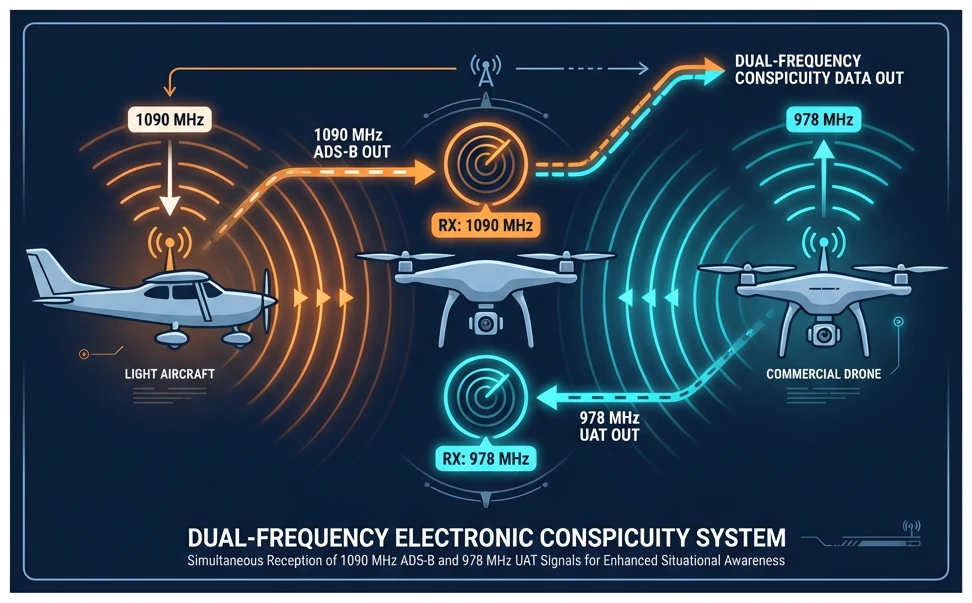
Position 7 requires BVLOS drones to emit ADS-B on 978 MHz UAT (Universal Access Transceiver), meeting DO-282B standards with SIL and SDA of at least 1. The 978 MHz frequency separates drone transmissions from the 1090 MHz band used by manned aircraft, reducing spectrum congestion.
Position 8 requires drones to carry dual-band ADS-B IN receivers capable of picking up both 1090 MHz (manned aircraft) and 978 MHz (other drones). You need to see everyone.
Position 8 had the strongest support of all nine positions, with 76.9% in favour. There's clear consensus that if drones are going to share airspace, they need to be able to detect other traffic.
Operator responsibility (Position 9)
Position 9 puts the responsibility for correct installation, configuration, and operation of EC equipment on you, the operator. No surprises, but worth flagging: as these standards firm up, getting your EC setup wrong won't just be a technical issue. It'll be a compliance one.
What the consultation actually revealed
The numbers tell a story. And it's not a simple one. Here's how each position landed, and who was driving the result.
| Position | What it says (plain English) | Overall result | Who drove it |
|---|---|---|---|
| 1. Role of EC | EC enables tactical and strategic deconfliction | Broadly supported | Consensus across groups |
| 2. System performance | Airborne + ground-based systems work together | Broadly supported | Consensus across groups |
| 3. What EC supports | DAA, UTM integration, traffic awareness, limited TCAS | Broadly supported | Consensus across groups |
| 4. Slow aircraft equipage | Aircraft under 140kts must carry 1090 MHz ADS-B | 74.3% opposed | 87.9% of opposition from glider/paraglider/hang glider/paramotor pilots |
| 5. Fast aircraft equipage | Aircraft over 140kts must carry Mode S with ADS-B ES | 64.4% opposed | GA community, broader base than Position 4 |
| 6. ADS-B IN optional | Manned aircraft don't have to receive signals | 47.3% supported | Supported by GA, less so by other groups |
| 7. UAS must transmit | BVLOS drones emit on 978 MHz UAT | Broadly supported | Consensus across groups |
| 8. UAS must receive | Drones receive on both 1090 MHz and 978 MHz | 76.9% in favour | Strongest support of all nine positions |
| 9. Operator responsibility | You're responsible for correct EC installation and use | Broadly supported | Consensus across groups |
| EC mandate | Should EC be mandated across UK airspace? | 66.46% opposed | GA community, cost and proportionality concerns |
A few things stand out here.
The manned equipage problem
Positions 4 and 5 drew the heaviest opposition, almost entirely from the GA community. Their concerns are legitimate: cost, weight on lightweight airframes, battery life, and the practicality of fitting electronics to aircraft that were never designed for them. But the consequence for UAS operators is real. If manned aircraft don't transmit, your drone can't see them.
The asymmetry
Look at Positions 6 and 8 together. There's broad consensus that drones should carry full EC capability (receive on both frequencies). But ADS-B IN for manned aircraft? Optional. The same community that wants drones to detect them is resistant to making themselves electronically visible. That creates a gap in the safety case that falls squarely on UAS operators to deal with.
The mandate question
66.46% opposed a mandate. The themes were predictable but legitimate: cost and proportionality, technology limitations (particularly for lightweight aircraft), GNSS vulnerability to jamming and spoofing, and concerns about rushing implementation before standards are mature.
Cross-cutting concerns
Several issues came up across multiple positions. Human factors research showed that pilots can become desensitised to alerts in busy environments, raising questions about how EC information is presented in the cockpit. GNSS jamming and spoofing remain genuine vulnerabilities. Operators running sensitive missions flagged privacy concerns about broadcasting their position. And multiple respondents called for updated CAP 1391 standards before any mandates take effect.
The CAA also referenced the January 2025 Washington DC mid-air collision (DCA25MA108) as a reminder of why electronic visibility matters, particularly where different types of air traffic converge.
And where was the UAS industry?
With just 47 respondents out of 808, the drone industry's voice in this consultation was barely a whisper. Whether that reflects apathy, silent agreement, or a belief that the outcome was already decided, the result is the same: a consultation that will shape BVLOS rules for years was overwhelmingly shaped by communities other than our own.
What this means for UAS operators
So what should you actually do with all of this? Here are the practical takeaways.
Your equipage path is getting clearer
978 MHz UAT ADS-B out, plus dual-band (1090 MHz and 978 MHz) ADS-B in. That's the direction of travel for BVLOS drones. If you're speccing new platforms or evaluating hardware, this is the configuration to plan around.
The detection gap is real
The CAA itself acknowledges that expecting drones to detect manned aircraft without EC is not currently possible. But with ADS-B IN remaining optional for manned aircraft and significant opposition to mandatory equipage, there's a real question about how many aircraft will actually be visible to your sensors. A partial EC environment means a weaker detect-and-avoid capability, and that directly affects your operational risk assessment.
SORA implications
EC is positioned as a mitigation within the SORA framework. The strength of that mitigation depends on how many other airspace users are electronically visible. If you're claiming EC-based mitigations in your SORA analysis, you'll need to account for the possibility that a significant portion of manned traffic may not be broadcasting. That's a harder safety case to make.
For operators already working through SORA, platforms like DroneDesk that support compliance workflows will need to reflect these evolving EC requirements as they're finalised. The detail of how EC mitigations are documented and justified is going to matter more as the technical standards solidify.
Don't over-invest in hardware yet
Minimum power levels, quality indicators (SIL and SDA thresholds), and speed classification metrics are all still being finalised. The CAA plans to update CAP 1391 before any mandates take effect. Hold off on locking in specific hardware purchases until those standards are confirmed, unless you're buying for testing and trials.
The mandate is coming, but slowly
A separate consultation specifically on EC mandate positions will follow. The CAA's EC devices page now confirms that a public consultation on implementing a UK-wide EC mandate will launch later this month. Timeline for actual implementation is less clear, but mandatory equipage likely won't land before late 2026 at the earliest, and more realistically into 2027.
What happens next
The CAA has laid out a clear programme of work for the rest of 2026 and into 2027:
- Testing, trials, and research throughout 2026 to validate EC performance in real-world conditions
- A revised EC policy (updated CAP 1391) and an updated Technical ConOps expected late 2026 or early 2027
- Parallel development of DAA, UTM, and ground infrastructure policies
- A separate consultation on the EC mandate, launching imminently
- A joint CAA/DfT decision confirming the use of aviation-protected spectrum as the national standard for EC
The CAA has been clear that EC is not a silver bullet. Their own words acknowledge it's only one part of a broader set of solutions. DAA technology, UTM infrastructure, and ground-based surveillance all need to develop alongside it.
Keep your seat at the table
EC policy is heading in the right direction for BVLOS integration. The technical framework makes sense. The challenge is participation. An EC system where drones can see and be seen, but a significant chunk of manned traffic can't be detected, isn't delivering the safety benefit it promises.
The upcoming mandate consultation is where this gets decided. If you're a commercial UAS operator, or you represent one, that consultation is your opportunity to shape the outcome. Engage with it. Respond to it. The GA community turned out in force for CAP 3140 (808 responses, overwhelmingly from their side). The UAS community needs to match that energy.
You can read the full CAP 3217 document here, and the original CAP 3140 Technical ConOps for background. Keep an eye on the CAA's electronic conspicuity page for the mandate consultation when it drops.
 Drone Part 107 Operations: When a Waiver May Be Needed →
 Drone Operating Rules for Managing Contractors and Employees →
 BVLOS Drone Requirements for Building a Safety Case →
 Drone Pilot Test Mistakes That Cost Candidates Marks →
 FAA 107 License vs Part 107 Certificate: What’s the Difference? →
 Drone Airport Rules: A Field Checklist for Site Assessments →
 FAA Part 107 Record-Keeping Rules for Commercial Teams →
 How to Review a DJI Flight Log After an Unexpected Event →
 Drone Laws Around the World: A Pre-Flight Research Framework →
 How to Compare Drone Survey Services for Complex Sites →