
Atypical Airspace Explained for UK Drone Operators
If you fly drones commercially in the UK, you will increasingly hear the phrase atypical airspace in conversations about infrastructure inspection, utilities work, emergency response and future BVLOS operations. It sounds like a new category of airspace, but that can be misleading.
In UK drone planning, “atypical airspace” is usually used as shorthand for an atypical air environment, a place where the normal risk of meeting crewed aircraft may be reduced because of the surrounding structures, terrain or operational context. It is not a free pass, and it is not a substitute for permissions, airspace checks or a robust risk assessment.
For drone operators, the value is practical. If you can show that a flight takes place in an environment where crewed aviation is unlikely to be present, and that you have suitable controls in place, you may be able to make a stronger safety case for certain Specific Category operations, especially infrastructure-focused work. But the evidence matters.
What does atypical airspace mean?
“Atypical airspace” is not an official UK airspace classification like Class D controlled airspace, a Flight Restriction Zone or a danger area. In most serious operational discussions, the more accurate term is atypical air environment.
An atypical air environment is a local operating environment where crewed aircraft would not normally be expected to fly because doing so would be impractical, unsafe, unnecessary or contrary to normal aviation behaviour. The classic examples involve drones operating close to assets that crewed aircraft generally avoid, such as tall structures, industrial plant, powerlines, bridges or the sides of buildings.
The key idea is reduced likelihood of airspace encounter, not “no air risk”. Helicopters, emergency aircraft, military aircraft, survey aircraft and low-level general aviation can still appear in places where drone teams might not expect them. That is why the UK Civil Aviation Authority’s core drone guidance, including CAP 722 for unmanned aircraft operations, continues to place emphasis on operational risk assessment, clear procedures and compliance with the conditions of any authorisation.
For a UK operator, the simplest way to think about atypical airspace is this: it is an argument you may use in your operational safety case, but only if the site, altitude, proximity to obstacles and surrounding aviation activity support it.
Why UK drone operators are talking about it
The topic matters because the UK drone sector is moving from mostly visual line of sight work towards more advanced operations. Utility inspections, rail corridor surveys, emergency service deployments, quarry mapping and industrial site monitoring all involve environments where drones can be safer, cheaper or more practical than putting people or crewed aircraft close to hazards.
Atypical environments are especially relevant when an operator wants to show that the drone will remain in a volume of airspace where a crewed aircraft encounter is unlikely. For example, a drone inspecting a chimney stack while staying close to the structure and below its top may present a different air risk from a drone flying across open countryside at the same height.
That difference can matter in a Specific Category application, a site-specific operating procedure or an internal safety case. It can also shape how you brief pilots, choose observers, set altitude limits, establish abort actions and record your planning evidence.
However, atypical airspace should never be treated as a loophole. The CAA’s Drone and Model Aircraft Code still applies where relevant, and operators must still comply with the Open or Specific Category rules that apply to the flight.
Atypical airspace is not the same as controlled or restricted airspace
One of the easiest mistakes is to confuse “atypical” with “restricted”. They describe different things.
Controlled, restricted and notified airspace are legal or procedural airspace constructs. Atypical airspace is an operational risk concept. You still need to check all normal airspace constraints before you decide that a location has atypical characteristics.
| Term | What it means for drone operators | Does it automatically allow drone flight? |
|---|---|---|
| Atypical air environment | A local environment where crewed aircraft are less likely because of structures, terrain or context | No. It may support your risk case, but it does not remove legal requirements |
| Flight Restriction Zone | Protected airspace around certain aerodromes | No. Permission is required from the relevant air traffic control unit or aerodrome operator |
| Restricted area | Airspace where flight is restricted under defined conditions | No. You must comply with the restriction and obtain permission where required |
| Danger area | Airspace where hazardous activity may take place | No. You must check activity status and follow the published procedures |
| Temporary restriction or NOTAM | Short-term warning or restriction, often for events, emergencies or aviation activity | No. You must check current notices before operating |
| Controlled airspace | Airspace where air traffic control services are provided to certain aircraft | Not by itself. Drone permissions depend on the specific restriction, location and operation |
This distinction is important. A site can be an atypical environment and still sit inside a Flight Restriction Zone. A bridge inspection can have atypical characteristics and still be affected by a temporary restriction. A quarry may seem isolated and still be close to military low flying routes or private helicopter activity.
Examples of atypical air environments
Atypical characteristics are highly site-specific. The same type of job can be low-risk in one location and unsuitable in another. Still, several scenarios commonly raise the question.
Linear infrastructure inspections
Powerlines, railways, pipelines and road corridors often create an environment where drones can operate close to the asset rather than in open airspace. The argument is usually strongest when the drone remains close to the structure or corridor, at a tightly controlled height, and within a well-defined operational volume.
For utility companies, this can be useful when planning repeatable inspection workflows. But it is not enough to say “we are near powerlines”. Helicopters may inspect powerlines too, emergency aircraft may transit nearby, and other aerial work may occur. Coordination with the asset owner and a current airspace check remain essential.
Tall structures and built assets
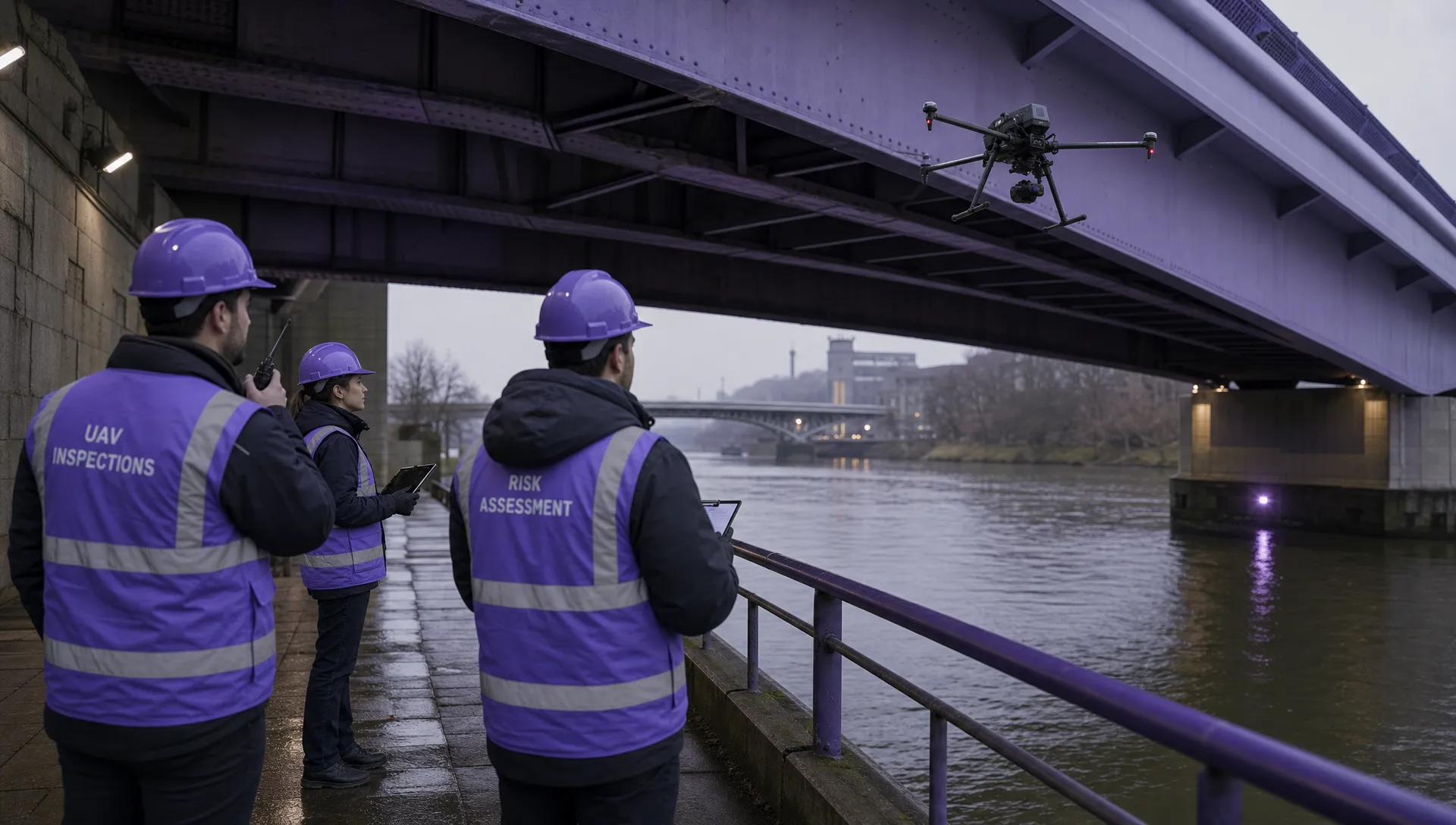
Telecoms masts, chimneys, wind turbines, tower cranes, bridges and building façades can all create atypical conditions. A drone operating close to a structure may be in an area crewed aircraft avoid because of collision risk.
The strongest operational case usually defines a lateral distance from the structure, an upper height limit, the take-off and landing area, the contingency area and the emergency plan. A vague statement that the site is “urban” or “near buildings” is not enough.
Industrial, quarrying and demolition sites
Some industrial sites contain plant, stockpiles, blasting areas, cranes, restricted access zones and other hazards that make drone use attractive. These sites can also have unusual ground risks, security controls and local vehicle movements.
For drone teams working in complex environments, the atypical airspace argument should sit alongside a site-specific ground risk assessment, not replace it. If you are building or refining that process, Dronedesk has a practical guide on how to build a drone flight risk assessment that works.

Emergency service scenes
Emergency services may operate drones within cordons, around incidents, near damaged structures or in areas where access is controlled. These environments can be atypical, but they can also be aviation-sensitive. Police helicopters, air ambulances, search and rescue aircraft and temporary restrictions may all be relevant.
For emergency service drone teams, the priority is command-and-control clarity. Who has airspace coordination responsibility? Is there an incident air desk? Are crewed aircraft expected? Has a temporary restriction been requested or issued? Those answers matter more than the label “atypical”.
When a location is probably not atypical
The concept loses value if it is stretched too far. Open fields, coastal paths, rural estates, beaches, reservoirs and large construction sites may feel quiet from the ground, but that does not automatically make them atypical from an aviation perspective.
A site is less likely to support an atypical airspace argument if the drone is operating away from obstacles, climbing into airspace where low-level aircraft may transit, or flying across broad open areas. It is also weaker where there are nearby aerodromes, heliports, glider sites, parachute sites, military activity, sightseeing flights or frequent emergency aviation.
A useful test is to ask: what physical or operational feature makes it unlikely that a crewed aircraft would be in this exact volume of airspace? If the answer is only “we have never seen one here”, you probably need a stronger case.
The planning checks you still need to complete
Atypical airspace does not remove normal pre-flight planning. It simply changes part of the air risk picture if you can evidence it properly.
Before relying on an atypical environment argument, UK operators should check, document and brief the following:
- The airspace classification and any nearby Flight Restriction Zones, restricted areas, danger areas or prohibited areas
- Current NOTAMs, temporary restrictions, emergency restrictions and relevant local aviation warnings
- Nearby aerodromes, heliports, hospital landing sites, glider sites, parachute sites and known low-level routes
- The operational volume, including flight geography, contingency volume and any ground risk buffer
- The maximum height, lateral limits and relationship between the drone and the obstacle or asset
- Landowner, site owner, client, local authority or asset owner permissions where required
- Weather, visibility, communications, lost-link procedures, emergency landing options and abort criteria
- Pilot competence, observer placement, crew communications and site access control
The UK Aeronautical Information Publication, available through NATS Aeronautical Information Service, remains an important official source for airspace and aerodrome information. For day-to-day drone planning, operators should also use recognised airspace tools, current NOTAM information and any sources specified in their operations manual or Operational Authorisation.
How to evidence atypical airspace in a risk assessment
The best atypical airspace arguments are specific, measurable and easy to audit. They show exactly where the aircraft will fly, why crewed aircraft are unlikely in that volume, and what controls keep the operation within that assumption.
A strong evidence pack might include a map showing the operating volume, screenshots from airspace tools, site photographs, obstacle heights, take-off and landing positions, stakeholder permissions, NOTAM checks and a record of any calls or coordination with local aviation stakeholders.
It should also explain the limits of the claim. For example, if the drone will inspect a bridge while remaining below deck level and within a defined distance of the structure, say so. If the drone will then climb above the structure for overview imagery, that may be a different risk condition and should be assessed separately.
Here is a practical way to frame the assessment:
| Evidence question | Good answer | Weak answer |
|---|---|---|
| Why is the environment atypical? | The drone will remain within 30 metres of a 90 metre structure and below the top of the structure | The site is quiet and rural |
| What airspace checks were completed? | FRZ, NOTAM, AIP, danger area status and nearby heli sites checked on the day of flight | The pilot checked an app last week |
| How is the aircraft kept inside the atypical volume? | Altitude limit, geofence, observer briefing and abort points documented | The pilot will be careful |
| What could invalidate the assumption? | HEMS activity, unexpected low-level aircraft, site emergency, weather deterioration or loss of communications | Nothing expected |
| How will the team respond? | Land immediately, hold position below defined height or follow a pre-briefed emergency route | Decide on the day |
This level of detail is especially important for organisations with multiple pilots. Survey companies, utilities and emergency services need repeatable procedures, not just experienced individuals making judgement calls in the field.
Atypical airspace and BVLOS operations
Atypical environments are often discussed in the context of beyond visual line of sight operations. That is because the air risk of BVLOS flight is heavily influenced by how likely the drone is to encounter crewed aircraft and how the operator will detect, avoid or otherwise mitigate that risk.
In simple terms, an operation close to infrastructure may be easier to justify than a BVLOS flight through open Class G airspace, provided the drone stays within the defined atypical volume and the operator has credible controls. But this does not mean all infrastructure BVLOS work is automatically acceptable.
The CAA will look at the full concept of operations, including the aircraft, command-and-control link, emergency procedures, ground risk, airspace environment, crew competence and evidence of compliance. Operators should always work from the current CAA requirements for the Specific Category and the conditions of their Operational Authorisation.
If your intended flight cannot be conducted under the Open Category rules, or outside the privileges of your existing authorisation, you should treat atypical airspace as one part of a wider approval strategy rather than a standalone permission.
Operational controls that make the argument stronger
The most persuasive controls are the ones that directly preserve the atypical nature of the operation. In other words, they stop the drone from drifting into ordinary shared airspace.
Examples include tight altitude limits, lateral distance limits from the asset, route constraints, geofencing where appropriate, visual observer positioning, clear pilot-to-observer communications, defined lost-link behaviour and conservative weather minima. On complex sites, a site controller or airspace coordinator may also be useful.
Crew briefing is just as important. Everyone involved should understand what makes the environment atypical, where that assumption stops, and what to do if a crewed aircraft appears. The phrase “land immediately” is useful only if the landing area, trigger point and communications process are already clear.
Documentation should be proportionate, but it should be good enough for a manager, auditor, client or regulator to understand the decision after the event.
Common mistakes to avoid
The first mistake is using “atypical airspace” as a label without explaining why it applies. If the risk assessment does not describe the obstacle, structure, terrain or operating constraint, it is unlikely to be convincing.
The second mistake is assuming that low altitude equals low air risk. UK drone pilots often think of 400 feet as “drone airspace”, but crewed aircraft can operate low for lawful reasons, including emergency response, take-off and landing, agricultural work, military training and infrastructure inspection.
The third mistake is failing to separate different phases of flight. A take-off from an open field, a transit to a structure and close inspection of that structure may each have different risk profiles. Only the close inspection phase may have atypical characteristics.
The fourth mistake is poor record keeping. If a client asks how the decision was made, or if an incident occurs, verbal assumptions are not enough. You need evidence of the checks, controls and permissions that informed the flight.
Managing atypical airspace planning with Dronedesk
Atypical environment planning is easier when airspace checks, job details, risk assessments, checklists and flight logs are kept in a consistent system. According to the Dronedesk features page, Dronedesk includes airspace intelligence, proximity intelligence, flight planning, configurable checklists, risk assessments, flight logging, and client, fleet and team management.
For operators dealing with complex sites, that means the planning record can sit alongside the client, aircraft, team and flight information rather than being scattered across emails, documents and screenshots. It does not replace professional judgement, but it can support a more disciplined workflow.
This is particularly relevant for teams that repeat similar missions across many sites. A utility inspection company, for example, may want consistent checklists for powerline work. A survey company may need a repeatable process for industrial sites. An emergency service may need clear records of who planned, approved and flew a mission.
Practical checklist for UK operators
Before describing a flight as being in atypical airspace, ask these questions:
- Is “atypical air environment” the more accurate term for what we mean?
- What feature makes crewed aircraft unlikely in the exact volume where the drone will fly?
- Have we defined the operating volume clearly enough for the pilot and any observers?
- Do the take-off, transit, inspection and recovery phases all have the same risk profile?
- Have we checked FRZs, NOTAMs, restricted areas, danger areas and nearby aviation sites?
- Are we relying on any permissions from an aerodrome, landowner, asset owner or site controller?
- What controls keep the drone inside the atypical volume?
- What event would invalidate the assumption and trigger an abort or landing?
- Is the evidence recorded in a way that can be reviewed later?
If you cannot answer these questions clearly, the flight may still be possible, but the atypical airspace argument needs more work.
Frequently Asked Questions
Is atypical airspace an official UK airspace category? No. The phrase is commonly used by drone operators, but the more precise term is usually atypical air environment. It is an operational risk concept, not a formal airspace classification like controlled airspace, a Flight Restriction Zone or a danger area.
Can I fly in atypical airspace without CAA authorisation? Only if the flight is otherwise legal under the rules that apply to it. Atypical characteristics do not remove the need to comply with the Open Category, Specific Category, your Operational Authorisation, FRZ permissions, NOTAMs or other restrictions.
Does atypical airspace make BVLOS legal? Not by itself. It may help support the air risk element of a BVLOS safety case, but BVLOS operations normally require appropriate Specific Category authorisation from the CAA unless a specific exemption or permission applies.
What is a good example of an atypical air environment? A drone inspecting a tall structure while remaining close to it and below its top may be operating in an atypical environment, because crewed aircraft would normally avoid that volume. The same drone flying away from the structure into open airspace may no longer have that protection.
What evidence should I keep? Keep airspace check records, NOTAM references, maps, site photos, obstacle information, permissions, risk assessments, checklists, crew briefings and flight logs. The aim is to show why the environment was considered atypical and how the operation stayed within the planned limits.
Final thoughts
Atypical airspace is a useful concept for UK drone operators, but only when it is used precisely. It should help you describe a real operational environment, not provide a convenient label for a difficult flight.
The safest approach is to define the volume, prove why crewed aircraft are unlikely there, apply controls that keep the drone inside that volume, and record the evidence. Do that well, and atypical environment planning can become a practical part of safer, more scalable drone operations.
If your team regularly plans complex flights around infrastructure, industrial sites or emergency environments, Dronedesk can help you manage the operational details in one place, from planning and checklists to risk assessments and flight logging.
 Atypical Airspace Explained for UK Drone Operators →
 FAA Unmanned Aircraft Regulations Made Simple →
 Part 107 Test Tips to Pass With Confidence →
 How to Pass the FAA Drone Written Test First Time →
 What a BVLOS Flight Means for Risk and Compliance →
 Drone VLOS Rules Explained for Commercial Teams →
 FAA Remote ID Rule Explained for Commercial Pilots →
 Drone Legal Requirements for Commercial Operations →
 Drone Near Airport Rules Explained for Safer Planning →
 International Drone Regulations Every Global Team Should Know →