
International Drone Regulations Every Global Team Should Know
Flying a drone in another country is rarely as simple as packing the aircraft, booking a flight and using the same procedures you use at home. For global drone teams, international drone regulations affect almost every part of the job: who can operate, where you can fly, what permissions are needed, how data can be collected, and what records must be kept afterwards.
The challenge is that there is no single global drone licence or universal operating permission. International bodies such as the International Civil Aviation Organization help shape global safety principles, but day-to-day drone rules are set by national aviation authorities. A survey company working across Europe, a utility provider inspecting assets in North America, or an emergency services team supporting a disaster response overseas may face very different requirements from one border to the next.
This guide gives global teams a practical overview of the regulatory themes that matter most, the regional differences to watch, and the operational habits that reduce compliance risk before, during and after international drone work.
The first rule of international drone compliance
Your home-country approval usually does not travel with you.
A remote pilot certificate, operational authorisation, insurance policy, aircraft registration or risk assessment that is valid in one jurisdiction may help demonstrate competence, but it rarely gives you automatic permission to fly elsewhere. In most countries, drone operations are governed by the local civil aviation authority, and that authority decides whether your aircraft, pilot, organisation and mission profile are acceptable.
This matters because international drone regulations are not only about aviation. A lawful overseas drone operation may also involve rules on:
- Airspace access and restricted zones
- Pilot competency and local registration
- Aircraft marking, identification and maintenance records
- Visual line of sight, night operations, BVLOS and flights over people
- Radio equipment, spectrum use and import controls
- Privacy, surveillance, data protection and critical infrastructure security
- Insurance, incident reporting and operational record keeping
For commercial operators, the safest assumption is simple: treat every new country as a new regulatory project, not just a new job site.
The regulatory concepts most countries share
Although the details vary, most drone regulations are built around a few common concepts. Understanding these makes it easier to interpret local rules quickly when expanding into a new market.
Operator registration and aircraft registration
Many jurisdictions distinguish between the organisation responsible for the drone operation and the individual aircraft being flown. The operator may need to register as a legal entity, while the drone may need a separate registration number or visible marking.
In some countries, registration applies only above a weight threshold. In others, commercial use triggers registration regardless of aircraft size. Teams should also check whether foreign operators can register directly or whether a local entity, partner or sponsor is required.
Pilot competency
Pilot qualification is one of the most common compliance gaps in cross-border operations. A UK General VLOS Certificate, an EU competency certificate or an FAA Remote Pilot Certificate may be valuable evidence of training, but local authorities may still require a national certificate, local exam, conversion process or temporary authorisation.
For emergency services and utility companies, this becomes especially important when multiple pilots are deployed at short notice. It is not enough to know that a pilot is competent internally. You must know whether they are legally recognised in the operating country for the type of mission planned.
Risk-based operating categories
Many regulators now use a risk-based model. Low-risk flights may be allowed under standard rules, while higher-risk operations require extra approvals, mitigations or case-by-case review.
The European Union, for example, uses the Open, Specific and Certified categories under the EASA civil drones framework. The UK Civil Aviation Authority also structures drone requirements around operational risk, with guidance available through the CAA drone rules. Other countries use different labels, but the logic is similar: the more complex the flight, the more evidence the operator must provide.
Typical factors that increase regulatory scrutiny include flying near people, in controlled airspace, beyond visual line of sight, at night, near critical infrastructure, or with heavier aircraft.
Airspace permissions
Airspace access is often the most time-sensitive part of international drone planning. Even if your pilot and aircraft are compliant, you may still need approval to fly in controlled airspace, near airports, close to military areas, over public events or around sensitive infrastructure.
Some countries have digital authorisation systems. Others require manual applications, local coordination or written permission from air navigation service providers. Global teams should build airspace lead times into project schedules, especially when operating near ports, power networks, rail corridors, urban centres or emergency scenes.
Operational limitations
Most countries regulate basic operational parameters such as maximum altitude, visual line of sight, distance from people, flights over crowds, night operations and separation from aerodromes. The numbers can vary significantly, and translations can introduce ambiguity.
For example, one authority may allow certain night operations under standard rules, while another may require a waiver or special authorisation. A BVLOS inspection along a pipeline may be routine under one permission framework but impossible without a lengthy approval process in another.
If the mission depends on a non-standard capability, verify that requirement before committing to timelines or pricing.
Regional snapshot: what global teams should expect
The table below is not a substitute for legal advice or direct authority guidance. It is a planning snapshot to help teams understand how different jurisdictions tend to frame commercial drone operations.
| Region or country | Main authority | Common framework for commercial operations | Key checks for global teams |
|---|---|---|---|
| United Kingdom | Civil Aviation Authority | Open category for lower-risk flights, Operational Authorisation for higher-risk work | Check CAA registration, pilot competency, airspace restrictions and requirements for flights near people or congested areas |
| European Union | EASA plus national aviation authorities | Open, Specific and Certified categories | Confirm operator registration, drone class requirements, cross-border recognition rules and any national geographical zones |
| United States | Federal Aviation Administration | Part 107 for most commercial small UAS operations | Check remote pilot certification, aircraft registration, Remote ID, LAANC or other controlled airspace authorisations, and waiver needs |
| Canada | Transport Canada | Basic and Advanced operations, with SFOC for operations outside standard rules | Confirm pilot certificate, drone registration, controlled airspace requirements and whether an SFOC is needed |
| Australia | Civil Aviation Safety Authority | Excluded category, standard operating conditions, RePL and ReOC depending on operation | Check CASA registration, accreditation or licensing, operator certificate requirements and local airspace restrictions |
| New Zealand | Civil Aviation Authority | Part 101 for standard unmanned aircraft operations, Part 102 for certificated operations | Confirm consent requirements, airspace approvals and whether the operation exceeds Part 101 limits |
| Singapore | Civil Aviation Authority of Singapore | Permit-based system depending on aircraft, purpose and location | Check registration, operator and activity permits, no-fly zones and security-sensitive locations |
In the United States, the FAA UAS programme remains the primary source for commercial drone requirements. In Canada, Transport Canada’s drone safety guidance explains registration, certification and operational categories. In Australia, CASA’s drone rules are the starting point for understanding commercial permissions and standard operating conditions.
For teams working in multiple countries, the lesson is not to memorise every rule. The better approach is to maintain a repeatable compliance workflow that forces the right questions early enough to prevent project delays.

The compliance issues that catch global drone teams out
International drone operations usually fail on details, not broad principles. Teams often know they need permission, but underestimate how many supporting requirements sit around the flight itself.
Local registration can take longer than expected
Some authorities process registrations quickly. Others require identity checks, company documentation, local addresses or additional reviews for foreign operators. If you are tendering for international survey work, build this into your mobilisation plan rather than waiting until a purchase order is signed.
BVLOS is never a minor detail
Beyond visual line of sight operations are among the most heavily scrutinised drone activities worldwide. Utility inspections, long linear surveys and emergency response mapping may all benefit from BVLOS, but permissions can require detailed safety cases, detect-and-avoid mitigations, communications planning and coordination with aviation stakeholders.
Even where BVLOS is becoming more common, do not assume it is available as a standard right. Confirm the current local position, especially because BVLOS policy is changing rapidly in several major markets.
Drone hardware may trigger separate rules
Aircraft choice can create regulatory consequences. Weight, camera type, thermal sensors, parachutes, Remote ID capability, class markings and radio equipment can all affect whether a flight is allowed.
There may also be import restrictions, customs processes or radio spectrum rules. A drone that is routine for domestic inspections may require extra declarations or may not be practical to deploy in another country without local support.
Privacy and data rules are not optional
Aviation approval does not automatically give you permission to collect, store or transfer data. Drone imagery can capture people, vehicle plates, private property, sensitive assets and critical infrastructure. In the UK and Europe, data protection obligations such as UK GDPR and GDPR may apply where personal data is captured or processed.
Global teams should clarify data ownership, storage location, retention periods, encryption requirements and onward transfer rules before collecting imagery. This is particularly important for utilities, emergency services and public-sector work, where operational data may be sensitive even when it is not personal data.
Local landowner and site permissions still matter
Airspace permission and take-off permission are separate issues. A flight may be legal from an aviation perspective but still blocked by land access, site safety rules, port authority requirements, police coordination or critical infrastructure policies.
For survey companies, this can be the difference between a smooth mobilisation and a wasted site visit. For emergency teams, it can determine whether drone deployment is integrated into the wider incident command structure or treated as an unmanaged risk.
A practical workflow for international drone operations
The best global drone teams do not rely on memory. They use a structured workflow that captures requirements consistently across countries, clients and mission types.
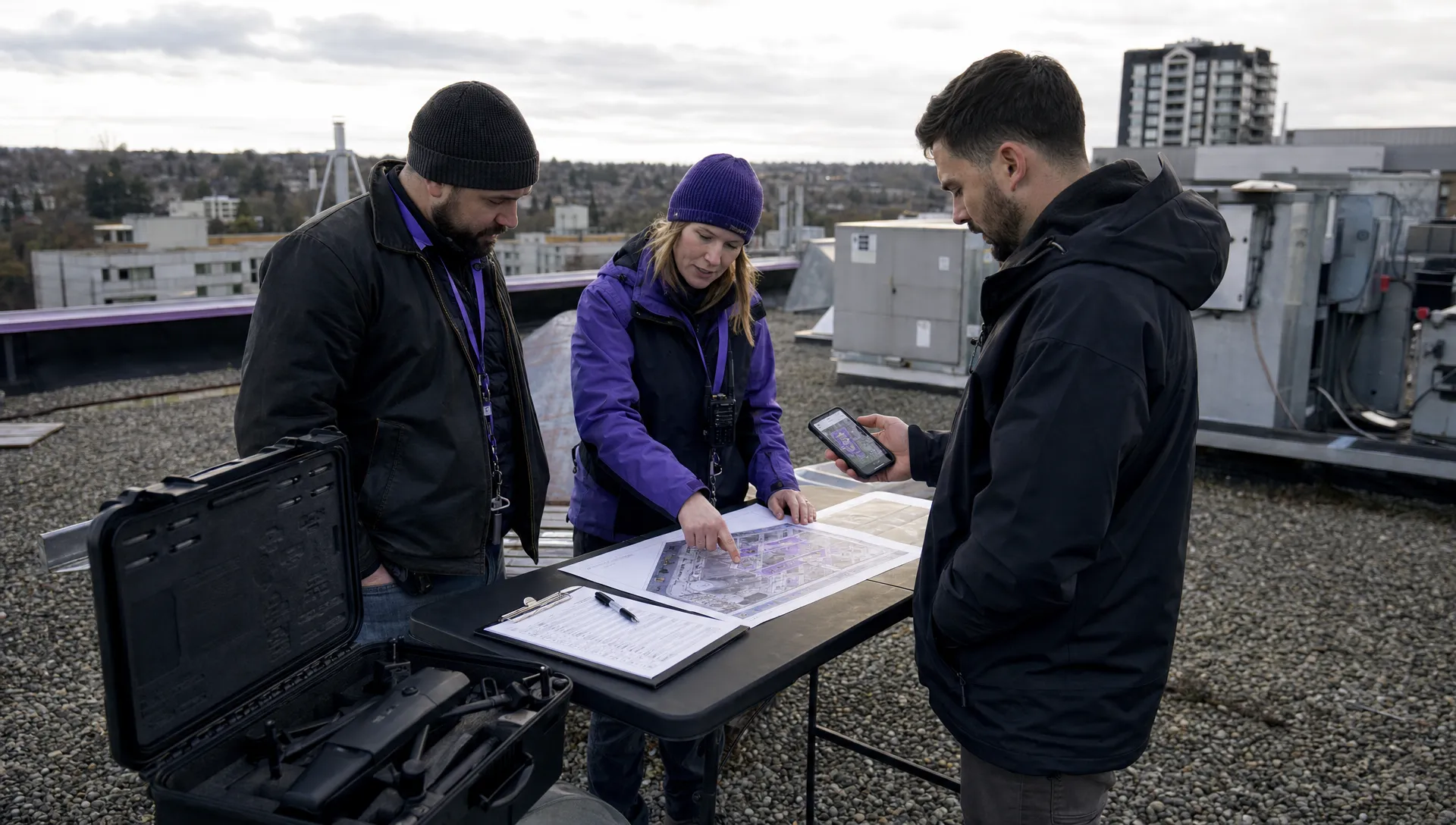
Start with a regulatory scoping stage before quoting or mobilising. Identify the country, local aviation authority, aircraft type, pilot team, operating environment, flight profile, data outputs and any non-standard requirements such as night flying, BVLOS or flight near people. This helps determine whether the job is routine, permission-dependent or potentially unviable within the client’s timeline.
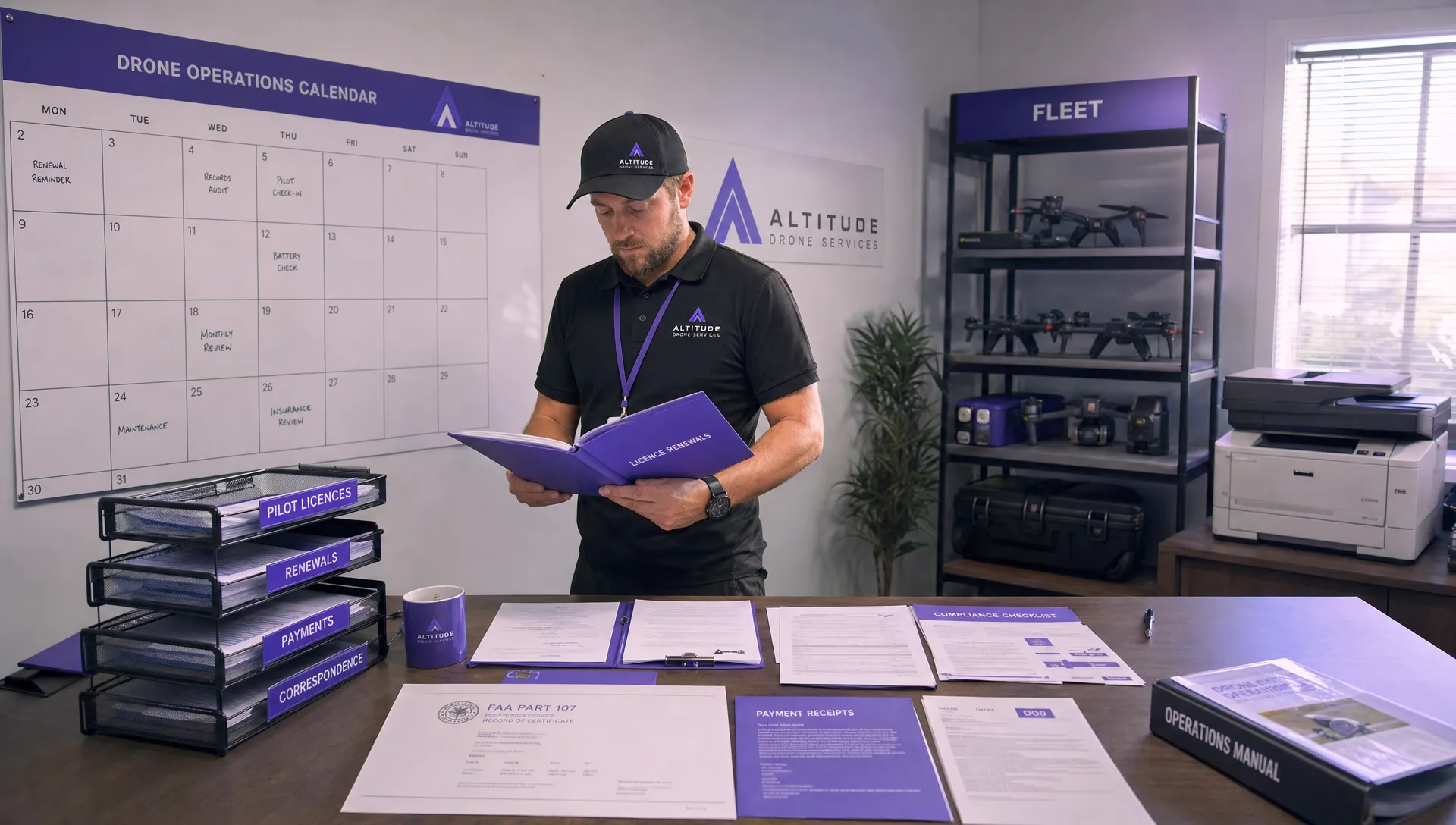
Next, build a country-specific compliance file. This should include authority guidance, registration evidence, pilot credentials, insurance documents, airspace approvals, local contacts, site permissions, privacy controls and incident reporting requirements. If the operation is repeated, the file becomes a valuable starting point, but it should still be reviewed before each deployment because rules and airspace restrictions can change.
Risk assessment should then connect the law to the real operating environment. A generic risk assessment is rarely enough for international work. Language barriers, unfamiliar airspace, different emergency services contacts, wildlife, terrain, climate, local bystanders, political sensitivities and security restrictions can all affect operational risk. If you need a practical structure, Dronedesk has a useful guide on building a drone flight risk assessment that works.
Finally, preserve evidence after the job. Keep flight logs, checklists, approvals, pilot assignments, incident notes, maintenance records and client communications in a form that can be retrieved quickly. This is essential if an authority, insurer, client auditor or internal safety manager asks how the operation was controlled.
What to standardise across a global drone team
International rules vary, but your internal operating discipline should not. Standardisation gives teams a common baseline while still leaving room for country-specific requirements.
Useful items to standardise include:
- A pre-deployment regulatory checklist for every new country
- A pilot competency matrix showing who can fly which aircraft and mission types
- A fleet register with aircraft specifications, registration details and maintenance history
- A documented airspace approval process with minimum lead times
- A privacy and data handling checklist for imagery and sensor outputs
- A post-flight evidence pack including logs, checklists and deviations
For growing organisations, spreadsheets often become difficult to control once teams, aircraft and clients are spread across multiple locations. Dronedesk’s drone fleet management guide explains the operational problems that appear as fleet complexity increases, and what to consider when choosing management software.
How Dronedesk fits into international compliance planning
Software does not replace legal advice, local authority approval or professional judgement. It can, however, help teams organise the operational evidence that regulators and clients expect to see.
Dronedesk is an all-in-one drone operations management platform with features including client management, fleet management, team management, airspace intelligence, proximity intelligence, flight planning, flight logging, data reporting, configurable checklists and risk assessments. For international teams, those capabilities support a more consistent way to plan jobs, manage operational information and retain records across pilots, aircraft and clients.
You can explore the full platform on the Dronedesk features page. For teams monitoring changing policy and industry developments, the curated drone industry newsfeed is also a useful way to keep an eye on global drone stories.
International drone regulation checklist
Before operating in another country, make sure your team can answer these questions clearly:
| Compliance area | Questions to answer before deployment |
|---|---|
| Authority | Which national aviation authority regulates the operation, and what official guidance applies? |
| Operator status | Does your organisation need local registration, a permit, a local sponsor or a recognised operating certificate? |
| Pilot status | Are your pilots recognised locally, or do they need a national certificate, exam, validation or temporary approval? |
| Aircraft | Is the drone registered, marked, insured and technically acceptable for the planned operation? |
| Airspace | Are controlled airspace, airport zones, restricted areas, military zones or temporary restrictions involved? |
| Mission profile | Does the flight involve BVLOS, night operations, people, roads, critical infrastructure or emergency scenes? |
| Site control | Do you have landowner, client, police, port, rail, utility or site manager permissions where required? |
| Data | Are privacy, security, data transfer and retention obligations documented? |
| Records | Can you produce approvals, checklists, risk assessments, flight logs and maintenance records after the job? |
This checklist is deliberately practical. It does not try to replace local legal review. Instead, it helps project managers, chief pilots and operations leads spot the questions that need authoritative answers before a drone ever leaves its case.
Frequently Asked Questions
Are drone regulations the same across the European Union? The EU has a common EASA framework, but national aviation authorities still manage local implementation, geographical zones, certain permissions and enforcement. Operators should check both EASA guidance and the relevant national authority before flying.
Can I use my UK or US drone licence in another country? Not automatically. Your existing qualification may support an application or demonstrate experience, but many countries require local registration, validation, permits or separate pilot certification.
What is the biggest compliance risk for international drone teams? The biggest risk is assuming that a familiar operation is legally equivalent abroad. BVLOS, flights near people, controlled airspace, privacy rules and local site permissions can vary significantly between jurisdictions.
Do emergency drone operations get automatic exemptions overseas? Usually not. Emergency services may have special pathways in some countries, but they still need to operate within local law and incident command arrangements. Pre-existing agreements and local coordination are essential.
How often should global drone teams review international regulations? Review regulations before every new country deployment and whenever a mission profile changes. You should also monitor updates in countries where you operate regularly, because drone rules and airspace procedures can change quickly.
Build compliance into the way your team works
International drone work rewards preparation. The organisations that scale safely across borders are not the ones that rely on last-minute checks. They are the ones that treat compliance, risk assessment, flight planning and record keeping as part of everyday operations.
If your team manages multiple pilots, aircraft, clients or jurisdictions, Dronedesk can help you keep operational planning and records in one place. Explore Dronedesk to see how its drone operations management platform supports safer, more organised commercial drone work.
 FAA Drone License Costs Beyond the Knowledge Test →
 Drone Part 107 Operations: When a Waiver May Be Needed →
 Drone Operating Rules for Managing Contractors and Employees →
 BVLOS Drone Requirements for Building a Safety Case →
 Drone Pilot Test Mistakes That Cost Candidates Marks →
 FAA 107 License vs Part 107 Certificate: What’s the Difference? →
 Drone Airport Rules: A Field Checklist for Site Assessments →
 FAA Part 107 Record-Keeping Rules for Commercial Teams →
 How to Review a DJI Flight Log After an Unexpected Event →
 Drone Laws Around the World: A Pre-Flight Research Framework →