
FAA Part 107 Record-Keeping Rules for Commercial Teams
Commercial drone teams tend to think FAA Part 107 record-keeping means keeping a flight log after every job. In reality, the rule is narrower and more practical: your team must be able to prove pilot qualification, aircraft registration, authorisations, waiver conditions and reportable accidents when the FAA asks. A clean record system also protects survey, utility and emergency-service operations from delays when a client, insurer or public agency wants evidence.
This guide is US-focused and written for commercial teams, not recreational flyers. Use it as operational guidance, not legal advice. FAA rules, waivers and guidance can change, so confirm your procedures against the FAA's official Part 107 summary and the current 14 CFR Part 107 text on eCFR before publishing or updating an SOP.
FAA Part 107 record-keeping: the short version
The key inspection rule is 14 CFR §107.7. It requires the remote pilot in command, owner or person manipulating the flight controls to make the remote pilot certificate and any other required document, record or report available to the FAA on request. It also allows the FAA to inspect or test the small UAS, the remote pilot and the person manipulating the controls.
For FAA Part 107 operations, that does not create a blanket federal requirement to keep a full operational flight log for every mission. It does mean your team should know which records are mandatory, which are conditional and which are best-practice evidence for professional operations.
| Record type | Regulatory position | Practical team approach |
|---|---|---|
| Remote pilot certificate | Must be available to the FAA on request | Keep current certificate details accessible to the remote PIC and operations manager |
| Recurrent training evidence | Needed to show pilot currency under Part 107 | Retain completion evidence for the current currency period |
| Aircraft registration | Required for commercial small UAS operations | Keep registration details with the aircraft profile and job file |
| Waivers and airspace authorisations | Required when the operation relies on them | Attach final approvals and operating conditions to the mission pack |
| Accident reports | Required when Part 107 reporting thresholds are met | Maintain an incident file with the report, evidence and follow-up actions |
| Routine flight logs | Not generally mandated for every Part 107 flight | Keep them for operational traceability, client assurance and insurance evidence |
| Maintenance and battery records | Not prescribed as a universal Part 107 logbook | Keep records that support the remote PIC's safe-condition decision |
This distinction matters. If your team treats every record as equally mandatory, people stop trusting the system. If you treat everything as optional, you may have nothing useful when a regulator, client or insurer asks what happened.
The records an FAA inspector can reasonably ask to see
Pilot qualification and currency
Every commercial mission needs a qualified remote pilot in command. Under 14 CFR §107.65, a person must meet the recency requirements to exercise remote pilot privileges, which generally means initial qualification or recurrent training within the previous 24 calendar months.
A sound FAA Part 107 file should include the remote PIC's certificate details and recurrent training evidence. For team operations, keep this separate from unnecessary personal identity documents. In many organisations, recording that ID was checked is cleaner than storing copies of driving licences or passports without a clear data-protection reason.
Aircraft registration and Remote ID
Commercial small UAS must be registered, and the registration number must be displayed as required by FAA rules. For team record-keeping, the aircraft profile should show the registration, make, model, serial number, assigned pilots, payloads where relevant and status of the aircraft.
Remote ID sits outside Part 107 itself, but it is part of day-to-day legality for most registered drones operating in US airspace unless an exception applies. The FAA's Remote ID guidance is the right source for current details. Keep Remote ID serial or module information with the aircraft record so the pilot is not searching emails in the field.
Waivers, airspace approvals and operating conditions
If a mission relies on a waiver, LAANC authorization or other FAA approval, the final approval and conditions need to be available to the crew. The application you submitted is not enough on its own. Your record should show what was approved, where it applies, when it expires and which conditions the remote PIC must brief before launch.
This is especially important for utilities, infrastructure surveys and emergency-service work, where mission locations can sit near controlled airspace, congested areas or sensitive facilities.
Flight records: legal minimum versus professional evidence
FAA Part 107 does not generally impose a universal flight-log requirement for every commercial flight. That surprises many operators because flight logs are still one of the most useful records a professional team can keep. The point is not to invent compliance work, but to create a reliable evidence trail for decisions you already make.
What to put in a mission pack
A mission pack should be short enough for crews to use and complete enough to reconstruct the operation later. For repeat survey routes or utility inspections, it also becomes the link between the client brief, aircraft assignment and safety controls.
| Mission record | Why it helps |
|---|---|
| Client or internal job reference | Connects the flight to the business reason for operating |
| Location, date and planned time window | Shows where and when the operation was intended to occur |
| Remote PIC and crew roles | Clarifies responsibility and handover points |
| Aircraft and payload details | Confirms the correct equipment was assigned |
| Airspace and restriction checks | Supports the legality of the planned operation |
| Weather review | Shows the crew considered conditions before launch |
| Site hazards and ground risk | Records the practical risk picture on the day |
| Checklist and go or no-go decision | Shows the remote PIC made an explicit safety decision |
If your risk assessment process needs tightening, Dronedesk has a separate guide on building a drone flight risk assessment that works, which is a useful companion to record-keeping rather than a substitute for it.
What to log after the flight
Post-flight records should capture what actually happened, not just what was planned. At a minimum, record take-off and landing times, aircraft used, battery sets, crew, location, anomalies, aborted flights, maintenance concerns and whether the flight met the mission objective.
For teams using DJI aircraft, raw telemetry can add useful context when reviewing a flight, investigating an issue or checking pilot technique. Dronedesk provides a DJI flight log analysis tool for reviewing DJI flight logs, which can sit alongside your normal operational records.
Incident and accident records under Part 107
The clearest formal reporting obligation is accident reporting. Under 14 CFR §107.9, the remote pilot in command must report an operation to the FAA within 10 calendar days if it results in serious injury to any person, any loss of consciousness or property damage above the stated threshold.
An FAA Part 107 accident threshold is triggered by damage to property other than the small unmanned aircraft if the cost of repair, including labour and materials, exceeds $500, or if the fair market value of the property exceeds $500 in the event of a total loss. Damage to the drone itself is excluded from that property-damage calculation.
Build a fast internal escalation path
The FAA reporting clock is short, so teams should not rely on ad hoc judgement after a stressful event. Your SOP should say who the remote PIC calls, who preserves evidence, who contacts the insurer, who notifies the client and who files the FAA report if required.
An internal incident file should capture the timeline, location, people involved, injury or property details, aircraft and battery identifiers, weather, crew statements, photos, raw logs and immediate corrective actions. Even when the FAA threshold is not met, near-miss records help you improve training and prevent repeat failures.
Building a retention policy for commercial teams
Because Part 107 does not set one universal retention period for every flight pack, your retention policy should be risk-based. Align it with contract terms, insurance requirements, public-sector procurement rules, privacy duties and the type of work you do. A powerline inspection programme will often need a more robust evidence trail than a simple marketing shoot.
| Record category | Sensible retention approach | Why it matters |
|---|---|---|
| Pilot qualification and recurrent training | Keep current evidence and at least the previous currency cycle | Supports pilot eligibility and audit continuity |
| Aircraft registration and Remote ID records | Keep while active and for a defined period after retirement | Helps reconstruct which aircraft was used on a job |
| Mission packs, checklists and flight logs | Set a standard period such as 24 to 36 months, longer if contractually required | Gives clients, insurers and managers a usable operational history |
| Incident and accident files | Keep under insurer, legal or organisational advice | Preserves evidence for claims, investigations and corrective action |
| Maintenance and battery records | Keep for the life of the asset and a post-retirement period | Supports airworthiness and safe-use decisions |
| Client approvals and deliverable records | Follow contract terms and privacy rules | Avoids keeping sensitive data longer than needed |
How to make records audit-ready
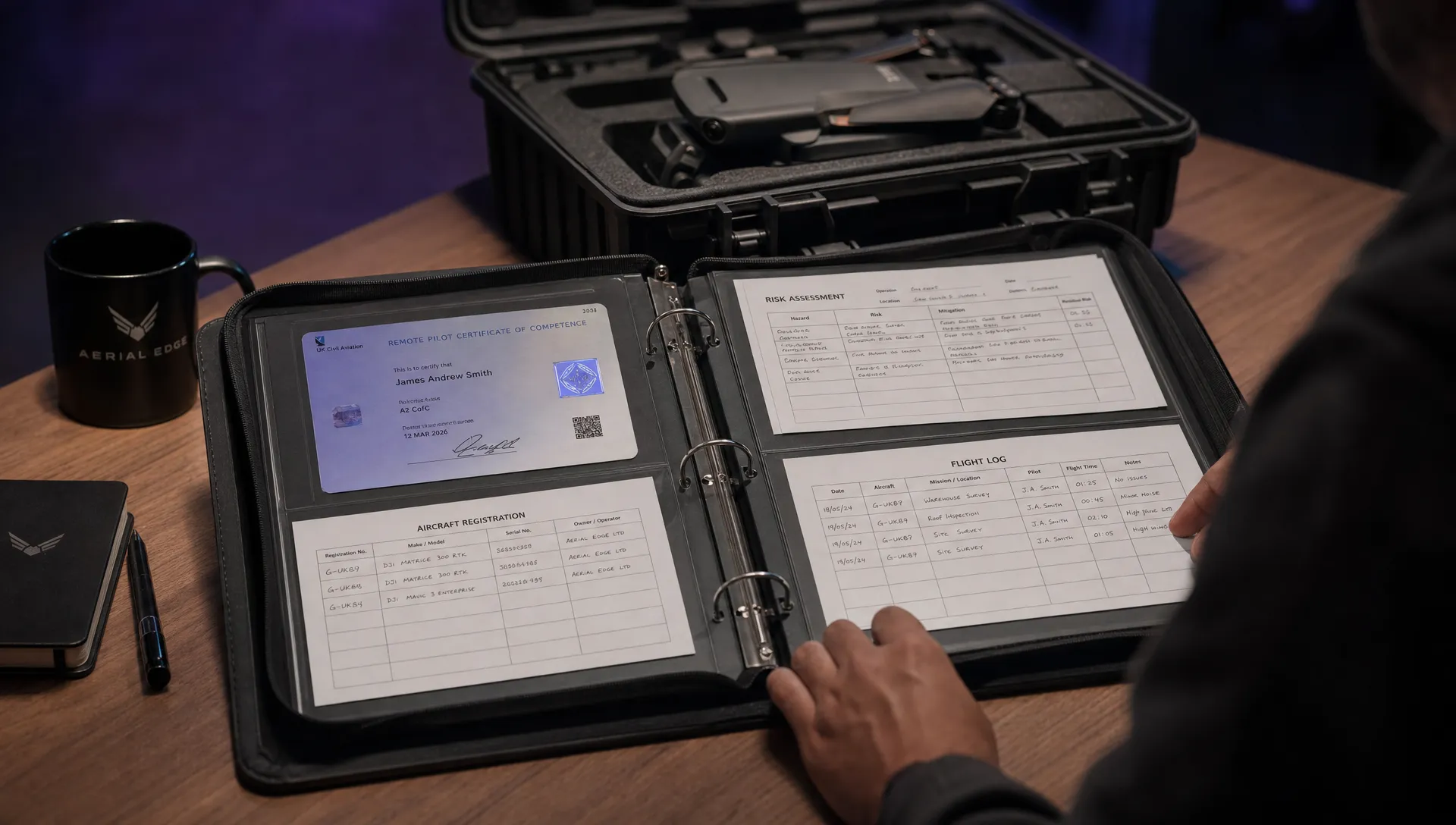
An audit-ready FAA Part 107 system is less about storing more documents and more about linking the right documents to the right flight. A regulator, safety manager or client should be able to move from job reference to pilot, aircraft, approval, checklist, risk assessment and outcome without digging through personal inboxes.
Create one operational source of truth
Shared drives and spreadsheets can work for very small teams, but they become fragile when pilots rotate, aircraft move between locations or jobs involve several departments. Use naming conventions, access controls and consistent job references so that records remain understandable after the original pilot has moved on.
Version control also matters. A risk assessment updated after the flight is not the same evidence as the one briefed before launch. Keep a completed record of what the remote PIC used at the time.
Connect planning, logging and reporting
Dronedesk is an all-in-one web platform for drone operations management. Its features include client management, fleet management, team management, airspace intelligence, proximity intelligence, flight planning, flight logging, data reporting, configurable checklists and risk assessments. That combination is useful because record-keeping problems usually happen at the joins between systems.
No software removes the remote PIC's responsibility to operate safely or comply with FAA conditions. The value is in giving the team a consistent place to plan, brief, log and report operations without rebuilding the same admin trail for every mission.
Common mistakes that create record gaps
Most FAA Part 107 record gaps are ordinary admin failures, not dramatic safety failures. They happen because crews are busy, files live in too many places or nobody has defined what a complete mission record looks like.
Common issues include:
- Treating a flight log as proof of compliance when the waiver, authorization or pilot currency evidence is missing
- Saving LAANC approvals in a pilot's personal email rather than the job file
- Updating checklists after the flight without preserving the completed version used on the day
- Keeping aircraft registration data in a spreadsheet that is not checked against the physical fleet
- Failing to record aborted flights, lost-link events, battery warnings or maintenance concerns
- Having no threshold-based escalation process for incidents and accidents
Fixing these gaps does not require bureaucracy. It requires a short mandatory record set, clear ownership and a review rhythm that catches issues before the next client audit or FAA request.
A practical workflow for commercial teams
The easiest way to turn FAA Part 107 record-keeping into daily practice is to make records part of the flight workflow rather than a separate admin task at the end of the month.
- Create a job or mission file before planning starts.
- Assign the remote PIC, crew and aircraft before any approval is requested.
- Attach airspace checks, authorisations, risk assessment and checklist before the go or no-go decision.
- Record the actual flight outcome immediately after landing, including anomalies and maintenance notes.
- Escalate any injury, property damage, lost-link event or near miss through the incident process the same day.
- Lock or archive the completed job file under your retention policy.
For growing teams, a monthly compliance review is worth the effort. Sample a handful of completed jobs, check that the record trail is complete and feed findings into training. The review should be practical: if pilots keep skipping a field, either explain why it matters or remove it.
Frequently Asked Questions
Does FAA Part 107 require commercial drone teams to keep flight logs? Not as a universal logbook requirement for every flight. However, flight logs are strongly recommended because they connect the mission plan, aircraft, pilot, actual flight activity and any anomalies. They can also support insurance, client assurance and internal safety reviews.
Which records must be available if the FAA asks? Under §107.7, the remote pilot certificate must be made available on request, along with any other document, record or report required under the applicable regulations. In practice, teams should also be ready to show aircraft registration, authorisations, waivers, pilot currency evidence and accident reports where relevant.
How long should we keep Part 107 records? Part 107 does not give one retention period for every operational record. Set a written policy that reflects your contracts, insurer requirements, privacy duties and operational risk. Many teams keep mission packs and routine flight logs for at least 24 to 36 months, but incident files may need longer retention under legal or insurance advice.
What accidents must be reported to the FAA? A report is required within 10 calendar days if the operation causes serious injury, loss of consciousness or qualifying property damage above the $500 threshold stated in §107.9. Damage to the drone itself is not included in that property-damage threshold.
Who owns record-keeping in a multi-pilot drone programme? The remote PIC remains responsible for the flight, but the organisation should assign record ownership clearly. Many teams split responsibility between the remote PIC for operational accuracy and an operations manager for retention, audits and system consistency.
Bring your drone records under control
If your commercial drone team is relying on spreadsheets, email folders and pilot memory, record-keeping will become harder as soon as the programme grows. Dronedesk helps teams connect flight planning, risk assessments, checklists, fleet records, flight logging and reporting in one operations management platform.
Start by defining your minimum record set, then make it easy for crews to complete it every time. That is how record-keeping moves from admin burden to operational evidence.
 FAA Part 107 Record-Keeping Rules for Commercial Teams →
 How to Review a DJI Flight Log After an Unexpected Event →
 Drone Laws Around the World: A Pre-Flight Research Framework →
 How to Compare Drone Survey Services for Complex Sites →
 How to Start a Drone Mapping Business With a Clear Workflow →
 Class C Airspace Drone Rules for Commercial Flights →
 How to Create a Drone Job Pack for Every Mission →
 FAA Small UAS Rule: Key Requirements for Operators →
 How to Build a Drone Pilot Flight Log That Is Audit Ready →
 FAA Drone Licence Requirements for Commercial Pilots →