
Drone Pilot Test Mistakes That Cost Candidates Marks
The drone pilot test is rarely failed because a candidate knows nothing about drones. More often, marks disappear through rushed airspace interpretation, weak operational judgement, sloppy risk language and exam technique that does not match how regulators expect pilots to think.
That matters whether you are an individual preparing for your first qualification or a survey, utility or emergency services organisation putting staff through assessment. Passing is not just about earning a certificate. It is about proving that you can plan, explain and fly in a way that stands up to real operational pressure.
Drone pilot test mistakes start before the exam
One of the most costly mistakes is revising from generic notes rather than the exact standard you are being assessed against. Drone rules differ by jurisdiction, aircraft class, operating category and mission type, so a candidate can know a useful fact and still apply it in the wrong context.
In the UK, start with the Civil Aviation Authority drone guidance and your training provider's syllabus. In the United States, the FAA Part 107 page is the official route for small UAS rules. In Europe, EASA's overview of European drone regulations explains the framework across Open, Specific and Certified categories.
The mistake is not only using old material. It is failing to ask, before revision begins, which rules apply to the assessment in front of you. A UK A2 CofC candidate, a GVC candidate and a US Remote Pilot applicant are not preparing for identical tests.
Misreading airspace and permission questions
In a drone pilot test, airspace questions usually reward process more than guesswork. Candidates lose marks when they jump straight to a conclusion without showing how they checked the surrounding airspace, local restrictions, aerodromes, temporary activity and ground hazards.
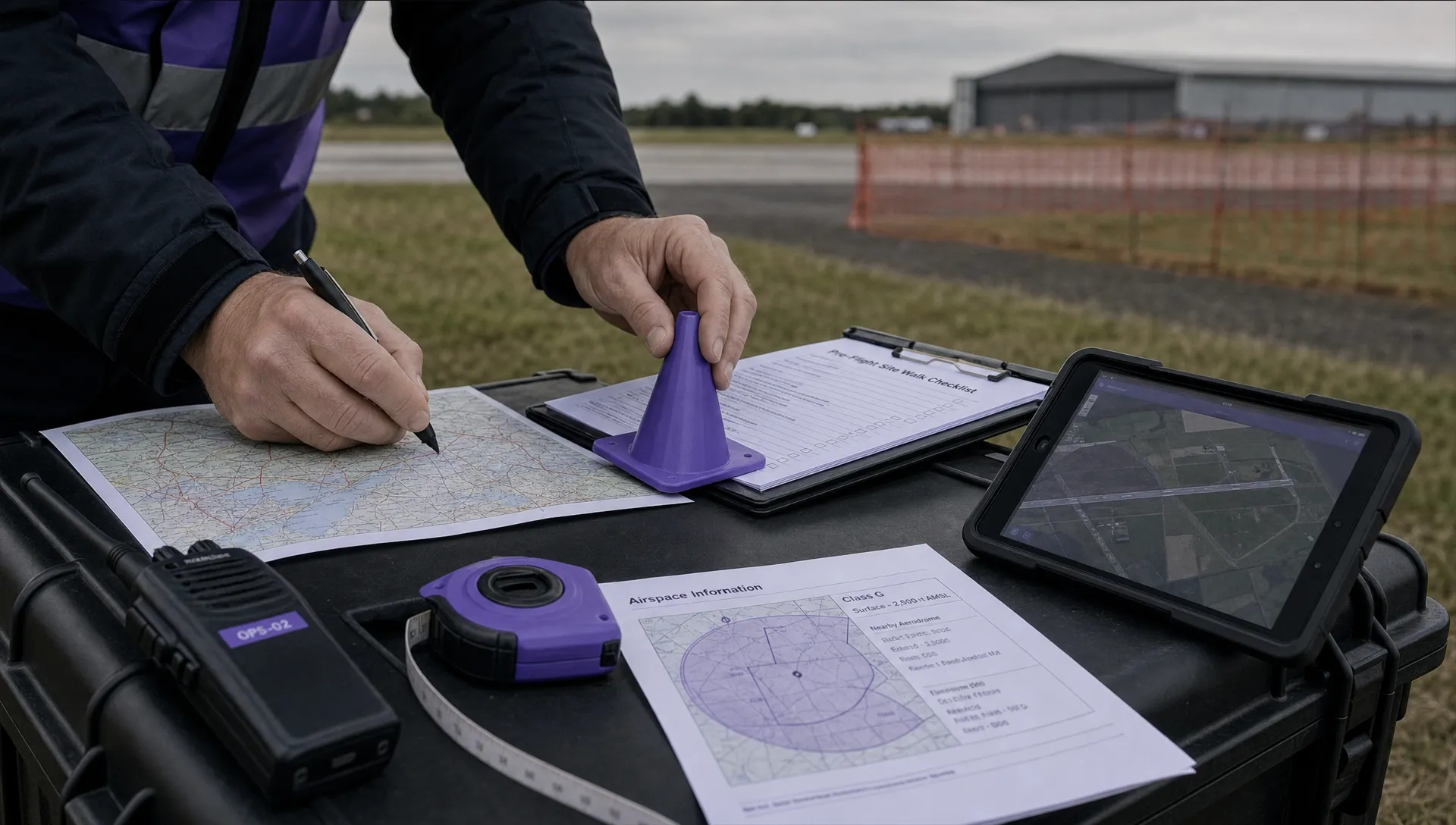
Common errors include treating countryside as automatically safe, assuming a map with no obvious airport means no aviation risk or failing to distinguish controlled airspace from a drone flight restriction zone. Around aerodromes, the correct answer often depends on the exact location, altitude, permission route and current local information. If this is a weak area, Dronedesk has a practical guide to planning flights near airports without surprises.
A stronger exam answer explains what you would check, where you would check it and what would make you stop or seek permission. That is the difference between knowing a rule and demonstrating command judgement.
| Mistake that costs marks | Why it weakens the answer | Better approach |
|---|---|---|
| Answering yes or no too quickly | It hides the decision process | State the checks you would complete before deciding |
| Ignoring temporary restrictions | The map may not show everything current | Check current aeronautical information and local notices |
| Treating all airspace as the same | Different areas require different actions | Identify the airspace, restriction type and permission route |
| Forgetting the ground environment | Aviation safety is not the only risk | Consider people, property, access, privacy and emergency options |
Treating risk assessment as a form-filling task
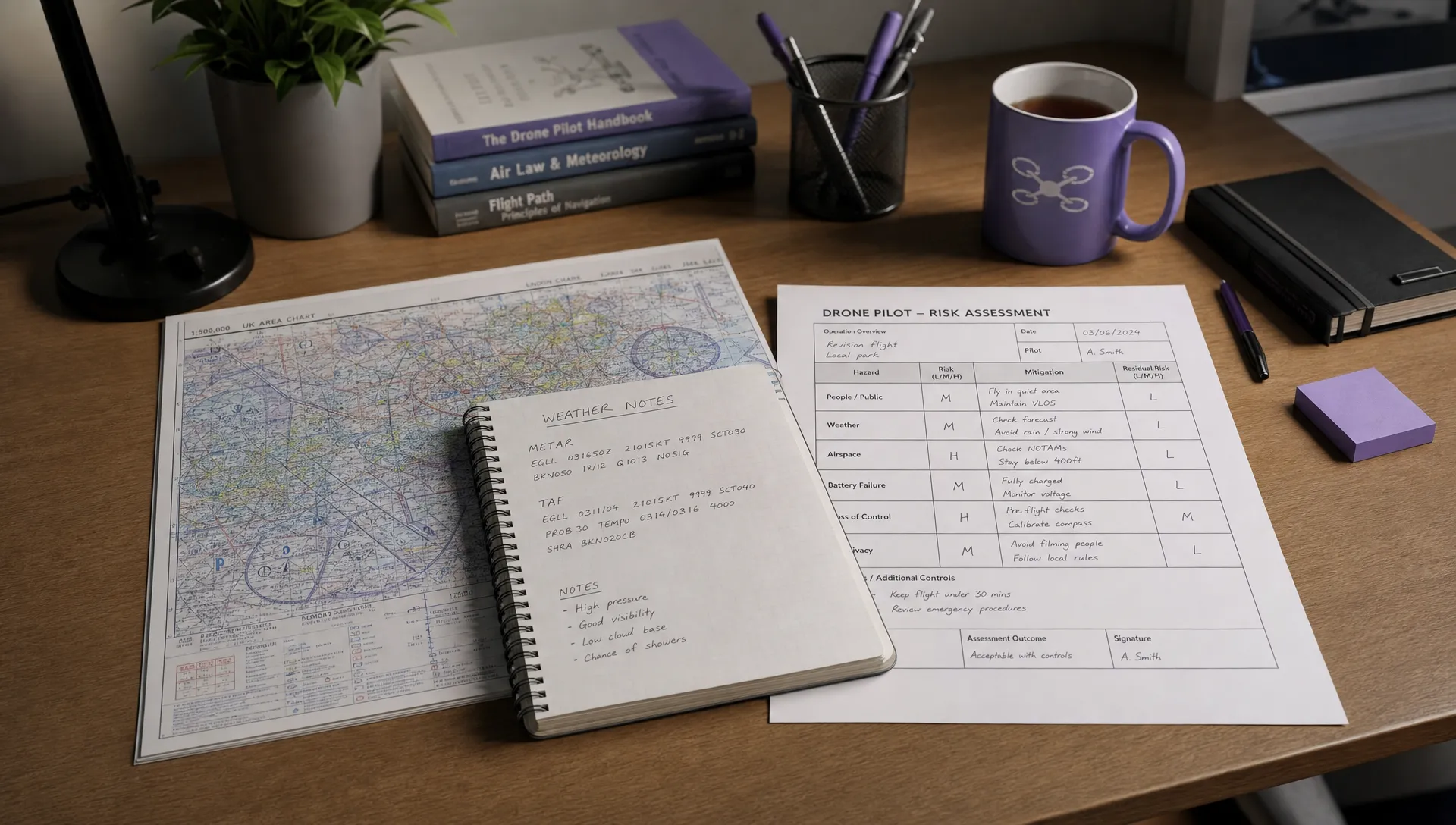
In the drone pilot test, risk assessment questions are often where operational maturity shows. A weak answer lists hazards but does not connect them to consequences, likelihood, severity or mitigations. The candidate writes that there are people nearby, but never explains how far away they are, whether they are under control, how the site will be managed or what would trigger cancellation.
Good risk language is specific. Instead of saying the site is low risk, explain why: the take-off area is segregated, the operating volume is clear of uninvolved people, the weather is inside limits, the emergency landing area is identified and the crew have a communication plan.
This is especially important for commercial operators because the same discipline carries into client work. If you want a deeper operational structure, this guide to building a drone flight risk assessment that works is a useful companion to exam preparation.
The mark-costing habit to remove is vague confidence. Examiners are not looking for bravado. They are looking for a pilot who can spot changing risk and act early enough to keep the flight safe.
Getting weather questions almost right
Weather questions in a drone pilot test are easy to underestimate because candidates often revise definitions but not operational consequences. It is not enough to know that wind, rain and visibility matter. You need to connect those conditions to aircraft performance, battery endurance, control margins, observer visibility and the safety of people on site.
Candidates commonly lose marks by quoting a maximum wind limit without considering gusts, direction, turbulence around buildings or the difference between forecast and actual conditions. Others forget that cold temperatures can affect batteries or that low sun can make visual line of sight harder to maintain.
If your syllabus includes METARs, TAFs or other aviation weather formats, practise reading them under time pressure. If it does not, still build the habit of checking forecast confidence, local topography and go or no-go thresholds. A professional pilot does not ask whether the aircraft can technically fly. They ask whether the mission can be flown safely, legally and usefully in the conditions available.
Human factors: the marks hidden in judgement
Many candidates prepare hard for regulations and aircraft systems but give thin answers on human factors. Fatigue, distraction, stress, complacency and pressure from a client can all affect a drone operation. For emergency services and utilities, these pressures can be sharper because the mission may feel urgent or operationally sensitive.
A strong answer acknowledges the pressure without surrendering to it. If a client asks for one more shot near the end of a battery, the safe pilot reassesses the plan rather than improvising. If a team member spots a hazard, the remote pilot should have a clear way to pause the operation and review the risk.
Marks are often lost when candidates describe the pilot as a lone decision-maker. In real operations, observers, payload operators, site contacts and landowners can all influence safety. The remote pilot must still retain authority, but good command includes briefing the team, listening to relevant information and making a calm decision.
Practical assessment mistakes that signal weak command
If your drone pilot test includes a practical flight or oral assessment, small behaviours can cost marks because they reveal how you will operate when nobody is coaching you. Rushing the site survey, skipping a briefing, fumbling emergency procedures or failing to verbalise a decision can all make a competent pilot look unprepared.
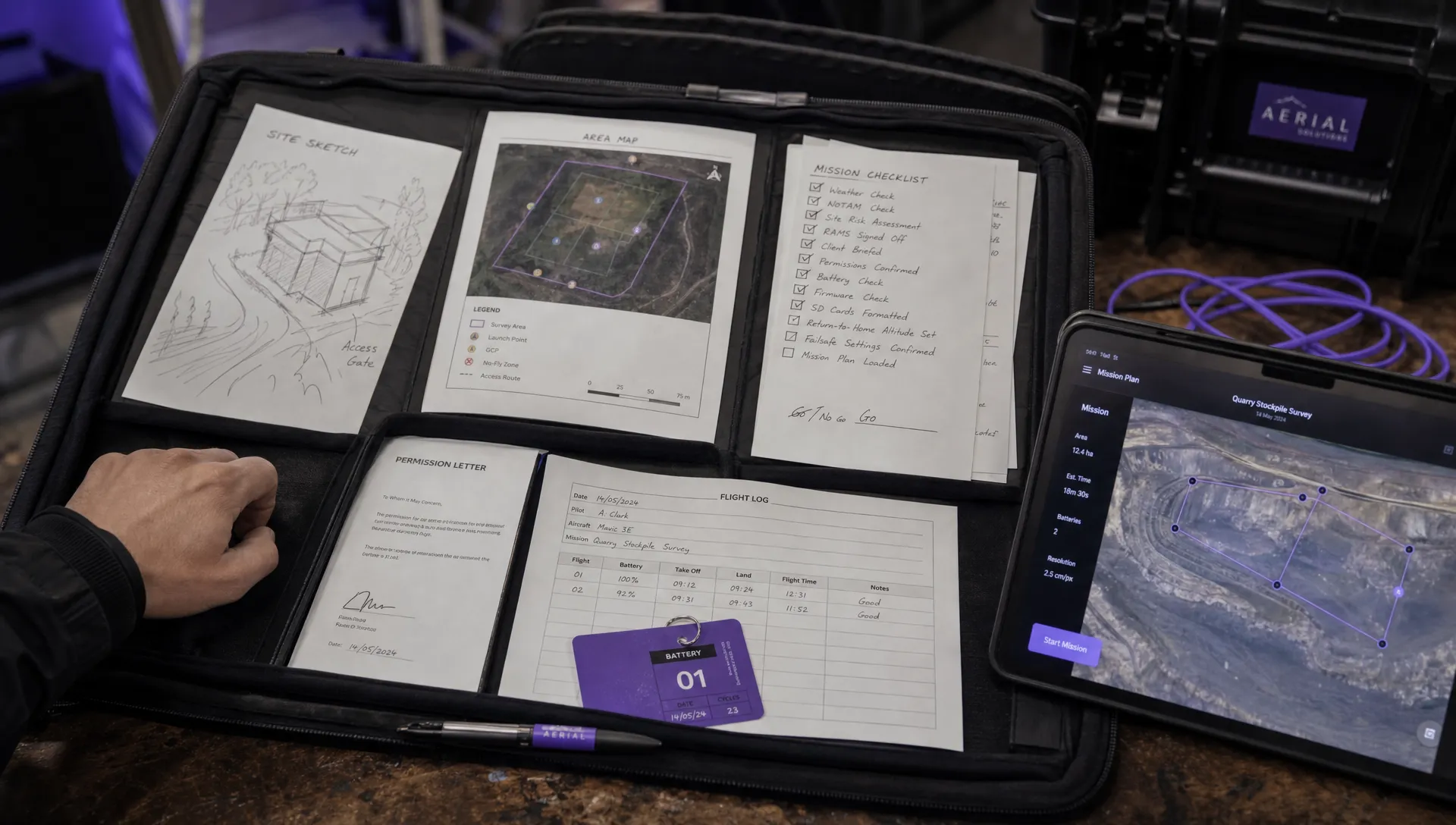
Good practical performance is usually methodical rather than dramatic. You confirm the operating area, brief roles, check the aircraft, assess weather, verify settings, manage batteries and explain what you are doing. If something changes, you stop and reassess. That calm sequence is often more convincing than fast stick skills.
Post-flight habits matter too. A complete log, accurate notes and a record of issues help turn a flight into defensible operational evidence. For operators moving from training into paid work, the Dronedesk features page lists tools for flight planning, airspace intelligence, proximity intelligence, configurable checklists, risk assessments and flight logging, all of which support the kind of disciplined workflow candidates are expected to demonstrate.
Vague answers lose marks even when the idea is right
The smartest drone pilot test answers are precise enough to be marked. Candidates often know what they mean, but the examiner can only credit what is actually said or written. Phrases such as check the area, monitor the weather or keep people safe are too broad unless you explain the action behind them.
Aim for answers that include a source, a threshold and a decision. For example, do not simply say you would check the weather. Say you would compare the forecast and on-site conditions against the aircraft, company and mission limits, then postpone if gusts, visibility or precipitation make control or visual line of sight unreliable.
| Vague answer | Stronger answer |
|---|---|
| I would check the map | I would check current airspace, restrictions, nearby aerodromes, NOTAMs where relevant and ground hazards before confirming the operating area |
| I would do a risk assessment | I would identify hazards, assess likelihood and severity, apply mitigations and decide whether residual risk is acceptable |
| I would keep away from people | I would define the operating area, identify uninvolved people and use separation, spotters or a revised plan if needed |
| I would land if there was a problem | I would use the pre-briefed emergency procedure and land in the nominated safe area if control, battery or site conditions deteriorated |
A simple revision plan that prevents avoidable mark loss
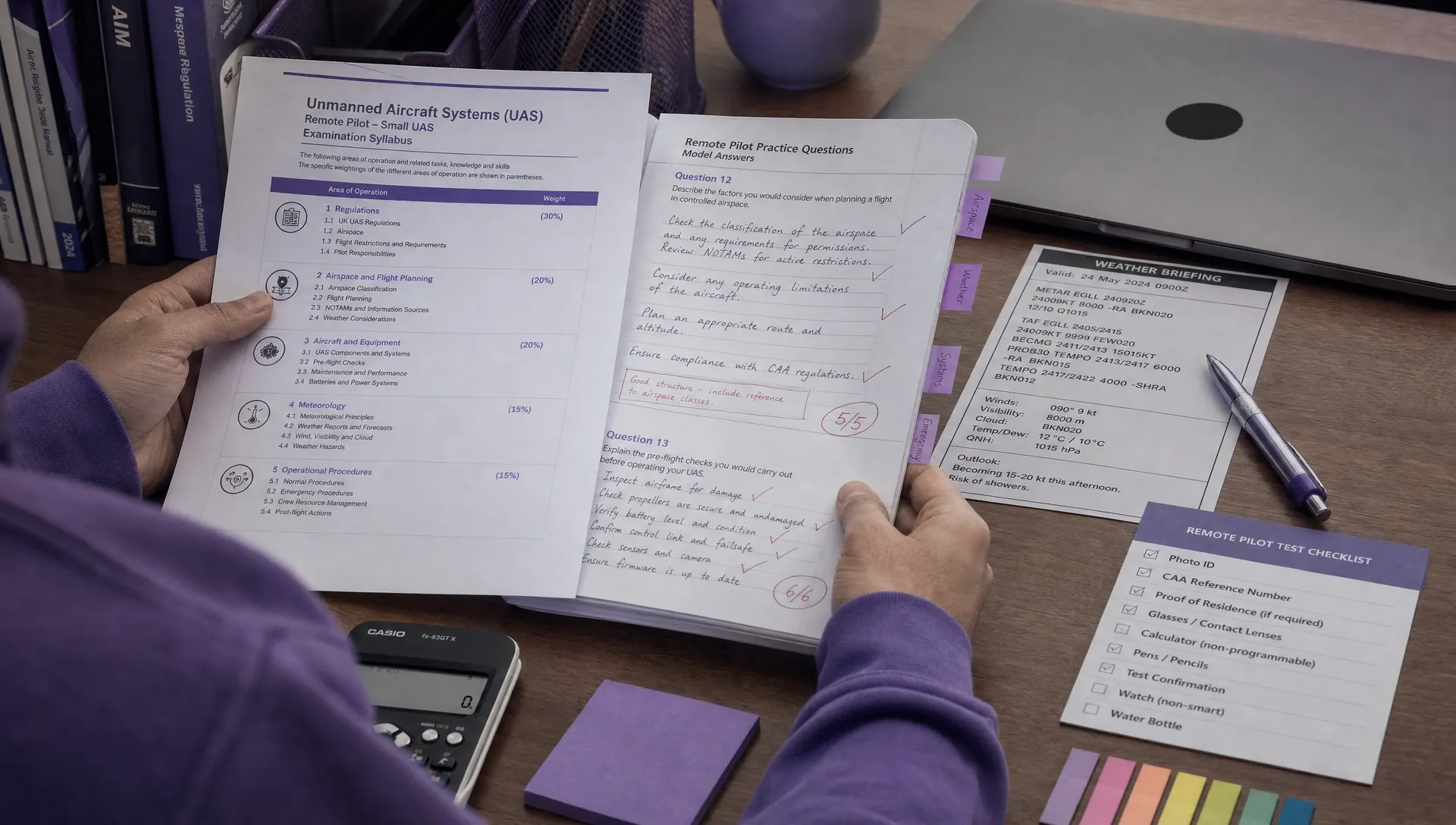
A good drone pilot test revision plan should mix knowledge, scenario practice and verbal explanation. Reading notes alone can give a false sense of readiness because real questions often test application rather than recall.
Use a short, repeatable routine in the final weeks before assessment:
- Build a one-page source list from official regulator pages, course materials and current operational guidance.
- Practise airspace scenarios by explaining the checks out loud before deciding whether the flight can proceed.
- Rewrite weak risk assessment answers until each hazard has a consequence, mitigation and go or no-go decision.
- Test yourself on weather by linking each condition to a specific operational impact.
- Rehearse practical briefings, emergency actions and post-flight logging until they feel natural rather than scripted.
Do not only revise your strongest topics. Most candidates prefer practising what already feels comfortable, but marks are usually lost in the areas they avoid. If airspace interpretation is slow, practise it. If your emergency procedure sounds vague, say it out loud until it becomes concise.
Why companies should treat the assessment as operational training
Passing the drone pilot test is only the start for organisations that fly surveys, inspections, emergency response or infrastructure work. The better goal is consistency: every pilot using the same planning logic, risk language, checklists and records.
That consistency matters when multiple pilots work across different sites, clients or aircraft. A utility inspection team, for example, needs more than individual competence. It needs repeatable planning, clear approvals, standardised risk controls and flight records that can be reviewed later. Dronedesk's guide to drone operations management explains how those workflows fit together once a drone programme grows beyond ad hoc planning.
For managers, exam preparation is a chance to spot weak habits before they appear on a live job. If a candidate cannot explain why a flight should be delayed in training, they may struggle to resist pressure during paid operations.
Frequently asked questions
What is the most common drone pilot test mistake? The most common mistake is answering from memory without applying the rule to the scenario. Examiners want to see how you check information, assess risk and reach a safe decision.
Do drone pilot exams test regulations only? No. Regulations are important, but many assessments also test airspace awareness, weather, human factors, operational planning, emergency procedures and risk assessment.
Is a UK drone assessment the same as a US Part 107 test? No. They sit under different regulatory systems. Use the official CAA material for UK operations, FAA material for US Part 107 and EASA material for European operations.
Can flight planning software replace revision? No. Software can support good planning and records, but you still need to understand the rules, make sound decisions and explain your reasoning in an assessment.
How should I prepare for practical assessment nerves? Rehearse the full sequence: site assessment, crew briefing, aircraft checks, take-off, normal flight, emergency actions, landing and logging. Familiar routines reduce rushed decisions.
Turn exam habits into safer operations
No drone pilot test pass will make operations safe by itself. The value comes from turning the same habits into daily practice: checking airspace properly, assessing risk clearly, briefing the team, recording the flight and reviewing what changed.
Dronedesk is built for that operational discipline, with tools for planning, risk assessments, checklists, fleet and team management, flight logging and reporting. If you are preparing pilots for commercial work, standardising the workflow early can make the step from assessment to real missions much smoother.
 Drone Pilot Test Mistakes That Cost Candidates Marks →
 FAA 107 License vs Part 107 Certificate: What’s the Difference? →
 Drone Airport Rules: A Field Checklist for Site Assessments →
 FAA Part 107 Record-Keeping Rules for Commercial Teams →
 How to Review a DJI Flight Log After an Unexpected Event →
 Drone Laws Around the World: A Pre-Flight Research Framework →
 How to Compare Drone Survey Services for Complex Sites →
 How to Start a Drone Mapping Business With a Clear Workflow →
 Class C Airspace Drone Rules for Commercial Flights →
 How to Create a Drone Job Pack for Every Mission →