
How to Prepare for the Drone Licence Test
Preparing for a drone licence test is not just about memorising rules. The test is designed to check whether you can make safe, legal decisions before and during a flight, especially when people, property, controlled airspace or commercial pressure are involved.
For new pilots, the hardest part is often knowing what to study first. In the UK, “drone licence” can mean different things depending on the aircraft, where you fly and whether your work falls into the Open or Specific category. In the US, people often search for the “drone license test” when they mean the FAA Part 107 knowledge test. In Europe, the equivalent may be an Open category online training and exam or an A2 qualification.
This guide focuses on how to prepare properly, regardless of the exact test route. It is written for operators who want to fly professionally, including survey teams, utilities, emergency services and growing drone businesses that need more than a pass mark. They need operational confidence.
Start by confirming which drone test you actually need
Before buying a course or sitting mock exams, identify the correct regulatory path for your country and type of operation. The name of the qualification matters less than the permissions it gives you.
In the UK, many pilots start with the Civil Aviation Authority’s Flyer ID test and Operator ID registration. The CAA Drone and Model Aircraft Code is the official place to begin. More advanced commercial or higher risk work may require additional training, an Operational Authorisation or a qualification such as a GVC, depending on the operation.
If you operate in the US, the FAA Part 107 remote pilot certificate is the main route for commercial drone operations. Dronedesk has a separate FAA Part 107 licence application guide if that is the path you are taking.
For operators working across borders, always check the aviation authority for the state where the flight will take place. Drone rules are similar in principle across many jurisdictions, but details such as registration, airspace permission, operational categories, competency renewals and remote ID requirements can differ.
| If you plan to fly | Likely preparation focus | Where to verify requirements |
|---|---|---|
| Recreationally in the UK | Flyer ID, Operator ID and the Drone Code | UK CAA |
| Commercially in the UK | Open category rules, Specific category requirements, risk assessment and authorisations | UK CAA and approved training providers |
| Commercially in the US | FAA Part 107 aeronautical knowledge test | FAA |
| In EU member states | EASA Open category rules, A1/A3 or A2 competency, national registration | EASA and national aviation authority |
| For emergency service or utility missions | Airspace coordination, safety cases, operating procedures and permissions | National aviation authority and internal governance |
A common mistake is preparing for the wrong level of test. A lightweight camera drone flown in a rural Open category setting is not the same regulatory challenge as an inspection near infrastructure, a road closure, a port or an airport boundary.
Understand what the test is really assessing
Drone theory exams are built around decision-making. They ask whether you understand how aviation rules, airspace, weather, aircraft limitations and human factors combine in a real operation.
Most tests draw from these broad subject areas:
- Air law and operational limitations
- Airspace classifications, restrictions and permissions
- Weather interpretation and flight conditions
- Aircraft performance, batteries and maintenance
- Human factors, fatigue and situational awareness
- Emergency procedures and abnormal events
- Privacy, data protection and security considerations
- Pre-flight planning, site assessment and record keeping
For professional pilots, the goal is not to scrape through the exam. The goal is to build habits that survive contact with real jobs, impatient clients and changing conditions on site.
For example, a survey company may need to decide whether a roof inspection can continue as wind increases around a building. A utility operator may need to assess public access near a substation. An emergency services team may need to coordinate with manned aviation during an incident. Those scenarios require the same knowledge the test checks, but applied under pressure.
Build a study plan around operational topics
A structured study plan beats random revision. Start with the official syllabus or learning objectives for your test, then turn each topic into something practical.
A good plan might run over two to four weeks for an introductory online test, or longer for a more demanding professional qualification. The exact timing depends on your aviation background, confidence with maps and airspace, and how much practical flying experience you already have.
Focus first on the rules that define whether a flight is legal. This includes operating categories, distance from people, maximum height, visual line of sight, registration, insurance, permissions and the difference between controlled, restricted and prohibited airspace.
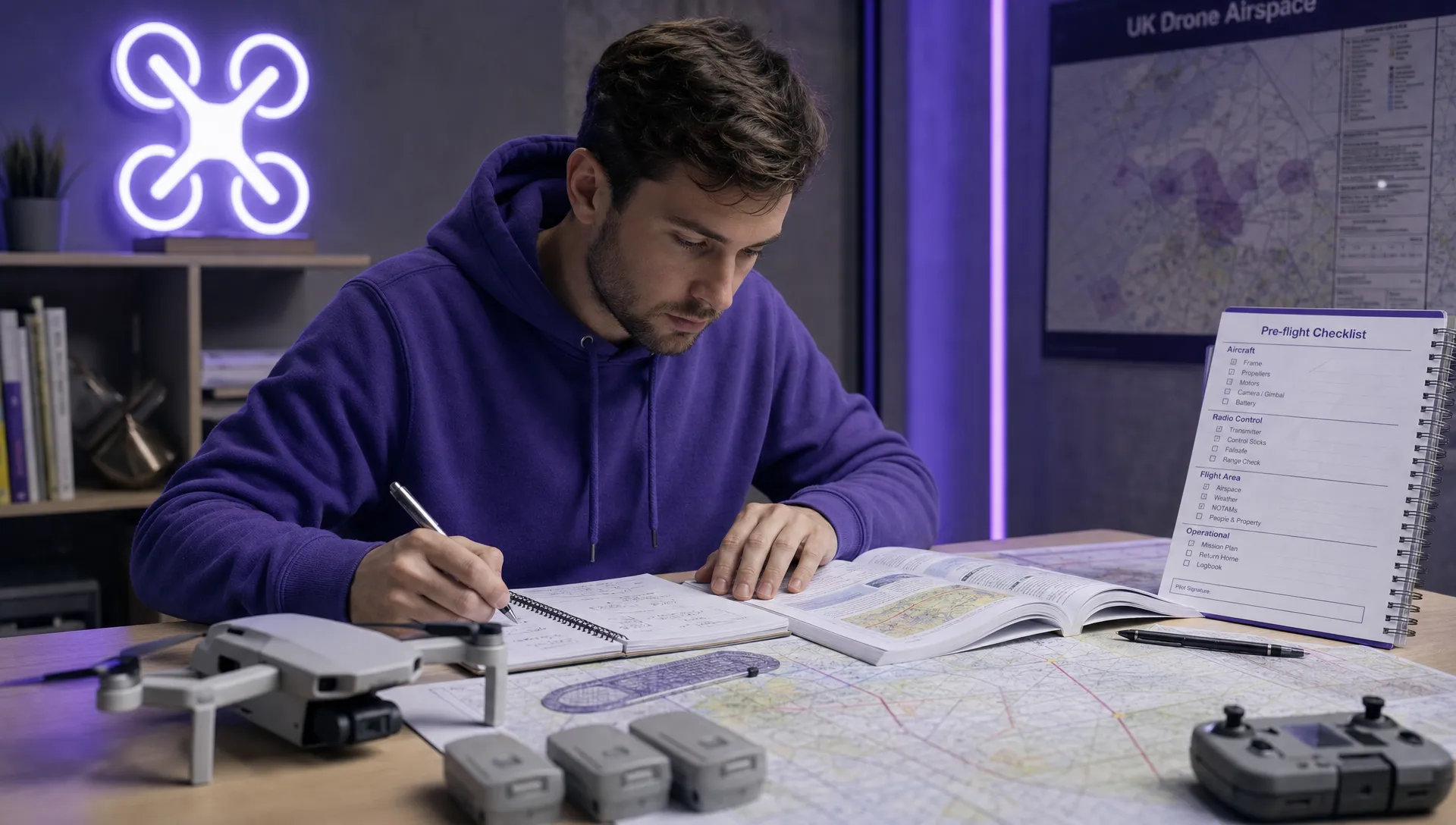
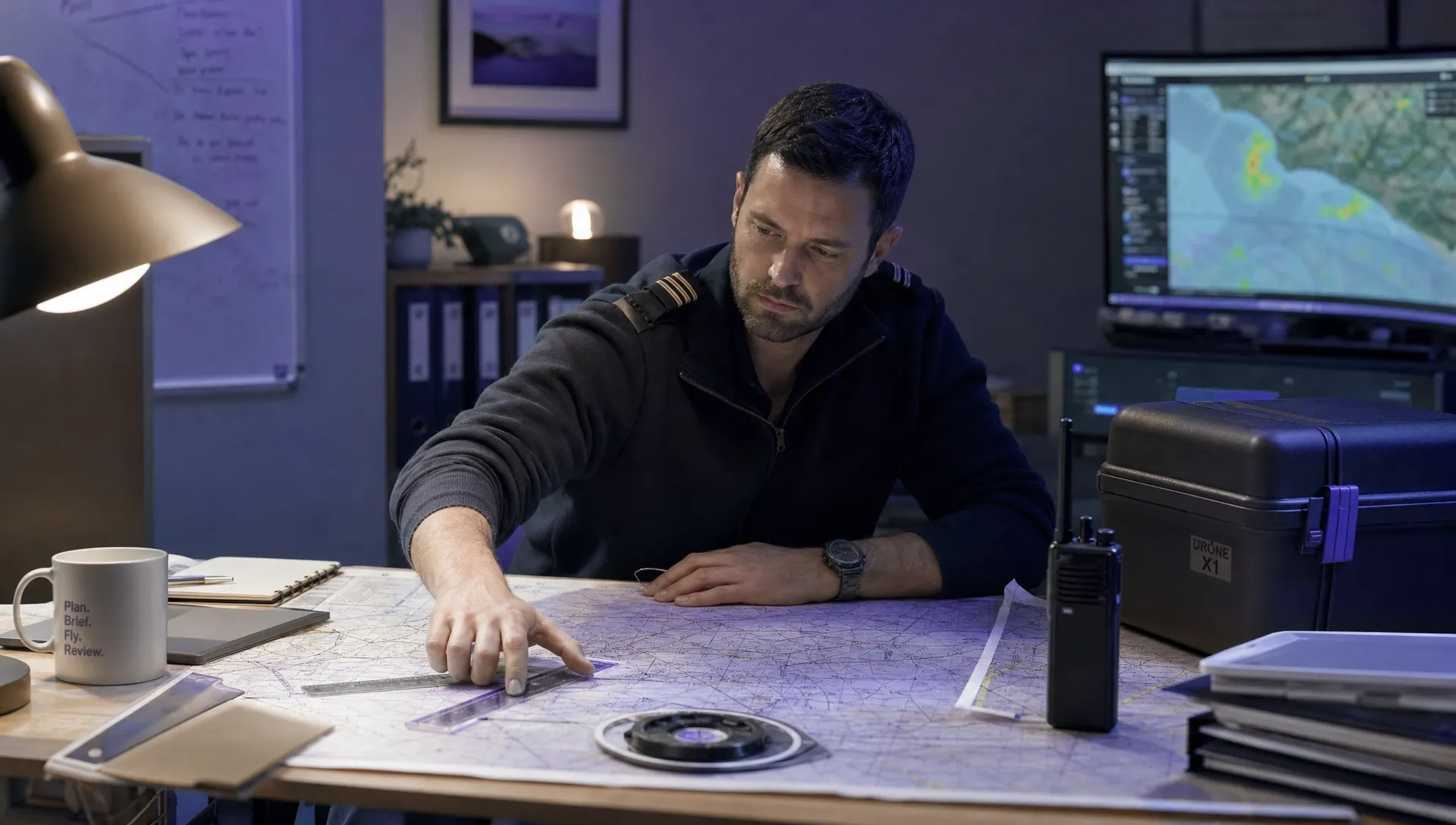
Then move into airspace and chart reading. Many candidates find this topic difficult because it uses unfamiliar symbols, vertical limits and aviation language. Spend time with real maps and airspace tools rather than only reading notes. Look up airports, heliports, prisons, military zones, temporary restrictions and NOTAMs where relevant to your jurisdiction.
Weather should come next. You do not need to become a meteorologist, but you do need to understand wind, gusts, visibility, precipitation, temperature, pressure and how local terrain or buildings can affect flight. Weather questions often test judgement rather than definitions.
Finally, revise aircraft knowledge and human factors. Battery behaviour, return-to-home settings, compass interference, GNSS reliability, crew communication and fatigue all appear in real incidents. Treat these topics as safety-critical, not as filler.
Use official sources before third-party summaries
Training videos, forums and cheat sheets can be useful, but they should not replace the regulator’s own material. Drone rules change, and old advice can stay visible online for years.
For UK pilots, start with the CAA’s current guidance, including the Drone Code and relevant CAA publications for your category of operation. For US pilots, use the FAA’s Unmanned Aircraft Systems guidance and current Part 107 testing resources. For EU operations, use EASA’s civil drones guidance and your national aviation authority’s registration and exam pages.
When using third-party material, check three things: the publication date, the country it applies to and whether it distinguishes between recreational, Open category, Specific category and commercial operations. If a source uses sweeping statements like “you can always fly below 120 metres” without context, treat it with caution.
Practise with realistic mission scenarios
Mock questions are helpful, but scenario-based practice is better. The test may ask theory, yet your brain learns faster when the information is tied to a mission.
Pick a realistic job and plan it from start to finish. For example, imagine you have been asked to inspect solar panels on a commercial roof, map a quarry, support a missing person search or capture progress imagery on a construction site.
For each scenario, answer these questions in writing:
- What category or permission does the flight fall under?
- What airspace, ground hazards and nearby sites could affect the operation?
- What weather limits would stop or change the flight?
- Who needs to be briefed before take-off?
- What emergency actions are required for lost link, flyaway, battery warning or public incursion?
- What records should be kept after the flight?
This method turns passive revision into active decision-making. It also exposes gaps quickly. If you cannot explain why a flight is or is not allowed, go back to the source material before attempting more mock questions.
For professional operators, this is where good operations management habits start. Dronedesk brings together features such as airspace intelligence, proximity intelligence, flight planning, configurable checklists, risk assessments and flight logging in one platform, which can help you practise the kind of structured workflow expected in commercial operations. You can explore those capabilities on the Dronedesk features page.
Learn airspace properly, not just enough to pass
Airspace knowledge is one of the clearest differences between a casual pilot and a professional operator. You need to know when a flight is routine, when it needs permission and when it should not proceed at all.
Pay particular attention to:
- Controlled airspace and flight restriction zones
- Aerodromes, heliports and hospital landing sites
- Temporary flight restrictions and NOTAMs
- Military airspace and danger areas
- Prisons, critical national infrastructure and sensitive sites
- Local bylaws, landowner permissions and site access constraints
Airport-related questions deserve extra care. Even if your test only covers the basics, operational planning near aerodromes can involve layered restrictions and local procedures. Dronedesk’s guide to planning drone flights near airports is a useful follow-up if you expect to work near controlled or complex airspace.
When revising, do not only ask “Can I fly here?” Ask “What evidence would I need to show that I checked properly?” That mindset matters for audits, clients and incident investigations.
Get comfortable with risk assessment language
Risk assessment is not just a paperwork exercise. It is how you prove that you have identified hazards, judged their likelihood and severity, applied controls and made a defensible go or no-go decision.
Many drone licence test questions touch risk indirectly. They may ask about distances from uninvolved people, weather limits, emergency procedures, aircraft defects, battery warnings or site control. Each one is really asking whether you can reduce risk before it becomes an incident.
Use simple language when practising. A hazard is something that can cause harm. A control is something you do to reduce the chance or impact of that harm. Residual risk is what remains after the controls are in place.
For example, a public footpath crossing a survey site is a hazard. Controls might include a take-off and landing area away from the path, a visual observer, temporary signage if appropriate, a pause procedure when people enter the area and a revised flight path. The residual risk depends on whether those controls are realistic on that day.
If you want to go deeper, this Dronedesk article on how to build a drone flight risk assessment that works is a practical next step after your theory revision.
Use mock exams the right way
Mock exams are useful, but only if you treat them as diagnostics. Taking the same quiz repeatedly until you remember the answers can create false confidence.
A better approach is to sit a mock test under timed conditions, mark it, then group every wrong answer by topic. If most of your mistakes are in airspace, spend another evening on charts and restrictions. If they are in weather, revise wind, visibility, cloud, temperature and how conditions affect small unmanned aircraft.
Keep a simple error log with three columns.
| Error type | What to record | Why it helps |
|---|---|---|
| Knowledge gap | The rule, term or concept you did not know | Shows what to relearn |
| Misread question | The word or detail you missed | Reduces avoidable mistakes |
| Judgement error | Why your decision was unsafe or non-compliant | Builds operational thinking |
| Overconfidence | Where you guessed too quickly | Improves exam discipline |
Do not ignore easy questions you get wrong. In aviation exams, basic mistakes often come from rushing. Read every question carefully, especially where words such as “maximum”, “minimum”, “unless”, “not” or “closest” appear.
Prepare your exam-day routine
The day before the test, stop trying to learn everything from scratch. Use the time to consolidate.
Review your weak topics, read the official summary material again and take one final mock test if that helps your confidence. Avoid late-night cramming. Fatigue makes careful reading harder, and many drone theory questions rely on small details.
On the day itself, check the exam format, identification requirements, allowed materials and time limit. For online tests, make sure your device, browser, internet connection and login details are ready. For in-person exams, arrive early and bring any required documents.
During the test, answer the questions you know first, then return to harder ones. If you are unsure, remove obviously wrong answers and choose the safest legally compliant option. Drone exams generally reward conservative decision-making. If an answer feels convenient for the pilot but risky for uninvolved people or other airspace users, question it.
After you pass, keep building evidence of safe operations
Passing the drone licence test is the start of competent operations, not the end. Professional clients increasingly expect documented planning, clear checklists, flight logs, maintenance records and repeatable procedures.
That matters for survey companies managing multiple pilots, utilities operating near assets, public safety teams working under pressure and any operator that wants to scale without losing control of compliance.
After passing, build a routine that covers:
- Current registration, IDs, certificates and authorisations
- Aircraft maintenance and battery records
- Site surveys and airspace checks
- Client and job information
- Risk assessments and method statements
- Crew briefings and emergency procedures
- Flight logs and post-flight notes
This is also the point where spreadsheets and scattered documents can start to hold a team back. A dedicated operations platform can make it easier to keep the right information in one place, especially when you are managing clients, aircraft, pilots, checklists, risk assessments and reporting across multiple jobs.
Common mistakes to avoid
The most common preparation mistake is treating the test as a memory challenge. Regulations matter, but safe drone operation is about applying them to changing sites and conditions.
Another mistake is relying on social media advice. Drone forums can be useful for discussion, but they are not a substitute for regulator guidance. If someone says a rule has changed, verify it with the aviation authority before acting on it.
Candidates also underestimate human factors. Tired pilots miss details. Solo operators can become task saturated. Commercial pressure can tempt people to fly in marginal conditions. These are not abstract exam topics. They are common ingredients in real incidents.
Finally, do not assume that passing one test qualifies you for every job. A basic online theory test does not automatically permit higher risk operations, complex airspace work or flights that fall outside the Open category. Match your qualification and permissions to the operation every time.
Frequently Asked Questions
Is the drone licence test hard? It depends on the test. Basic online theory tests are manageable with careful study, but professional qualifications require stronger knowledge of airspace, operating rules, risk assessment, weather and emergency procedures. The test becomes easier when you study through real flight scenarios rather than memorising isolated facts.
How long should I study for a drone licence test? For a basic introductory test, a few focused evenings may be enough if you already understand the rules. For a professional route such as Part 107, A2 CofC or GVC-style training, allow more time and follow the official syllabus. Your weak areas, especially airspace and weather, should determine the schedule.
Do I need a drone licence for commercial work in the UK? The UK does not use “licence” as a single blanket term for every drone pilot. You may need registration, a Flyer ID, an Operator ID, additional competency, an Operational Authorisation or other permissions depending on the aircraft and operation. Check the current CAA guidance before accepting commercial work.
What is the best way to revise airspace for the drone test? Use official guidance, current airspace tools and real map examples. Pick locations near airports, heliports, restricted areas and urban sites, then decide what checks or permissions would be required. This is more effective than only reading symbol lists.
What should I do after passing the test? Set up a repeatable operating system for planning, risk assessment, checklists, flight logging and record keeping. Passing proves baseline knowledge, but professional reliability comes from using that knowledge consistently on every job.
Turn test preparation into better drone operations
A good drone licence test result is useful. A repeatable planning and compliance process is what keeps operations safe when work gets busy.
Dronedesk is built for drone operators who need to manage the practical side of professional flying, from clients, fleets and teams to airspace checks, flight planning, risk assessments, configurable checklists, flight logging and reporting. If you are preparing for your test because you want to operate commercially, start building those habits now.
Explore how Dronedesk supports safer, more organised drone operations at dronedesk.io.
 How to Prepare for the Drone Licence Test →
 How to Choose a Drone Mapping Service for Your Project →
 Drone Safety Rules That Every Commercial Team Needs →
 Airport Drone Rules: How to Plan Flights Without Surprises →
 FAA Part 107 Licence: Your Step-by-Step Application Guide →
 How to View DJI Flight Logs Online Safely →
 What Part 107 Covers Beyond the Pilot Certificate →
 How to Download and Read a DJI Flight Log →
 Drone Videography Planning Tips for Professional Crews →
 EU Drone Rules for Sub-250g Aircraft Explained →