
FAA Drone Rules Every Commercial Pilot Should Know
The FAA drone rules are not just exam material. They define whether a commercial mission can legally launch, what evidence you should keep, and when you need extra approval before taking off.
For commercial drone pilots, survey teams, utility operators and emergency service programmes, the baseline is usually 14 CFR Part 107, the FAA’s small UAS rule. This guide summarises the rules every commercial pilot should understand before planning work in US airspace. It is a practical overview, not legal advice, and you should always verify details against the current official Part 107 text and FAA guidance before flying.
Part 107 is the commercial starting point
If a flight is not purely recreational, assume it falls under commercial or non-recreational rules. That includes paid work, client deliverables, internal business use, marketing footage, infrastructure inspections, mapping, training flights for a company, and many public sector missions.
Under Part 107, the person responsible for the flight is the Remote Pilot in Command, often shortened to RPIC. The RPIC is accountable for deciding whether the flight is safe, legal and properly authorised. A client, incident commander, project manager or landowner cannot override that responsibility.
Commercial pilots should also remember that Part 107 is not the only legal layer. Depending on the mission, you may also need to consider airspace authorisations, Temporary Flight Restrictions, local take-off and landing rules, privacy laws, property access, public safety procedures, contractual requirements and insurance conditions.
You need a Remote Pilot Certificate
To fly under Part 107, the RPIC must hold a valid FAA Remote Pilot Certificate with a small UAS rating. New applicants generally need to be at least 16 years old, able to read, speak, write and understand English, be in a physical and mental condition to operate safely, and pass the FAA aeronautical knowledge test.
Holding the certificate is not a one-time compliance task. Remote pilots must keep their knowledge current, which is done through FAA recurrent training within the required cycle. If you fly only occasionally, it is easy to overlook recency, so make it part of your compliance review before accepting a job.
A visual observer does not normally need to hold a Remote Pilot Certificate, but they must understand their role and communicate effectively with the RPIC. If a team member is manipulating the controls, the RPIC must be able to take direct control where required by the operation.
Register every commercial drone and comply with Remote ID
A common misconception is that sub-250 g drones avoid all FAA administrative requirements. That may apply to some recreational scenarios, but drones flown under Part 107 must be registered, regardless of weight.
The aircraft registration number must be marked on the drone in accordance with FAA requirements. Registration is handled through FAADroneZone, which is also used for certain waivers, airspace processes and official UAS services.
Remote ID is now part of normal commercial compliance. In general, drones required to be registered must comply with Remote ID, either through a standard Remote ID drone or an approved broadcast module, unless a specific exception applies. The FAA’s Remote ID guidance is the place to check current details.
For commercial operators, Remote ID should be treated like battery status or firmware readiness. It belongs in the pre-flight check. If the drone or broadcast module is not functioning as required, the mission may not be legal to fly.
Know the core Part 107 operating limits
Part 107 gives commercial pilots a flexible operating framework, but only within defined limits. Many enforcement problems start when a pilot treats one limit, such as altitude, as the only rule that matters.
| Rule area | Standard Part 107 baseline |
|---|---|
| Aircraft size | Small UAS must weigh less than 55 lb, including payload |
| Visual line of sight | The aircraft must normally remain within visual line of sight |
| Altitude | Maximum 400 ft AGL, or within 400 ft of a structure where allowed |
| Speed | Maximum groundspeed of 87 knots, roughly 100 mph |
| Visibility | Minimum flight visibility of 3 statute miles from the control station |
| Clouds | Remain at least 500 ft below and 2,000 ft horizontally from clouds |
| Right of way | Yield to all crewed aircraft |
| Hazardous materials | Carrying hazardous materials is not allowed under standard Part 107 |
| Multiple drones | One RPIC may not operate multiple drones at once without appropriate authority |
| Fitness to fly | No operation while impaired by alcohol, drugs, fatigue or medical condition |
Night operations are allowed under Part 107 if the pilot has completed the required training or testing and the drone has anti-collision lighting visible for at least 3 statute miles, subject to conditions. Do not rely on older guidance that says every night operation needs a waiver, because the rules changed in 2021.
The visual line of sight rule deserves special attention. Binoculars, a live video feed or a visual observer positioned far away do not automatically make a beyond visual line of sight operation legal. The RPIC must plan the mission so the aircraft can be seen and its attitude, altitude, direction and potential hazards can be assessed as required by the rule, unless a waiver or other FAA authority permits otherwise.
Airspace authorisation is separate from landowner permission
You can have full permission from a landowner and still be unable to fly because of controlled airspace. You can also have FAA airspace authorisation and still be unable to take off from a particular site because the landowner, local authority or site controller has not allowed it.
Under Part 107, operations in Class G airspace usually do not require FAA airspace authorisation. Operations in controlled airspace, including Class B, C, D and certain Class E surface areas, require FAA authorisation before flight.
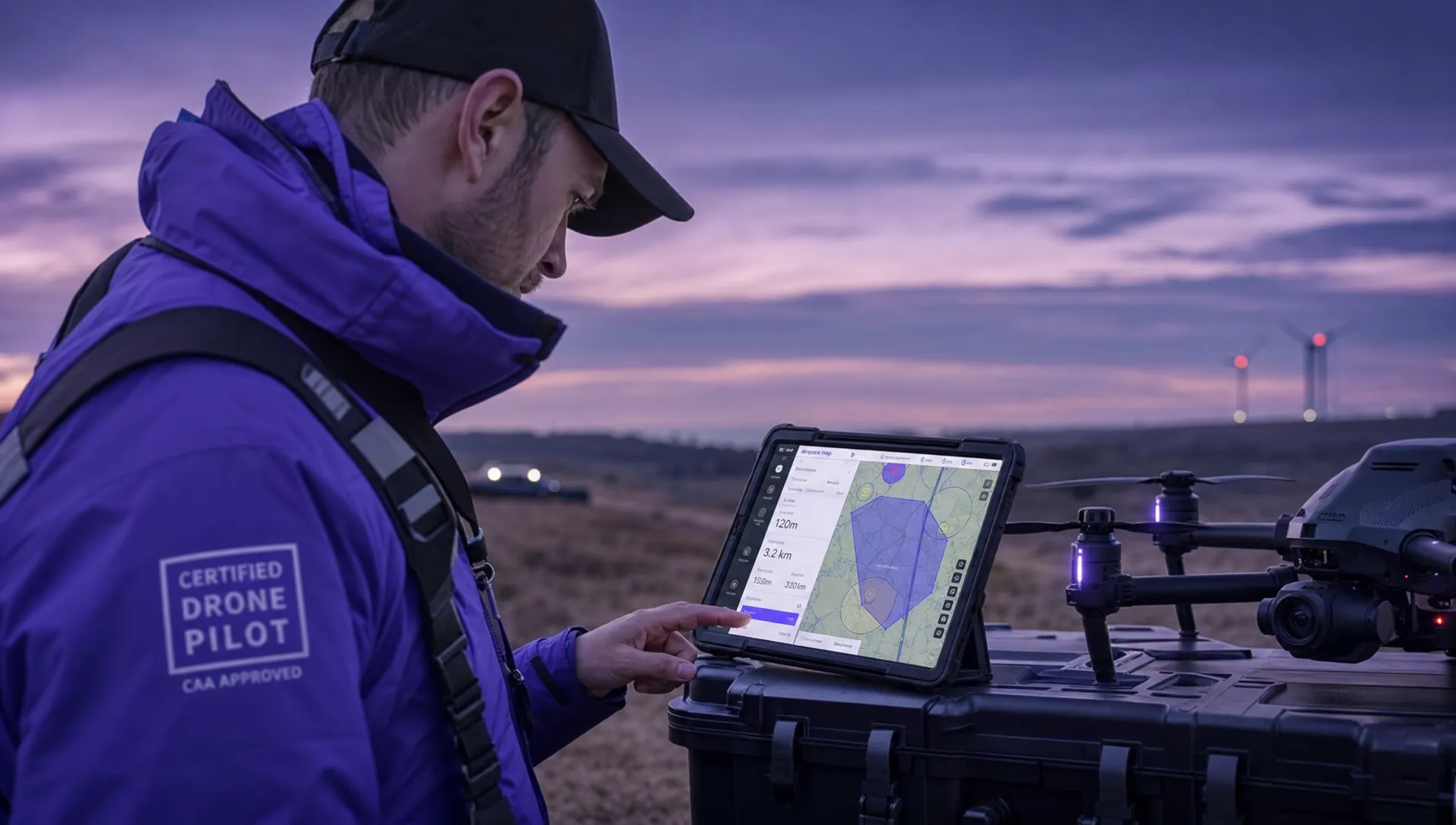
For many controlled-airspace missions, pilots use LAANC, the Low Altitude Authorization and Notification Capability. LAANC can provide near real-time authorisations in participating airspace, often based on UAS Facility Map grid altitudes. If LAANC is unavailable or the mission needs something outside standard parameters, you may need to use FAA DroneZone instead.
Do not confuse LAANC approval with blanket permission to do anything in that area. You must still comply with Part 107, the altitude and time limits in the authorisation, any operational provisions, Remote ID, weather minimums, and local restrictions.
Temporary Flight Restrictions are another critical airspace layer. VIP movements, stadium events, wildfire response, disaster areas and security-sensitive locations can all trigger restrictions. A flight that looked legal yesterday may be prohibited today.
Operations over people and moving vehicles need careful classification
Part 107 allows some operations over people and moving vehicles, but only when the aircraft and operation meet specific categories and conditions. This is one of the most misunderstood areas of the FAA drone rules.
The current framework includes Categories 1, 2, 3 and 4. Category 1 is generally for very light drones that meet the rule’s requirements. Categories 2 and 3 require an FAA-accepted Declaration of Compliance and must meet injury severity and design requirements. Category 4 involves an aircraft with an airworthiness certificate and operating limitations.
In practical terms, do not assume your drone can legally fly over people simply because it is small, popular or marketed as safe. You need to know which category it qualifies for, whether exposed rotating parts are addressed, whether Remote ID is required for the planned operation, and whether sustained flight over open-air assemblies is permitted.
Operations over moving vehicles also have strict conditions. Transiting briefly over a road is not the same as sustained flight over traffic. Utility inspections, road surveys, construction progress work and incident response can all create vehicle-overflight exposure, so build this into the flight plan rather than treating it as an incidental detail.
Waivers are for missions outside the standard box
If a mission cannot be flown within standard Part 107 rules, you may need a waiver or another FAA approval. Common waiver areas include beyond visual line of sight, operations from a moving vehicle or vessel in circumstances not otherwise allowed, operating multiple drones with one pilot, or other non-standard procedures.
A waiver is not just a formality. The FAA expects you to explain how you will maintain an equivalent level of safety. That usually means clear procedures, defined crew roles, communication plans, risk controls, contingency actions, training records and a strong operational rationale.
For example, a utility company wanting to inspect a long linear asset beyond visual line of sight should expect to justify detect-and-avoid measures, command and control reliability, lost-link procedures, airspace risk, ground risk, crew coordination and emergency actions. A simple statement that the route is remote is unlikely to be enough.
The FAA has continued to explore rulemaking for more routine BVLOS operations, often discussed in the industry in connection with Part 108. Until any new rule is final, effective and applicable to your operation, Part 107 visual line of sight requirements and waiver processes remain the practical baseline.
Pre-flight planning is a regulatory duty, not just good practice
Part 107 requires the RPIC to assess the operating environment before flight. That includes local weather, airspace, flight restrictions, people and property on the ground, obstacles, crew coordination, aircraft condition and any other hazard that could affect safe operation.
A good commercial pre-flight process should answer questions such as these:
- Is the pilot current, fit to fly and properly briefed?
- Is the aircraft registered, airworthy for the mission and Remote ID compliant?
- Are airspace authorisations, site permissions and client requirements confirmed?
- Are weather, visibility, cloud clearance and wind conditions within limits?
- Are people, vehicles, roads, railways, powerlines and sensitive sites accounted for?
- Are emergency procedures, lost-link actions and landing areas clear?
- Is the planned flight within Part 107, or does it require a waiver or different authority?
For higher-risk work, such as emergency response, infrastructure inspection or urban surveying, a structured risk assessment is more than paperwork. It helps the RPIC prove that hazards were identified before launch and that controls were in place. If you want a practical framework, Dronedesk has a detailed guide on building a drone flight risk assessment that works.
Keep records that would make sense after an incident
The FAA can require you to produce your Remote Pilot Certificate, aircraft registration and other required documents. It can also inspect or test the small UAS, the RPIC and associated records where the rules allow.
Part 107 also includes accident reporting requirements. A report must be made to the FAA within 10 calendar days if an operation results in serious injury, loss of consciousness, or property damage above the threshold specified in the rule, excluding damage to the drone itself.
Part 107 does not prescribe one universal logbook format for every commercial operator, but serious organisations should keep records that support safety, compliance and business continuity. These often include flight logs, aircraft maintenance notes, battery records, pilot currency, site surveys, client briefs, permissions, airspace approvals, weather checks, risk assessments, checklists and incident reports.
For a growing operation, spreadsheets can become fragile quickly. Multiple aircraft, pilots, clients, job sites, batteries and authorisations create a recordkeeping burden that is difficult to audit later. If that sounds familiar, the Dronedesk guide to drone fleet management explains when a more structured approach becomes useful.
Special considerations for survey, utility and emergency work
Survey companies often operate near roads, buildings, workers and members of the public. The main compliance risks are usually airspace assumptions, overflight of people or vehicles, loss of visual line of sight during mapping patterns, and inadequate site control. A mapping grid that looks efficient on screen may not be legal if it takes the aircraft beyond visual line of sight or over uninvolved people.
Utility companies face similar issues, with added challenges around linear infrastructure, electromagnetic interference, remote terrain, critical sites and emergency repairs. Long corridors are especially likely to push against visual line of sight limits. If the inspection genuinely requires BVLOS, plan early for the correct FAA pathway rather than trying to stretch standard Part 107.
Emergency services may fly under Part 107, a public aircraft Certificate of Waiver or Authorization, or other applicable authority depending on the agency and mission. Public safety teams also need to coordinate around incident command, temporary flight restrictions, crewed aircraft, media drones, mutual aid teams and evidence handling. During urgent incidents, the FAA has processes for emergency approvals, but they are not a substitute for having a mature drone programme before the call comes in.
Commercial delivery and carriage of property can trigger additional complexity. Part 107 permits limited carriage of property within defined conditions, but more advanced delivery operations may require other approvals or certification pathways. If your business model involves transporting goods, treat the regulatory review as a core part of planning, not an afterthought.
How to build FAA rules into everyday operations
Compliance is easiest when it is part of your workflow rather than a separate scramble before each flight. The aim is to make the safe and legal action the default action.
A practical operating rhythm looks like this:
| Stage | Compliance focus | Evidence to keep |
|---|---|---|
| Enquiry | Is the job legally flyable under Part 107 or another authority? | Client brief, location, mission purpose |
| Planning | Airspace, site risk, people, vehicles, weather, permissions | Flight plan, risk assessment, authorisations |
| Pre-flight | Aircraft status, Remote ID, crew briefing, local conditions | Checklist, weather check, final go or no-go decision |
| Flight | Remain within limits and manage changes | Flight log, crew notes, incident notes if needed |
| Post-flight | Review issues and maintain records | Logs, maintenance actions, client deliverables |
This is where operations management software can help. Dronedesk brings client management, fleet management, team management, airspace intelligence, proximity intelligence, flight planning, flight logging, data reporting, configurable checklists and risk assessments into one drone operations management platform. It does not replace FAA authorisations or pilot judgement, but it can help operators keep the moving parts of commercial compliance organised.
A quick FAA compliance checklist before launch
Before a commercial flight, pause long enough to confirm the basics. Most avoidable violations are not caused by obscure rule interpretations. They happen because a simple step was missed.
- The RPIC is certificated, current and fit to fly.
- The drone is registered, marked and Remote ID compliant.
- The planned flight is within Part 107 limits or covered by the correct waiver or authority.
- Airspace has been checked, and authorisation is in place where required.
- Temporary Flight Restrictions and local restrictions have been reviewed.
- Weather, visibility and cloud clearance meet the rule.
- People, vehicles, roads, structures and sensitive sites have been assessed.
- Operations over people or vehicles are legal for the aircraft category and mission.
- Emergency procedures, landing zones and lost-link actions are briefed.
- Flight logs, checklists and risk assessments will be retained after the mission.
Frequently Asked Questions
Do I need Part 107 if the client is not paying me? Payment is not the only test. If the flight supports a business, organisation, public agency, portfolio, marketing activity or other non-recreational purpose, Part 107 or another appropriate authority may be required.
Can a Part 107 pilot fly at night? Yes, night operations are allowed if the pilot has completed the required FAA training or testing and the drone has compliant anti-collision lighting visible for at least 3 statute miles, subject to the rule’s conditions.
Can I fly over people with a standard commercial drone? Only if the drone and operation meet the applicable Part 107 category and conditions. Do not assume a drone is eligible just because it is lightweight or widely used. Check the aircraft’s compliance status and the specific mission profile.
Do I need LAANC for every commercial drone flight? No. LAANC is used for many operations in controlled airspace where it is available. Flights in Class G airspace usually do not require FAA airspace authorisation, but you must still check for TFRs and comply with all other rules.
Does Remote ID apply to small drones under 250 g? If the drone is flown under Part 107, it must be registered, and registered drones are generally subject to Remote ID requirements unless a specific exception applies.
Is BVLOS legal under Part 107? Standard Part 107 requires visual line of sight. BVLOS operations generally require a waiver or another FAA-approved pathway unless a specific applicable rule or authorisation allows the operation.
Final thought
The commercial pilots who handle FAA drone rules best are not the ones who memorise the most acronyms. They are the ones who turn regulations into repeatable habits: check the airspace, verify the aircraft, brief the crew, assess the ground risk, document the decision and stop the flight when conditions no longer match the plan.
That discipline protects your certificate, your client, your organisation and the wider drone industry.
 FAA 107 License vs Part 107 Certificate: What’s the Difference? →
 FAA Part 107 Record-Keeping Rules for Commercial Teams →
 How to Review a DJI Flight Log After an Unexpected Event →
 Drone Laws Around the World: A Pre-Flight Research Framework →
 How to Compare Drone Survey Services for Complex Sites →
 How to Start a Drone Mapping Business With a Clear Workflow →
 Class C Airspace Drone Rules for Commercial Flights →
 How to Create a Drone Job Pack for Every Mission →
 FAA Small UAS Rule: Key Requirements for Operators →
 How to Build a Drone Pilot Flight Log That Is Audit Ready →