
What Is a BVLOS Drone and Why It Matters
BVLOS is one of the most important terms in commercial drone operations, but it is also one of the most misunderstood. A BVLOS drone is not simply a long-range aircraft. It is a drone being operated beyond the remote pilot’s direct visual line of sight, supported by the right technology, procedures, approvals and risk controls.
That distinction matters. For survey companies, utilities, emergency services and other professional operators, BVLOS changes what drones can realistically do. Instead of inspecting a short section of road, rail, pipeline or coastline at a time, teams can plan longer, more automated and more repeatable missions. Instead of sending people into hazardous areas first, a drone can become an early source of situational awareness.
But BVLOS also raises the bar. When the pilot can no longer rely on direct eyesight to monitor the aircraft and surrounding airspace, the operation needs stronger planning, better data, robust communications and a defensible safety case.
What does BVLOS drone mean?
BVLOS stands for Beyond Visual Line of Sight. In practical terms, it means the drone is flown at a distance, location or orientation where the remote pilot cannot maintain direct, unaided visual contact with the aircraft throughout the flight.
A key point is that a live camera feed does not usually count as visual line of sight. If the pilot can only see what the drone’s camera sees, they may have useful situational data, but they do not have the same external view they would have when watching the aircraft directly. The pilot may not be able to judge other aircraft, birds, wires, terrain, people or obstacles outside the camera’s field of view.
So, when people talk about a “BVLOS drone”, they usually mean one of two things:
- A drone platform capable of supporting BVLOS operations through range, endurance, communications, automation and safety features.
- A drone operation that has been approved, planned and controlled as a BVLOS mission.
The second meaning is often the more important one. A capable aircraft alone does not make an operation safe or compliant. BVLOS depends on the whole operating system, including the people, procedures, technology, airspace context, contingency plans and evidence used to prove that risks are managed.
BVLOS vs VLOS vs EVLOS
Commercial drone teams often work across different visibility models. Understanding the differences helps avoid confusion during planning and authorisation.
| Operating model | What it means | Typical operational impact |
|---|---|---|
| VLOS | The remote pilot keeps direct visual contact with the drone | Simpler operations, but limited range and coverage |
| EVLOS | Visual line of sight is extended using trained observers | Greater coverage than VLOS, but still people-intensive |
| BVLOS | The drone flies beyond direct visual observation by the pilot | Enables longer missions, but requires stronger risk controls and approval |
| Automated BVLOS | The drone follows planned routes or tasks with human oversight | Useful for repeatable operations, but still requires human accountability and contingency planning |
BVLOS and automation are related, but they are not the same. A BVLOS flight can be manually controlled, semi-automated or highly automated. Equally, an automated flight within a small site may still be VLOS if the pilot can see the drone throughout.
How BVLOS drone operations work
A BVLOS operation replaces direct eyesight with a combination of systems and procedures. The exact setup varies by aircraft, country, use case and risk level, but most serious BVLOS concepts include several common elements.
The first is a reliable command and control link, often shortened to C2. This is the connection that allows the remote pilot or control system to send instructions to the drone and receive telemetry back. BVLOS operations need clear rules for what happens if that link degrades or is lost.
The second is navigation and tracking. The operator needs to know where the drone is, where it is going and whether it remains inside the approved operating volume. That can involve GNSS, onboard sensors, geofencing, telemetry, remote tracking systems and defined emergency behaviours.
The third is detect and avoid, often called DAA. In simple terms, the operation needs a way to reduce the risk of conflict with other airspace users. Depending on the environment, that might involve strategic deconfliction, airspace restrictions, ground-based observers, electronic conspicuity, onboard sensors, radar, procedural controls or a combination of measures.
The fourth is ground risk management. BVLOS is not only about other aircraft. Operators must also consider people, vehicles, property, critical infrastructure, terrain, roads, railways and emergency landing areas below the flight path.
Finally, there is operational governance. BVLOS flights need careful planning, documented responsibilities, trained personnel, checklists, maintenance records, flight logs, incident reporting and evidence that the operation was conducted as authorised.
Why BVLOS matters
The value of BVLOS is scale. VLOS drone work is already useful, but it often requires operators to move from one launch point to another, keeping the aircraft nearby at all times. That can be inefficient when the asset being inspected is long, remote or difficult to access.
For utilities, BVLOS can make it more practical to inspect power lines, pipelines, wind farms, solar farms and water infrastructure across large areas. The drone can collect consistent data along a corridor while reducing the need for teams to enter hazardous terrain.
For survey companies, BVLOS can support wider mapping and inspection projects where coverage, repeatability and data continuity matter. Instead of treating each flight as an isolated task, teams can design larger data capture workflows around the project objective.
For emergency services, the benefit is often speed and safety. A BVLOS drone can potentially provide early visibility of fires, floods, traffic incidents, missing person search areas or hazardous scenes before responders commit people on the ground. It can also help maintain overwatch across an incident area when conditions are changing.
For logistics and medical transport, BVLOS is central because the whole business case depends on moving items between locations without a pilot physically following the aircraft. Real-world trials, including BVLOS medical transport studies, show why regulators, healthcare organisations and drone operators are taking the capability seriously.
Common BVLOS use cases
| Sector | BVLOS opportunity | What operators must prove |
|---|---|---|
| Utilities | Linear inspection of power lines, pipelines, rail and water assets | Airspace awareness, route safety, asset proximity controls and emergency procedures |
| Surveying | Large-area mapping, environmental monitoring and corridor surveys | Data quality, flight repeatability, ground risk controls and operational consistency |
| Emergency services | Search, overwatch, wildfire monitoring, flood assessment and incident response | Rapid deployment processes, clear command roles and safe integration with other aircraft |
| Logistics | Medical, industrial or remote-site deliveries | Route reliability, payload security, contingency planning and public risk management |
| Environmental operations | Wildlife monitoring, coastal surveys and remote habitat inspection | Low-disturbance procedures, endurance planning and weather limitations |
The pattern is clear. BVLOS becomes most valuable when the mission is too large, too dangerous, too remote or too time-sensitive for traditional VLOS flying to be efficient.
The regulatory reality
BVLOS is heavily regulated because it changes the risk profile of a drone flight. In the UK, the Civil Aviation Authority explains BVLOS in the context of flying where the remote pilot cannot maintain direct, unaided visual contact with the unmanned aircraft. The CAA provides guidance on flying beyond visual line of sight and expects operators to demonstrate that risks are appropriately controlled.
Across Europe, many higher-risk drone operations are assessed using structured safety methodologies such as SORA, the Specific Operations Risk Assessment, described by EASA’s specific category guidance. In the United States and other jurisdictions, BVLOS frameworks continue to evolve through waivers, exemptions, trials and proposed rulemaking.
The details differ between countries, but the underlying regulatory questions are similar:
- What could go wrong during the flight?
- Who or what could be harmed?
- How likely is that harm?
- What technical and procedural controls reduce the risk?
- How will the operator prove the controls are working?
That is why BVLOS planning is not just an aviation paperwork exercise. It is a safety argument supported by evidence.
The risk profile of BVLOS drone flights
BVLOS introduces risks that may be less prominent in short-range VLOS work. A lost link, incorrect route, unexpected airspace conflict or unplanned landing can have greater consequences when the drone is far from the pilot.
| Risk area | Key question | Example controls |
|---|---|---|
| Air risk | Could the drone conflict with crewed aircraft or other drones? | Airspace analysis, detect-and-avoid measures, coordination and altitude limits |
| Ground risk | Could the drone harm people or property below? | Route design, buffer zones, population analysis and emergency landing planning |
| Technical reliability | What happens if a system fails? | Maintenance records, redundancy, fail-safe behaviours and pre-flight checks |
| Communications | What happens if the control link is degraded or lost? | C2 performance requirements, lost-link procedures and telemetry monitoring |
| Human factors | Can the team manage the workload and decisions? | Training, role clarity, checklists and rehearsed contingency actions |
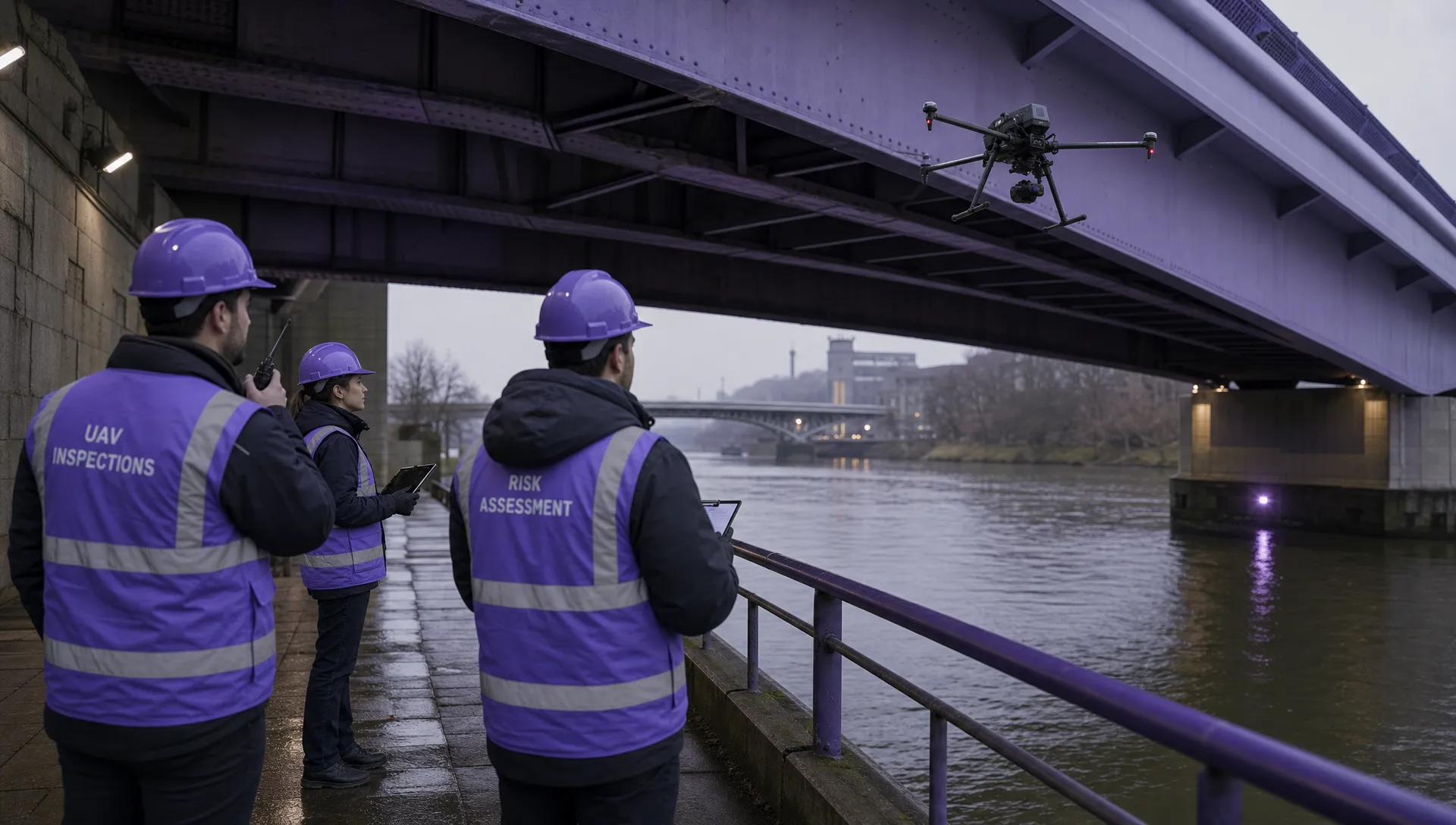
For operators building more advanced safety cases, a practical risk assessment process is essential. Dronedesk has a dedicated guide on building a drone flight risk assessment that works, which is especially relevant when missions become more complex.
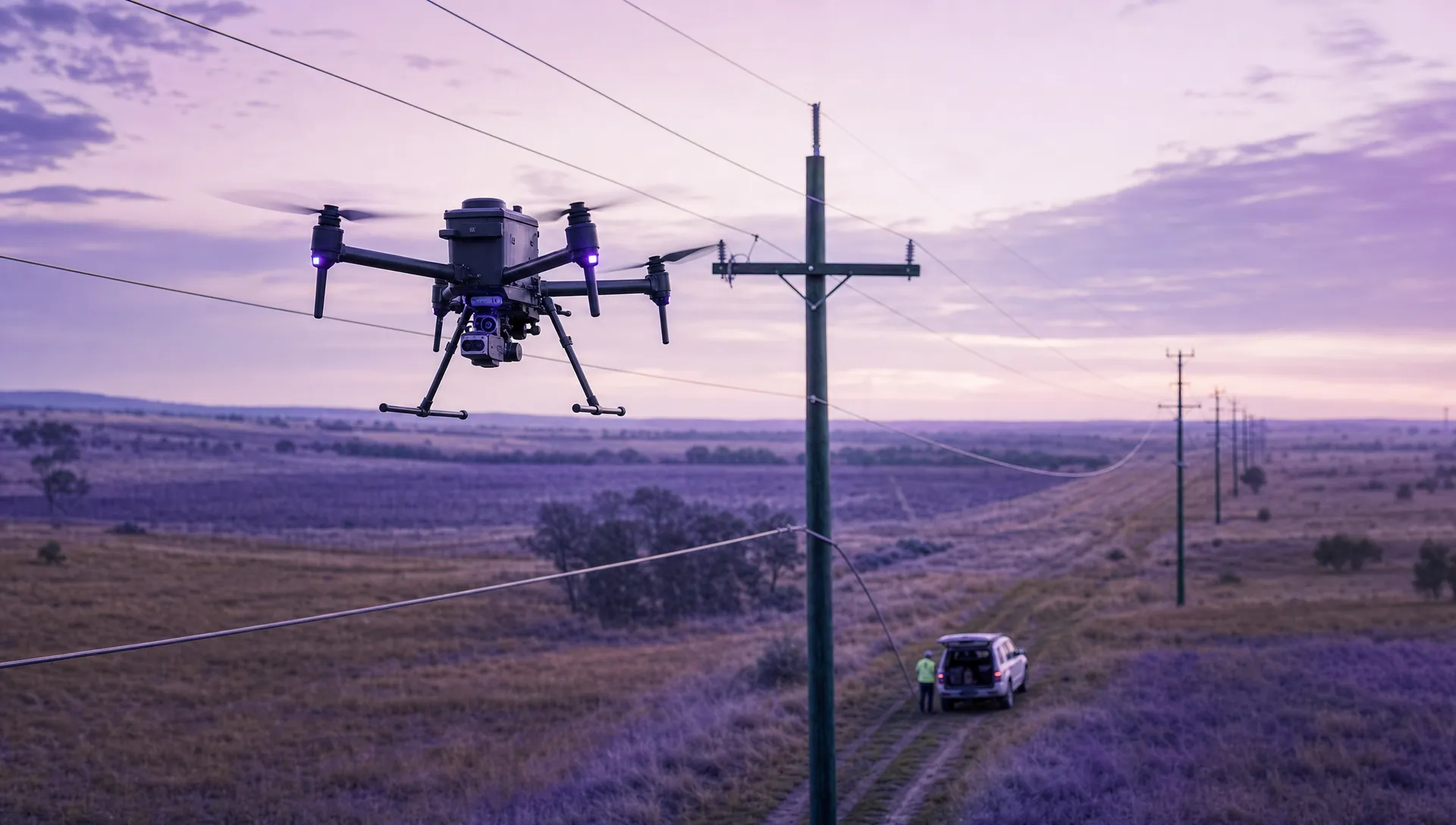
What makes a drone suitable for BVLOS?
Not every drone that can fly far is suitable for BVLOS. Range is only one part of the equation. The aircraft must be dependable enough for the intended operating environment and supported by the right systems.
A BVLOS-capable platform will typically need strong endurance, reliable telemetry, predictable failsafe behaviour, accurate positioning and a payload suited to the mission. For infrastructure inspection, that payload may include high-resolution imaging, thermal sensors or LiDAR. For emergency services, live video, thermal imaging and rapid deployment may matter more. For delivery, payload security, flight stability and route reliability become central.
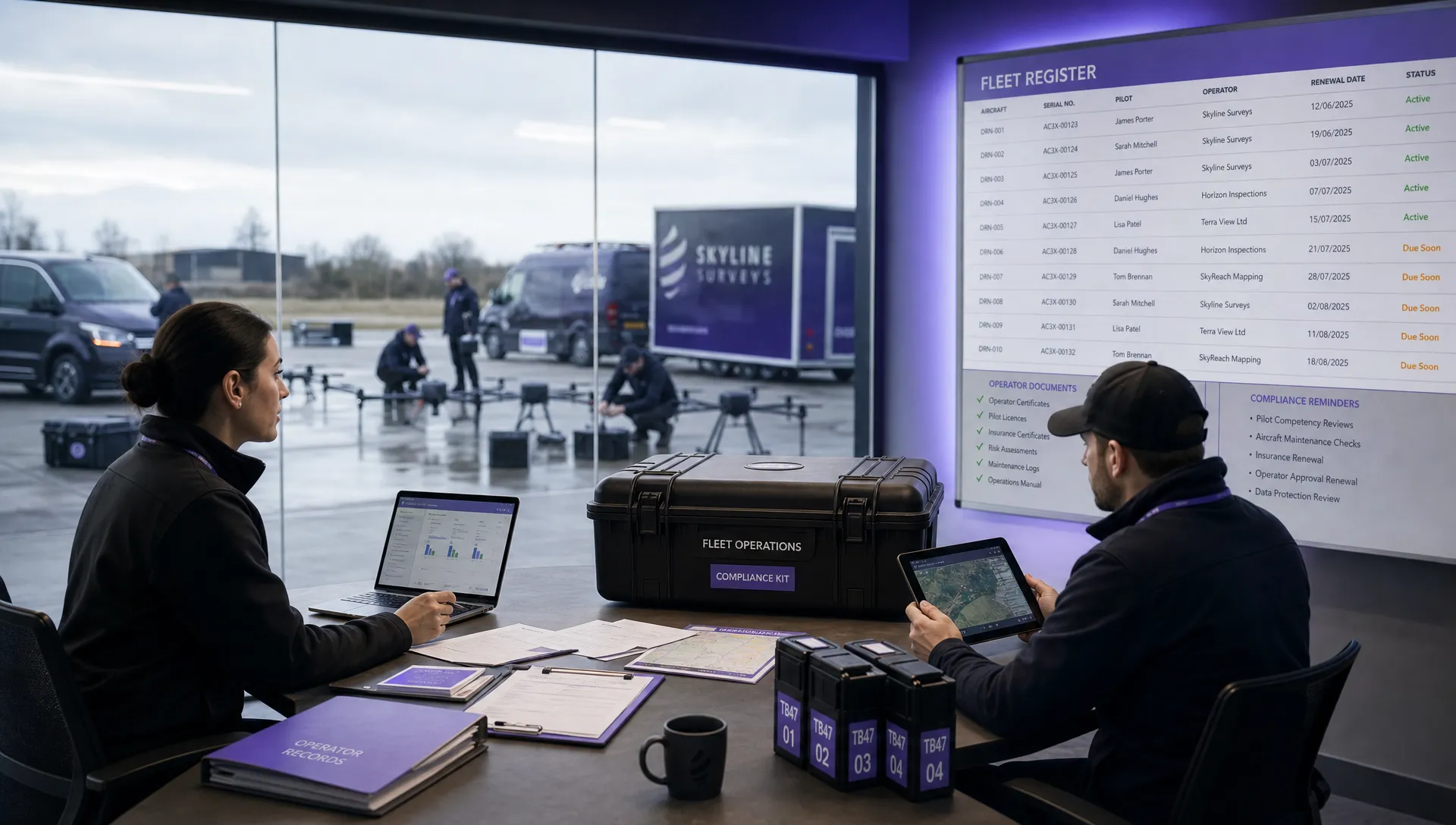
Maintenance and configuration control also become more important. When a drone is operating beyond visual range, the operator must trust the aircraft’s condition, firmware status, battery health, sensor performance and communications setup. A spreadsheet may work for a small VLOS fleet, but BVLOS programmes usually need more disciplined records. For teams scaling beyond ad hoc aircraft tracking, Dronedesk’s drone fleet management guide explains the operational building blocks behind a more controlled fleet.
The operational stack behind BVLOS
BVLOS success is rarely about one impressive aircraft. It is about the stack around the aircraft. That includes planning, approvals, people, procedures, data, records and post-flight review.
Before a mission, operators need to understand the client requirement, site constraints, airspace, nearby hazards, land access, weather, aircraft suitability and emergency options. During the mission, they need clear responsibilities, active monitoring, decision points and contingency procedures. After the mission, they need logs, maintenance updates, reports, evidence retention and lessons learned.
This is where drone operations management software becomes relevant. According to the Dronedesk features page, Dronedesk includes client management, fleet management, team management, airspace intelligence, proximity intelligence, flight planning, flight logging, data reporting, configurable checklists and risk assessments. Those are the types of operational records and workflows that become increasingly important as drone teams move from simple VLOS jobs towards more complex missions.
Software does not replace regulatory approval, pilot competence or engineering reliability. It does, however, help operators keep the operational picture organised, documented and repeatable.
How to prepare for BVLOS operations
If your organisation is considering BVLOS, start with the use case rather than the drone. A strong concept of operations will define the mission, environment, aircraft, people, procedures, risk controls and evidence needed.
Useful preparation steps include:
- Identify the operational problem BVLOS would solve, such as longer asset inspection routes or faster emergency assessment.
- Map the intended operating environment, including airspace, terrain, population, infrastructure and communications coverage.
- Assess whether your aircraft, payload, C2 link and contingency behaviours are suitable for the mission.
- Build a risk assessment that covers air risk, ground risk, technical failures and human factors.
- Define roles for the remote pilot, observers, payload operators, incident commanders or client representatives.
- Create checklists and logs that prove the mission was planned, flown and reviewed properly.
- Engage early with the relevant aviation authority or approval pathway in your jurisdiction.
The earlier these elements are addressed, the easier it is to spot whether the plan is realistic. BVLOS is not something to add at the end of a project. It needs to shape the project from the beginning.
Common misconceptions about BVLOS drones
“BVLOS just means flying further.” Distance is part of it, but the real issue is loss of direct visual observation. A flight behind a building or hill may create BVLOS conditions even if the drone is not far away.
“A camera feed makes it VLOS.” A camera can support situational awareness, but it does not give the same view as unaided visual observation of the aircraft and surrounding sky.
“BVLOS is always autonomous.” BVLOS flights may use automation, but a human operator is still responsible for oversight, decision-making and compliance with the authorisation.
“The drone manufacturer handles compliance.” A manufacturer can provide important capabilities, documents and reliability data, but the operator is responsible for the actual operation, safety case and procedures.
“BVLOS approval is only for large companies.” Large organisations may have more resources, but smaller specialist operators can also build strong BVLOS concepts when the use case is clear and the risk controls are credible.
Frequently Asked Questions
What is a BVLOS drone? A BVLOS drone is a drone used in an operation beyond the remote pilot’s direct visual line of sight. More accurately, BVLOS describes the operating mode, not just the aircraft type.
Is BVLOS legal in the UK? BVLOS can be legal in the UK, but it normally requires the correct CAA authorisation and a safety case showing that air and ground risks are controlled. Operators should always check current CAA guidance before planning BVLOS flights.
Does BVLOS mean the drone flies autonomously? Not necessarily. BVLOS can involve manual control, automation or a mixture of both. The defining factor is that the drone is beyond direct visual line of sight, not the level of automation.
Why is BVLOS important for utility companies? Utilities often manage long, remote or hazardous assets such as power lines, pipelines and water infrastructure. BVLOS can make these inspections more scalable by allowing drones to cover longer routes with appropriate controls.
What records are important for BVLOS operations? Operators should maintain evidence of planning, risk assessments, airspace checks, aircraft status, team roles, checklists, flight logs, maintenance actions and post-flight reviews. The exact records depend on the authorisation and jurisdiction.
Bringing BVLOS into your operation
BVLOS matters because it moves drones from short-range tools to scalable operational assets. For commercial operators, survey teams, utilities and emergency services, that can mean wider coverage, better access to difficult environments and more timely data for decision-making.
The organisations that succeed with BVLOS will not be the ones that only buy longer-range drones. They will be the ones that build reliable processes, maintain strong records, understand risk and prove that every flight is planned and controlled.
If you are strengthening the management side of your drone programme, explore how Dronedesk supports professional drone operations with the planning, logging, checklist, risk assessment and management tools needed for more disciplined missions.
 What Is a BVLOS Drone and Why It Matters →
 Drone Registration Regulations Businesses Must Follow →
 Atypical Airspace Explained for UK Drone Operators →
 FAA Unmanned Aircraft Regulations Made Simple →
 Part 107 Test Tips to Pass With Confidence →
 How to Pass the FAA Drone Written Test First Time →
 What a BVLOS Flight Means for Risk and Compliance →
 Drone VLOS Rules Explained for Commercial Teams →
 FAA Remote ID Rule Explained for Commercial Pilots →
 Drone Legal Requirements for Commercial Operations →