
FAA 107 Explained for Commercial Drone Operators
If you operate drones for money, for a client, or for any business purpose in the United States, FAA 107 is the rule set you are most likely to deal with first. More precisely, “FAA 107” refers to 14 CFR Part 107, the Federal Aviation Administration’s rules for civil small unmanned aircraft systems.
For commercial drone operators, Part 107 is not just a pilot test. It affects who can act as remote pilot in command, where you can fly, how you plan missions, what records you should keep, and when you need extra FAA approval. It is the baseline compliance framework for many survey, inspection, media, construction, utility and public safety drone operations.
This guide explains FAA 107 in practical terms, so you can turn the regulation into a repeatable operating process rather than a last-minute paperwork exercise.
What is FAA 107?
FAA Part 107 is the US rule set for operating small unmanned aircraft systems for non-recreational purposes. A small UAS under Part 107 means the drone, including everything attached to it or carried by it, weighs less than 55 lb.
The FAA’s commercial drone operator guidance describes Part 107 as the standard route for many business drone operations. The detailed legal text sits in 14 CFR Part 107 on the eCFR, which should always be your source of truth for current wording.
In simple terms, Part 107 usually applies when a drone is flown for work or business value. That includes obvious paid jobs, such as roof inspections or mapping, but it can also include internal business use, such as a utility company inspecting its own assets or a contractor documenting progress on a site.
| FAA 107 concept | What it means for operators |
|---|---|
| Small UAS | Drone plus payload must be under 55 lb |
| Non-recreational use | Business, client, agency or organisational purpose |
| Remote pilot in command | A certificated person responsible for the safety and legality of the flight |
| Operating limitations | Rules for altitude, visibility, airspace, speed, people, vehicles and more |
| Authorisations and waivers | Extra FAA approvals needed for certain airspace or operations outside standard limits |
Part 107 is not the only possible framework. Some government agencies, including emergency services, may operate under a public aircraft operation structure or Certificate of Waiver or Authorization, often called a COA. However, many public safety departments still use Part 107 for some or all routine drone missions because it is a clear and widely understood pathway.
Who needs a Part 107 Remote Pilot Certificate?
Every Part 107 operation must have a remote pilot in command, often shortened to Remote PIC. The Remote PIC is responsible for the operation, even if another trained person is physically manipulating the controls under their direct supervision.
To qualify for a Remote Pilot Certificate with a small UAS rating, a person generally needs to be at least 16 years old, able to read, speak, write and understand English, physically and mentally fit to safely operate a drone, and able to pass the required aeronautical knowledge process. Most new pilots do this by passing the FAA Unmanned Aircraft General, Small UAG, knowledge test at an approved testing centre and then applying through FAA systems.
The certificate itself does not expire in the same way as a simple one-off permit, but pilots must maintain aeronautical knowledge currency. The FAA currently uses online recurrent training for Part 107 pilots, and operators should make sure their pilots complete the required recurrent training within the required cycle before flying commercially.
For companies, the key point is this: Part 107 compliance is not only about having “a licensed pilot” somewhere in the organisation. Each operation needs a clearly assigned Remote PIC who is current, briefed, competent for the mission, and able to make go or no-go decisions.
The core FAA 107 operating rules
Part 107 contains many details, but the following rules shape day-to-day commercial operations most often.
Aircraft registration and Remote ID
Drones used under Part 107 must be registered with the FAA, and the registration number must be displayed on the aircraft. Operators should also check that the aircraft is correctly set up for Remote ID where required.
Remote ID is the system that allows a drone in flight to broadcast identification and location information. The FAA’s Remote ID guidance explains the current requirements and acceptable compliance routes. In practice, commercial operators should treat Remote ID status as part of fleet readiness, just like firmware, battery health and maintenance condition.
Visual line of sight
Under standard Part 107 rules, the aircraft must remain within visual line of sight. The Remote PIC must be able to know the drone’s location, attitude, altitude and direction of flight, and must be able to observe the surrounding airspace for hazards.
Visual observers can help, especially on complex sites, but they do not automatically turn a beyond visual line of sight mission into a compliant operation. BVLOS usually requires specific FAA approval unless a future rule or waiver applies to the operation.
Altitude, speed and weather limits
The standard altitude limit is 400 ft above ground level, or within 400 ft of a structure when operating near that structure. The standard maximum groundspeed is 100 mph, or 87 knots.
Part 107 also includes weather visibility and cloud clearance rules. Operators generally need at least 3 statute miles of visibility from the control station, and must maintain required cloud clearance. These numbers matter for real mission planning, especially for early morning utility inspections, coastal survey work, emergency response after storms, or operations near low cloud.
Controlled airspace
You cannot simply launch in controlled airspace because the site is familiar or because the aircraft is small. Part 107 operators need FAA authorisation for operations in controlled airspace where required, commonly through LAANC where available, or through FAA DroneZone.
LAANC can be fast, but it is still an authorisation process rather than a planning shortcut. Always check the exact grid, altitude, time window and any conditions attached to the approval. Also remember that UAS Facility Maps are planning aids, not automatic permission.
Night operations
Part 107 allows night operations without the old style night waiver if the required conditions are met. The remote pilot must have completed the relevant training, and the aircraft must have anti-collision lighting visible for at least 3 statute miles, subject to the rule’s details and safety considerations.
For commercial teams, night flying should still be treated as a higher-risk operation. Reduced visual cues, lighting glare, tired crews, public concern and emergency landing constraints all need to be covered in the mission risk assessment.
Operations over people and moving vehicles
Do not assume that a Part 107 certificate gives blanket permission to fly over people, crowds or traffic. Operations over people and moving vehicles are governed by specific categories and aircraft eligibility requirements. The rules take into account aircraft weight, injury risk, exposed rotating parts, Remote ID, declarations of compliance and the nature of the people or vehicles below.
For example, a lightweight aircraft may be treated differently from a heavier inspection drone, and a closed worksite with briefed staff is not the same as an open-air public assembly. If a mission involves people, roads, rail corridors or public events, plan this element early rather than trying to justify it on site.
Preflight condition and crew briefing
Part 107 expects the Remote PIC to ensure the aircraft is in a condition for safe operation. That means preflight checks are not box-ticking. They should confirm that the aircraft, batteries, control link, payload, software settings, Remote ID status and operating environment are fit for the mission.
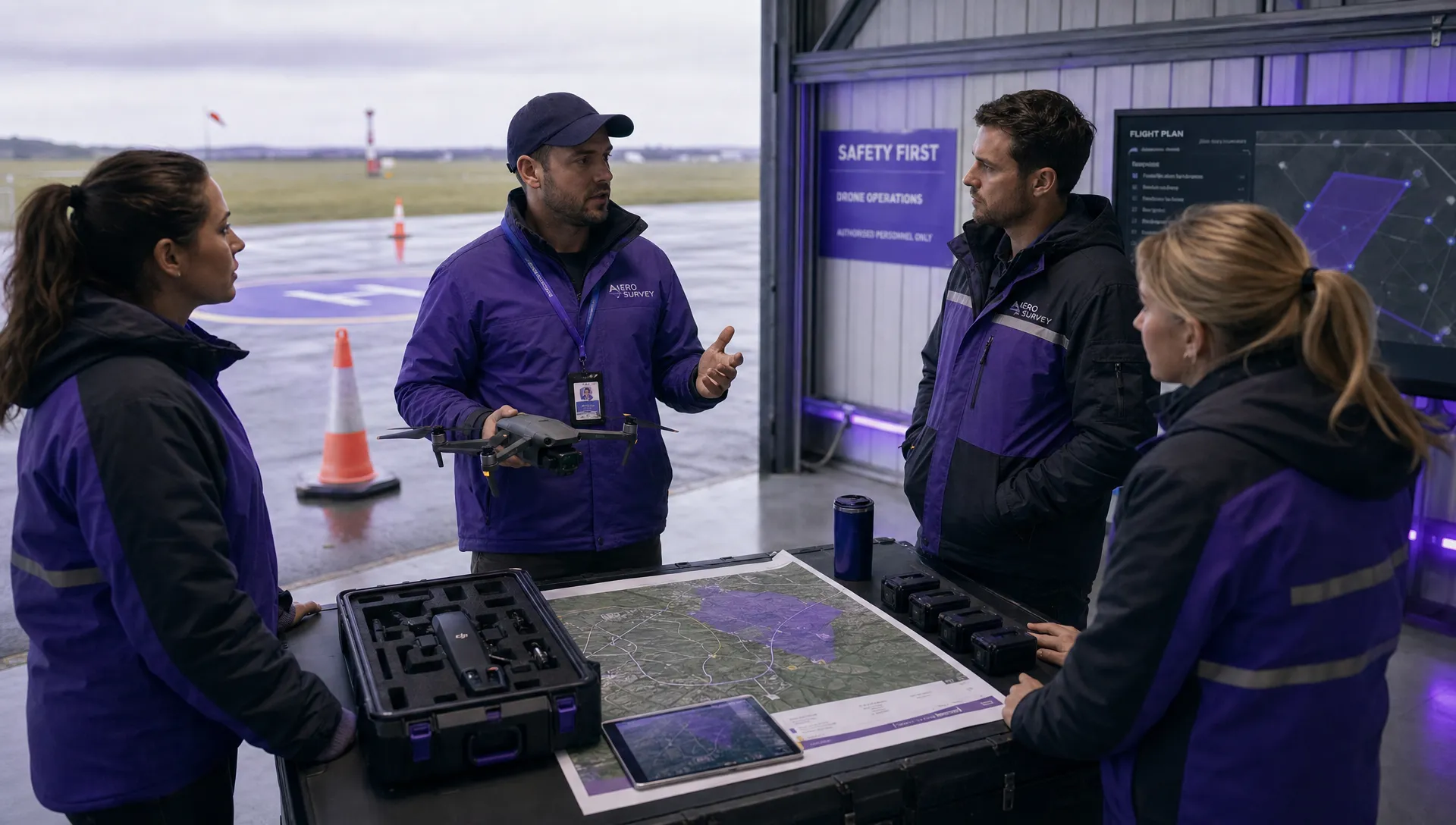
Crew briefing is equally important. Everyone involved should understand the operating area, emergency procedures, lost link actions, roles, communication method, airspace constraints and abort criteria.
Airspace authorisations vs waivers
Commercial operators often use the words “authorisation” and “waiver” interchangeably, but under FAA 107 they are different things.
An airspace authorisation allows an operation in controlled airspace, usually within the standard Part 107 rules. A waiver allows an operator to deviate from a specific Part 107 operating rule, if the FAA accepts that the proposed operation can be conducted safely.
| Approval type | Typical purpose | Example |
|---|---|---|
| LAANC authorisation | Access controlled airspace at or below approved altitudes | Mapping a site near an airport within a LAANC grid |
| DroneZone airspace authorisation | Controlled airspace request not handled through LAANC | Planned work in controlled airspace needing manual review |
| Part 107 waiver | Permission to operate outside a standard Part 107 limitation | Certain BVLOS or other non-standard operations |
A strong waiver application is not just a request. It is a safety case. The FAA will expect you to explain the operation, hazards, mitigations, crew responsibilities, training, communications, contingency procedures and how you will maintain an acceptable level of safety.
This is where documented operational discipline helps. If your business already uses consistent checklists, flight logs, risk assessments and standard operating procedures, it is easier to demonstrate that your operation is controlled and repeatable.
Turning FAA 107 into a commercial operating workflow
The best drone companies do not treat FAA 107 as a separate compliance task. They build it into their normal workflow from enquiry to close-out.
A practical Part 107 workflow usually has four stages: mission intake, planning, flight execution and record keeping.
During mission intake, you decide whether the job is feasible under standard Part 107. You look at location, airspace, operating altitude, proximity to people, site access, client expectations, payload, deadlines and whether any waiver or authorisation is needed.
During planning, you confirm the operational details. That includes checking airspace, NOTAMs and temporary flight restrictions, reviewing site hazards, confirming Remote PIC currency, assigning crew roles, checking aircraft readiness, preparing emergency procedures and completing the risk assessment. If you want a deeper practical framework, Dronedesk has a useful guide on how to build a drone flight risk assessment that works.
During execution, the Remote PIC should be empowered to delay, modify or cancel the flight. Commercial pressure is never a safety mitigation. If wind, visibility, people, aircraft activity or site conditions change, the plan should change with them.
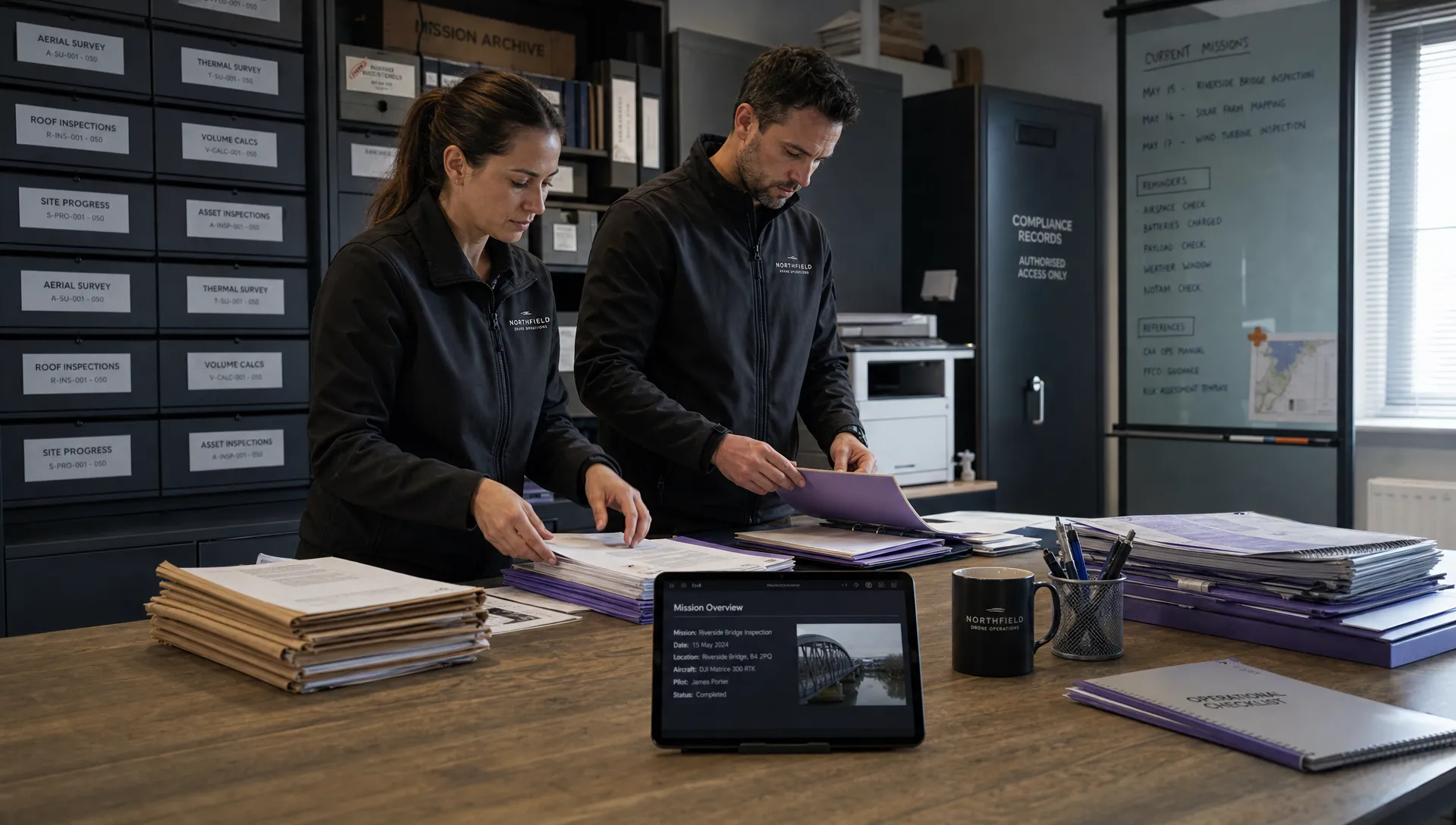
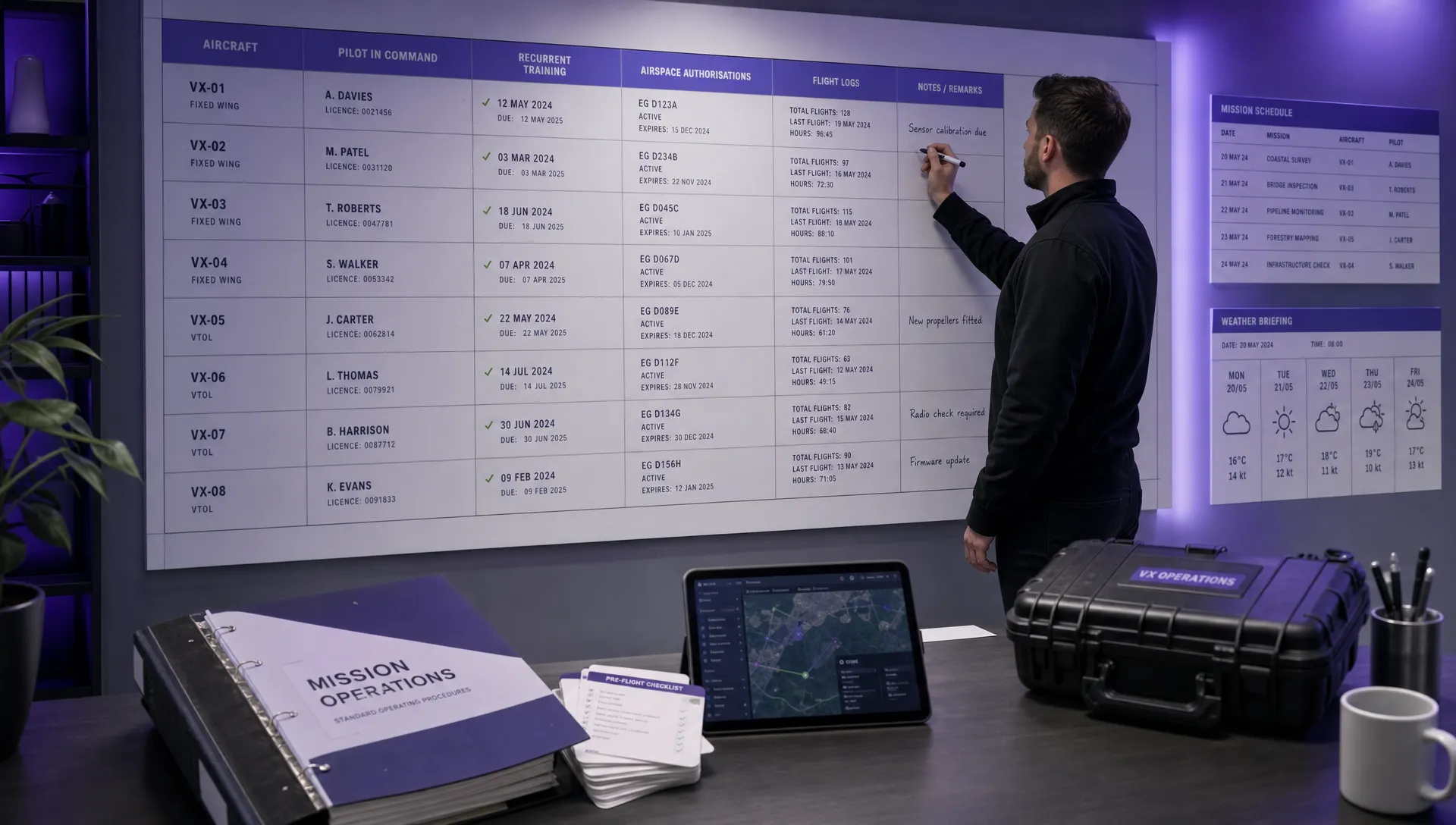
During close-out, keep records that show what was planned, approved, flown and learned. Part 107 does not turn every drone job into a paperwork marathon, but commercial operators should be able to evidence key decisions if a client, insurer, internal auditor or regulator asks questions later.
Useful records often include:
- Remote Pilot Certificate and recurrent training status
- Aircraft registration and Remote ID status
- Airspace authorisations or waiver references
- Site survey, risk assessment and crew briefing records
- Preflight and post-flight checklists
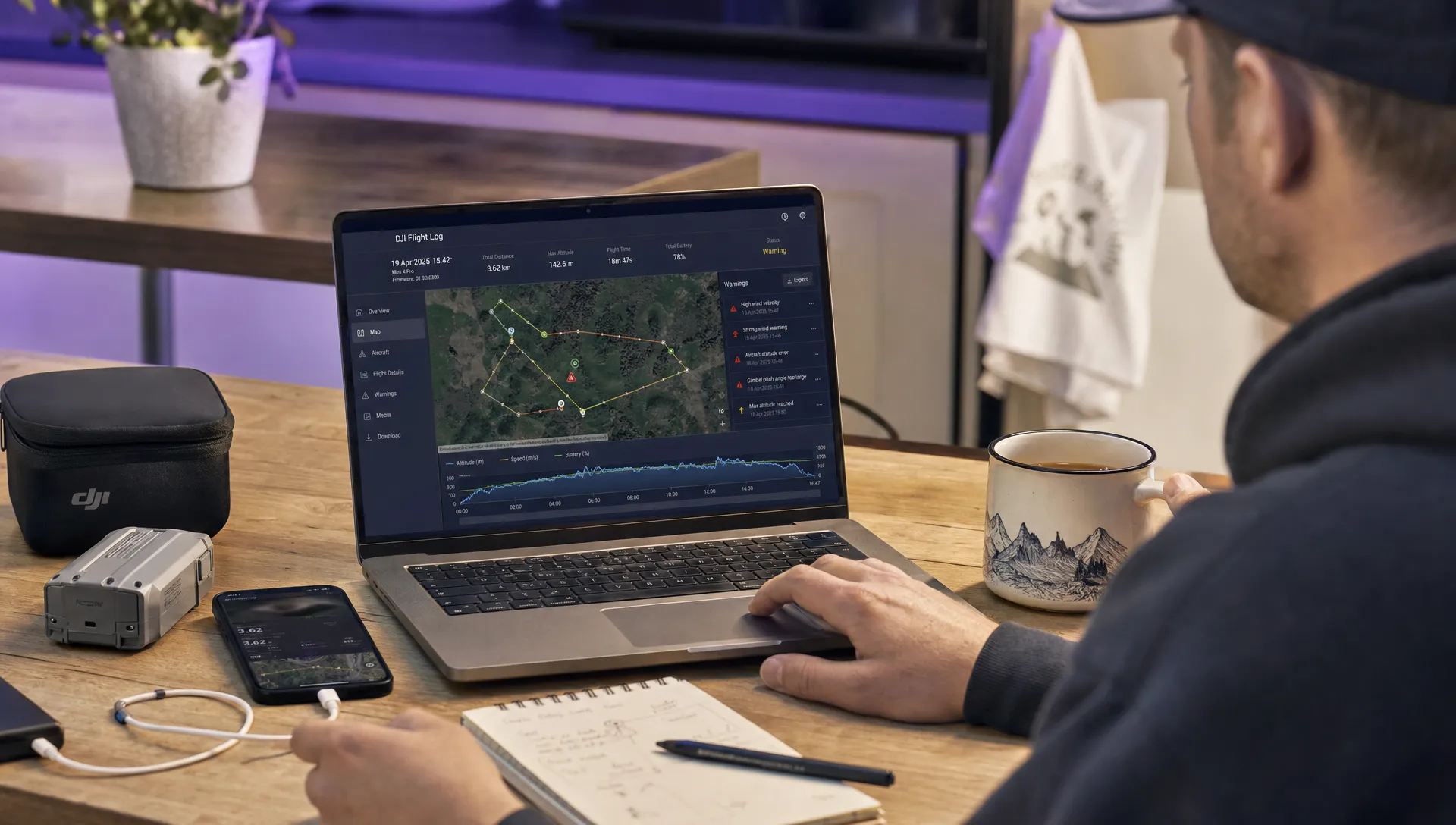
- Flight logs, battery records and maintenance notes
- Incident, defect or near-miss reports
Dronedesk is designed around this kind of operational admin, with features including client management, fleet management, team management, airspace intelligence, proximity intelligence, flight planning, flight logging, data reporting, configurable checklists and risk assessments. You can review the platform’s current capabilities on the Dronedesk features page.
What FAA 107 means for different commercial sectors
The same regulation can feel very different depending on the mission profile. A roof inspection, a transmission line patrol and a public safety deployment all sit under the same Part 107 framework, but the operational risks are not the same.
Survey and mapping companies
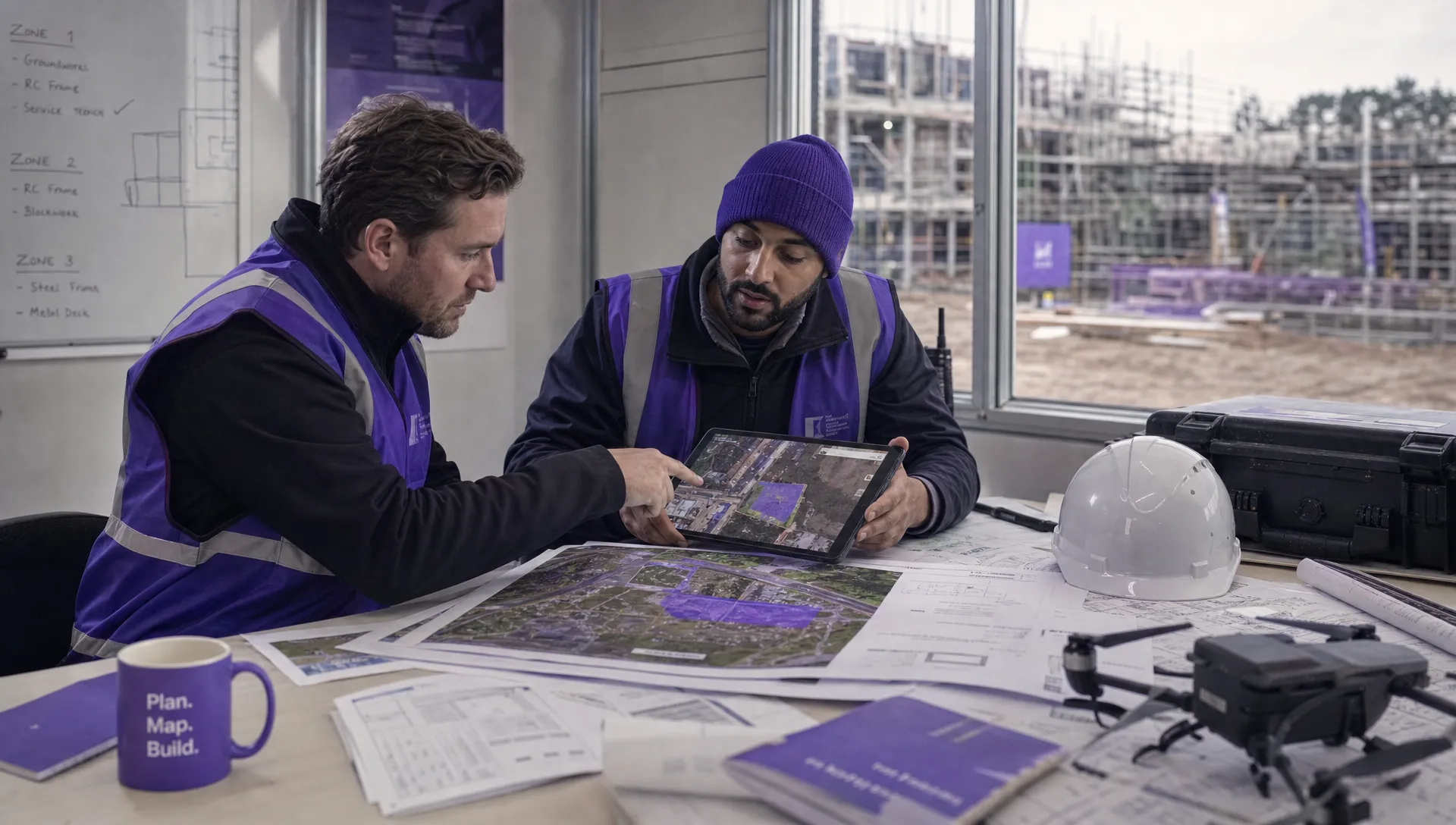
Survey operators often fly repeatable grid missions, which makes planning discipline essential. The key FAA 107 issues are usually controlled airspace, altitude, VLOS, launch and recovery location, battery endurance, people on site, and whether the mapping area can be covered safely without stretching visual line of sight.
Accuracy requirements can also create pressure to fly at a particular altitude or overlap pattern. If the required data cannot be captured within Part 107 limits, the answer is not to quietly exceed the limit. It is to redesign the mission, split the site, use additional crew, seek the right approval, or adjust the deliverable.
Utility and infrastructure operators
Utility inspections often involve linear assets, difficult terrain, electromagnetic environments, roads, railways and critical infrastructure. VLOS is one of the biggest operational constraints for long corridors. Teams need to plan launch points, observer positions, handover procedures where applicable, emergency landing options and permissions for access.
Fleet records matter here too. As utility drone programmes grow, it becomes harder to manage aircraft status, batteries, pilots, sensors and maintenance in spreadsheets. For growing teams, a structured approach to drone fleet management helps keep operational readiness and compliance visible.
Emergency services and public safety teams
Emergency services may operate under Part 107, a public aircraft framework, or a combination depending on the agency, mission and legal structure. For urgent incidents, the challenge is balancing speed with airspace coordination, scene safety, privacy, evidence handling and crew fatigue.
Part 107 can support many public safety missions, but incident commanders should know in advance which authority their team is operating under. That decision should not be improvised at the roadside during a major event.
Temporary flight restrictions, crewed aircraft, media drones, public crowds and multi-agency command structures can all affect whether a drone should launch. Pre-written procedures and regular training are essential.
Common FAA 107 mistakes commercial operators should avoid
Many Part 107 problems are not caused by ignorance of the headline rules. They happen because operators fail to connect those rules to real-world job pressure.
One common mistake is assuming that airspace approval solves every compliance issue. LAANC may authorise the airspace, but it does not waive VLOS, people overflight, weather limits, Remote ID requirements or site safety obligations.
Another mistake is letting the client define the flight. Clients can define the outcome they need, but the Remote PIC must define what is safe and legal. If a client asks for a shot over a crowd, a low pass near traffic, or a flight beyond visual range, the operator must either plan a compliant method or decline that part of the request.
A third mistake is poor record keeping. If something goes wrong, “we checked it on an app” is rarely enough. Keep the authorisation, the risk assessment, the checklist, the flight log and the decision trail.
Finally, do not treat recurrent training as the only measure of competence. A current Part 107 pilot may still need mission-specific training for thermal work, public safety operations, confined urban sites, night operations, specialist payloads or complex crew coordination.
Accident reporting under Part 107
Part 107 includes FAA accident reporting requirements. In general, an operator must report certain serious outcomes to the FAA within 10 calendar days, including serious injury, loss of consciousness, or property damage above the specified threshold to property other than the small unmanned aircraft.
Even when an event does not meet the FAA reporting threshold, commercial operators should still record incidents, near misses, defects and lessons learned internally. These records help improve procedures, support insurance discussions, and show that the organisation takes safety management seriously.
FAA 107 compliance checklist for operators
Use this as a practical pre-job sense check, not as a substitute for the regulation or your own operations manual.
| Question | Why it matters |
|---|---|
| Is the operation genuinely within Part 107? | Confirms the right legal framework |
| Is the Remote PIC certificated and current? | Establishes legal responsibility and competence |
| Is the aircraft registered and Remote ID compliant where required? | Confirms aircraft eligibility |
| Is the airspace clear or authorised? | Prevents controlled airspace violations |
| Can VLOS be maintained throughout? | Addresses one of the main Part 107 limitations |
| Are altitude, speed, visibility and cloud limits met? | Confirms operating conditions are legal |
| Are people, vehicles and property risks controlled? | Reduces exposure to the highest consequence hazards |
| Are emergency procedures briefed? | Improves response to lost link, flyaway, injury or intrusion |
| Are records saved after the job? | Creates an audit trail for clients, insurers and regulators |
Frequently Asked Questions
Is FAA 107 the same as a drone licence? In everyday language, people often call it a drone licence, but the FAA term is a Remote Pilot Certificate with a small UAS rating. It allows a pilot to act as Remote PIC for Part 107 operations when they meet currency and operating requirements.
Do I need FAA 107 if I am not charging money? Possibly. Part 107 is about non-recreational purpose, not only direct payment. If the flight supports a business, employer, agency or organisation, it may fall under Part 107 even if no invoice is issued for that specific flight.
Can Part 107 pilots fly at night? Yes, if the Part 107 night operation requirements are met, including relevant pilot training and suitable anti-collision lighting. Operators should still complete a mission-specific risk assessment because night flying changes visibility, navigation and emergency response assumptions.
Do I need LAANC for every commercial drone flight? No. LAANC is for obtaining authorisation in participating controlled airspace. If you are operating in uncontrolled Class G airspace, LAANC is normally not required, but all other Part 107 rules still apply.
Does FAA 107 allow BVLOS operations? Standard Part 107 is built around visual line of sight. BVLOS generally requires a waiver or other specific FAA approval unless a current rule applies to that operation. Operators should not treat future BVLOS rulemaking as permission to fly BVLOS today.
How long should commercial drone operators keep flight records? Part 107 does not create a single universal retention period for every operational document, but businesses should keep records long enough to support regulatory questions, insurance requirements, client obligations, maintenance tracking and internal safety management.
Build FAA 107 into the way you operate
FAA 107 is much easier to manage when it is embedded into your normal operating process. For commercial drone operators, the goal is not simply to pass the test. The goal is to plan consistently, brief properly, fly within clear limits, and keep records that prove what happened.
Dronedesk helps drone teams manage that operational workflow in one place, from flight planning and risk assessments to checklists, fleet records, team management, flight logging and reporting. If your Part 107 admin is spread across spreadsheets, emails and disconnected apps, visit Dronedesk to see how a dedicated drone operations platform can support safer, more organised commercial flying.
 FAA Part 107 Record-Keeping Rules for Commercial Teams →
 How to Review a DJI Flight Log After an Unexpected Event →
 Drone Laws Around the World: A Pre-Flight Research Framework →
 How to Compare Drone Survey Services for Complex Sites →
 How to Start a Drone Mapping Business With a Clear Workflow →
 Class C Airspace Drone Rules for Commercial Flights →
 How to Create a Drone Job Pack for Every Mission →
 FAA Small UAS Rule: Key Requirements for Operators →
 How to Build a Drone Pilot Flight Log That Is Audit Ready →
 FAA Drone Licence Requirements for Commercial Pilots →