
Drone Manufacturers Compared for Enterprise Operations
Choosing a drone manufacturer for enterprise operations is no longer a simple aircraft comparison. For survey companies, utilities, emergency services and established drone operators, the real question is how well the manufacturer supports repeatable missions, auditable compliance, mixed payloads, trained crews and long-term fleet growth.
A cheap aircraft can become expensive if it creates operational friction. A premium platform can also be poor value if its capabilities exceed the mission profile. The best choice usually comes from matching the manufacturer’s ecosystem to the work you perform most often, then validating it through controlled field trials.
This comparison focuses on enterprise use cases rather than hobby flying. It looks at the main drone manufacturers you are likely to encounter in commercial procurement, where each tends to fit best and what operational risks to consider before standardising your fleet.
What enterprise buyers should compare first
Enterprise teams often start with camera resolution, flight time or price. Those details matter, but they sit inside a wider operational system. A drone used by a utility inspection team, for example, must support reliable pre-flight planning, repeatable checklists, airspace review, crew allocation, asset management, risk assessment and flight logging.
Before comparing manufacturers, define the operational problem in plain terms. Are you mapping 500-hectare rural sites, inspecting live infrastructure, supporting emergency response, capturing marketing imagery or running a multi-client drone services business? Each scenario changes the answer.
For most enterprise operators, the strongest procurement criteria are:
- Mission fit: aircraft type, sensor compatibility, endurance, wind performance and launch requirements.
- Operational safety: redundancy, obstacle avoidance, return-to-home behaviour, battery management and fail-safe design.
- Payload ecosystem: thermal, RGB, zoom, multispectral, LiDAR or custom payload support.
- Data governance: where data is processed, how accounts are managed and whether the setup meets internal security policies.
- Maintenance and support: spare parts availability, repair pathways, firmware lifecycle and local dealer competence.
- Software compatibility: how well the aircraft fits mapping, inspection, asset management and operations management workflows.
- Fleet scalability: whether the manufacturer can support multiple aircraft, multiple pilots and standardised procedures across regions.
If your team is already managing several aircraft or crews, the manufacturer decision should sit alongside your wider drone fleet management process, not outside it.
Drone manufacturers compared at a glance
The table below summarises common enterprise-fit manufacturers. It is not a ranking, because the best manufacturer for a police thermal deployment may be a poor choice for high-accuracy corridor mapping.
| Manufacturer | Typical enterprise fit | Strengths | Watch-outs |
|---|---|---|---|
| DJI Enterprise | General enterprise, inspection, mapping, public safety, media | Broad product range, mature payload ecosystem, strong availability, extensive third-party software support | Data governance, procurement restrictions and geopolitical considerations may affect some public-sector or critical infrastructure buyers |
| Skydio | Close-proximity inspection, public safety, autonomous operations | Strong autonomy, obstacle avoidance focus, US-origin options for sensitive procurement | More focused aircraft range and regional availability may limit use outside specific programmes |
| Autel Robotics | Inspection, public safety, portable enterprise work | Capable thermal and zoom platforms, familiar multirotor workflows, useful DJI alternative for some teams | Smaller enterprise ecosystem than DJI and varying support depth by region |
| Parrot | Lightweight public safety, security-conscious operations, rapid deployment | Compact systems, European manufacturer, good fit for portable reconnaissance and inspection tasks | Less suitable for heavy payloads or large-scale industrial sensor ecosystems |
| Wingtra | Surveying, large-area mapping, mining, construction, environmental work | VTOL fixed-wing design, efficient area coverage, survey-focused workflow | Specialist mapping platform rather than a general inspection or emergency response drone |
| senseFly (AgEagle) | Surveying, agriculture, environmental monitoring, corridor mapping | Long fixed-wing mapping heritage, efficient coverage, established survey workflows | Less flexible for hover-based inspections and heavier payloads |
| Quantum-Systems | Surveying, security, public-sector and specialist fixed-wing operations | European fixed-wing VTOL systems, strong focus on professional and government use cases | More specialist procurement route than mainstream multirotor fleets |
| Freefly Systems | Heavy-lift payloads, LiDAR, cinematography, specialist inspection | High-end build, modularity, payload flexibility, US manufacturer | Requires experienced operators and a stronger budget case |
| Inspired Flight | Industrial payloads, US-origin procurement, LiDAR and specialist enterprise work | Heavy-lift and modular enterprise platforms, attractive for sensitive procurement environments | Best suited to teams with specialist payload needs rather than basic aerial capture |
DJI Enterprise: the broadest ecosystem, with procurement caveats
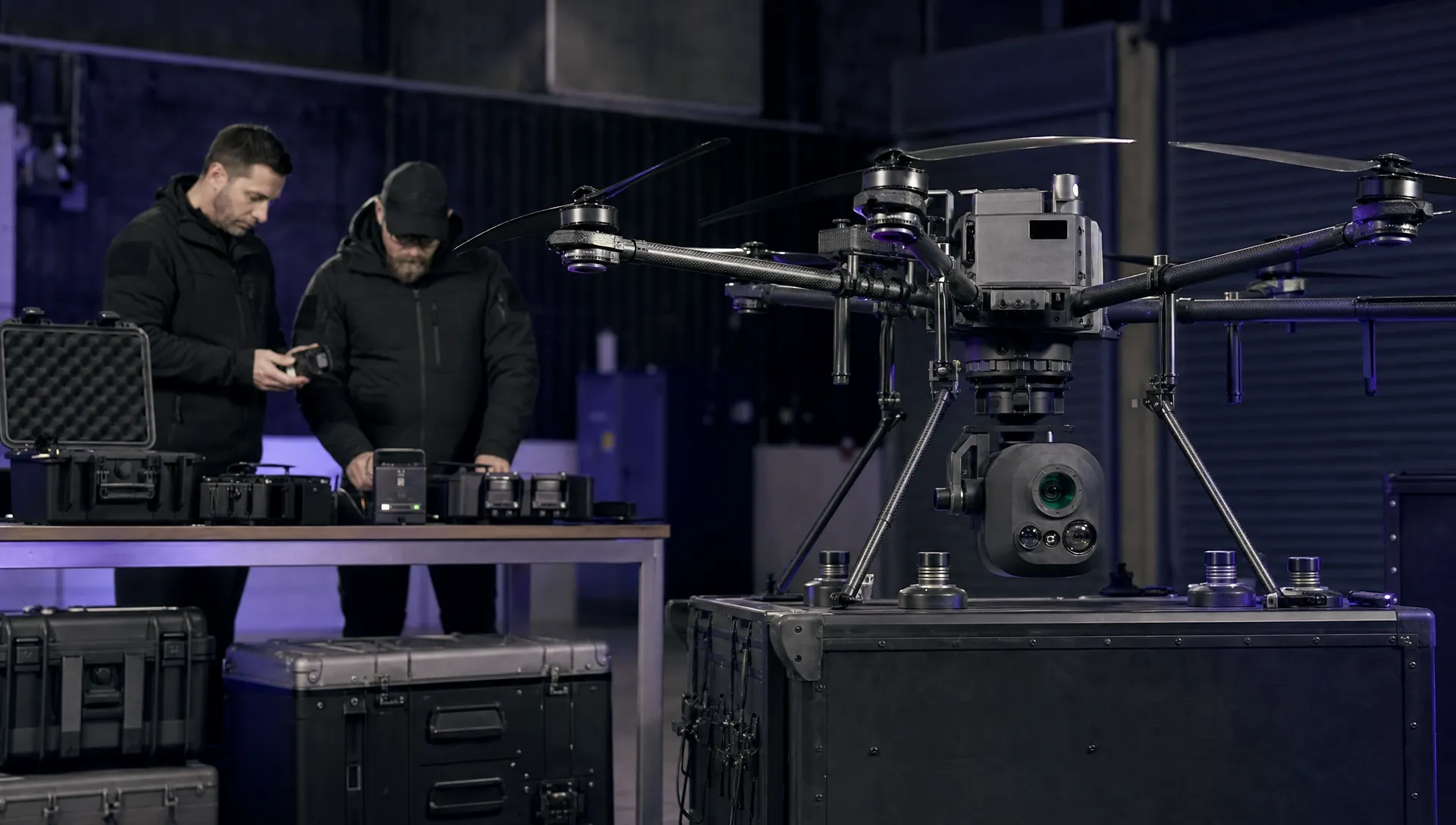
DJI Enterprise remains the manufacturer many commercial teams evaluate first. Its enterprise range covers compact mapping platforms, thermal inspection drones and larger aircraft capable of carrying more sophisticated payloads. The practical advantage is not only the aircraft. It is the ecosystem around them: batteries, charging cases, payloads, training providers, accessories and third-party software support.
For survey companies and drone service providers, DJI aircraft often integrate cleanly with common mapping and inspection workflows. That can reduce the friction of onboarding pilots, processing data and finding replacement equipment. For utilities, models in the Matrice family are widely used for thermal inspection, zoom inspection and asset documentation.
The main caveat is procurement sensitivity. Some public-sector, defence, emergency service and critical infrastructure organisations must consider data governance, national procurement rules and internal cyber policies. These concerns do not make DJI unsuitable for every enterprise user, but they should be assessed early rather than late in the buying process.
DJI tends to be strongest when you need a versatile enterprise ecosystem, fast availability and broad software compatibility. It is less straightforward when your organisation requires a specific country-of-origin profile or a highly controlled data assurance route.
Skydio: autonomy-first enterprise operations
Skydio has built its enterprise reputation around autonomy, obstacle avoidance and close-proximity operation. That makes it especially relevant for inspection teams working around structures, industrial sites, bridges, telecoms assets and public safety scenes where situational complexity is high.
For emergency services, an autonomy-focused aircraft can help pilots maintain awareness in dynamic environments. For utilities, it can be useful around poles, substations and infrastructure where manual positioning creates risk. Skydio’s dock-based and remote operation direction is also relevant for organisations exploring repeatable inspection routes or drone-in-a-box concepts.
The trade-off is that Skydio is not trying to be everything to everyone. Its range is more focused than DJI’s, and international availability, pricing and support will depend heavily on region and channel. For UK and European teams, check distributor support, repair turnaround and payload availability before committing to fleet-wide adoption.
Skydio is a strong shortlist candidate when autonomy, cyber assurance and US-origin procurement are high priorities. It is less compelling if your main need is a very broad aircraft catalogue or low-cost mixed-use fleet.
Autel Robotics: capable alternatives for inspection and response
Autel Robotics offers enterprise multirotors that often appeal to teams wanting capable thermal, zoom and mapping options outside the DJI ecosystem. For operators already familiar with conventional multirotor workflows, the learning curve can be manageable.
Autel can suit public safety teams, inspection providers and smaller enterprise departments that need portable aircraft with professional sensors. Its enterprise drones can be particularly attractive where procurement teams want to benchmark more than one manufacturer before buying.
The main question is ecosystem depth. Check how readily you can source batteries, chargers, propellers, payloads and repairs in your region. Also validate compatibility with the software you rely on for mapping, inspection reporting and operational records.
Autel is worth comparing when you want a practical enterprise multirotor alternative. It is not always the strongest choice for organisations that depend on the largest possible third-party ecosystem.
Parrot: compact, security-conscious European options
Parrot is a French manufacturer with enterprise-relevant aircraft such as the ANAFI range. Its systems are often considered for lightweight inspection, public safety, security and rapid deployment roles where portability matters.
Parrot’s appeal is strongest where teams want compact aircraft from a European manufacturer, especially for reconnaissance-style missions, basic inspection and situational awareness. Smaller aircraft can be easier to transport, quicker to deploy and simpler to manage across distributed response teams.
The limitations are physical. Compact drones cannot match larger platforms for payload flexibility, endurance in difficult conditions or heavy industrial sensor support. If your operation needs high-end LiDAR, large thermal payloads or prolonged work in challenging weather, Parrot may be better as a supplementary fleet option than a primary enterprise platform.
Wingtra, senseFly and Quantum-Systems: fixed-wing VTOL for survey scale
Survey companies should separate multirotor drones from fixed-wing and VTOL fixed-wing systems early in procurement. If your core work involves large sites, long corridors or repeatable mapping deliverables, manufacturers such as Wingtra, senseFly and Quantum-Systems deserve serious attention.
Wingtra is well known for survey-grade VTOL fixed-wing mapping. Its aircraft take off and land vertically, then fly like fixed-wing platforms for efficient area coverage. That combination is valuable where launch space is limited but large-area efficiency still matters.
senseFly, part of AgEagle’s drone portfolio, has a long history in fixed-wing mapping through the eBee line. It is commonly associated with agriculture, environmental monitoring, mining and surveying workflows.
Quantum-Systems, based in Germany, focuses on professional fixed-wing VTOL platforms for survey, security and public-sector applications. It is often relevant where European supply chain considerations, specialist mission profiles or government procurement requirements shape the shortlist.
The drawback of these manufacturers is specialisation. Fixed-wing VTOL aircraft are not usually the best option for close visual inspection, emergency overwatch in confined areas or general content capture. They shine when accurate, efficient, repeatable mapping is the main mission.
For teams still defining their processing workflow, it is worth comparing airframe choice alongside drone mapping software options, because sensor, image capture pattern and processing pipeline must work together.
Freefly and Inspired Flight: heavy-lift and specialist payload work
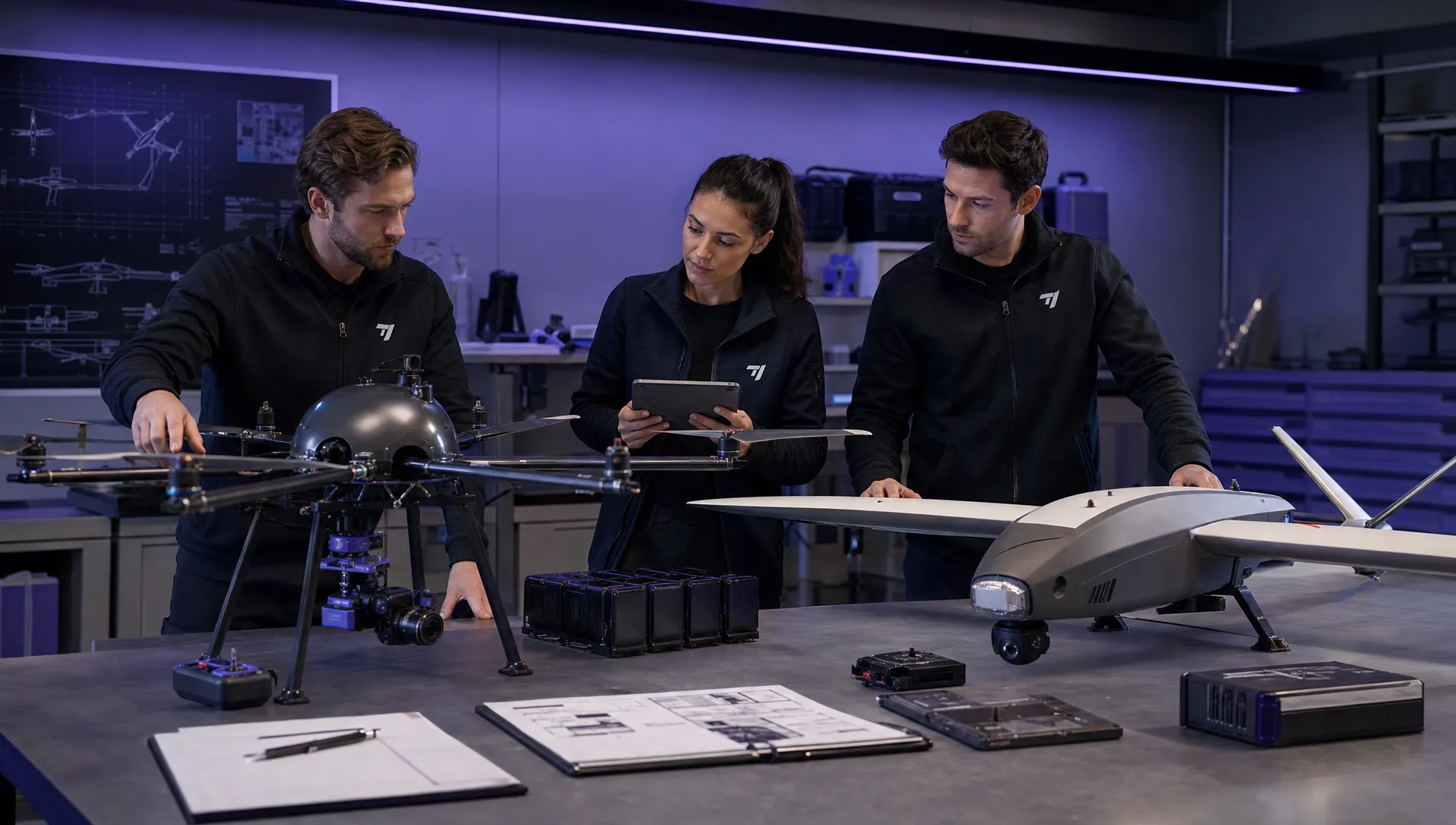
Freefly Systems and Inspired Flight are relevant when enterprise operations move beyond standard camera payloads. These manufacturers tend to appear in conversations about LiDAR, cinema-grade payloads, research sensors, industrial inspection payloads and US-origin procurement.
Freefly has a strong reputation in professional cinematography and specialist payload integration. Its platforms can be attractive to teams that need aircraft flexibility rather than a closed, single-purpose setup.
Inspired Flight is often considered by organisations that need US-made industrial drones for sensitive operations, including infrastructure, energy, surveying and public-sector work. Its aircraft are generally better suited to teams with defined payload requirements and experienced pilots.
These manufacturers are rarely the cheapest way to start an enterprise drone programme. Their value appears when the payload is the mission. If a £50,000 sensor is the reason for the flight, the airframe must be chosen around lift capacity, vibration management, redundancy, integration support and maintenance confidence.
Best manufacturer by enterprise use case
A useful comparison does not ask, “Which manufacturer is best?” It asks, “Best for which mission, under which constraints?” The matrix below can help narrow the field.
| Use case | Manufacturers commonly shortlisted | Why they fit |
|---|---|---|
| Large-area topographic survey | Wingtra, senseFly, Quantum-Systems, DJI Enterprise | Efficient coverage, survey sensors, RTK or PPK workflows, mapping software compatibility |
| Utility inspection | DJI Enterprise, Skydio, Autel, Freefly, Inspired Flight | Thermal and zoom payloads, close-proximity capability, payload flexibility, repeatable inspection routes |
| Emergency services | DJI Enterprise, Skydio, Autel, Parrot | Rapid deployment, thermal awareness, portability, established public safety workflows |
| Specialist LiDAR | Freefly, Inspired Flight, DJI Enterprise, Wingtra | Payload support, sensor integration, flight stability, survey workflow maturity |
| Sensitive public-sector procurement | Skydio, Parrot, Quantum-Systems, Freefly, Inspired Flight | Country-of-origin considerations, procurement alignment, security review options |
| Mixed commercial drone services | DJI Enterprise, Autel, Skydio | Versatile aircraft, broad use cases, manageable training requirements |
This table is a starting point, not a substitute for testing. Enterprise operators should run a structured trial that includes pilots, safety managers, data teams and the people who will use the deliverables.
Operational factors that matter after purchase
The manufacturer decision only pays off if the aircraft can be absorbed into day-to-day operations. Many enterprise drone programmes struggle not because the aircraft is weak, but because the surrounding process is inconsistent.
A strong rollout plan should cover aircraft onboarding, pilot training, maintenance rules, battery lifecycle, incident reporting, risk assessment templates and record retention. In regulated environments, it should also document how crews check airspace, proximity hazards, landowner permissions and site-specific constraints.
This is where operations management becomes as important as the manufacturer. Dronedesk is built as an all-in-one platform for drone operators, with features including client management, fleet management, team management, airspace intelligence, proximity intelligence, flight planning, flight logging, data reporting, configurable checklists and risk assessments. You can review the full feature set on the Dronedesk features page.
For enterprise teams, the practical goal is standardisation. Whether you operate DJI, Skydio, Wingtra or a mixed fleet, every mission still needs a defensible planning and logging process. That consistency is what helps a growing operation remain safe, auditable and manageable.
A practical scoring model for procurement teams
If your organisation is comparing drone manufacturers formally, use a scoring model that reflects operational reality. Weight the criteria before inviting demos, otherwise the most polished demonstration can distort the decision.
| Criterion | Suggested weighting | What to assess |
|---|---|---|
| Mission capability | 25% | Aircraft performance, payload fit, endurance, image quality and site suitability |
| Safety and reliability | 20% | Redundancy, obstacle avoidance, fail-safes, battery systems and weather tolerance |
| Compliance and data governance | 15% | Data handling, account control, audit requirements and procurement restrictions |
| Support and maintainability | 15% | Local repair, spare parts, warranty, training and distributor strength |
| Software ecosystem | 10% | Mapping, inspection, reporting and operations management compatibility |
| Total cost of ownership | 10% | Aircraft, payloads, batteries, training, maintenance, replacement cycles and downtime |
| Scalability | 5% | Suitability for multi-site, multi-pilot and mixed-fleet operations |
The percentages can change. A police drone unit may give more weight to deployment speed and data governance. A survey company may increase the weighting for accuracy, sensor compatibility and processing workflow. A utility may prioritise thermal payloads, inspection repeatability and safety near critical infrastructure.
Common mistakes when choosing drone manufacturers
Enterprise buyers tend to make the same avoidable mistakes.
The first is buying for the most exciting mission rather than the most common mission. If 80% of your flights are standard roof inspections, do not let a rare LiDAR project dictate the whole fleet strategy.
The second is underestimating battery, payload and maintenance costs. Enterprise drones are systems, not single purchases. Batteries age, payloads need calibration, props wear, cases break and firmware changes affect workflows.
The third is ignoring pilot experience. A highly capable aircraft can still create operational risk if pilots are not trained for its automation, emergency modes or sensor workflows. Procurement should include training time and documented procedures.
The fourth is choosing a manufacturer without checking software fit. If your mapping platform, inspection reporting tool or operations management process cannot handle the aircraft cleanly, the gap will appear later as manual admin.
The fifth is assuming one manufacturer must solve every problem. Many mature enterprise operators run mixed fleets. A survey team may use Wingtra for large sites and DJI for visual inspection. A utility may combine Skydio for close asset work with a heavier platform for LiDAR. The key is to manage the mixed fleet properly rather than pretend every aircraft is interchangeable.
Recommended shortlisting approach
For most enterprise teams, a sensible shortlist has three layers.
Start with the mission leader. This is the manufacturer best aligned with your highest-volume work. For a survey company, that may be Wingtra, senseFly, Quantum-Systems or DJI Enterprise. For a utility inspection team, it may be DJI Enterprise, Skydio, Freefly or Inspired Flight. For emergency services, it may be DJI Enterprise, Skydio, Autel or Parrot.
Add a procurement-safe alternative. This gives you resilience if country-of-origin rules, supplier availability or data governance policies change. It also gives commercial leverage during purchasing.
Then test a specialist option. This may be a heavy-lift platform, fixed-wing VTOL aircraft or autonomy-focused drone that solves a narrower but valuable mission.
During trials, evaluate the whole workflow: planning, setup, launch, mission execution, data capture, landing, upload, reporting, maintenance and flight logging. The aircraft is only one part of enterprise performance.
Frequently Asked Questions
Which drone manufacturer is best for enterprise operations? There is no single best manufacturer for every enterprise operation. DJI Enterprise is often shortlisted for versatility, Skydio for autonomy, Wingtra for survey mapping, Freefly and Inspired Flight for specialist payloads and Parrot for compact European public safety use cases.
Are DJI drones suitable for enterprise and public-sector work? DJI drones are widely used in enterprise operations, but public-sector and critical infrastructure buyers should review data governance, procurement rules and internal security policies before purchase.
What should survey companies look for in a drone manufacturer? Survey companies should prioritise sensor quality, RTK or PPK workflows, coverage efficiency, mapping software compatibility, support, repeatable flight planning and payload stability.
What should emergency services prioritise when comparing manufacturers? Emergency services should focus on deployment speed, thermal capability, reliability, pilot workload, data governance, training, battery logistics and support availability.
Is a mixed drone fleet a good idea? A mixed fleet can be effective when different aircraft serve clearly defined missions. It becomes risky when procedures, maintenance records, pilot training and flight logs are not standardised.
Bringing the manufacturer decision into your operations workflow
Comparing drone manufacturers is a procurement task, but running them safely is an operational discipline. The right aircraft should make your work easier to plan, execute, document and improve.
Before committing to a fleet, test the aircraft in real mission conditions and map how it will fit into your safety, compliance and reporting workflow. If you need a structured way to manage clients, fleets, teams, airspace checks, proximity intelligence, flight planning, flight logging, checklists and risk assessments, Dronedesk is designed to help drone operators keep those moving parts in one place.
A strong manufacturer gives you capable hardware. A strong operations process turns that hardware into a reliable enterprise programme.
 Drone Manufacturers Compared for Enterprise Operations →
 How to Prepare for the Drone Licence Test →
 How to Choose a Drone Mapping Service for Your Project →
 Drone Safety Rules That Every Commercial Team Needs →
 Airport Drone Rules: How to Plan Flights Without Surprises →
 FAA Part 107 Licence: Your Step-by-Step Application Guide →
 How to View DJI Flight Logs Online Safely →
 What Part 107 Covers Beyond the Pilot Certificate →
 How to Download and Read a DJI Flight Log →
 Drone Videography Planning Tips for Professional Crews →