
Drone Flying Rules Explained for Business Use
For business drone operators, the rules are not just a box-ticking exercise. They shape whether you can accept a job, how you plan it, what evidence you need to keep, and how confidently you can explain your operation to a client, insurer or regulator.
In the UK, the most important point is this: drone flying rules are based on operational risk, not simply on whether you are being paid. A low-risk roof inspection for a client may be possible in the Open category, while an unpaid flight near a crowd, airport or emergency incident could be illegal without authorisation.
This guide explains the drone flying rules that matter most for business use, with a practical focus for survey companies, utilities, emergency services and professional operators managing repeatable operations.
The UK drone rules framework in plain English
UK drone regulation is overseen by the Civil Aviation Authority (CAA). The best starting point for current legal requirements is the CAA drones guidance and the UK Drone and Model Aircraft Code, which set out the core responsibilities for operators and remote pilots.
As of 2026, most UK drone flights fall into one of three categories.
| Category | What it means | Typical business examples |
|---|---|---|
| Open | Lower-risk flights that stay within strict limits, without needing an operational authorisation | Simple property surveys, marketing imagery, progress photos, basic inspections away from uninvolved people |
| Specific | Higher-risk flights that need a CAA operational authorisation or recognised declaration route | Flights close to people, complex urban work, some infrastructure inspections, operations that need additional controls |
| Certified | Highest-risk operations with requirements closer to crewed aviation | Large unmanned aircraft, carrying people, high-risk cargo or very complex operations |
Most business operators spend their time between the Open and Specific categories. The key commercial question is not, “Am I being paid?” It is, “Can this flight be completed within the Open category rules, or does the risk profile require Specific category authorisation?”
Registration, competency and insurance
Before accepting commercial drone work, you need to understand who is responsible for the aircraft, who is flying it, and what qualifications or records are required.
The operator is the person or organisation responsible for managing the drone. The remote pilot is the person controlling the aircraft. In a small business, these may be the same person. In a utility company, survey firm or emergency services team, they are often different people.
| Requirement | What business operators need to know |
|---|---|
| Operator ID | Required for most drones, including drones of 250g or more and drones with a camera unless they are classed as toys. The Operator ID must be displayed on the drone. |
| Flyer ID | Usually required where the remote pilot must pass the CAA theory test. Smaller drones may have different requirements, so check the current CAA rules for the aircraft you use. |
| Competency certificates | A2 CofC or GVC style training may be needed depending on aircraft, operating category and whether you need CAA authorisation. |
| Insurance | Commercial drone work generally requires aviation insurance that meets the applicable UK requirements, including the retained EC 785/2004 framework for commercial operations. |
| Records | Open category flights may not require the same paperwork as Specific category flights, but professional operators should still keep clear records for audit, client assurance and incident review. |
Do not assume that owning a lightweight drone removes all compliance duties. A sub-250g aircraft can make some operations easier, but it does not remove your responsibilities around airspace, privacy, safe conduct, registration where applicable, or local restrictions.
Core drone flying rules for routine business work
The exact requirements depend on the aircraft, location and category of operation. However, most commercial drone flights in the UK are built around a familiar set of safety principles.
You should normally plan to:
- Keep the drone within visual line of sight unless you have the correct authorisation for beyond visual line of sight operations.
- Stay below the maximum permitted height, generally 120 metres or 400 feet above the surface, unless a specific authorisation allows otherwise.
- Avoid flight restriction zones, controlled airspace, prohibited areas, restricted areas, danger areas and temporary restrictions unless you have the required permission.
- Keep the required separation from uninvolved people, and never fly over assemblies of people in the Open category.
- Operate within the correct Open subcategory or hold the appropriate Specific category authorisation.
- Maintain safe control of the aircraft, including battery margins, weather limits, emergency procedures and lost-link planning.
- Respect privacy and data protection rules when capturing images, video or sensor data that could identify people.
A client’s permission to survey a site does not give you permission to ignore airspace restrictions, overfly the public, launch from land you do not control, or capture personal data without a lawful basis.
What business use changes in practice
Because UK rules are risk-based, a commercial flight is not automatically more restricted than a recreational one. In practice, though, business use raises the standard of planning and evidence.
A professional operator is expected to understand the task, assess the site, brief the team, manage the client’s expectations, keep records, and show that the flight was planned and conducted safely. That matters when working around contractors, members of the public, critical infrastructure, emergency scenes, roads, railways, ports or sensitive sites.
| Business scenario | Likely rule considerations |
|---|---|
| Roof survey of a private building | Airspace check, landowner permission, safe separation from uninvolved people, privacy controls for neighbouring properties |
| Construction site progress capture | Worker segregation, site induction, ground risk controls, coordination with principal contractor, flight logging |
| Utility asset inspection | Proximity to roads, rail, power infrastructure, restricted sites, possible need for Specific category authorisation |
| Emergency services deployment | Incident command coordination, temporary airspace restrictions, public safety, evidence handling, rapid but documented risk assessment |
| Urban mapping or photogrammetry | People density, take-off and landing control, privacy, repeatable flight planning, traffic and pedestrian management |
For survey companies and utilities, the challenge is often consistency. One pilot may know the rules well, but the organisation needs every job planned to the same standard. For emergency services, speed matters, but rapid deployment still needs clear operational control and post-flight accountability.
When business flights move into the Specific category
If your planned flight cannot meet the Open category limits, you will usually need to operate in the Specific category. That means obtaining the right CAA authorisation before the flight and complying with the conditions attached to it.
Common reasons a business operation may need Specific category approval include:
- Flying closer to uninvolved people than the Open category allows.
- Operating in complex urban environments where public separation cannot be reliably maintained.
- Flying beyond visual line of sight.
- Using heavier aircraft or specialist payloads outside Open category limits.
- Operating above standard height limits.
- Conducting repeatable infrastructure inspections where the ground and air risk cannot be managed under Open category conditions.
Specific category operations typically require more formal documentation, such as an operations manual, defined procedures, competency evidence, maintenance records, risk assessments and flight logs. The paperwork is not there for its own sake. It is the evidence that your business understands the risk and has a controlled way to manage it.
If risk assessment is a weak point in your process, this guide on building a drone flight risk assessment that works is a useful next step.
A practical compliance workflow for business drone jobs
A reliable workflow helps prevent missed checks, especially when you have multiple pilots, aircraft, clients and sites. Use this as a practical structure before each job.
- Define the task clearly: Confirm what data the client needs, where the aircraft must fly, what altitude is required, what payload will be used, and whether the output can be captured from a safer location or with a smaller aircraft.
- Choose the operating category: Decide whether the flight fits the Open category or needs Specific category authorisation. If you are unsure, treat it as a planning issue before committing to the job.
- Check people and aircraft readiness: Confirm the remote pilot’s competency, the operator registration, aircraft serviceability, firmware status, battery condition, payload setup and insurance.
- Assess airspace and location constraints: Review aerodrome zones, controlled airspace, NOTAMs, restricted areas, local bylaws, land access, nearby hazards and any temporary restrictions.
- Assess ground risk: Identify uninvolved people, roads, railways, buildings, livestock, emergency access routes, public footpaths and areas where you may need cordons or observers.
- Document the plan: Produce a proportionate risk assessment, method statement, emergency plan, checklists and any client briefing material needed for the operation.
- Brief everyone involved: Make sure the remote pilot, observers, client contacts and site managers understand roles, boundaries, abort criteria and emergency procedures.
- Log the flight and review it: Record what happened, including aircraft used, crew, location, timings, batteries, incidents, deviations and lessons learned.
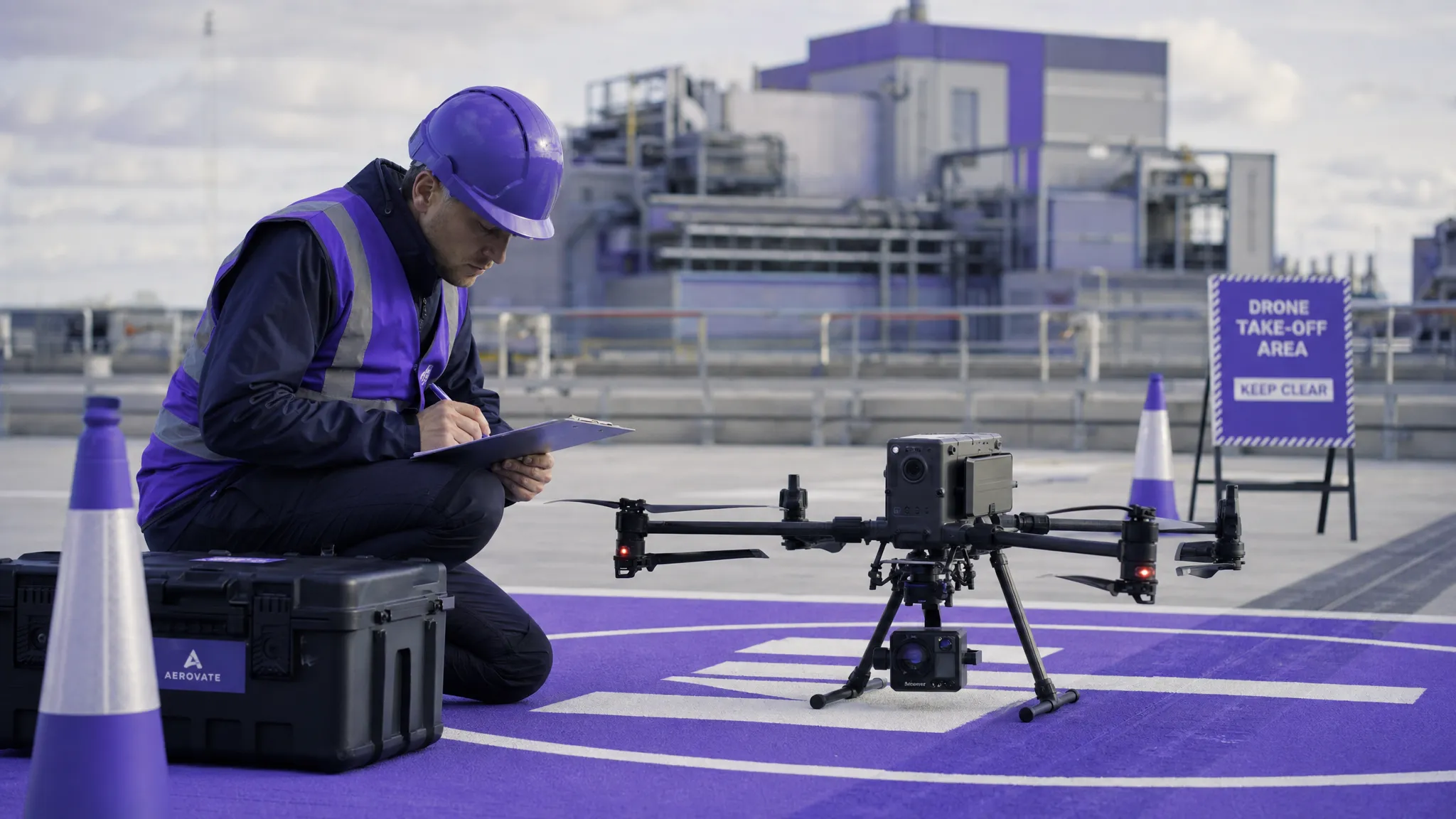
Airspace, land permission and privacy are separate checks
Business operators often focus on CAA flight rules but overlook the fact that several permissions can apply at once.
Airspace permission determines whether the flight is allowed in that part of the sky. Land permission determines whether you can take off, land or operate from a particular site. Privacy and data protection rules determine how you collect, process, store and share imagery or sensor data.
For example, a roof inspection may be outside an airport flight restriction zone and technically possible under Open category rules. You may still need permission from the landowner to launch, a safe way to manage nearby pedestrians, and a plan to avoid recording neighbouring gardens or identifiable people unnecessarily.
If your drone captures personal data, the UK GDPR and Data Protection Act 2018 may apply. The Information Commissioner’s Office provides guidance on drones and privacy that is especially relevant for operators capturing imagery in public or semi-public spaces.
Sector-specific considerations for business users
Different sectors face different operational pressures, even when the same core drone flying rules apply.
Survey companies need repeatability. Clients expect accurate outputs, but the operator must also prove that every site was assessed properly. Consistent checklists, aircraft records and flight logs help protect margins and reduce rework caused by incomplete planning.
Utility companies often operate near higher-risk environments, such as power lines, substations, roads, rail corridors, water infrastructure or remote terrain. The main challenge is rarely just flying the drone. It is coordinating access, identifying hazards, managing specialist payloads and documenting why the chosen method was safe.
Emergency services need speed and control. Drone teams may be deployed to missing person searches, incident overwatch, fire scenes or public safety events. The operational environment can change quickly, so command structure, crew roles, airspace awareness and post-flight records are critical. Dronedesk’s law enforcement case study shows how one police force approached the challenge of managing pilots, assets, documentation and compliance in an in-house drone programme.
How Dronedesk supports compliant business operations
For organisations running regular drone work, compliance becomes much harder when information is split between spreadsheets, email inboxes, mapping tools, paper checklists and separate flight logs.
Dronedesk’s drone operations management features bring key operational functions into one platform, including client management, fleet management, team management, airspace intelligence, proximity intelligence, flight planning, flight logging, data reporting, configurable checklists and risk assessments.
That matters because business compliance is not just about knowing the rules. It is about proving that the right checks were made, by the right people, for the right aircraft, at the right site, before and after each flight. For teams managing several aircraft or pilots, a structured system also makes it easier to maintain consistency as operations scale. If your organisation is growing beyond ad hoc aircraft tracking, this drone fleet management guide explains what changes when spreadsheets stop being enough.
Common mistakes that put business drone operators at risk
Many compliance problems start with reasonable but unsafe assumptions. The most common is thinking that “commercial” automatically means you need CAA authorisation for every flight, or the opposite, thinking that a small drone can be flown almost anywhere because it is lightweight.
Another frequent issue is relying on a single map check. Airspace apps are useful, but they do not replace a full assessment of the ground environment, people, property access, privacy and site-specific hazards.
Poor record keeping is also a problem. If a client asks for evidence, an insurer reviews an incident, or a regulator investigates a complaint, a professional operator should be able to show what was planned, who flew, what aircraft was used and how the risks were controlled.
Finally, rules and guidance change. Build a habit of checking the CAA’s latest material, reviewing your operations manual, refreshing pilot competency, and updating checklists when your aircraft, team or operating environment changes.
Frequently Asked Questions
Do I need a drone licence for business use in the UK? There is no single “commercial drone licence” that covers every business flight. You need the right registration, pilot competency and, where required, CAA operational authorisation for the type of operation you plan to conduct.
Can I fly a drone commercially in the Open category? Yes, if the flight meets the Open category rules. The fact that a job is paid does not automatically move it into the Specific category, but the location, aircraft, people proximity and operating method might.
How high can a business drone fly in the UK? The standard limit is generally 120 metres or 400 feet above the surface, unless you have a specific authorisation that allows a different height. Always check the current CAA rules and any airspace restrictions for the site.
Can I fly over people for a paid job? It depends on the aircraft and operating category, but you must never fly over assemblies of people in the Open category. For flights close to uninvolved people, check the exact subcategory rules or obtain the right Specific category authorisation.
Do commercial drone operators need insurance? Yes, commercial drone operations generally require suitable aviation insurance that meets the applicable UK requirements. Clients may also set their own insurance levels in contracts or procurement documents.
Who is responsible for compliance, the pilot or the company? Both can have responsibilities. The operator is responsible for managing the drone operation, while the remote pilot is responsible for safely conducting the flight. In professional teams, those responsibilities should be clearly documented.
Make drone flying rules easier to manage
Knowing the rules is only the first step. For business use, the real challenge is applying them consistently across clients, sites, pilots and aircraft.
If your team needs a clearer way to manage planning, risk assessments, checklists, flight logs, fleet records and operational evidence, Dronedesk gives drone operators a single platform for end-to-end operations management.
 FAA Part 107 Record-Keeping Rules for Commercial Teams →
 How to Review a DJI Flight Log After an Unexpected Event →
 Drone Laws Around the World: A Pre-Flight Research Framework →
 How to Compare Drone Survey Services for Complex Sites →
 How to Start a Drone Mapping Business With a Clear Workflow →
 Class C Airspace Drone Rules for Commercial Flights →
 How to Create a Drone Job Pack for Every Mission →
 FAA Small UAS Rule: Key Requirements for Operators →
 How to Build a Drone Pilot Flight Log That Is Audit Ready →
 FAA Drone Licence Requirements for Commercial Pilots →