
Canadian Drone Regulations Explained for Business Use
Canadian drone regulations are designed around the risk of the operation, not simply whether the flight is paid work. A real estate shoot, utility inspection, search-and-rescue exercise and quarry survey may all use the same aircraft, but the rules can change with airspace, proximity to people, altitude, visibility, aircraft weight and whether you can keep the drone in sight.
For businesses, the practical question is not: can we use a drone commercially? It is: which operating category applies, and can we prove that each flight was planned and flown within it?
This guide explains the main Canadian drone regulations that matter for business use, including registration, pilot certification, Basic and Advanced operations, airspace approvals, SFOCs, recordkeeping and sector-specific planning considerations. It is a practical overview, not legal advice. Always confirm the latest requirements with Transport Canada’s drone safety guidance and the current Canadian Aviation Regulations.
The big picture: Canada regulates the operation, not just the operator
Canada’s core drone rules sit mainly in Part IX of the Canadian Aviation Regulations, often called the CARs. Transport Canada uses the term RPAS, meaning remotely piloted aircraft system. For most business teams, this covers drones between 250 g and 25 kg flown within visual line of sight.
A key point for commercial operators is that Canada does not have a separate commercial drone licence in the way some people expect. Instead, you need the right pilot certificate, aircraft registration, operating category and permissions for the mission you are flying.
That means a small mapping job in uncontrolled rural airspace may be relatively straightforward, while a public safety flight near an airport, a roof inspection in a crowded urban area or a utility inspection beyond visual line of sight can trigger more demanding requirements.
The compliance mindset is simple: classify the aircraft, classify the operation, verify airspace and site restrictions, document your plan, fly within the approved conditions, then retain the records.
Step 1: classify your drone and operation
The first compliance decision is aircraft weight. The second is operational risk. Together, they tell you whether the flight is likely to fall under micro-drone rules, Basic operations, Advanced operations or a Special Flight Operations Certificate.
| Category | Typical business meaning | Core regulatory implication |
|---|---|---|
| Micro drone, under 250 g | Lightweight media capture, simple site photos, confined low-risk work | No pilot certificate or registration is normally required, but reckless or negligent operation is still prohibited |
| 250 g to 25 kg, visual line of sight | Most commercial survey, inspection, media, construction and emergency service drones | Registration and a pilot certificate are required, with Basic or Advanced rules depending on the operation |
| Over 25 kg, or outside standard rules | Heavier industrial aircraft, specialist payloads, complex operations | Often requires additional Transport Canada authorisation, commonly through an SFOC |
| Beyond visual line of sight, high-risk or unusual operations | Linear infrastructure inspection, remote emergency response, long corridor survey | May require specific authorisation or an SFOC depending on the exact operation and current rules |
Micro drones can be useful for businesses, but they are not a compliance loophole. If you use a sub-250 g drone to collect images of a client site, you still need to consider privacy, property permission, municipal rules, workplace safety and the general aviation requirement not to endanger people or aircraft.
For drones from 250 g to 25 kg, most day-to-day business planning starts with the Basic versus Advanced distinction.
Basic versus Advanced operations in Canada
Basic operations are lower-risk flights. Advanced operations are triggered when the mission moves closer to people, controlled airspace, certified airports or certified heliports.
You should treat Basic as a strict category. If your operation fails any Basic condition, it is not Basic. You then need to assess it as Advanced or consider whether further authorisation is required.
| Requirement area | Basic operation | Advanced operation |
|---|---|---|
| Airspace | Uncontrolled airspace only | May include controlled airspace with the required airspace authorisation |
| Distance from bystanders | More than 30 m horizontally from bystanders | May be within 30 m of bystanders if all Advanced requirements are met |
| Flying over bystanders | Not allowed | May be allowed if the drone and operation meet the required conditions |
| Airports and heliports | Must remain outside the prescribed distances from certified airports and certified heliports | May operate closer with the right certificate, aircraft capability and approvals |
| Pilot requirement | Basic pilot certificate | Advanced pilot certificate, including passing the required exam and flight review |
| Aircraft requirement | Registered drone, operated within the rules | Registered drone, with appropriate RPAS Safety Assurance where required |
For Basic operations, Transport Canada generally requires you to fly in uncontrolled airspace, avoid flying over bystanders, remain more than 30 m horizontally from bystanders and stay outside the prescribed distances from certified airports, military aerodromes and certified heliports.
Advanced operations include flights in controlled airspace, flights near or over people, and flights closer to certified airports or heliports. For these, the pilot needs an Advanced certificate, and the drone may need a manufacturer-declared RPAS Safety Assurance for the type of Advanced operation being conducted.
For businesses, this distinction matters at the quoting stage. A survey company may price a rural stockpile survey very differently from an urban roof survey beside a hospital heliport. A utility company may need additional spotters, access permissions and contingency planning for work near roads or substations. An emergency service may need pre-planned procedures for controlled airspace, night operations and incident command coordination.
Registration, pilot certification and aircraft requirements
If your business drone weighs 250 g or more and up to 25 kg, it must normally be registered with Transport Canada. The registration number must be clearly marked on the drone. Registration is tied to the aircraft, not simply to the pilot.
The pilot must hold the certificate required for the operation. A Basic certificate is obtained by passing the Basic exam. An Advanced certificate requires passing the Advanced exam and completing a flight review. The pilot should be able to show proof of certification when required.
For Advanced operations, aircraft suitability is especially important. Canada uses RPAS Safety Assurance declarations for certain Advanced use cases, such as controlled airspace operations, operations near people and operations over people. Do not assume that a capable commercial drone is automatically approved for every Advanced scenario. Check the manufacturer declaration and Transport Canada information before committing to the job.
Businesses should also manage maintenance and configuration carefully. Firmware versions, payload changes, repaired propellers, replacement batteries and aircraft modifications can affect operational risk. Even when a change does not create a new regulatory category, it may change your risk assessment.
Airspace, location and operational limits
Airspace is often where business drone plans succeed or fail. A site can look simple on the ground but sit under controlled airspace, near a heliport, beside a restricted zone or inside a temporary restriction.
For controlled airspace, operators typically use NAV CANADA’s tools and processes to request authorisation. The NAV CANADA drone flight planning information is a useful starting point for understanding how authorisations work in Canadian controlled airspace.
Uncontrolled airspace does not mean unregulated airspace. You still need to respect altitude limits, maintain visual line of sight, avoid aircraft, avoid creating a hazard and keep within the conditions of your certificate and operation type.
Important planning checks include the maximum altitude, usually 122 m or 400 ft above ground level unless otherwise authorised; whether the pilot can maintain visual line of sight; proximity to airports, heliports and aerodromes; NOTAMs and temporary restrictions; nearby emergency operations; local bylaws affecting take-off and landing; and permissions for private property, public land, roads, parks or critical infrastructure sites.
National parks, provincial parks and municipal land often require separate permission for drone take-off and landing. These are not always aviation rules, but they can stop a job just as quickly. Client permission is also not the same as landowner permission, so confirm who controls the site before mobilisation.
Privacy is another practical compliance issue. If a business collects identifiable images, video or other personal information, Canadian privacy laws may apply. For private-sector commercial activity, the Office of the Privacy Commissioner of Canada provides guidance on PIPEDA and personal information. Public bodies, including many emergency services, may also be subject to provincial public-sector privacy laws.
When an SFOC may be needed
A Special Flight Operations Certificate, RPAS, is used when the operation does not fit the standard rules or when Transport Canada requires a specific authorisation. For commercial teams, SFOCs are most relevant when the aircraft, environment or mission profile goes beyond routine Basic or Advanced operations.
Common triggers can include drones over 25 kg, operations above standard altitude limits, beyond visual line of sight operations that are not otherwise permitted under current rules, foreign operators, unusual operating environments, or flights that need exemptions from standard CAR requirements.
As of 2026, Canada continues to modernise RPAS rules, particularly for more complex operations such as lower-risk beyond visual line of sight work. Even so, businesses should not assume that BVLOS is routine for their specific mission. The aircraft, location, airspace, population density, detect-and-avoid arrangements, communications, crew procedures and contingency plans all matter.
If your project may need an SFOC, start early. Applications can require detailed operational descriptions, crew qualifications, risk mitigations, emergency procedures, coordination evidence and supporting documents. This is especially important for utility corridors, emergency service deployments, research operations and infrastructure projects with fixed deadlines.
Records and procedures commercial clients expect
Transport Canada requires operators to keep certain records, including records related to flights, crew and maintenance. Many organisations use the practical rule of retaining flight and crew records for at least 12 months and maintenance or modification records for at least 24 months, but you should always check the current CARs and any SFOC conditions that apply to your operation.
For business use, regulatory records are only the baseline. Clients increasingly expect a professional operations pack that shows the flight was planned, authorised, risk assessed and completed safely. That is particularly true for utilities, public agencies, construction contractors and survey clients working under their own safety management systems.
| Document or record | Why it matters for business operations |
|---|---|
| Flight plan | Shows intended location, timing, crew, aircraft, airspace and operating limits |
| Site survey | Identifies hazards such as roads, wires, public access, terrain, buildings and emergency landing areas |
| Airspace authorisation | Proves permission for controlled airspace or other required approvals |
| Pilot certificate and aircraft registration | Confirms the basic legal eligibility of the pilot and drone |
| Risk assessment | Documents hazards, likelihood, severity and mitigations before flight |
| Checklists | Creates a repeatable pre-flight, on-site and post-flight process |
| Maintenance and battery records | Helps prove aircraft airworthiness and supports incident investigation if needed |
| Flight log | Records what actually happened, not just what was planned |
| Privacy and data handling notes | Shows how imagery, personal information and client data are controlled |
A strong flight risk assessment should be practical, not a paperwork exercise. It should help the pilot decide whether to fly, delay, change the plan or add mitigations such as observers, barriers, public notices, alternative launch points or different flight paths.
An operations platform can make this easier to manage consistently. Dronedesk’s features page lists flight planning, airspace intelligence, proximity intelligence, risk assessments, configurable checklists, flight logging, fleet management, team management, client management and data reporting, all of which align with the documentation burden commercial operators face.
Sector-specific considerations for business drone use
Survey companies
Survey teams often operate in rural or semi-industrial environments, but they still need to watch for controlled airspace, nearby aerodromes, public access, roads, railways, power lines and landowner permissions. Mapping missions also involve repeat flight lines, which can increase exposure time compared with a short inspection.
If you operate multiple aircraft, pilots and payloads, spreadsheets can quickly become fragile. A structured approach to drone fleet management helps keep aircraft status, maintenance, batteries, pilots and job records under control as the operation grows.
Utility companies
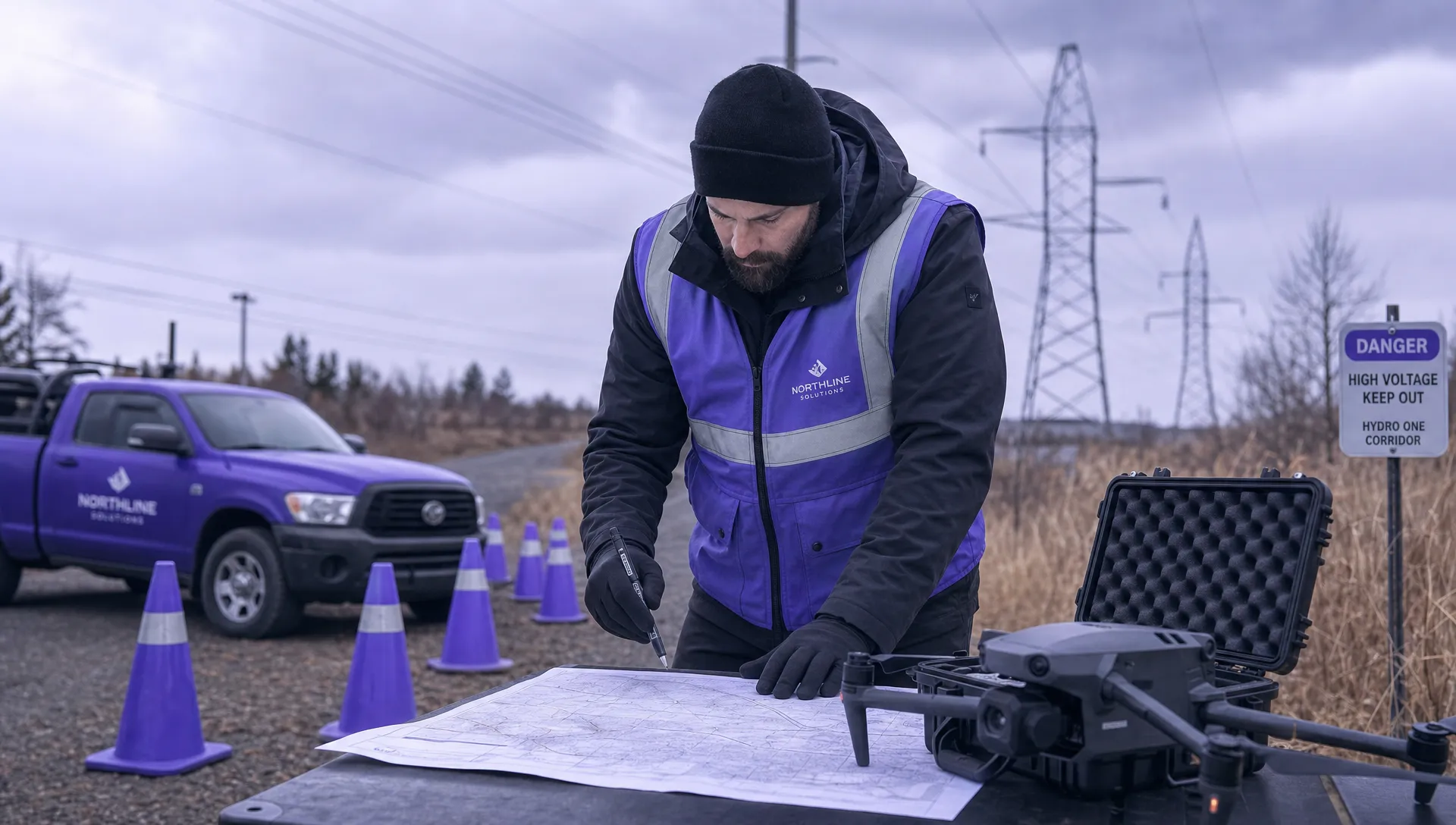
Utility work can be compliance-heavy because it often involves linear infrastructure, remote locations, substations, roads, rail corridors, critical infrastructure and sometimes beyond visual line of sight ambitions. Even a visual line of sight inspection may need careful access planning, observer placement and communications between the pilot, spotters and site personnel.
Power line, pipeline, telecoms and renewable energy inspections should also consider electromagnetic interference, emergency landing areas, land access rights, environmental restrictions and the consequences of distracting road users or workers. If a job sits close to people or controlled airspace, plan early for Advanced requirements or further authorisation.
Emergency services
Emergency services can benefit from drones during missing person searches, fire scene assessment, flood response, collision reconstruction and public order planning. However, urgent does not mean unregulated. Flights should be coordinated through the appropriate command structure and airspace process, especially where crewed aircraft, medevac helicopters, firefighting aircraft or police aviation assets may be operating.
Unauthorised drones near wildfires, disasters or emergency response areas can create serious safety risks. Emergency service drone programmes should pre-plan roles, training, authorisation pathways, data retention, privacy controls and inter-agency coordination before an incident occurs.
A practical compliance workflow for Canadian business flights
Canadian drone regulations become easier to manage when your team uses the same workflow every time. The exact detail will vary by organisation, but the sequence below works well as a commercial planning framework.
| Stage | Compliance question | Practical action |
|---|---|---|
| Enquiry | Is the job feasible under Canadian drone regulations? | Check location, aircraft, airspace, people, altitude, visibility and likely category before quoting |
| Scoping | Is it Basic, Advanced or something more complex? | Identify certificate needs, aircraft requirements, authorisations and possible SFOC triggers |
| Pre-planning | Can the flight be made safe and lawful? | Build the flight plan, risk assessment, site survey, crew plan and client permissions |
| Airspace approval | Is external authorisation required? | Submit controlled airspace or other approval requests with enough lead time |
| Pre-flight | Are conditions still within limits? | Re-check weather, NOTAMs, site access, people, aircraft status, batteries and emergency procedures |
| On-site | Is the actual environment different from the plan? | Pause and update the risk assessment if people, vehicles, aircraft or hazards change |
| Post-flight | Can you prove what happened? | Complete flight logs, maintenance notes, incident reports and client deliverable records |
| Review | What should improve next time? | Capture lessons learned, update checklists and correct recurring planning gaps |
The most mature operators treat compliance as an operational habit, not a final box-tick. A job that was compliant last month may not be compliant today if the airspace status, site access, bystander risk, aircraft configuration or crew availability has changed.
Common compliance pitfalls to avoid
Many business drone problems are not caused by pilots ignoring the rules. They are caused by assumptions made too early in the job.
- Treating uncontrolled airspace as an automatic green light, without checking altitude, bystanders, aircraft activity or local restrictions.
- Assuming a micro drone removes all business obligations, including privacy, property access and workplace safety duties.
- Planning as Basic, then arriving on site and flying within 30 m of bystanders.
- Forgetting that controlled airspace authorisation is separate from holding an Advanced pilot certificate.
- Using a drone for Advanced operations without checking its RPAS Safety Assurance status.
- Copying an old risk assessment without updating it for the actual site, crew, aircraft and weather.
- Keeping airspace approvals, checklists, maintenance notes and flight logs in separate places where they are hard to retrieve.
The cure is a repeatable planning system and a culture where pilots are expected to stop, reassess and escalate when the real-world conditions no longer match the plan.
Frequently Asked Questions
Do I need a commercial drone licence in Canada? Canada does not use a separate commercial drone licence for most standard operations. For drones from 250 g to 25 kg, you normally need a registered drone and the correct pilot certificate, Basic or Advanced, based on the operation.
Can a business fly a drone under 250 g without certification? In many cases, yes. Micro drones under 250 g generally do not need registration or a pilot certificate, but the operator must not fly recklessly or endanger aviation safety. Business users must still consider privacy, property permission, local rules and client safety requirements.
What is the difference between Basic and Advanced drone operations? Basic operations are lower-risk flights in uncontrolled airspace, away from bystanders and away from prescribed airport or heliport distances. Advanced operations cover higher-risk scenarios such as controlled airspace, proximity to people, flying over people or operating closer to certified airports and heliports.
Does an Advanced certificate let me fly in controlled airspace automatically? No. An Advanced certificate is only one requirement. You still need the appropriate airspace authorisation, and your drone must be suitable for the Advanced operation you plan to conduct.
When does a business need an SFOC in Canada? An SFOC may be needed when the operation falls outside standard rules, such as certain BVLOS missions, drones over 25 kg, flights above normal altitude limits, foreign operations or other complex scenarios. Check Transport Canada requirements before planning or quoting the work.
What records should commercial drone operators keep? At minimum, keep records of flights, crew, aircraft registration, pilot certification, maintenance, modifications and repairs as required by the CARs. For professional work, also retain flight plans, risk assessments, checklists, airspace approvals, site permissions and incident notes.
Build compliance into every flight
Canadian drone regulations are manageable when they are built into your operating process from the start. For business users, the goal is not just to get airborne. It is to show that every flight was properly categorised, authorised, risk assessed, flown and recorded.
If your team wants one place to organise the documentation and workflows discussed above, Dronedesk is built for drone operations management and flight planning. It does not replace Transport Canada approvals or professional legal advice, but it can help commercial drone teams run a more consistent process before, during and after each flight.
 How to Review a DJI Flight Log After an Unexpected Event →
 Drone Laws Around the World: A Pre-Flight Research Framework →
 How to Compare Drone Survey Services for Complex Sites →
 How to Start a Drone Mapping Business With a Clear Workflow →
 Class C Airspace Drone Rules for Commercial Flights →
 How to Create a Drone Job Pack for Every Mission →
 FAA Small UAS Rule: Key Requirements for Operators →
 How to Build a Drone Pilot Flight Log That Is Audit Ready →
 FAA Drone Licence Requirements for Commercial Pilots →
 FAA BVLOS Waivers Granted: What Successful Cases Show →