
AUS Drone Laws Explained for Commercial Operators
If you operate drones for surveys, inspections, mapping, emergency response or media work in Australia, the legal question is rarely just, “Can I fly here?” It is usually, “Which operating category am I in, what credentials do I need, and what evidence should I keep?”
That is why AUS drone laws can feel confusing. A 249 g drone flown for a quick roof inspection, a 1.5 kg mapping drone used on a construction site and a larger aircraft used for utility corridor inspections may all be commercial operations, but they can sit in very different regulatory pathways.
In Australia, the Civil Aviation Safety Authority, known as CASA, regulates drone operations under the remotely piloted aircraft system. This guide explains the practical rules commercial operators need to understand, including registration, accreditation, RePL and ReOC requirements, standard operating conditions, airspace checks and risk assessment expectations.
This is a practical overview, not legal advice. Always check the latest CASA drone rules and any job-specific approvals before flying.
Who regulates commercial drone operations in Australia?
CASA is the national aviation safety regulator responsible for drone rules in Australia. In CASA terminology, drones are generally referred to as remotely piloted aircraft, or RPA, and commercial drone operations are regulated under Part 101 of the Civil Aviation Safety Regulations.
For a commercial operator, the key point is that CASA looks at more than whether you were paid directly for a flight. A flight may be commercial if it is carried out for hire or reward, for a business, for an employer, for a government agency or as part of your work duties. That can include:
- A survey company collecting site imagery for a client.
- A utility company inspecting poles, substations, pipelines or transmission corridors.
- A local authority or emergency service using a drone operationally.
- A construction firm using a drone to monitor progress.
- A real estate, agriculture, insurance or media business using aerial data.
CASA is not the only organisation you may need to consider. Airservices Australia, Defence, national parks, local councils, landholders, police, privacy regulators and workplace safety authorities can all affect whether a job is lawful and operationally acceptable.
The four questions that determine your compliance pathway
Before you decide whether you need a licence, certificate or approval, work through four questions.
First, what does the aircraft weigh? CASA distinguishes between micro, very small, small, medium and larger RPA categories. Weight has a direct effect on whether you may be able to fly under an excluded category or whether a Remote Pilot Licence, known as a RePL, and a remotely piloted aircraft operator's certificate, known as a ReOC, are required.
Second, what is the purpose of the flight? Recreational rules are different from work, business and government operations. If the flight supports a commercial activity, treat it as a commercial operation even if the drone is small.
Third, where is the flight taking place? Controlled airspace, nearby aerodromes, helicopter landing sites, restricted areas, emergency incidents, populous areas and sensitive infrastructure can all trigger limits or approval requirements.
Fourth, what is the flight profile? Standard visual line of sight, daytime work below 120 m above ground level is very different from night operations, beyond visual line of sight work, operations near people or flights over populous areas.
Commercial operating pathways under Australian drone laws
For many operators, the biggest distinction is between excluded category work and operations that require a RePL and ReOC. Excluded category operations are lower-risk commercial operations that can be conducted without a RePL or ReOC, provided CASA's conditions are met.
| Commercial pathway | Typical use case | Main compliance requirements |
|---|---|---|
| Micro RPA, 250 g or less | Low-risk commercial imagery or simple site documentation | Follow CASA's standard drone safety rules. Commercial registration requirements still need to be checked and followed for business use. |
| Very small RPA, more than 250 g up to 2 kg | Many small mapping, inspection and photography jobs | Usually eligible for excluded category operations if flown within standard conditions. You need an Aviation Reference Number, drone registration, operator accreditation where applicable and CASA notification before operating. |
| Private landholder operations up to 25 kg | Limited work over your own land, such as certain agricultural or land-management tasks | May be allowed under landholder excluded category conditions. This is not a general permission to conduct paid work for others. |
| Commercial operations outside excluded category | Larger drones, non-standard locations, night, BVLOS, higher-risk work or operations for third parties with heavier aircraft | Usually require a RePL for the remote pilot and operation under a ReOC, plus any relevant CASA approvals. |
| Specialist or higher-risk operations | BVLOS, operations near controlled aerodromes, over populous areas, complex emergency response or advanced utility work | Require specific planning, authorisations and a stronger safety case. |
The excluded category is useful, but it is not a loophole. It is a tightly defined pathway. If your operation falls outside its limits, for example because of aircraft weight, location, proximity to people or flight profile, you need to move into the appropriate certified pathway.
The standard operating conditions commercial teams must build around
Many commercial drone jobs in Australia are planned around CASA's standard operating conditions. These are the baseline rules that lower-risk operators are expected to follow unless they hold a specific approval.
In practical terms, you should plan around these core requirements:
- Fly no higher than 120 m, or 400 ft, above ground level.
- Keep the drone within visual line of sight, not just visible on a screen.
- Fly only during the day unless you have the required authorisation.
- Keep at least 30 m away from people who are not directly involved in the operation.
- Do not fly over people.
- Do not fly over a populous area if a failure could create an unreasonable risk to people or property.
- Operate only one drone at a time per remote pilot.
- Do not create a hazard to another aircraft, person or property.
- Do not fly near emergency operations unless you are part of the response and have the appropriate permission.
The 30 m rule is a common source of mistakes. It is not just about avoiding crowds. On a construction site, for example, workers, contractors, pedestrians and vehicle drivers may all be uninvolved people unless they have been briefed and are under the control of the operation.
The “populous area” rule is also broader than many operators expect. A location does not need to look like a packed city centre to be problematic. If a drone failure could reasonably put people or property at risk, the area may be considered populous for that operation.
Registration, accreditation, RePL and ReOC explained
Most commercial operators need to understand four CASA terms: ARN, registration, accreditation and certification.
An Aviation Reference Number, or ARN, is the identifier CASA uses for individuals and organisations. Commercial operators often need an individual ARN for pilots and an organisation ARN for the business or agency.
Drone registration applies to drones flown for business or as part of your job. CASA's drone registration guidance explains which aircraft must be registered, how registration works and how long it remains valid. Do not assume a small drone is automatically outside the registration framework if it is used commercially.
Operator accreditation is CASA's online competency pathway for certain excluded category operations. It is not the same as a RePL. It is designed for lower-risk commercial drone work where a full remote pilot licence and operator certificate are not required. CASA's operator accreditation information sets out who needs accreditation and when it applies.
A RePL is a remote pilot licence. A ReOC is the organisation-level certificate that allows a business or agency to conduct more complex commercial RPA operations. If you are flying outside excluded category limits, you will usually need a RePL and to operate under a ReOC.
For excluded category work, you must also notify CASA before you start operating. That notification is not an approval to ignore the standard conditions. It is a formal notice that you intend to conduct eligible excluded category operations.
Airspace checks are not optional
Airspace is one of the most important parts of commercial drone planning in Australia. A job that is legal in an open rural paddock can require a very different process if it sits near a controlled aerodrome, hospital helipad, military area, restricted airspace or emergency incident.
For drones over 250 g, flying within 5.5 km of a controlled aerodrome is restricted unless you have the proper authorisation. Around non-controlled aerodromes and helicopter landing sites, you must take particular care. If you become aware of crewed aircraft operating to or from the site, you must not create a hazard and may need to land or move away safely.
Commercial operators should also check for prohibited, restricted and danger areas, temporary restrictions, NOTAMs, nearby emergency activity, sensitive infrastructure, local council rules and land access requirements. CASA also points operators towards drone safety apps to help identify airspace and location-based constraints.
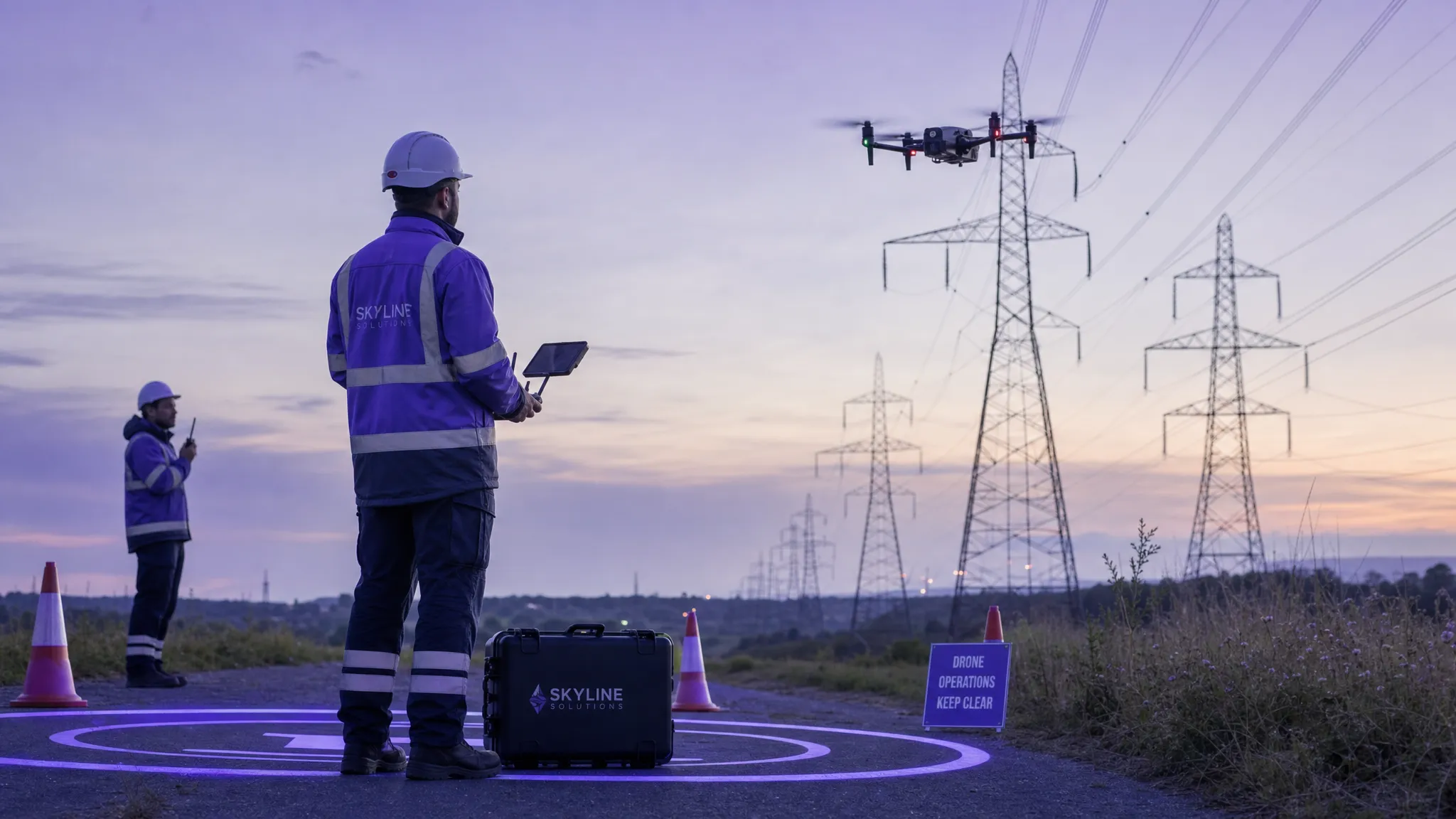
For teams managing repeatable operations, the challenge is turning those checks into a consistent workflow. Dronedesk includes airspace intelligence, proximity intelligence, flight planning, flight logging, configurable checklists and risk assessments, all described on the Dronedesk features page, so operators can bring key planning and record-keeping tasks into one operational process.
Risk assessments need to be job-specific
Australian drone compliance is not just about ticking a legal box. CASA expects operators to manage aviation safety risk, and commercial clients increasingly expect evidence that the operator has thought through the site, the aircraft, the people and the emergency procedures.
A useful drone risk assessment should consider the actual conditions of the job, not just a generic template. For example, a roof inspection beside a school, a bridge survey over a road and a utility inspection near a rural airstrip all present different hazards.
At minimum, your risk assessment should address aircraft suitability, pilot competency, weather, launch and recovery areas, bystanders, road and pedestrian interfaces, airspace, communications, battery management, lost link behaviour, emergency landing options and incident response.
If your current process is inconsistent, the Dronedesk guide on building a drone flight risk assessment that works is a useful next step for turning risk thinking into a repeatable operational document.
Common commercial scenarios and the legal pressure points
The rules become clearer when you apply them to real operational scenarios.
| Scenario | Main legal and operational pressure points |
|---|---|
| Construction progress mapping | Confirm excluded category eligibility, maintain separation from workers, manage take-off areas, check cranes, dust, site traffic and airspace. |
| Utility line or pipeline inspection | Watch for BVLOS temptation, road crossings, land access, helicopters, emergency landing options and critical infrastructure requirements. |
| Roof or facade inspection in a town | Assess 30 m separation, overflight of people, populous area risk, privacy, council rules and property access. |
| Emergency services deployment | Coordinate with the incident controller, avoid conflicting aircraft, document authority to operate and do not fly near emergency activity unless authorised. |
| Night thermal inspection | Standard conditions do not permit ordinary night flight, so check whether your pilot and organisation hold the required permissions. |
| Work near an airport or helipad | Check controlled airspace, 5.5 km restrictions, approach and departure paths, local procedures and authorisation requirements. |
| BVLOS corridor inspection | Expect a much more detailed CASA approval process, safety case, detect-and-avoid strategy and operational controls. |
For survey companies and utilities in particular, BVLOS can look attractive because linear assets are often long, remote and repetitive. But BVLOS is not simply an efficiency upgrade. It changes the safety case because the remote pilot can no longer rely on unaided visual observation of the aircraft and surrounding airspace.
Privacy, data protection and local restrictions still matter
CASA's role is aviation safety. It does not give you a general right to film, photograph, survey or access land. Commercial operators must also consider privacy, surveillance, data handling, workplace safety, trespass and contractual obligations.
In Australia, privacy obligations can arise under federal privacy law, state and territory surveillance devices legislation, workplace policies and client requirements. For example, imagery captured for an asset inspection may also include homes, vehicles, number plates, staff, members of the public or sensitive infrastructure.
Good practice is to collect only what the job requires, brief the client on data use, secure the imagery, limit access, define retention periods and have a clear process for handling complaints or incidental capture. These controls are especially important for government agencies, emergency services, utilities and any operator working around critical infrastructure.
Local rules matter too. National parks, councils, port authorities, mining sites, rail corridors and private landholders may impose their own permission requirements. CASA approval to fly does not automatically grant land access or site permission.
A pre-flight compliance checklist for commercial operators
Before each commercial flight, your team should be able to answer these questions clearly:
- Is the flight commercial, government, work-related or recreational?
- What is the drone's weight category and is it registered if required?
- Are the pilot's credentials suitable for the operation?
- Is the operation genuinely within excluded category limits, or does it require a RePL, ReOC or further CASA approval?
- Has CASA notification been completed if operating in the excluded category?
- Is the planned flight within standard operating conditions?
- Have airspace, aerodromes, helipads, restricted areas, emergency activity and NOTAMs been checked?
- Can 30 m separation from uninvolved people be maintained throughout the flight?
- Is the area potentially populous if the aircraft fails?
- Are landholder, council, client and site permissions in place?
- Has a job-specific risk assessment been completed and briefed to the crew?
- Are emergency procedures, communications and landing areas understood?
- Will the flight, maintenance and any incidents be logged after the job?
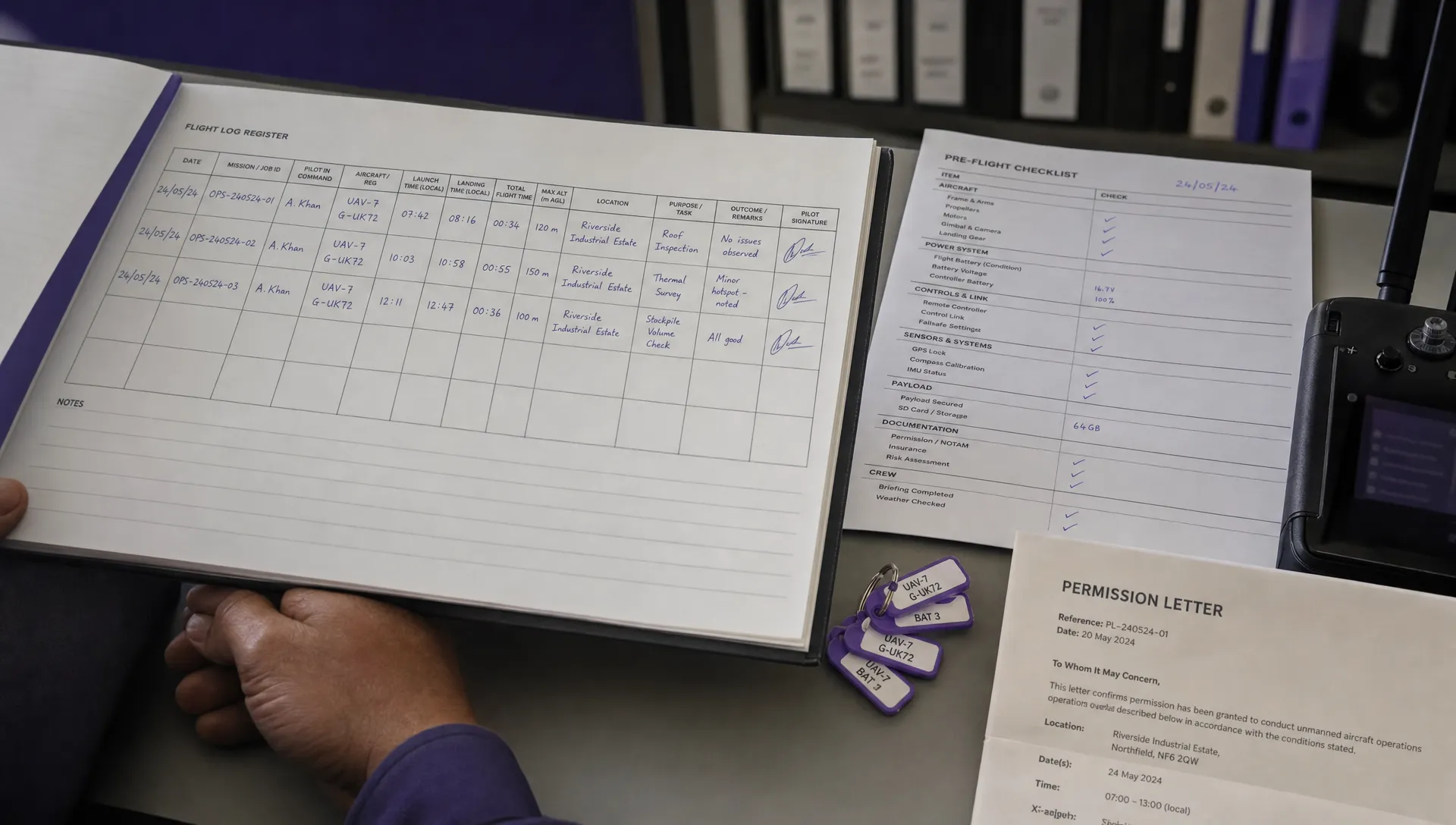
The final point is often overlooked. Flight logs, maintenance records, pilot currency, battery records and risk assessments are not just admin. They are the evidence trail that shows your operation is controlled and repeatable.
What changes when your drone operation scales?
A solo operator with one sub-2 kg aircraft can often keep track of requirements manually, at least at the start. The compliance burden grows quickly when you add multiple pilots, aircraft, clients, sites and recurring missions.
At that point, the issue is not just knowing the law. It is making sure each job follows the same standard, each aircraft is fit to fly, each pilot is current, each risk assessment is suitable and each flight is logged. Survey companies, utilities and emergency services often need auditable processes because drone work becomes part of a broader operational, safety or procurement framework.
If your operation is reaching that stage, a structured approach to fleet, maintenance and record management becomes essential. The Dronedesk drone fleet management guide explains how operators can think about aircraft, pilots, maintenance, compliance records and software as their programme matures.
Frequently asked questions
Do I need a licence to fly a drone commercially in Australia? Not always. Some lower-risk commercial operations can be flown in the excluded category without a RePL or ReOC, but you must meet CASA's conditions. If the operation falls outside those limits, you will generally need a RePL and to operate under a ReOC.
Can I fly a drone under 2 kg for business without a ReOC? Often yes, if it is an eligible excluded category operation and you comply with standard operating conditions, registration, accreditation and CASA notification requirements. The weight alone is not enough. Location and flight profile still matter.
Do commercial drones need to be registered in Australia? Drones flown for business or as part of your job generally need to be registered with CASA. Check CASA's current registration rules for the aircraft weight, operator type and validity period before flying.
Can commercial operators fly at night in Australia? Standard operating conditions are daytime only. Night operations require the appropriate permissions, procedures and pilot or operator capability. Do not treat night work as a normal excluded category flight unless CASA's rules specifically allow your scenario.
Can I fly BVLOS for inspections or surveys? BVLOS operations require specific approval and a much stronger safety case. They are common goals for utility and infrastructure operators, but they are not covered by ordinary standard operating conditions.
Does CASA approval override council, park or landholder rules? No. CASA regulates aviation safety, but you may still need land access, council permission, national park approval, client authorisation or other site-specific consent.
Is drone insurance mandatory for commercial operators? CASA does not impose a blanket public liability insurance requirement for every drone operation, but many clients, landholders, councils and procurement frameworks require it. Commercial operators should treat insurance as a normal business risk consideration.
Turn Australian drone rules into a repeatable workflow
AUS drone laws are manageable when you break them into aircraft category, pilot credentials, operator approvals, airspace, site risk and records. The harder part is applying those checks consistently across every job, especially as your team, fleet and client base grow.
Dronedesk helps drone operators manage the operational side of compliance with tools for client management, fleet management, team management, airspace and proximity intelligence, flight planning, flight logging, data reporting, configurable checklists and risk assessments.
If you are building or scaling a commercial drone operation, visit Dronedesk to see how a dedicated drone operations management platform can support safer, more organised flight planning and record keeping.
 FAA 107 License vs Part 107 Certificate: What’s the Difference? →
 FAA Part 107 Record-Keeping Rules for Commercial Teams →
 How to Review a DJI Flight Log After an Unexpected Event →
 Drone Laws Around the World: A Pre-Flight Research Framework →
 How to Compare Drone Survey Services for Complex Sites →
 How to Start a Drone Mapping Business With a Clear Workflow →
 Class C Airspace Drone Rules for Commercial Flights →
 How to Create a Drone Job Pack for Every Mission →
 FAA Small UAS Rule: Key Requirements for Operators →
 How to Build a Drone Pilot Flight Log That Is Audit Ready →