
FAA UAS Rules Explained for Commercial Pilots
If you fly a drone for a client, employer, inspection programme, utility network or emergency response agency in US airspace, the FAA treats that mission differently from a purely recreational flight. The main rulebook for most small commercial drone work is 14 CFR Part 107, often called the small UAS rule.
The key point is simple: Part 107 is not just a pilot test. It governs who may fly, what aircraft may be used, where the flight can happen, how close you can get to people and traffic, and what approvals you need when the mission falls outside standard limits.
This guide explains FAA UAS rules in practical language for commercial pilots. It is written for operators who need to plan real missions, not just pass an exam. Always verify the latest requirements directly with the FAA before flying, especially for waivers, airspace authorisations and emerging BVLOS rules.
Which FAA rules apply to commercial drone pilots?
For most commercial pilots, the starting point is Part 107. It applies to small unmanned aircraft systems that weigh less than 55 lb, including payload, and are flown for a non-recreational purpose. That includes paid work, but it also includes internal business use, such as a construction company surveying its own site or a utility team inspecting its own assets.
Part 107 commonly covers missions such as aerial photography, mapping, roof inspections, public safety support, infrastructure monitoring, real estate media, environmental surveys and many routine training flights.
However, Part 107 is not the only FAA pathway. Some operations require extra approvals or a different regulatory basis. Examples include drones weighing 55 lb or more, BVLOS flights, certain delivery operations, agricultural spraying, and public aircraft operations by eligible government agencies. Public safety organisations, for instance, may fly under Part 107 for many missions or use a Certificate of Waiver or Authorisation, often called a COA, where appropriate.
The practical question before every mission is not just whether you are a qualified drone pilot. It is whether the specific aircraft, location, flight profile, crew setup and client requirement all fit within the rule you plan to use.
Part 107 essentials at a glance
The FAA publishes a commercial drone overview on its Part 107 commercial operators page, but pilots need to translate those requirements into field decisions. The table below summarises the rules most likely to affect daily commercial operations.
| Topic | Core FAA requirement | Practical meaning for commercial pilots |
|---|---|---|
| Pilot qualification | A Remote Pilot Certificate with a small UAS rating is required, or the aircraft must be flown under the direct supervision of someone who has one. | Every mission needs a clearly assigned remote pilot in command. |
| Aircraft size | Part 107 covers small UAS under 55 lb including payload. | Heavier aircraft need a different FAA approval route. |
| Registration | Drones used under Part 107 must be registered and marked. | Even very light drones used commercially generally need FAA registration. |
| Remote ID | Most registered drones must broadcast Remote ID information. | Check the aircraft or broadcast module before leaving for site. |
| Visual line of sight | The drone must remain within unaided visual line of sight unless a waiver or other approval allows otherwise. | Binoculars, FPV feed or a map screen do not replace VLOS. |
| Altitude and speed | Standard limits include 400 ft AGL, or within 400 ft of a structure, and 100 mph groundspeed. | Tall-structure work still needs careful airspace and risk review. |
| Airspace | Controlled airspace requires FAA authorisation. | LAANC or DroneZone approval is needed before flying in many Class B, C, D and surface Class E areas. |
| Weather | Minimum flight visibility is 3 statute miles, with cloud clearance requirements. | Poor visibility can make a technically simple job non-compliant. |
| Night operations | Night flight is allowed if the pilot is qualified under current training rules and the drone has compliant anti-collision lighting. | Night work is routine for some teams, but it still needs planning and lighting checks. |
| People and vehicles | Operations over people and moving vehicles are limited unless the aircraft and operation meet specific categories or an approval applies. | Do not assume a small drone can fly over a crowd or road traffic. |
| Accidents | Certain serious injuries and property damage above the FAA threshold must be reported within 10 days. | Incident reporting procedures should be part of your operations manual. |
Remote Pilot Certificate: what it really means
A Remote Pilot Certificate is the FAA credential that allows a person to act as remote pilot in command under Part 107. For most new pilots, earning it means passing the FAA aeronautical knowledge test. Once certificated, the pilot must keep current through FAA recurrent training every 24 calendar months.
The remote pilot in command, often shortened to RPIC, is responsible for the safety and legality of the flight. That responsibility is broader than manipulating the sticks. The RPIC must make sure the aircraft is safe to fly, the crew understands the mission, the operating area is suitable, and the flight can be conducted without creating an undue hazard.
A non-certificated person may manipulate the controls only if they are under the direct supervision of a certificated RPIC who can immediately take control. This can be useful for training or specialist payload work, but it does not transfer accountability away from the RPIC.
Commercial teams should define the RPIC before the job starts, particularly where there are multiple pilots, observers, payload operators or client representatives on site. Ambiguity in the field is a common source of compliance gaps.
Aircraft registration, marking and Remote ID
Every drone used under Part 107 must be registered with the FAA, and the registration number must be displayed on the aircraft. Unlike recreational flying, using a sub-250 g drone for a business task does not generally remove the registration requirement.
Remote ID is also now a core part of FAA UAS rules. In simple terms, Remote ID is a digital licence plate for drones. It broadcasts identification and location information so authorised parties can understand which drone is operating in the area.
A commercial pilot will usually comply through one of two routes. The first is a Standard Remote ID drone, where the capability is built into the aircraft. The second is an FAA-compliant broadcast module attached to the aircraft. If using a broadcast module, check the FAA limitations that apply, including the VLOS requirement.
The FAA explains the rule on its Remote ID page. For operators with mixed fleets, Remote ID should be treated as a dispatch item, just like batteries, propellers and firmware. The aircraft registration, Remote ID serial number and actual aircraft on site should all match your records.
Operating limits that shape the mission
The standard Part 107 operating limits are designed to keep small drones separated from crewed aircraft and reduce risk to people on the ground. They are also the limits most likely to collide with client expectations.
The altitude rule is often misunderstood. In general, Part 107 flights are limited to 400 ft above ground level. There is an important structure allowance: you may operate above 400 ft AGL if you remain within 400 ft of a structure and do not fly higher than 400 ft above the structure’s uppermost limit. This matters for tower inspections, bridge work and industrial sites, but it is not a free pass to climb without considering airspace, visibility and hazards.
VLOS is another core requirement. The drone must remain close enough for the required crew to see it with unaided vision, apart from corrective lenses. A live camera feed helps with framing and inspection detail, but it does not satisfy VLOS on its own. If the mission requires the drone to go beyond visual range, you are in waiver or special authorisation territory.
Weather minimums are also binding. Part 107 requires at least 3 statute miles of flight visibility from the control station, plus cloud clearance of at least 500 ft below and 2,000 ft horizontally. For survey and utility work, marginal weather can also degrade data quality, GNSS performance, battery margins and emergency landing options.
Night operations are permitted under Part 107 when the pilot has completed the required training and the drone has anti-collision lighting visible for at least 3 statute miles. A night mission should still include a specific risk assessment covering depth perception, obstacle detection, crew positioning, lighting spill, public interaction and emergency recovery.
Airspace authorisation: LAANC, DroneZone and restrictions
Having a Remote Pilot Certificate does not give you automatic permission to fly anywhere. If your operation is in controlled airspace, you need FAA authorisation before launch. Many authorisations can be requested through LAANC, the Low Altitude Authorisation and Notification Capability, which provides near real-time approvals at participating airports and within published grid limits.
For operations that fall outside LAANC availability or published grid values, pilots may need to apply through FAA DroneZone. These requests can take longer, so they should be built into the job timeline rather than left to the morning of the flight. The FAA provides more detail through its LAANC information.
Airspace planning should also include Temporary Flight Restrictions, special use airspace, stadium restrictions, emergency response restrictions, national security UAS restrictions and local site constraints. The FAA controls the airspace, but landowners and agencies may control where you can take off, land or operate from. National parks, critical infrastructure sites, prisons, ports and emergency scenes may involve additional permissions or prohibitions.
For emergency services and infrastructure operators, airspace coordination can change quickly. A wildfire, police incident, medevac operation or disaster response can make yesterday’s plan unsuitable today. Build a final airspace check into your pre-flight workflow, even for familiar sites.
Operations over people, vehicles and sensitive sites
Commercial clients often want imagery where people, roads or public areas are present. Part 107 does allow some operations over people, but only when the aircraft and operation meet the relevant rule category or when the FAA has granted an applicable waiver.
| Operation category | Typical use case | Key caution |
|---|---|---|
| Category 1 | Very light aircraft under 0.55 lb, including everything attached. | No exposed rotating parts that can lacerate skin, and additional Remote ID conditions apply for sustained flight over open-air assemblies. |
| Category 2 | Aircraft designed and declared to meet FAA injury severity requirements. | Requires an FAA-accepted means of compliance and declaration of compliance. |
| Category 3 | Limited operations over people with tighter restrictions. | Not suitable for unrestricted flight over crowds. |
| Category 4 | Aircraft with an airworthiness certificate. | Must be operated within the approved limitations. |
Do not rely on weight alone. A small aircraft can still be non-compliant if it has exposed rotating parts, lacks the required declaration, or is flown in a way the category does not permit.
Operations over moving vehicles have separate restrictions. In many cases, a drone may only transit over vehicles briefly or operate within a closed or restricted access site where people have been notified. This is especially important for road surveys, traffic monitoring, accident reconstruction and utility work along highways.
Sensitive sites add another layer. A power substation, rail corridor, refinery or emergency incident may be legal from an airspace perspective but still require landowner permission, security coordination, radio discipline or a formal method statement. Professional compliance is not just about avoiding an FAA violation. It is about proving that the mission was planned, briefed and controlled.
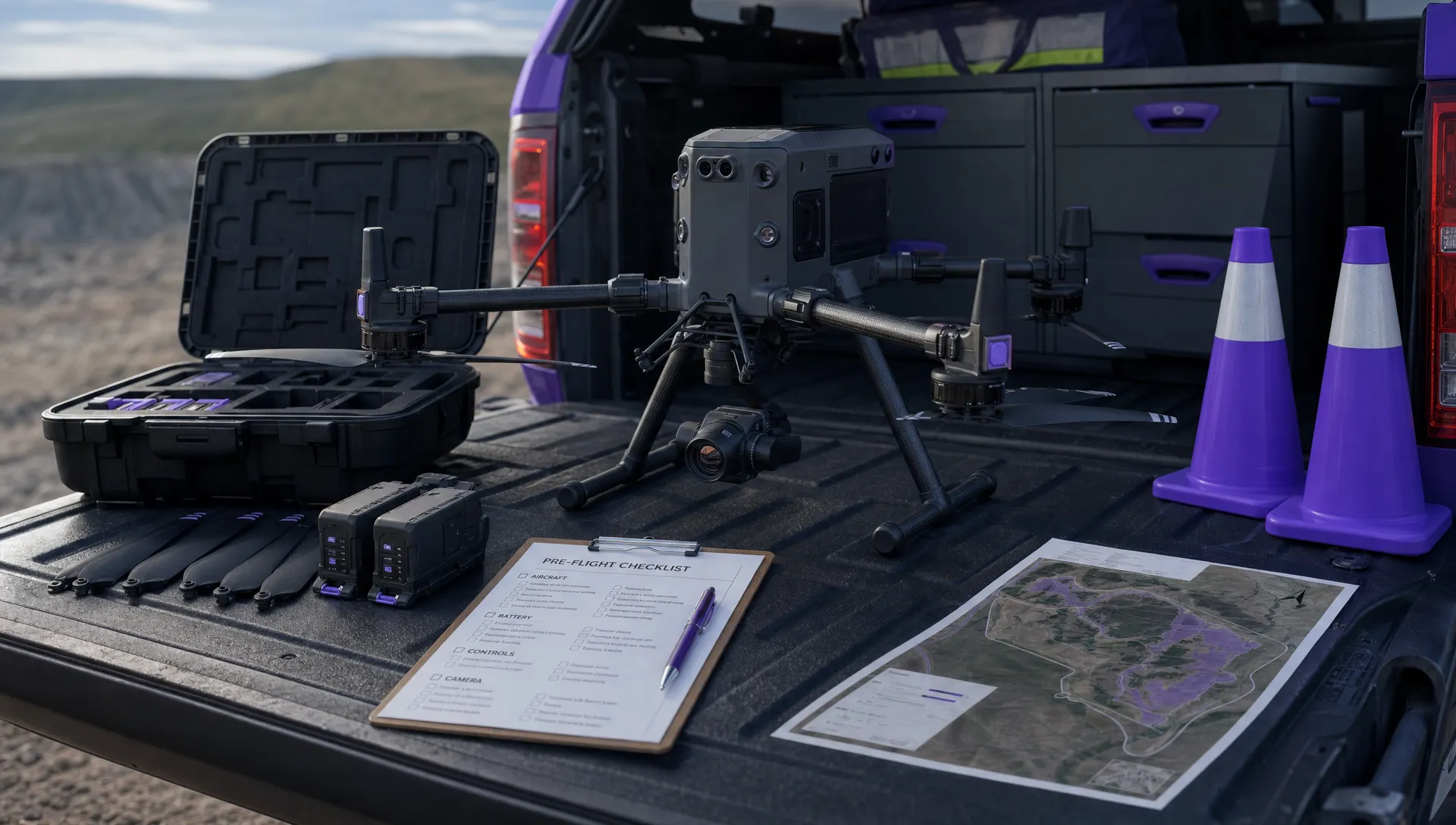
BVLOS, waivers and special operations
Beyond visual line of sight is one of the most important growth areas in commercial drone operations. It is also one of the easiest areas to oversimplify. Under standard Part 107 rules, VLOS is required. If the aircraft will fly beyond the visual range of the remote pilot and required crew, the operator needs an FAA waiver or another valid approval path.
A strong waiver application is not just a request for permission. It must explain how the operator will manage the risk normally controlled by the rule being waived. For BVLOS, that usually means addressing detect-and-avoid capability, command and control link reliability, contingency procedures, lost link behaviour, airspace coordination, crew training and operational boundaries.
If you are exploring this area, it is worth understanding the operational concept before thinking about technology. This primer on how beyond visual line of sight drone operations work gives useful context for teams planning future inspection, public safety or network-scale missions.
Other mission types may also sit outside routine Part 107. Agricultural spraying can trigger Part 137 requirements and state-level pesticide rules. Some delivery operations may require air carrier certification or exemptions. Drones over 55 lb need a different route altogether. The safest assumption is that if the mission looks unusual, heavy, automated, BVLOS, hazardous or passenger-like in its risk profile, you should check whether Part 107 alone is enough.
Documentation and risk assessment for commercial teams
Part 107 does not require every routine commercial flight to be submitted to the FAA in advance, but it does place responsibility on the operator to conduct safe operations. In practice, clients, insurers, procurement teams and regulators may all expect evidence that the flight was properly planned.
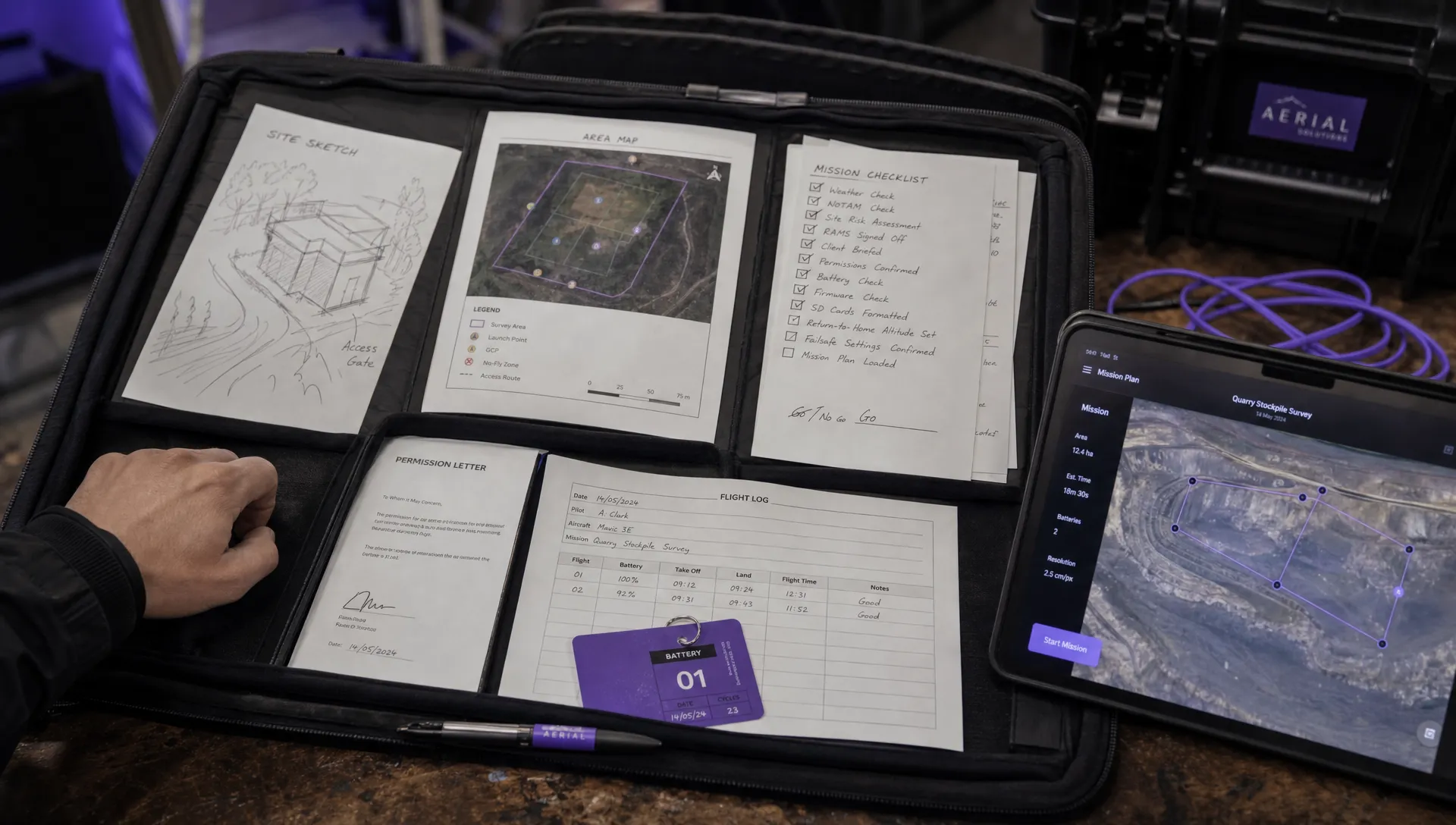
Good documentation should connect the rule to the mission. A flight log with no site risk assessment tells only part of the story. A risk assessment with no record of aircraft condition, crew roles or airspace approval also leaves gaps.
Commercial operators should consider keeping records such as:
- Remote Pilot Certificate details and recurrent training currency.
- Aircraft registration, Remote ID status, maintenance and battery records.
- Airspace checks, LAANC approvals, waiver documents and site permissions.
- Pre-flight risk assessments, crew briefings and emergency procedures.
- Flight logs, incident notes, client requirements and deliverables.
For a deeper look at the risk side, see this guide on how to build a drone flight risk assessment that works. The goal is not to create paperwork for its own sake. It is to make sure foreseeable hazards are identified before take-off and that the crew can explain the decisions made.
For commercial teams that want one operations system, Dronedesk’s features include client management, fleet management, team management, airspace intelligence, proximity intelligence, flight planning, flight logging, data reporting, configurable checklists and risk assessments. That combination is useful when a mission involves multiple aircraft, pilots, sites and approvals, because the operational record stays tied to the job.
Common FAA compliance mistakes commercial pilots should avoid
Many Part 107 issues are not caused by reckless flying. They happen because a team treats one approval as if it covers the whole mission, or because a small change on site is not rechecked against the rules.
Common mistakes include:
- Treating LAANC as permission to ignore people, vehicles, property access or client site rules.
- Assuming a camera feed or visual observer automatically allows BVLOS.
- Flying over people because the drone is small, without checking the Part 107 operation category.
- Forgetting that Remote ID applies to the aircraft actually being flown, not just the fleet in general.
- Launching in Class G airspace without checking TFRs, stadium restrictions or nearby emergency activity.
- Failing to define who is RPIC when several qualified pilots are present.
- Not recording maintenance defects, battery issues, aborted flights or incidents.
A good rule of thumb is to ask whether you could explain the mission to an FAA inspector, client safety manager or insurer after the event. If the answer depends on memory rather than records, your process is probably too fragile.
A practical pre-flight workflow for Part 107 missions
A repeatable workflow helps commercial pilots turn FAA UAS rules into everyday habits. The details will vary by mission, but the sequence below works for many survey, inspection, public safety and media operations.
- Confirm that Part 107 is the correct regulatory basis for the mission.
- Assign the RPIC, visual observers and any payload or safety roles.
- Verify aircraft registration, Remote ID status, maintenance condition, firmware, batteries and payload configuration.
- Check airspace, LAANC or DroneZone authorisation, TFRs, special restrictions and local take-off or landing permissions.
- Assess site hazards, including people, vehicles, obstacles, electromagnetic interference, wildlife, weather and emergency landing zones.
- Confirm operating limits for altitude, VLOS, visibility, cloud clearance, night lighting and proximity to non-participants.
- Brief the crew on the plan, abort criteria, lost link actions, communication signals and emergency procedures.
- Fly the mission, log the flight and retain the records needed to demonstrate safe and compliant operation.
This workflow is deliberately plain. The best compliance process is one that pilots actually use under time pressure, not a document that stays in the office.
Frequently Asked Questions
Is Part 107 the same as a drone licence? Part 107 is the FAA rule for most small commercial drone operations. The Remote Pilot Certificate is the pilot qualification issued under that rule. You need both the right certificate and a mission that fits the Part 107 operating limits, unless another approval applies.
Can commercial drone pilots fly at night under FAA rules? Yes, Part 107 allows night operations when the remote pilot has completed the required training and the drone has anti-collision lighting visible for at least 3 statute miles. The mission still needs normal airspace approval, VLOS and risk controls.
Do I need LAANC to fly in Class G airspace? No, LAANC is for FAA authorisation in controlled airspace. However, Class G does not mean unrestricted. You still need to check for TFRs, special restrictions, landowner permissions, people, vehicles and other hazards.
Can I fly over people during a commercial drone job? Only if the aircraft and operation meet the relevant Part 107 operations-over-people category, or if you have an applicable FAA waiver or approval. A small drone is not automatically approved for flight over crowds.
What if my client wants a BVLOS inspection? Standard Part 107 requires visual line of sight. A BVLOS mission needs an FAA waiver or another valid approval route. Build extra time into the project plan for the application, safety case and operational procedures.
Are FAA UAS rules the same as UK drone rules? No. FAA rules apply in the United States. UK operations are regulated by the Civil Aviation Authority. Operators working internationally should plan against the rules of the country where the aircraft will fly.
Plan commercial UAS operations with confidence
FAA compliance is easiest when it is built into the way your team plans, flies and records every job. If your operation is growing beyond ad hoc documents and disconnected spreadsheets, Dronedesk provides drone operations management and flight planning tools designed for professional operators.
From risk assessments and checklists to flight logging and fleet records, a structured workflow helps your pilots stay focused on the mission while keeping the compliance trail clear.
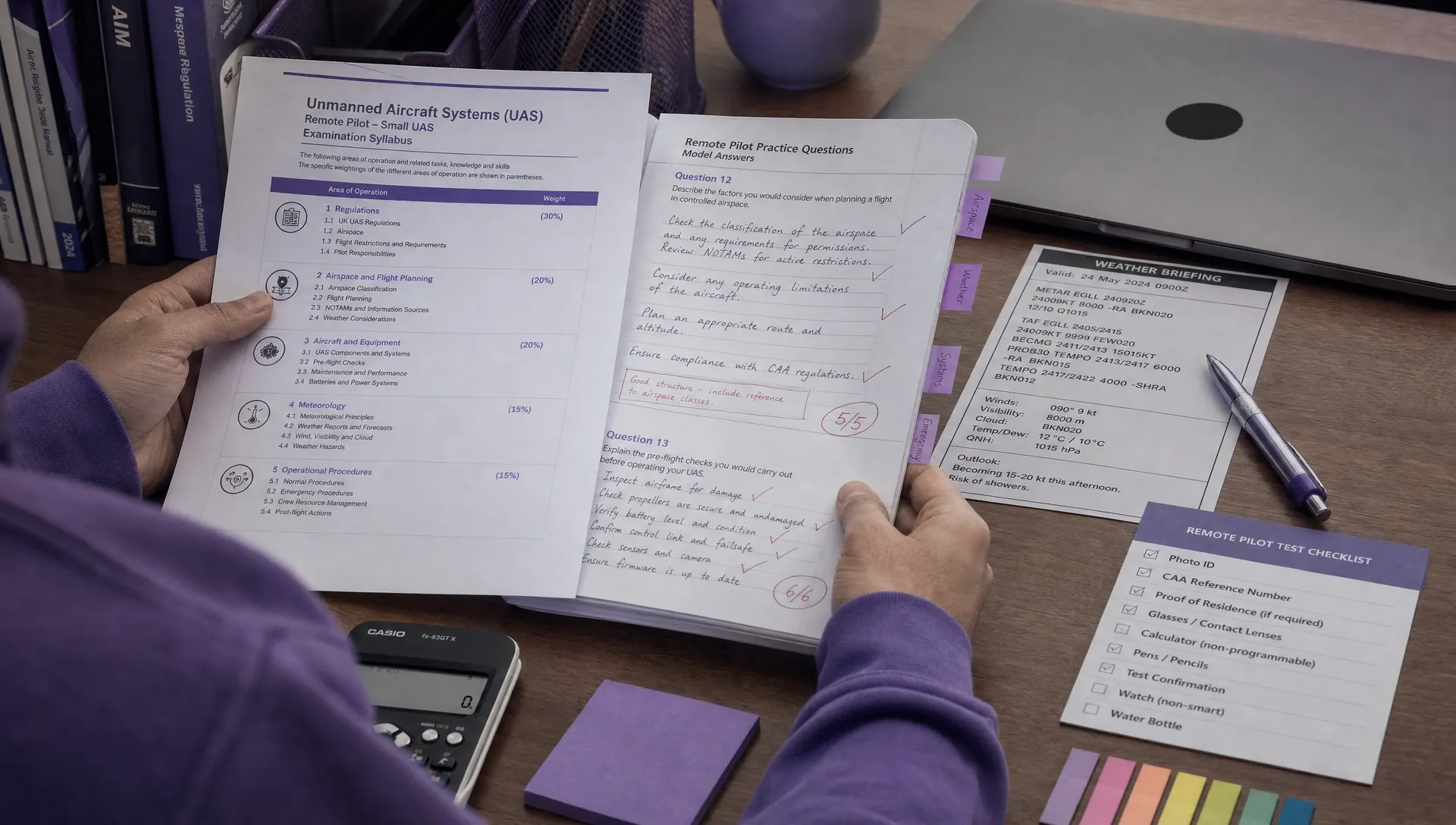 Drone Pilot Test Mistakes That Cost Candidates Marks →
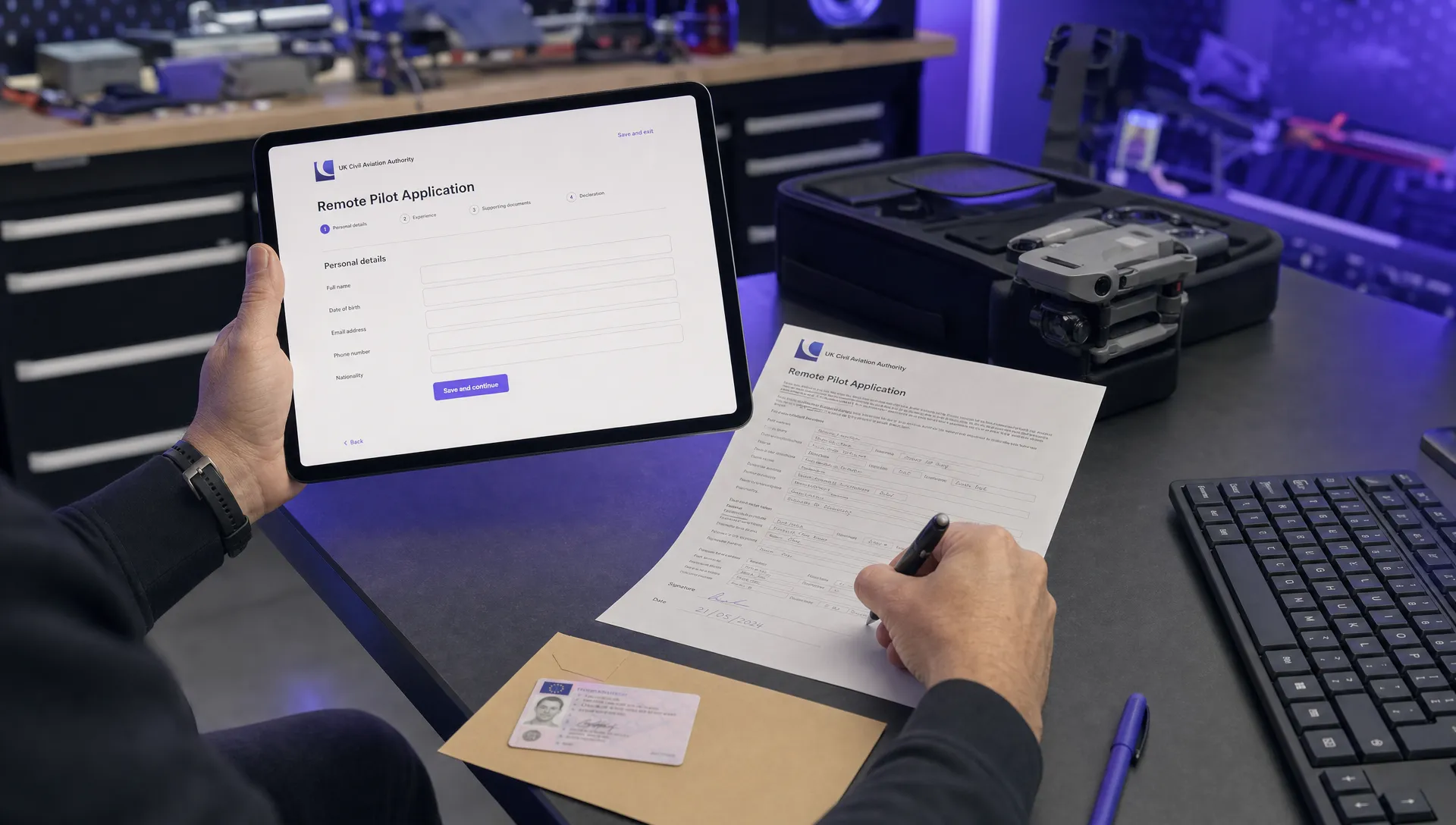 FAA 107 License vs Part 107 Certificate: What’s the Difference? →
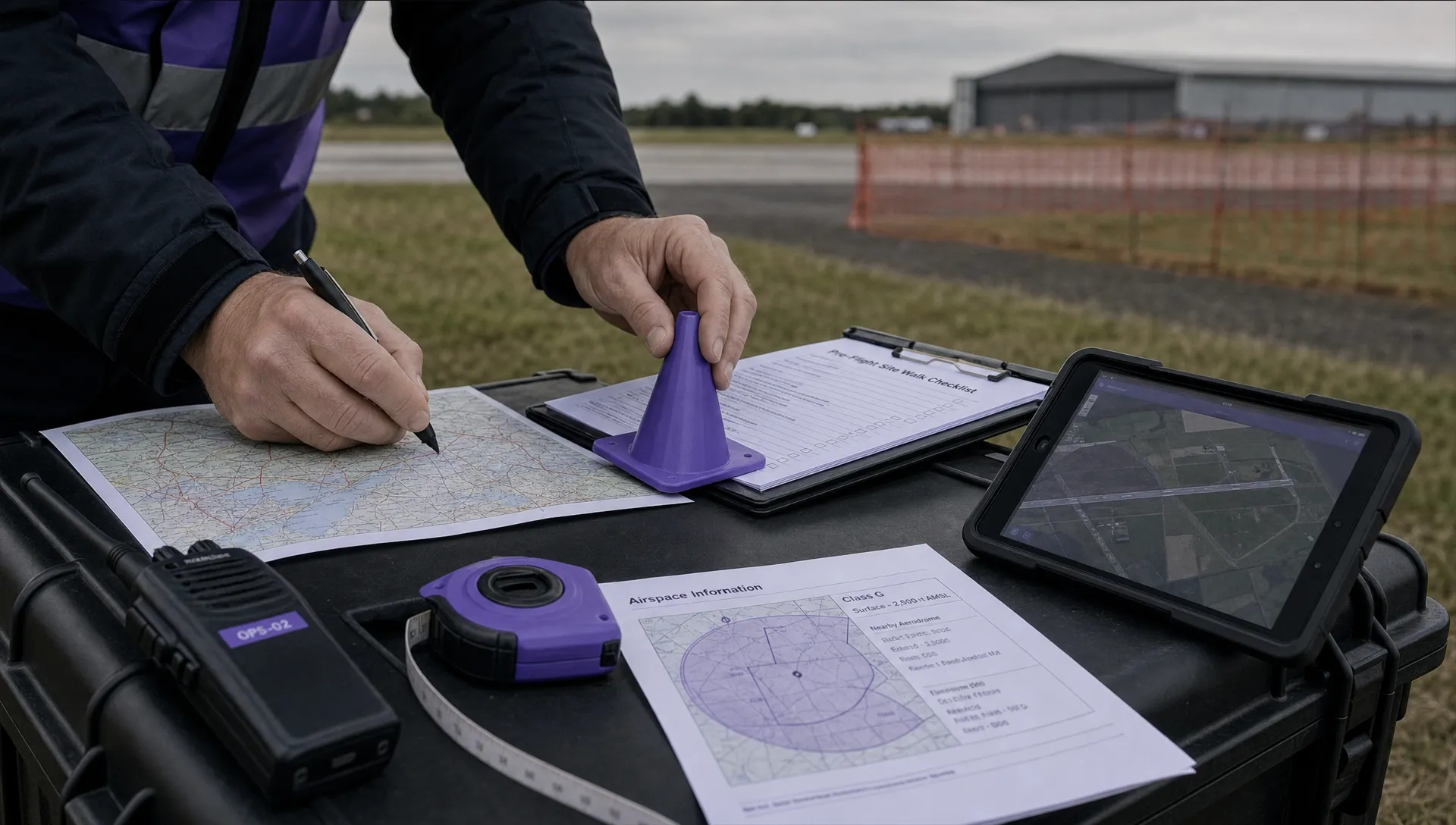 Drone Airport Rules: A Field Checklist for Site Assessments →
 FAA Part 107 Record-Keeping Rules for Commercial Teams →
 How to Review a DJI Flight Log After an Unexpected Event →
 Drone Laws Around the World: A Pre-Flight Research Framework →
 How to Compare Drone Survey Services for Complex Sites →
 How to Start a Drone Mapping Business With a Clear Workflow →
 Class C Airspace Drone Rules for Commercial Flights →
 How to Create a Drone Job Pack for Every Mission →