
FAA AC 107-2 Explained for Commercial Drone Pilots
FAA AC 107-2 is one of the most useful documents a commercial drone pilot can read, but it is often misunderstood. It is not a replacement for Part 107, it does not grant permission to fly, and it is not a shortcut around waivers or airspace authorisations. Its value is more practical: it helps pilots and drone programme managers understand how the FAA expects Part 107 operations to be planned, supervised and documented.
For commercial drone operators, survey companies, utilities and emergency services, that matters. The difference between a compliant flight and a risky one is rarely just a certificate in someone’s wallet. It is the planning process behind the mission, the decisions made by the remote pilot in command, and the evidence that the operation was properly assessed before launch.
Below is a practical explanation of FAA AC 107-2, what it covers, how it fits with 14 CFR Part 107, and how to turn the guidance into safer day to day operating procedures.
What is FAA AC 107-2?
FAA AC 107-2 is an Advisory Circular issued by the Federal Aviation Administration to explain the small unmanned aircraft rules in 14 CFR Part 107. The FAA uses Advisory Circulars to provide guidance, examples and acceptable methods for complying with regulations.
The key word is guidance. FAA AC 107-2 is not itself the law. The binding legal requirements sit in 14 CFR Part 107, while the current Advisory Circular should be checked through the FAA Advisory Circular library. If the FAA has published a newer revision by the time you read this, use the latest version.
In practice, AC 107-2 helps explain how Part 107 applies to typical commercial drone operations, including pilot responsibilities, aircraft requirements, operating limitations, airspace approvals, night operations, operations over people, waivers, maintenance expectations and accident reporting.
For a commercial pilot, the document is best treated as a bridge between regulation and operational reality. Part 107 tells you what the rule is. AC 107-2 helps you understand what the rule means when you are standing in a car park, next to a substation, on a construction site or at an emergency scene with a drone ready to fly.
Why commercial drone pilots should care
Many Part 107 rules are concise. That is useful for legislation, but not always enough for operational planning. A rule might say that the remote pilot in command must ensure the aircraft is in a condition for safe operation. AC 107-2 helps translate that obligation into pre-flight checks, maintenance awareness and decision making.
For operators serving paying clients, the document is also useful evidence of due diligence. If your procedures, checklists, crew briefings and risk assessments are aligned with FAA guidance, you are in a stronger position to show that your operation was planned professionally.
That does not mean that following the Advisory Circular guarantees compliance in every scenario. Local restrictions, temporary flight restrictions, client site rules, property permissions, emergency service coordination, privacy laws and other FAA rules may still apply. But AC 107-2 gives you a solid starting point for a defensible Part 107 workflow.
FAA AC 107-2 versus Part 107
The simplest way to understand the relationship is this: Part 107 is the regulation, FAA AC 107-2 is explanatory guidance.
| Question | Part 107 | FAA AC 107-2 |
|---|---|---|
| Is it legally binding? | Yes | No, but it reflects FAA guidance |
| What does it contain? | The regulatory requirements for small UAS operations | Explanations, examples and acceptable approaches |
| Should pilots read it? | Yes | Yes, especially for practical interpretation |
| Does it authorise a flight? | Only within the rule’s limits | No, it does not grant operational approval |
| Can it help with waivers? | It identifies requirements and waiverable sections | It helps frame risk controls and compliance thinking |
This distinction is important when training new pilots or building standard operating procedures. Do not cite AC 107-2 as the authority that allows a mission. Use it to support the way you comply with the actual Part 107 requirements.
The main areas FAA AC 107-2 explains
Remote pilot in command responsibilities
Part 107 places significant responsibility on the remote pilot in command, often shortened to RPIC. AC 107-2 reinforces that the RPIC is not just the person holding the controller. The RPIC is responsible for the safe conduct of the flight.
That responsibility includes assessing the operating environment, checking the aircraft, briefing crew members, ensuring the flight remains within the rules, and discontinuing the operation if conditions become unsafe. The RPIC must also consider their own fitness to fly, including fatigue, medication, alcohol, stress and distraction.
For commercial teams, this is where many operational errors begin. A company may have strong procedures, but if the person designated as RPIC is unclear, or if responsibility is informally shared, decision making can become weak. Every job should identify the RPIC before the aircraft is powered on.
Aircraft eligibility, registration and condition for safe operation
Part 107 applies to small unmanned aircraft weighing less than 55 pounds, including everything attached to or carried by the aircraft at take-off. Commercial aircraft used under Part 107 normally require FAA registration, and the registration number must be displayed in accordance with FAA requirements.
AC 107-2 also explains that a Part 107 aircraft does not need the same airworthiness certificate as a crewed aircraft in typical operations. Instead, the RPIC must determine that the drone is in a condition for safe operation before flight.
That decision should be based on more than a quick glance. Battery condition, propellers, firmware status, payload attachment, remote controller performance, GNSS reception, compass health, sensor warnings and recent maintenance history can all affect safety.
Most Part 107 aircraft that require registration must also comply with the FAA’s Remote ID requirements, unless a specific exception applies. Remote ID is not a replacement for registration, airspace approval or operational compliance. It is an additional identification requirement that operators need to manage as part of fleet readiness.
Operating limitations
AC 107-2 is particularly useful when interpreting the core operating limitations in Part 107. These are the boundaries within which most routine commercial flights take place.
Common Part 107 operating limits include:
- Maximum groundspeed of 87 knots, which is about 100 mph.
- Maximum altitude of 400 feet above ground level, or within 400 feet of a structure and not higher than 400 feet above the structure’s uppermost limit.
- Minimum flight visibility of 3 statute miles from the control station.
- Cloud clearance of at least 500 feet below clouds and 2,000 feet horizontally from clouds.
- Visual line of sight, using unaided vision except for corrective lenses.
- No careless or reckless operation.
- Yielding right of way to all other aircraft.
- Restrictions on operating from moving vehicles, operating multiple drones at once, carrying hazardous material and flying over people unless the operation meets the relevant rule or authorisation.
The list looks simple until you apply it to real work. A roof inspection beside a tower may involve the structure altitude rule. A utility inspection along a road may raise questions about moving vehicles and operations over people. A mapping job near a Class D airport may need controlled airspace authorisation. A night search mission needs trained personnel, suitable anti-collision lighting and a controlled operating environment.
That is where AC 107-2 earns its keep. It helps pilots think through the rule in operational context.
Airspace authorisations and LAANC
A Part 107 remote pilot certificate does not give you permission to fly in all airspace. Under Part 107, operations in Class B, Class C, Class D and certain Class E airspace require FAA authorisation. In uncontrolled Class G airspace, FAA airspace authorisation is not normally required under Part 107, but other restrictions may still apply.
The FAA’s LAANC programme provides near real time processing for many controlled airspace requests. Where LAANC is not available, operators may need to use the FAA’s alternative authorisation process.
AC 107-2 helps pilots understand that airspace approval is only one layer of permission. It does not grant property access, waive local restrictions, override temporary flight restrictions or remove the need for site coordination.
For commercial operators, the best practice is to treat airspace as a documented planning item. Record what airspace was checked, what approval was obtained, what altitude was authorised, and what conditions applied. If the approval has a time window, make sure the actual flight sits within it.
Night operations under Part 107
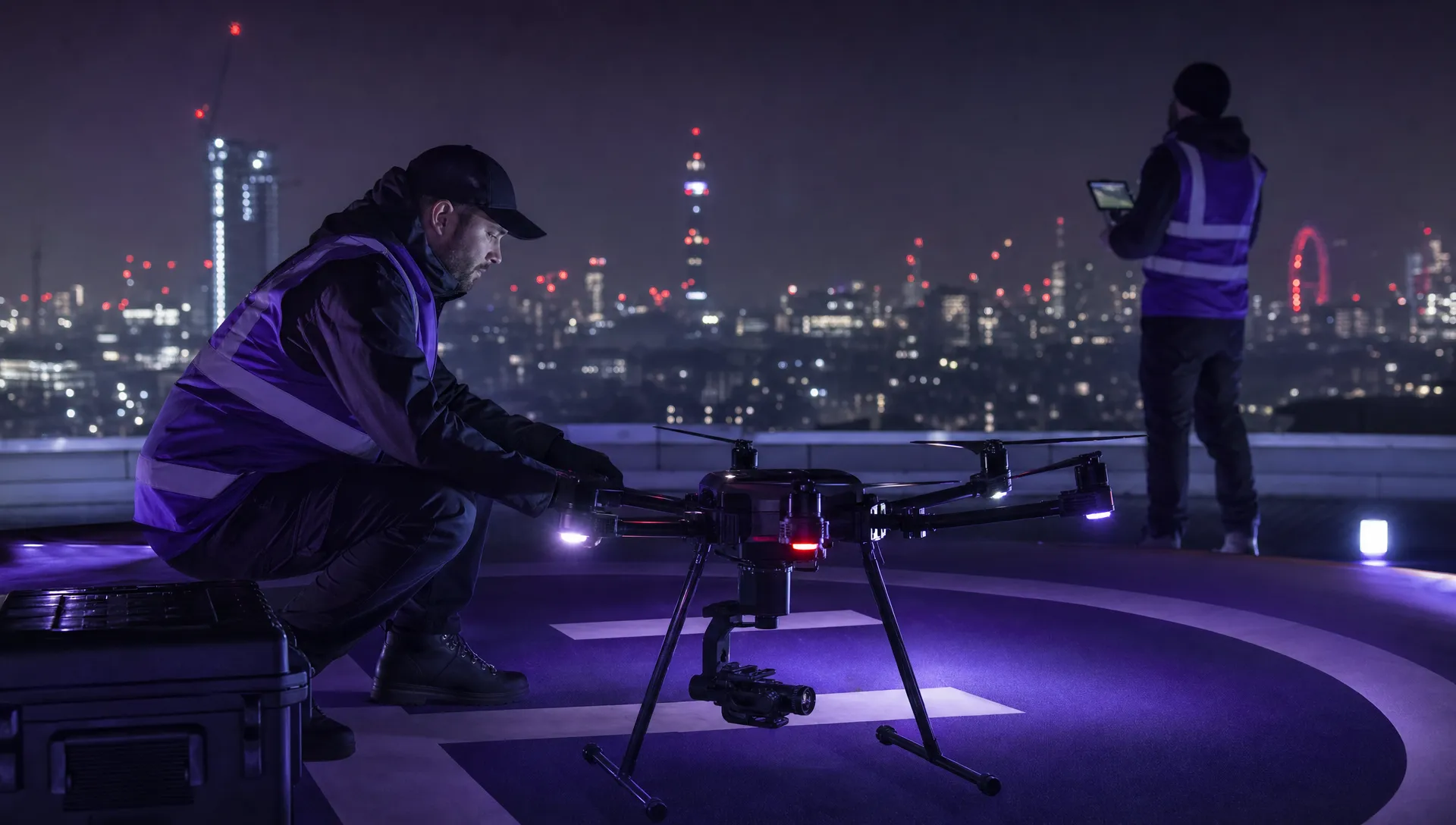
Commercial drone pilots often remember the older rule that night operations required a waiver. That changed. Under current Part 107 rules, night operations can be conducted without a night waiver if the applicable requirements are met.
In broad terms, the remote pilot must have completed the required FAA knowledge testing or recurrent training that includes night operations, and the aircraft must have anti-collision lighting visible for at least 3 statute miles. The lighting must be sufficient to help other aircraft see and avoid the drone, although intensity may be reduced if necessary for operational safety.
AC 107-2 is useful because it pushes the pilot beyond a simple question of whether a light is fitted. Night flight affects depth perception, visual line of sight, crew coordination, obstacle detection, emergency landing options and public perception. A professional night operation should include a specific night risk assessment, not merely a daytime plan flown after sunset.
Operations over people and moving vehicles
FAA AC 107-2 also helps explain operations over people, one of the most important areas for commercial pilots working in cities, events, construction sites and emergency response.
Part 107 allows certain operations over people if the aircraft and operation meet defined categories. These categories consider factors such as aircraft weight, exposed rotating parts, injury risk, FAA accepted declarations of compliance, aircraft labelling and operational restrictions. Operations over moving vehicles have additional limitations.
The key lesson is that flying near people is not the same as being authorised to fly over them. A take-off area with controlled access, a closed worksite with briefed participants, and a public pavement next to a client building each create different compliance questions.
Pilots should be careful with the phrase direct participant. A person is not a direct participant merely because they are nearby, curious, employed by the client or wearing a hard hat. Direct participants are involved in the operation and should be properly briefed.
For survey companies and utility operators, this can be a major planning issue. Linear infrastructure inspections may cross roads, footpaths, car parks or residential areas. The safest and most compliant plan may involve timing the work for low activity, using observers, changing the flight path, establishing a controlled take-off and landing zone, or seeking a waiver where the rule cannot otherwise be met.
Waivers, deviations and what the FAA expects
Part 107 includes provisions that may be waived if the FAA determines that the proposed operation can be conducted safely. Waivers are especially relevant for operations beyond visual line of sight, operations over people beyond the standard categories, multiple aircraft operations, certain moving vehicle scenarios, or other advanced use cases.
AC 107-2 does not guarantee a waiver, but it helps operators understand the safety logic the FAA will expect. A strong waiver application is not just a statement that the pilot is experienced or the drone is reliable. It should explain hazards, mitigations, crew roles, communication procedures, contingency plans, lost link behaviour, detect and avoid methods, training and records.
If your organisation is exploring advanced operations, it is worth understanding how beyond visual line of sight drone operations differ from routine Part 107 VLOS missions. BVLOS is not simply flying further away. It changes the way you manage airspace awareness, command and control, emergency procedures and risk.
Accident reporting and record keeping
Part 107 requires certain accidents to be reported to the FAA within 10 calendar days. In general, this applies where an operation results in serious injury, loss of consciousness, or property damage above the FAA’s reporting threshold, excluding damage to the small unmanned aircraft itself.
AC 107-2 helps pilots understand these obligations, but good commercial practice goes further. Even when an event does not meet the FAA reporting threshold, internal records can help identify recurring issues, improve training and protect the operator if questions arise later.
Useful operational records include flight logs, maintenance notes, battery histories, site assessments, risk assessments, airspace approvals, crew briefings, client permissions, weather checks and incident reports. For larger teams, those records should be consistent enough that a manager can review them across pilots, aircraft and locations.
This is especially important for public safety and utility operations, where flights may happen under pressure and at short notice. A repeatable record keeping process reduces ambiguity when the mission is over and people need to understand what happened.
Turning FAA AC 107-2 into an operational workflow
The best way to use FAA AC 107-2 is not to file it away after passing the Part 107 exam. Use it as a framework for your operating procedures.
A practical workflow might look like this:
| Planning area | What to check | Evidence to keep |
|---|---|---|
| Pilot readiness | Certificate, recurrent training, fitness to fly, night training if applicable | Pilot records and job assignment |
| Aircraft readiness | Registration, Remote ID status, maintenance, batteries, payload, firmware and physical condition | Fleet record and pre-flight checklist |
| Site conditions | Airspace, weather, obstacles, people, roads, property access and emergency landing areas | Site survey, airspace check and risk assessment |
| Operational limits | Altitude, VLOS, speed, visibility, clouds, night requirements and over people rules | Flight plan and crew briefing |
| Permissions | FAA authorisation, waiver, client approval, landowner access and local coordination | Approval records and conditions |
| Flight close-out | Logs, incidents, battery notes, maintenance defects and client deliverables | Flight log and post-flight notes |
The workflow should be simple enough for pilots to use in the field, but structured enough to prove that the key Part 107 issues were addressed. A long form that nobody completes properly is less useful than a clear checklist that pilots actually follow.
For risk assessments in particular, it helps to move beyond generic templates. A construction progress flight, a thermal roof inspection and a wildfire support mission do not have the same hazards. If you need a deeper framework, this guide on building a drone flight risk assessment that works explains how to make risk controls practical rather than box ticking.
Common misunderstandings about FAA AC 107-2
Misunderstanding 1: AC 107-2 is the rule
It is not. The rule is Part 107. AC 107-2 explains the rule and provides guidance. When in doubt, check the current regulation, the current Advisory Circular and any FAA authorisation or waiver conditions that apply to your flight.
Misunderstanding 2: A Part 107 certificate allows flight anywhere
It does not. Controlled airspace, temporary flight restrictions, restricted areas, stadium restrictions, national security restrictions, emergency response activity, local rules and landowner permissions may all affect a mission.
Misunderstanding 3: A visual observer makes BVLOS legal
A visual observer can support VLOS operations, but adding a visual observer does not automatically make a beyond visual line of sight operation compliant. The aircraft must still be operated within the applicable visual line of sight requirements unless a waiver or other authority allows otherwise.
Misunderstanding 4: Night flight is routine now
Night flight is more accessible than it used to be, but it is not casual. The pilot must meet the training requirements, the aircraft must have suitable anti-collision lighting, and the operation still needs a realistic assessment of visibility, obstacles, people and emergency options.
Misunderstanding 5: Software replaces pilot judgement
Flight planning tools, airspace data and operational management systems can support compliance, but the RPIC remains responsible for the safe conduct of the flight. The best tools make judgement easier to apply and easier to document. They do not remove it.
Sector specific considerations
Survey companies
Survey work often involves repeatable mapping patterns, precise altitudes and large sites. The main AC 107-2 issues are usually VLOS, controlled airspace, altitude near structures, operations over people, battery endurance and managing crew handover on larger sites. Survey teams should pay close attention to whether the planned grid keeps the aircraft visible throughout the mission.
Utility companies
Utilities often operate around substations, transmission lines, pipelines, rail corridors, roads and other sensitive infrastructure. The planning challenge is not only aviation compliance. It is also site safety, public proximity, vehicle movement, asset owner rules and emergency landing options. For growing programmes, a structured approach to aircraft, pilot and maintenance records becomes essential. Dronedesk’s drone fleet management guide covers the operational issues that appear as teams scale beyond a few aircraft.
Emergency services
Emergency services may operate under Part 107, public aircraft rules or a combination of frameworks depending on the agency and mission. AC 107-2 remains valuable when Part 107 is used, but incident command, temporary flight restrictions, crew resource management and rapid airspace coordination may be just as important. Public safety pilots should be especially cautious about launching quickly without documenting who is RPIC, what airspace has been checked and how other aircraft will be deconflicted.
Multi-pilot commercial teams
As soon as more than one pilot is involved, consistency becomes a compliance issue. If each pilot uses a different planning method, stores records differently or interprets Part 107 limits differently, the organisation becomes harder to manage. AC 107-2 can be used as a common reference for training, standard operating procedures and internal audits.
How Dronedesk fits into a Part 107 workflow
Dronedesk is designed for drone operations management and flight planning. Its published feature set includes client management, fleet management, team management, airspace intelligence, proximity intelligence, flight planning, flight logging, data reporting, configurable checklists and risk assessments, all of which are relevant to building a more structured operational process. You can review the full capability list on the Dronedesk features page.
The important point is that no software makes a flight compliant by itself. The pilot and operator still need to understand Part 107, check the current FAA rules, obtain the right approvals and make safe decisions. What a dedicated operations platform can do is help bring the moving parts of commercial drone work into one repeatable process, from planning and risk assessment through to logging and reporting.
Frequently Asked Questions
Is FAA AC 107-2 legally binding? No. FAA AC 107-2 is guidance, not the regulation itself. The legal requirements are in 14 CFR Part 107 and any applicable FAA authorisation, waiver or other rule.
Do I need to read FAA AC 107-2 if I already passed the Part 107 test? Yes, it is still useful. The test confirms knowledge at a point in time, while the Advisory Circular helps you interpret and apply the rules in real operations.
Does FAA AC 107-2 allow night operations? The authority comes from Part 107, not the Advisory Circular. Current Part 107 rules allow night operations if the pilot has met the FAA training or testing requirements and the drone has compliant anti-collision lighting.
Does LAANC approval mean my whole operation is approved? No. LAANC deals with controlled airspace authorisation. You still need to comply with all other Part 107 requirements, site permissions, local restrictions and any conditions attached to the approval.
Can FAA AC 107-2 help with waiver applications? Yes, but indirectly. It helps you understand the FAA’s safety expectations and the operational issues you need to address. A waiver application still needs detailed mitigations specific to the proposed operation.
Build AC 107-2 into every commercial flight
FAA AC 107-2 is most valuable when it becomes part of your everyday operating culture. Do not treat it as exam revision or a document that only matters when something goes wrong. Use it to shape checklists, pilot briefings, risk assessments, airspace reviews, maintenance records and post-flight logs.
For commercial drone pilots, the goal is simple: make every flight easier to justify before take-off and easier to evidence afterwards. If your team wants a more structured way to manage planning, checklists, risk assessments, flight logs and operational records, Dronedesk can help you bring those workflows together in one place.
 Drone Part 107 Operations: When a Waiver May Be Needed →
 Drone Operating Rules for Managing Contractors and Employees →
 BVLOS Drone Requirements for Building a Safety Case →
 Drone Pilot Test Mistakes That Cost Candidates Marks →
 FAA 107 License vs Part 107 Certificate: What’s the Difference? →
 Drone Airport Rules: A Field Checklist for Site Assessments →
 FAA Part 107 Record-Keeping Rules for Commercial Teams →
 How to Review a DJI Flight Log After an Unexpected Event →
 Drone Laws Around the World: A Pre-Flight Research Framework →
 How to Compare Drone Survey Services for Complex Sites →